
Why Fuel Bladder Space Is the Smarter Way to Carry More Fuel
Fuel bladder space is the practical advantage that lets operators carry significantly more fuel — without the weight, cost, or permanence of rigid tank installations.
Here’s the short answer for buyers evaluating this option:
| Feature | Fuel Bladder | Rigid Tank |
|---|---|---|
| Space when empty | Folds to ~10% of full volume | Full footprint always |
| Deployment time | Hours | Days to weeks |
| Cost vs. rigid tank | 50–70% less | Baseline |
| Custom sizing | Yes — shape, capacity, fittings | Limited |
| Portability | High — collapses flat | None |
| Typical lifespan (TPU) | 8–12 years | Varies by material |
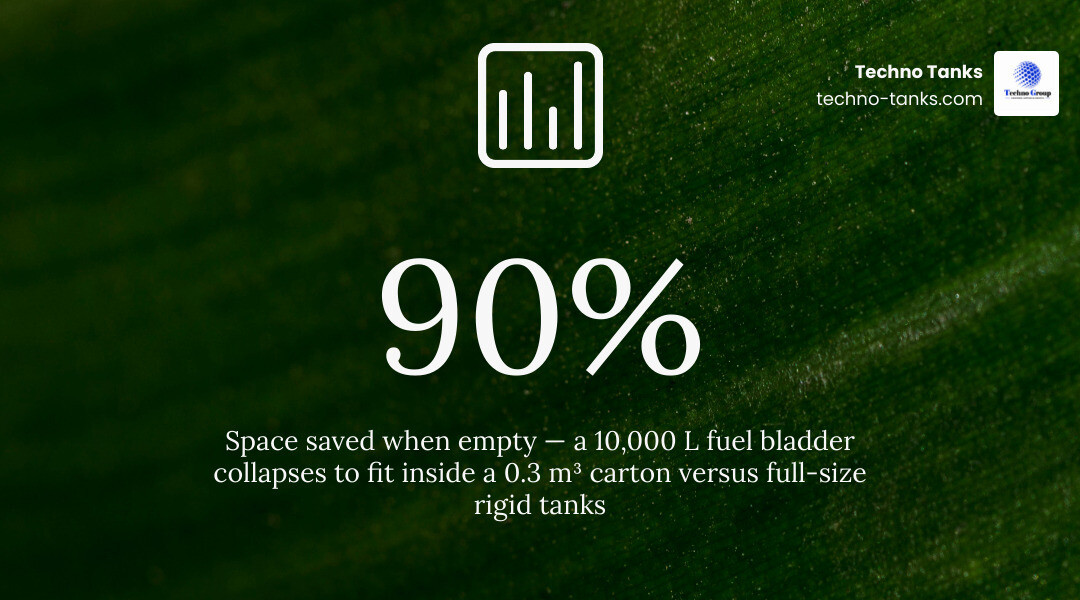
For commercial vessel operators, expedition crews, and anyone managing fuel logistics in tight or remote environments, the numbers are hard to ignore. A 10,000-liter bladder, when empty, can fold down to fit inside a 0.3 cubic meter carton. That’s up to 90% space savings compared to a rigid equivalent.
The tradeoff isn’t quality. It’s rigidity — and for most field applications, rigidity is exactly what you don’t need.
This guide covers how to maximize fuel bladder space across marine, industrial, and specialized deployments — including how to choose the right size, material, and configuration for your specific operation.
Understanding Fuel Bladder Space and Efficiency
In remote logistics and maritime operations, space is the ultimate currency. Every square inch of deck space or storage volume must be justified. Traditional rigid steel or aluminum tanks are fundamentally inefficient because their volumetric footprint remains completely static, regardless of whether they contain 10,000 gallons of fuel or zero.
Flexible fuel bladders solve this structural limitation through volumetric adaptability. When filled, the bladder expands to contain the liquid; as the fuel is consumed, the bladder collapses. Once completely empty, it can be folded, rolled, and stored in a compact compartment, freeing up valuable physical space for other equipment, cargo, or personnel.
This footprint reduction changes how operators plan long-distance journeys or remote field setups. Rather than dedicating permanent space to a heavy, empty metal box, operators deploy flexible bladders as dynamic storage. For a deeper look into how these systems function in marine environments, consult The Complete Guide to Marine Bladder Tanks and Storage.
Maximizing Fuel Bladder Space on Marine Vessels
Onboard a commercial vessel, workboat, or yacht, deck space is highly restricted. Traditional auxiliary fuel options, such as rigid jerry cans or secondary permanent tanks, permanently compromise the vessel’s layout.
To maximize usable area, operators rely on specialized low-profile geometries. “Space-saver” configurations are engineered with a compact footprint, optimizing the bladder’s height and width to fit neatly into tight deck corners or narrow compartments. In contrast, traditional pillow-style bladders spread the fuel weight over a wider, flatter area, which is ideal for open deck spaces where vertical clearance is limited but stability is paramount.
Using these space-saving designs, vessels can safely carry auxiliary fuel for extended-range voyages without permanently sacrificing deck space. Once the auxiliary fuel is transferred to the main engine tanks, the bladder is rolled up and stowed, returning the deck to its original configuration. Learn more about selecting the right on-deck setup in our guide on Marine Fuel Bladders.
Comparing Footprints: Flexible Bladders vs. Rigid Tanks
When comparing long-term fuel storage options, decision-makers must evaluate physical footprint, weight, installation time, and financial cost. Rigid tanks require dedicated structural support, crane access for installation, and weeks of site preparation. Flexible bladders can be deployed on any flat, cleared surface in a matter of hours.
| Parameter | Flexible Fuel Bladder | Rigid Metal/Plastic Tank |
|---|---|---|
| Empty Footprint | Collapses down to ~10% of filled size | Remains 100% of filled size |
| Dry Weight | Extremely lightweight; highly portable | Heavy; requires mechanical lifting |
| Deployment Time | 1 to 3 hours | Weeks of construction/installation |
| Capital Cost | 50% to 70% cheaper than rigid tanks | High material and fabrication costs |
| Maintenance | Simple washing, drying, and dry storage | Demanding inspection, rust treatment, welding |
This comparison highlights why flexible systems are often the preferred alternative for temporary or auxiliary installations. For a comprehensive breakdown of these differences, read our analysis on Fuel Bladder vs Fuel Tank.
Material Engineering: TPU vs. PVC for Long-Term Durability
The performance and safety of a flexible fuel bladder depend entirely on its material science. Because these systems contain highly volatile and chemically aggressive hydrocarbons, using the wrong polymer can lead to delamination, structural failure, and environmental hazards. The industry primarily relies on two technical fabrics: Thermoplastic Polyurethane (TPU) and Polyvinyl Chloride (PVC).
For heavy-duty, mission-critical applications, TPU-coated fabrics are the industry standard. TPU molecules feature a unique block copolymer structure that provides exceptional resistance to abrasion, mechanical punctures, and chemical degradation. PVC, while cheaper and widely used for water containment, degrades rapidly when exposed to fuel hydrocarbons, leading to plasticizer migration which makes the material brittle and prone to cracking. For reliable, long-term hydrocarbon containment, high-performance Collapsible Fuel Tanks must utilize military-grade TPU.
Chemical Resistance and Lifespan of TPU Bladders
TPU fuel bladders offer an operational lifespan of 8 to 12 years, compared to just 3 to 5 years for standard PVC-coated polyester bladders. This longevity is directly linked to TPU’s superior chemical resistance. Hydrocarbons like diesel, biodiesel (including B20 blends), aviation fuel (such as JP-8), and gasoline will rapidly break down the chemical bonds of lower-grade polymers. TPU remains inert, preventing fuel contamination and maintaining structural integrity over thousands of fill-and-empty cycles.
To maximize this lifespan, operators must follow proper care and handling procedures. Simple adjustments in how the bladder is cleaned, stored, and protected from abrasive debris can add years to its service life. Detailed maintenance steps are outlined in our guide on How to Extend Fuel Bladder Lifespan with 5 Easy Changes.
Optimizing Fuel Bladder Space in Extreme Temperatures
Industrial and marine operations do not always take place in temperate climates. From arctic exploration sites to sun-baked desert operations, fuel storage systems must withstand extreme environmental exposure without cracking or leaking.
High-quality TPU formulations maintain their flexibility and structural integrity across an impressive temperature range of -40°C to +90°C. In sub-zero conditions, where PVC becomes glass-brittle and cracks upon folding, TPU remains highly flexible, allowing empty bladders to be packed away without damaging the material. Furthermore, advanced bladders incorporate specialized UV stabilizers and a white matte finish to reduce solar heat absorption, preventing fuel vaporization and gas buildup in hot climates. This makes them highly effective for demanding Offshore Fuel Solutions.
Key Components and Customization for Mission-Critical Operations
A flexible fuel bladder is not merely a fabric bag; it is a highly engineered system designed to integrate seamlessly with standard industrial and marine fueling infrastructure. Customization options ensure that the bladder fits the exact spatial and physical requirements of the operation.
Customization begins with physical dimensions. Bladders can be fabricated in rectangular, square, or custom low-profile shapes to maximize the efficiency of the available fuel bladder space. Additionally, material thickness can be adjusted (typically between 1.2 mm and 1.5 mm, or up to 50 mils) depending on the risk of puncture or abrasion in the operating environment. For assistance in matching capacity to physical space, refer to the Fuel Bladder Sizing Guide.
Baffle Systems and Fluid Control
One of the greatest challenges of transporting liquid in a flexible container is dynamic fluid movement, commonly known as “slosh.” When a vessel encounters rough seas or a transport vehicle navigates uneven terrain, the shifting weight of the fuel can destabilize the craft or vehicle, creating a severe safety hazard.
To mitigate this risk, high-capacity bladders can be specified with internal baffle systems. Baffles are interior fabric walls or chambers that restrict the rapid movement of fuel, dampening the kinetic energy of the shifting liquid.
- Baffled Bladders: Ideal for high-movement environments, such as marine vessel decks, transport trucks, and rough-water operations. They maintain vessel stability and reduce mechanical stress on tie-down points.
- Un-baffled Bladders: Suitable for static, ground-based storage where the bladder remains stationary on a flat, prepared surface. They are more economical and collapse slightly flatter when empty.
Fittings, Valves, and Anti-Static Safety
Safe fuel transfer requires robust, leak-proof connections. Standard bladders are equipped with heavy-duty aluminum or stainless steel male camlock fittings (typically 2-inch or 3-inch sizes) that are 100% radio-frequency (RF) welded directly into the fabric matrix.
In addition to standard inlet and outlet ports, mission-critical bladders feature:
- Pressure Relief Valves: Automatically vent excess vapor buildup caused by high temperatures, preventing over-pressurization.
- Venting Systems: Ensure smooth, continuous fuel flow during high-rate pumping without collapsing the bladder prematurely.
- Anti-Static Protection and Grounding Points: Crucial for static safety during refueling. TPU fabrics designed for fuel storage comply with strict static dissipation standards (such as NFPA 30) to prevent spark ignition during fuel transfer.
Industrial and Specialized Applications of Collapsible Fuel Storage
Because of their rapid deployment speed, cost efficiency, and minimal empty footprint, flexible fuel bladders are used globally across a wide range of demanding industries. When permanent steel tanks are logistically impossible or economically impractical, collapsible systems provide the ideal solution for Temporary Fuel Storage.
Military, Mining, and Disaster Response Deployments
In tactical defense and disaster relief operations, fuel is the lifeblood of survival. Establishing permanent fuel infrastructure in a conflict zone or a natural disaster area is slow, expensive, and dangerous.
Military and humanitarian logistics teams deploy high-capacity collapsible bladders to establish rapid-response fuel depots. These bladders can be flown in on light transport aircraft, unrolled by a small crew, and filled with diesel or jet fuel in a matter of hours. This capability was highlighted in historical tactical operations, such as the U.S. Air Forces Central logistics updates detailed in Fueling the fight > U.S. Air Forces Central > News, proving the critical nature of mobile fuel assets in demanding environments.
Similarly, remote mining and exploration operations rely on flexible bladders to supply generators and heavy machinery deep in the wilderness, where constructing concrete-contained steel tanks is environmentally and financially restrictive.
Remote Industrial and Construction Site Fuel Management
On large-scale construction sites, infrastructure projects, or agricultural properties, machinery must be kept running continuously to meet tight deadlines. Moving heavy equipment back and forth to a centralized fueling station wastes time and fuel.
Deploying temporary, high-capacity fuel bladders directly on-site optimizes the logistical footprint. These bladders can be set up in remote sectors of a job site, protected by secondary containment berms to comply with local environmental regulations (such as EPA and SPCC guidelines), and easily relocated as the project progresses.
Best Practices for Installation, Maintenance, and Lifespan Extension
To ensure the safety of personnel and maximize the operational lifespan of a flexible fuel bladder, operators must adhere to strict installation and handling protocols. Because a filled bladder can weigh thousands of pounds, improper setup can lead to structural damage or environmental spills.
- Ground Preparation: Before unrolling the bladder, inspect the site thoroughly. Remove all sharp rocks, branches, glass, or metal debris. Lay down a heavy-duty ground cloth or protective underlayment to shield the bladder from abrasion.
- Use Secondary Containment: Always place the bladder inside a certified containment berm. This ensures compliance with environmental regulations and provides a safety barrier in the unlikely event of a spill.
- Secure Tie-Downs: When deploying a bladder on a vessel deck or a transport bed, use the integrated D-rings to lash the unit securely. A moving bladder is highly dangerous. Never attempt to transport a partially filled, un-baffled bladder in rough conditions.
- Gravity and Siphon Flow: For marine gasoline transfer, gravity or siphon flow is often recommended to minimize static generation. If electric pumps are required, ensure they are rated explosion-proof and properly grounded.
- Purging and Rolling: To extract the final gallons of fuel from the bladder, gently roll the empty fabric from the outer edges toward the discharge fitting. This consolidates the remaining liquid for complete extraction.
- Storage Procedures: Once empty, rinse the bladder if necessary, allow it to dry completely to prevent mold or hydrolysis, and fold it flat. Store the collapsed unit in a cool, dry, well-ventilated locker away from direct sunlight.
For specialized transfer operations, using dedicated Fuel Transfer Bladders ensures the system is optimized for high-flow, repeated deployment.
Emerging Uses: From Deep Sea to Outer Space
The principles of collapsible fluid storage are now being applied beyond traditional marine and terrestrial applications. In cutting-edge engineering fields, flexible bladders are solving complex fluid management challenges where rigid tanks are completely unfeasible.
In maritime design, advanced naval architecture guides, such as the Excel Ship Designer v2026.01.22 | Page 59 | Mongoose Publishing, highlight how flexible fuel and water bladders are increasingly integrated into ship ballast and auxiliary range systems to dynamically manage vessel trim and weight distribution.
Even more remarkably, aerospace engineers are adapting this technology for space exploration. The European Space Agency’s SISTEM (Small Inflatable Space Tank Engineering Model) prototype demonstrates a 13-liter inflatable space tank designed for gas and cryogenic liquid storage. This flexible design enables high compaction (>60% volume reduction) during launch, allowing multiple storage systems to be packed into tight payloads and deployed only when needed in orbit or on planetary surfaces. For more on this research, view the ESA – Flexible Storage Solutions for Human Spaceflight Activities.
Frequently Asked Questions About Space-Saving Fuel Bladders
Can fuel bladders be mounted below deck on marine vessels?
Under standard maritime safety guidelines, including Coast Guard regulations, flexible fuel bladders are generally not permitted for permanent, in-hull installation below deck on recreational or commercial vessels. They are designed as temporary, auxiliary storage and should be securely lashed above deck. This above-deck placement allows for safe gravity-fed fuel transfer, proper atmospheric venting, and immediate visual inspection in case of spills or leaks during filling.
How much storage space do collapsible bladders save when empty?
Collapsible fuel bladders provide up to a 90% reduction in physical storage volume when completely empty. For example, a massive 10,000-liter (approx. 2,640 gallons) industrial fuel bladder can be folded down flat enough to fit inside a standard 0.3 cubic meter cardboard carton. This high compaction ratio allows logistics teams to transport dozens of empty tanks to a remote site in a single utility vehicle.
What is the typical lifespan of a TPU fuel bladder?
A premium Thermoplastic Polyurethane (TPU) fuel bladder has an operational lifespan of 8 to 12 years when properly maintained and stored. In comparison, cheaper Polyvinyl Chloride (PVC) coated bladders typically last only 3 to 5 years before the material becomes brittle due to hydrocarbon exposure. Factors that influence lifespan include UV exposure, abrasion against rough surfaces, and whether the bladder is thoroughly dried before long-term storage.
Conclusion
Maximizing fuel bladder space is the most efficient way to extend your vessel’s range, secure backup fuel reserves, or establish rapid-response industrial fuel depots. By trading the heavy, permanent footprint of rigid steel tanks for the dynamic adaptability of high-grade TPU bladders, operators gain unmatched logistical flexibility.
Techno Tanks designs and manufactures heavy-duty, military-grade flexible fuel bladders ranging from 30 to 3,000 gallons. Whether you require a custom-shaped deck bladder for an offshore voyage, a baffled space-saver model for rough waters, or high-capacity collapsible tanks for remote industrial sites, we build solutions tailored to your exact specifications.
Techno Tanks fuel bladder pricing depends on size, fuel type, configuration, application, custom requirements, and project scope. To get accurate pricing based on your specific fuel storage, transfer, sizing, and use-case requirements, contact our technical team today.

