
Why Gas Compatible Boat Bladders Are the Smarter Alternative to Rigid Tanks
Gas compatible boat bladders are flexible, collapsible fuel tanks built to safely store and transfer gasoline (and diesel) aboard vessels — without the weight, cost, or permanence of rigid tank installations.
If you need a fast answer, here’s the core of it:
What to know before you buy a gas compatible boat bladder:
- Material matters most — only TPU (thermoplastic polyurethane) construction is reliably compatible with gasoline long-term; avoid PVC for hydrocarbon fuel storage
- Sizes range from 50 to 300+ gallons — select based on your vessel’s deck space, range requirements, and fuel burn rate
- Above-deck placement only — U.S. Coast Guard regulations prohibit in-hull fuel bladder locations
- Pillow style or Space Saver — pillow style sits low and stable on deck; Space Saver fits tighter footprints and confined areas
- Baffled configurations reduce fuel movement in rough conditions — a critical consideration for offshore use
- Tie-down is non-negotiable — full bladders can weigh 150 to over 3,000 lbs and must be secured to deck rings in any sea state
- Pricing depends on size, configuration, and custom requirements — request a quote for accurate numbers
These aren’t products for casual day trips. Operators who rely on gas compatible boat bladders are typically running extended offshore passages, managing auxiliary fuel capacity on work vessels, or deploying backup fuel solutions where permanent tanks aren’t practical.
Techno Tanks manufactures marine fuel bladders using military-spec thermoplastic polyurethane — built to handle gasoline, diesel, biodiesel, ethanol, methanol, and 100LL fuel in demanding marine environments.
Gas compatible boat bladders terms explained:
Understanding Gas Compatible Boat Bladders vs. Rigid Tanks
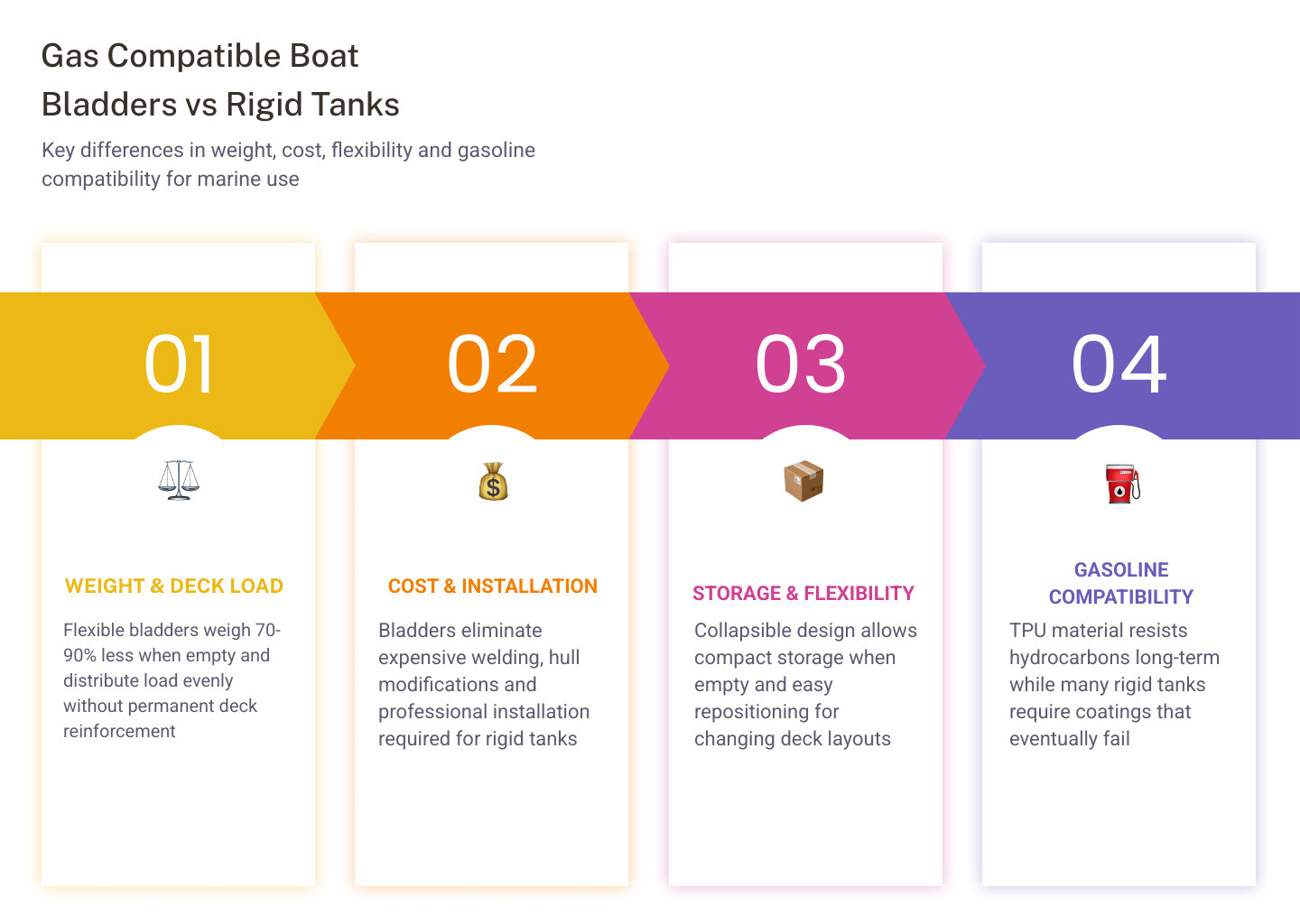
When planning long-range offshore transits, vessel operators historically faced a tough choice: install permanent, heavy metal tanks or limit their operational range. Today, flexible fuel storage offers a third, highly efficient path. Understanding the engineering differences between a temporary bladder and a traditional built-in tank is key to optimizing your deck layout and vessel dynamics.
Permanent rigid fuel tanks—whether fabricated from marine-grade aluminum, stainless steel, or fiberglass—add static, unyielding weight to a vessel. They require dedicated hull space and, once installed, cannot be reconfigured. Furthermore, rigid metal tanks are susceptible to crevice corrosion, weld failures, and condensation buildup over time.
In contrast, flexible fuel bladders provide a temporary range-extension solution that can be deployed only when needed. When empty, a flexible fuel bladder can be rolled up or folded flat, reducing its storage volume by up to 90%. For perspective, a large 10,000-liter (approximately 2,642-gallon) industrial-scale flexible bladder can fold down into a compact 0.3 cubic meter carton. For marine operators, this means that once the auxiliary fuel is transferred to the main tanks, the empty bladder can be stowed away in a dry locker, completely freeing up valuable deck space.
From a financial perspective, fuel storage bladders typically cost 50% to 70% less than custom-fabricated rigid tanks. They also eliminate the weeks of shipyard downtime required for custom tank fabrication and deck cutting, deploying in hours rather than weeks.
To explore a detailed engineering breakdown of these two systems, refer to our comprehensive comparison guide: Fuel Bladder vs Fuel Tank.
Weight distribution is another critical operational factor. As fuel is consumed from a flexible bladder, the bladder naturally collapses. This eliminates the free-surface effect (the sloshing of liquid in a partially filled rigid tank), which can severely compromise vessel stability in high seas.
Material Science: Why TPU is Essential for Gas Compatible Boat Bladders
Using the wrong material for gasoline containment is a recipe for catastrophic failure. Gasoline is a highly volatile hydrocarbon solvent that aggressively attacks many common polymers. When selecting gas compatible boat bladders, understanding the polymer chemistry of the containment fabric is essential.
Historically, PVC has been used for water storage and short-term diesel containment. However, PVC is entirely unsuitable for gasoline. The aromatic hydrocarbons and ethanol present in modern marine gasoline rapidly leach the plasticizers out of PVC, rendering the material brittle, prone to cracking, and highly susceptible to sudden rupture.
For reliable, long-term gasoline containment, Thermoplastic Polyurethane (TPU) is the industry standard. TPU is a highly resilient elastomer that offers exceptional chemical compatibility with hydrocarbon fuels, including gasoline, diesel, biodiesel, ethanol blends, and aviation fuels like 100LL. TPU molecules feature highly stable urethane linkages that resist solvent penetration, swelling, and chemical degradation.
| Performance Metric | Thermoplastic Polyurethane (TPU) | Polyvinyl Chloride (PVC) |
|---|---|---|
| Gasoline & Hydrocarbon Compatibility | Excellent (No plasticizer leaching) | Poor (Rapidly degrades and embrittles) |
| Average Lifespan in Fuel Service | 8 to 12 Years | 3 to 5 Years (Water/Diesel only) |
| Operating Temperature Range | -40°C to +90°C | -10°C to +50°C |
| Tensile & Puncture Strength | Extremely High (Mil-spec grade) | Moderate |
| Environmental Impact | 100% Recyclable | Non-recyclable (Contains chlorine) |
In addition to superior chemical resistance, military-spec TPU-coated fabrics feature extreme tensile strength and puncture resistance. These fabrics are engineered to withstand the constant chafing, vibration, and UV exposure common to saltwater environments.
For operators seeking highly durable gasoline containment, Techno Tanks utilizes premium TPU-coated polyester fabrics designed to meet rigorous marine safety guidelines. Learn more about our specialized construction methods here: Gasoline Fuel Bladders.
Selecting the Right Size, Style, and Configuration
Choosing the correct bladder size is not simply a matter of buying the largest capacity that will fit on your deck. You must balance your vessel’s fuel burn rate, the physical deck footprint, and the payload capacity of your boat.
Every gallon of gasoline weighs approximately 6.1 lbs (while diesel weighs about 7.1 lbs). A 100-gallon bladder filled with gasoline adds over 600 lbs of concentrated weight to your deck. Placing this much weight too far forward or too far aft can severely alter your vessel’s running attitude, center of gravity, and overall safety.
Before ordering a bladder, consult our Fuel Bladder Sizing Guide to calculate your exact space and weight tolerances.
Pillow Style vs. Space Saver Gas Compatible Boat Bladders
Marine bladders are generally manufactured in two primary configurations: Pillow Style and Space Saver.
- Pillow Style Bladders: These units feature a low-profile, wide-footprint design. Because they distribute fuel weight over a larger surface area, they are incredibly stable on deck and minimize the vertical center of gravity. They are ideal for wide-open cockpit decks or bow areas on larger sportfishing vessels and workboats.
- Space Saver Bladders: These models are designed with a more compact, square or rectangular footprint that utilizes vertical height to achieve capacity. They are engineered for vessels with limited deck space or tight, dedicated compartments where a wide pillow bladder cannot be accommodated.
Both styles are engineered to collapse completely flat when empty, ensuring they do not interfere with operations once the fuel has been transferred. To view standard dimensions and style specifications, check out our marine fuel bladders page.
Baffled vs. Un-Baffled Configurations for Offshore Stability
For offshore operations where high seas and heavy pitching are expected, the choice between a baffled and un-baffled bladder is critical.
Un-baffled bladders are highly economical and work perfectly for stationary fuel storage, dockside transfers, or calm-water transits. However, when a vessel encounters rough seas, the fuel inside an un-baffled bladder can slosh violently from side to side. This rapid movement of hundreds or thousands of pounds of fuel can upset the vessel’s equilibrium, causing dangerous handling characteristics.
Baffled bladders feature internal fabric walls or chambers that restrict the rapid movement of fuel. By dampening liquid slosh, baffled bladders ensure the vessel remains stable and predictable even when running through heavy swells. For offshore sportfishers, long-range cruisers, and commercial workboats, baffled configurations are highly recommended.
Safe Installation, Securing, and Fuel System Integration
A fuel bladder is only as safe as its installation. Because a filled bladder represents a massive, shifting weight on your deck, securing it properly is paramount to vessel safety.
Always place a protective underlayment mat beneath the bladder. Even on clean decks, fiberglass non-skid patterns, sand, or salt crystals can act as abrasives under a heavy, vibrating bladder. A heavy-duty rubber or foam mat prevents friction wear on the bladder’s TPU skin.
For a detailed look at integrating backup fuel systems safely, read The Ultimate Guide to Marine Emergency Fuel Supply Systems.
Connecting Gas Compatible Boat Bladders to Marine Engines
There are two primary methods for integrating a fuel bladder into your boat’s fuel system: direct engine feed or fuel transfer.
- Direct Engine Feed (Hard Plumbing): Some operators choose to plumb the bladder directly into the engine’s fuel selection manifold using fuel-compatible quick-connect fittings and brass ball valves. While this eliminates the need to transfer fuel mid-trip, it requires careful plumbing. The fuel lines must match or exceed the engine’s factory fuel line diameter (typically 3/8-inch) to prevent fuel starvation. Additionally, operators must monitor the bladder closely; if the engine draws the bladder completely flat, air can enter the fuel system, causing the engine to stall.
- Fuel Transfer (Gravity or Pump): The safer and more common method is to use the bladder as an auxiliary reserve, transferring its contents into the boat’s main rigid tank once space becomes available. This can be accomplished via gravity flow (if the bladder is secured on an elevated deck) or by using a dedicated transfer pump.
Safety Note: When transferring gasoline, never use a standard utility pump. You must use a pump specifically rated for gasoline transfer, featuring an explosion-proof motor and static-dissipative hoses. Alternatively, manual siphon pumps or gravity flow are highly reliable, spark-free methods.
Safety Protocols, Venting, and Coast Guard Compliance
When operating with gas compatible boat bladders, strict adherence to safety protocols is non-negotiable:
- Above-Deck Placement Only: U.S. Coast Guard regulations do not permit fuel bladders to be mounted below deck or inside enclosed, unventilated compartments. Gasoline vapors are heavier than air and will accumulate in low, enclosed areas, creating an extreme explosion hazard. Above-deck placement ensures any vapors are naturally swept away by the wind.
- Pressure Venting: As gasoline warms in the sun, it expands and releases vapor. Ensure your bladder is equipped with a high-quality pressure-relief vent valve. Techno Tanks bladders feature specialized dual-action aluminum flanges with Viton seals to handle thermal expansion safely.
- Static Dissipation: Flowing fuel generates static electricity. Ensure all transfer hoses, nozzles, and pump systems are properly grounded to prevent static sparks during fuel transfer.
Frequently Asked Questions about Marine Fuel Bladders
Can gasoline fuel bladders be mounted below deck?
No. Under U.S. Coast Guard guidelines and basic marine safety protocols, fuel bladders containing gasoline must never be placed below deck or in enclosed spaces. Enclosed areas lack the active ventilation required to safely disperse gasoline vapors. A minor vapor leak in an engine compartment or bilge can easily be ignited by an electrical spark, resulting in a catastrophic explosion. Always secure your gasoline bladder in a well-ventilated, above-deck cockpit or bow area.
How do you safely transfer fuel from a bladder to the main tank?
The safest method is gravity transfer or manual siphon, as these methods do not introduce electrical components or potential spark sources. If you must use an electric pump, it must be an ignition-protected, explosion-proof pump specifically certified for gasoline transfer. Always ensure the receiving tank is properly vented, and keep a fire extinguisher nearby during any fuel transfer operation. Never attempt to fill a bladder while the vessel is underway in rough seas.
What is the expected lifespan and maintenance of a TPU fuel bladder?
A high-quality TPU fuel bladder from Techno Tanks has an expected service life of 8 to 12 years when properly maintained. To maximize lifespan:
- Avoid leaving the bladder empty on deck in direct sunlight for extended periods; UV rays can eventually degrade even stabilized elastomers.
- Once empty, rinse the exterior of the bladder with fresh water to remove salt deposits.
- Allow the bladder to dry completely before folding or rolling it.
- Store the dry, collapsed bladder in a cool, dry, and well-ventilated locker away from sharp tools or heavy equipment.
Conclusion
Extending your vessel’s range shouldn’t require a permanent, budget-busting structural modification. Gas compatible boat bladders offer a highly reliable, cost-effective, and temporary solution for serious offshore operators who demand more flexibility from their vessels.
By selecting high-grade, military-spec TPU bladders, you ensure absolute chemical compatibility with volatile gasoline blends while protecting your crew and vessel. Whether you are running a commercial workboat, setting up a range-extension system for an offshore sportfisher, or securing emergency backup fuel, selecting the right size and style is the key to a safe voyage.
At Techno Tanks, we specialize in manufacturing custom, high-durability marine fuel bladders tailored to your vessel’s exact specifications. Our team can help you navigate sizing, capacity, and custom fitting configurations to keep you cruising safely.
Ready to extend your vessel’s range without compromising your deck space or your budget? Contact Techno Tanks today for a custom fuel bladder quote.

