
Why Marine Fuel Tank Fittings Are the Backbone of a Safe Boat Fuel System
Marine fuel tank fittings are the connectors, valves, and adapters that link your fuel tank to your engine — and choosing the wrong ones can mean fuel leaks, engine stalls, or worse, a fire on the water.
Here is a quick summary of what you need to know:
| Fitting Type | Function |
|---|---|
| Fuel valve | Controls fuel flow from tank to engine |
| Anti-siphon valve | Prevents fuel from back-flowing or siphoning |
| Vent valve | Releases pressure buildup inside the tank |
| Primer bulb | Manually primes fuel line before engine start |
| Quick-connect/sprayless connector | Allows safe, leak-free line disconnection |
| Fuel sender | Monitors tank fuel level and sends signal to gauge |
| Filler fitting | Sealed entry point for refueling |
Common materials include brass, stainless steel (304), and polyethylene, sized to standard threads like 1/4″ NPT or barb sizes of 3/8″ and 5/16″.
Every fitting in your fuel system plays a role in keeping fuel moving safely from tank to engine. A single worn O-ring or mismatched thread can introduce an air leak that starves your engine — or a fuel leak that puts everyone on board at risk.
If you carry extra fuel for long fishing runs or extended cruises, the stakes are even higher. The fittings on your auxiliary or portable tank are just as critical as those on your primary system.
This guide walks you through everything — types, materials, sizing, installation, regulations, and maintenance — so you can make confident decisions about your boat’s fuel system.
For Techno Tanks systems, a useful product-side reference point is the Fuel Line Quick Connector. Use the fitting guidance below to determine whether its connection style and dimensions match your hose, valve, and engine setup rather than choosing a connector by appearance alone.
I’m Ivan Jimenez, founder of Digital Ivan and Doral SEO, where I build authority content systems for technical and industrial brands — including marine fuel system products like marine fuel tank fittings for Techno Tanks. With experience translating complex product specifications into clear, buyer-ready guidance, I’ll help you cut through the noise and find exactly what your fuel system needs.
Essential Types of Marine Fuel Tank Fittings
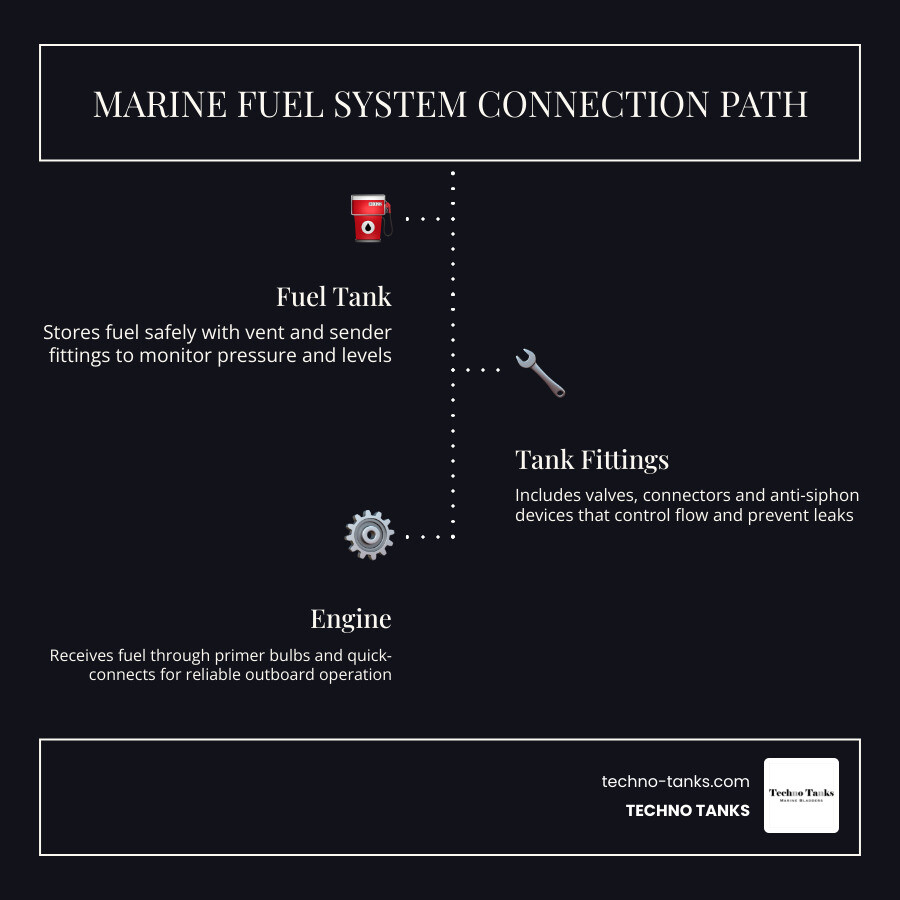
At a basic level, boat fuel systems are simple: store fuel, move fuel, burn fuel. The part that gets complicated is everything in between.
The main categories of marine fuel tank fittings include:
- Fuel shutoff valves, such as a Fuel Valve SS304, which let us isolate the tank for service, storage, or emergencies
- Anti-siphon valves, which reduce the risk of gravity-fed fuel escape if a line fails
- Vent valves, which manage tank breathing and pressure balance
- Primer bulbs, which help pull fuel through the line before startup
- Quick-connect and sprayless connectors, which make line changes cleaner and safer
- Splitter and branch fittings, including a Splitter Valve or T-Barb Connector, used when one system feeds multiple lines or tanks
- Pick-up fittings and extension pieces, such as a Fuel Line Extension Connector, that link hose sections or adapt layouts
- Pressure-management parts, including a Manual Pressure Valve, useful in specialized fuel storage setups
- Fuel senders and pick-up assemblies that help us measure fuel level and draw fuel from the correct depth in the tank
Research across the marine aftermarket shows just how many variations exist. Large marine suppliers stock hundreds of tank and fitting products, and major brands offer dozens to more than 100 related accessories. That tells us something important: there is no single “standard fitting” for every boat.

Functionality of Anti-Siphon and Vent Valves
Anti-siphon valves and vent valves do different jobs, but both are safety-critical.
An anti-siphon valve is essentially a one-way restriction device placed at the tank outlet. Its purpose is to stop fuel from free-flowing out of the tank if a downstream hose ruptures or becomes disconnected. In a built-in tank mounted above part of the fuel line run, this matters a lot. Without anti-siphon protection, gravity can do what gravity always does: make a bad day worse.
A vent valve handles tank breathing. As fuel is drawn out, air must enter. As the tank warms, vapors expand and pressure must be managed. Proper venting helps prevent:
- Vacuum lock that starves the engine
- Pressure buildup that pushes vapors or fuel where they do not belong
- Tank deformation in severe cases
- Erratic fuel flow
If you are plumbing multiple tanks into one feed, routing and valving become even more important. This discussion on multiple fuel tanks with a single feed line is a good reminder that check valves, shutoffs, and venting strategy must be thought through as a system, not as random hardware from a parts bin.
Role of Senders and Pick-up Tubes in Marine Fuel Tank Fittings
Fuel senders tell the gauge how much fuel remains. Pick-up tubes tell the engine where to drink from. Both are easy to overlook until they fail at the worst possible moment, usually far from the dock and right after someone says, “We should have plenty left.”
A sender must match:
- Tank depth
- Fuel type
- Gauge resistance range
- Mounting pattern
- Seal material
For gasoline and diesel systems alike, gasket and seal compatibility matters. Ethanol-blended fuels can be hard on lower-grade rubber, which is why chemically resistant seals such as Viton O-Rings are often the smarter choice.
Pick-up tube depth matters too. Too short, and you leave usable fuel stranded. Too long, and the tube may bottom out, restrict flow, or pull debris from the tank floor. In portable or flexible tank applications, the geometry can differ from a rigid built-in tank, so fitting selection has to reflect the tank design.
Material Selection and Thread Standards
Choosing the right fitting material is about more than price. It is about fuel compatibility, corrosion resistance, weight, and service life.
Here is a practical comparison:
| Material | Main Advantages | Watchouts | Common Uses |
|---|---|---|---|
| Brass | Good machinability, widely available, reliable sealing | Can corrode in some marine environments if poorly matched | Valves, hose barbs, adapters |
| Aluminum | Lightweight, common in some tank systems | Must be matched carefully to avoid galvanic issues | Fill components, tank necks, some adapters |
| Stainless Steel 304 | Strong, corrosion resistant, durable in harsh use | Higher cost, thread galling possible if mishandled | Shutoff valves, premium fittings, exposed hardware |
For example, a stainless shutoff like the Fuel Valve SS304 is a strong option where durability and corrosion resistance are priorities. Aluminum components such as a Male Elbow Connector or Filler Pipe Aluminium can be useful where weight and packaging matter.
Thread standard is where many installations go wrong.
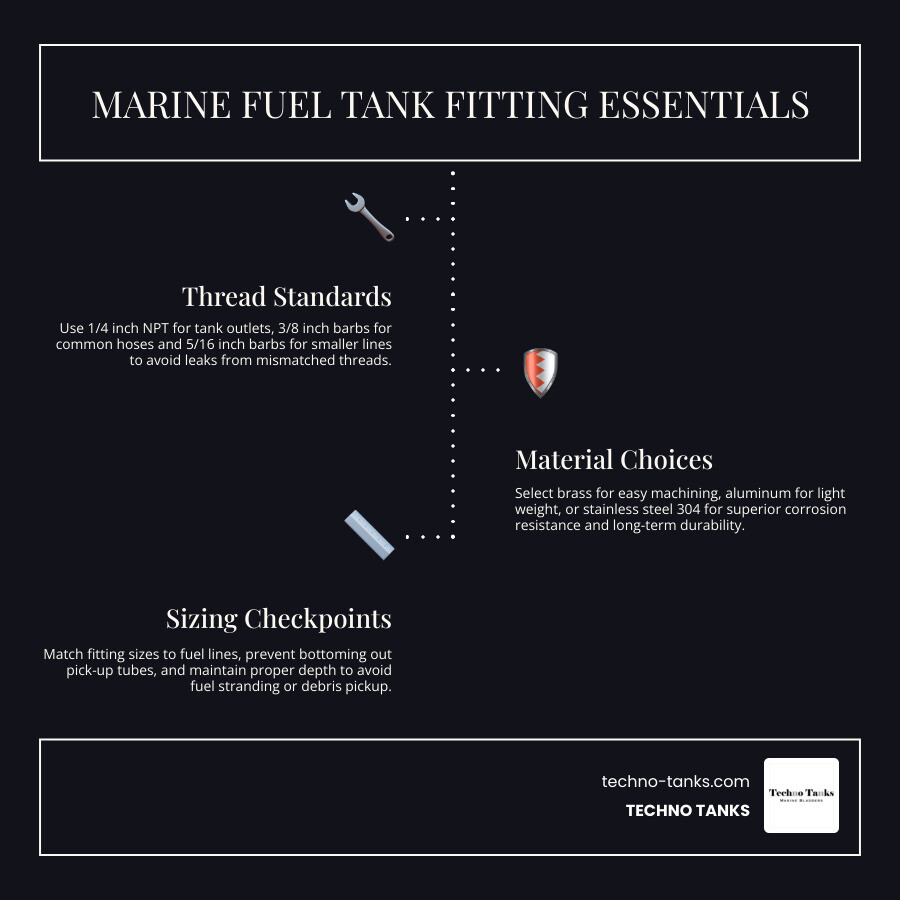
The most common thread in small marine fuel tank fittings is 1/4″ NPT. You will see this repeatedly in tank-end fittings, sprayless connectors, and adapters. NPT is tapered, which means it seals by thread interference. BSP threads are different in angle and form, so mixing NPT and BSP is a classic way to create a leak that “almost fits.”
Useful sizing checkpoints include:
- 1/4″ NPT for many tank outlet and connector fittings
- 3/8″ barb for common fuel hose sizes
- 5/16″ barb for smaller fuel line runs
- 1″ fittings in some fill or vent-related components
If you need an example of adapter-style hardware, see this fuel delivery tank adapter reference. On the Techno Tanks side, parts like the Male to Male Nipple Connector NPT and Male Elbow Connector help bridge common plumbing layouts without improvising.
Safety Features and Regulatory Compliance
Modern marine fuel systems are not just about moving fuel. They are also about controlling vapor emissions and reducing spill risk.
That is where EPA- and CARB-compliant components come in. Research on current marine fittings shows that low-permeation fuel system parts, compliant connectors, and vapor-management accessories are now standard expectations in many products, especially on portable tank systems.
The big compliance themes are:
- Reduced fuel vapor permeation through hoses and components
- Better sealing at disconnect points
- Controlled venting and pressure relief
- Compatibility with ethanol-blended fuels
- Cleaner connection and disconnection during maintenance or tank changes
The USCG boating fuel and emissions reference is useful background reading because it reinforces how emissions controls and fuel safety overlap in real-world boating.
One especially helpful innovation is the sprayless connector. Products like this sprayless tank male connector example use internal check valves so fuel does not spit back when lines are disconnected. Some documented examples also note very low restriction at operating flow rates and compatibility with ethanol-blended fuels.
That matters because quick disconnects used to be a little too exciting. A line under pressure plus a tired connector equals a face full of fuel and some very creative language. Sprayless designs help solve that.
For systems where convenience matters, a Fuel Line Quick Connector can improve both safety and serviceability, provided it matches the thread, hose size, and engine-side connection standard.
Installation and Maintenance Best Practices
Even the best fitting can fail if installed badly.
That is not a product problem. That is a human-with-a-wrench problem.
Good installation starts with planning the entire fuel path:
- Tank outlet location
- Shutoff valve position
- Hose routing
- Vent routing
- Fill point location
- Access for inspection
- Vibration and chafe protection
This is especially important when working with auxiliary storage systems, portable tanks, or flexible tanks. At Techno Tanks, we design flexible marine fuel bladders for range extension, so we pay close attention to secure routing, motion control, and compatible accessories. Our Marine Bladder Operating Instruction Tips are a good companion reference if your setup includes flexible fuel storage.
A proper fill assembly also matters. Components such as a Filler Pipe or Filler Pipe Aluminium, paired with the right Fuel Cap or Replacement Fuel Cap, help keep contamination and vapor loss under control.

Best Practices for Installing Marine Fuel Tank Fittings
When we install marine fuel tank fittings, we recommend a few non-negotiables:
- Match threads exactly
- Confirm NPT vs BSP before assembly
- Never force a fitting because it “looks close”
- Use fuel-compatible thread sealant where required
- Many male NPT fittings need a fuel-rated sealant
- Do not overapply; excess sealant can migrate into the fuel path
- Support the fitting and hose
- Hoses should not hang off the fitting under tension
- Use clamps and supports to reduce vibration loading
- Position hose clamps correctly
- Place clamps behind the barb bead, not on top of it
- Use marine-grade clamps and inspect for corrosion
- Avoid sharp bends
- Tight bends can kink hose, restrict flow, and stress connector bodies
- Leak test after installation
- Inspect under operating conditions, not just while dry at the dock
- Keep service access in mind
- If a fitting cannot be reached, it will not be inspected often enough
This fuel tank installation article is a helpful reminder that installation quality affects the entire life of the system, not just day one.
Troubleshooting Common Marine Fuel Tank Fittings Issues
Most fitting-related problems show up in familiar ways:
Air leaks
- Engine surges
- Hard starting
- Primer bulb not staying firm
- Bubbles visible in clear diagnostic line sections
Possible causes:
- Loose clamps
- Cracked connector body
- Poor thread seal
- Flattened or damaged O-ring
Fuel spraying during disconnect
- Worn quick-connect
- Non-sprayless old-style fitting
- Failed internal check valve
Possible causes:
- Replace worn coupler
- Upgrade to a sprayless connector
- Inspect seals and disconnect technique
O-ring degradation
- Cracks
- Flattening
- Swelling
- Sticky or brittle feel
Solution:
- Replace with fuel-compatible seals such as Viton O-Rings
Restricted fuel flow
- Engine starves at high throttle
- Primer bulb collapses
- Tank vents poorly
Possible causes:
- Clogged anti-siphon valve
- Obstructed vent valve
- Hose kink
- Debris in pick-up tube
For a practical 2026 maintenance schedule, we suggest:
- Before every trip: visual leak and hose inspection
- Monthly in active season: check connectors, bulb firmness, and cap seals
- Annually: inspect all O-rings, replace suspect quick-connects, verify vent function, and retighten serviceable joints as needed
- Immediately: replace any fitting that becomes hard to connect, disconnect, or keep sealed
Frequently Asked Questions
How do portable and built-in tanks differ in fitting requirements?
Portable tanks usually use quick-disconnect systems, compact tank-end fittings, and integrated venting solutions. Built-in tanks more often use permanent threaded plumbing, fixed fill assemblies, dedicated vent lines, and anti-siphon protection.
The key differences are:
- Portable tanks prioritize easy removal and reconnection
- Built-in tanks prioritize permanent sealing and structural support
- Portable systems often use connector-specific tank fittings
- Built-in systems more often use direct NPT-plumbed components
- Vent strategy can differ significantly between the two
This overview of universal boat fuel tank fittings reflects how many portable-tank connection variants exist.
For extended-range boating, we also need to consider auxiliary storage. If we are integrating a flexible bladder tank, the fittings must suit the bladder’s transfer method, hose size, venting approach, and securing method. That is one reason we build our systems around dedicated accessories rather than guesswork.
What are the benefits of sprayless marine fuel tank fittings?
Sprayless fittings improve both safety and convenience.
Their main benefits are:
- Less fuel discharge during disconnect
- Lower spill risk during fueling or maintenance
- Cleaner handling in pressurized fuel lines
- Reduced vapor release at the connection point
- Better user confidence when changing tanks
Some product examples in the market also highlight automatic check valves, pre-applied thread sealant, and compatibility with standard 1/4″ NPT tank fittings. This sprayless connector reference shows the type of design features we mean.
When should I replace my fuel line connectors and O-rings?
Replace them when you see any of the following:
- Cracking
- Stiffness
- Fuel odor at the connection
- Wetness around the fitting
- Difficulty connecting or disconnecting
- Primer bulb losing firmness after sitting
- O-rings that are flattened, swollen, or brittle
At minimum, inspect annually. In heavy-use boats, especially those exposed to sun, ethanol fuel, and frequent tank swapping, mid-season checks are smart. If you are replacing seals, use fuel-compatible options like Viton O-Rings.
Conclusion
Choosing the right marine fuel tank fittings is really about building a system that is safe, compatible, and easy to maintain. That means understanding function first, then matching material, thread standard, hose size, and compliance requirements.
For us, that is especially important when a boat carries auxiliary fuel for longer fishing trips or cruising legs. At Techno Tanks, we manufacture flexible marine fuel bladders in patented, recyclable TPU construction, with capacities from 30 to 3000 gallons. Those systems perform best when paired with the right caps, valves, connectors, and transfer accessories.
If you are building or upgrading a fuel setup, explore our Accessories for Marine Fuel and Liquid Bladders and start with a dependable Fuel Line Quick Connector. The right fitting is a small part with a very big job.

