
Why Quick Disconnect Fuel Line Fittings Matter for Fuel System Integrity
Quick disconnect fuel line fittings are mechanical connectors that allow fuel lines to be joined or separated rapidly — without tools, without threading, and without breaking the fuel system seal. They are used across automotive, marine, commercial, and industrial fuel systems wherever fast, reliable, leak-free connections are needed.
Here’s what you need to know at a glance:
| Feature | Detail |
|---|---|
| How they work | Push-to-connect mechanism locks with an internal clip or collar; pull or squeeze to release |
| Common sizes | 5/16 in., 3/8 in., 1/2 in., 6AN |
| Common materials | Aluminum, brass, nylon, steel |
| Typical applications | EFI fuel rails, outboard engines, marine fuel lines, auxiliary fuel systems |
| Key benefit | Tool-free connection and disconnection with a sealed, leak-resistant fit |
| Safety note | Depressurize the fuel system before disconnecting |
These fittings are not just a convenience feature. In commercial marine and offshore fuel systems — where fuel lines connect portable tanks, flexible fuel bladders, or auxiliary fuel storage to engines — a loose or degraded fitting is a serious safety and operational risk. Getting the right fitting, in the right material, for the right line size is a practical decision with real consequences.
This guide covers everything operators, technicians, and serious buyers need to know: how these fittings work, which types suit which applications, how to install and remove them correctly, and what to watch for when maintaining a fuel system that depends on them.
If you are evaluating this type of connection for a Techno Tanks bladder system, compare your requirements with the Techno Tanks Fuel Line Quick Connector. Confirm hose size, thread/interface, and engine-side compatibility before purchase.
Understanding Quick Disconnect Fuel Line Fittings and How They Work
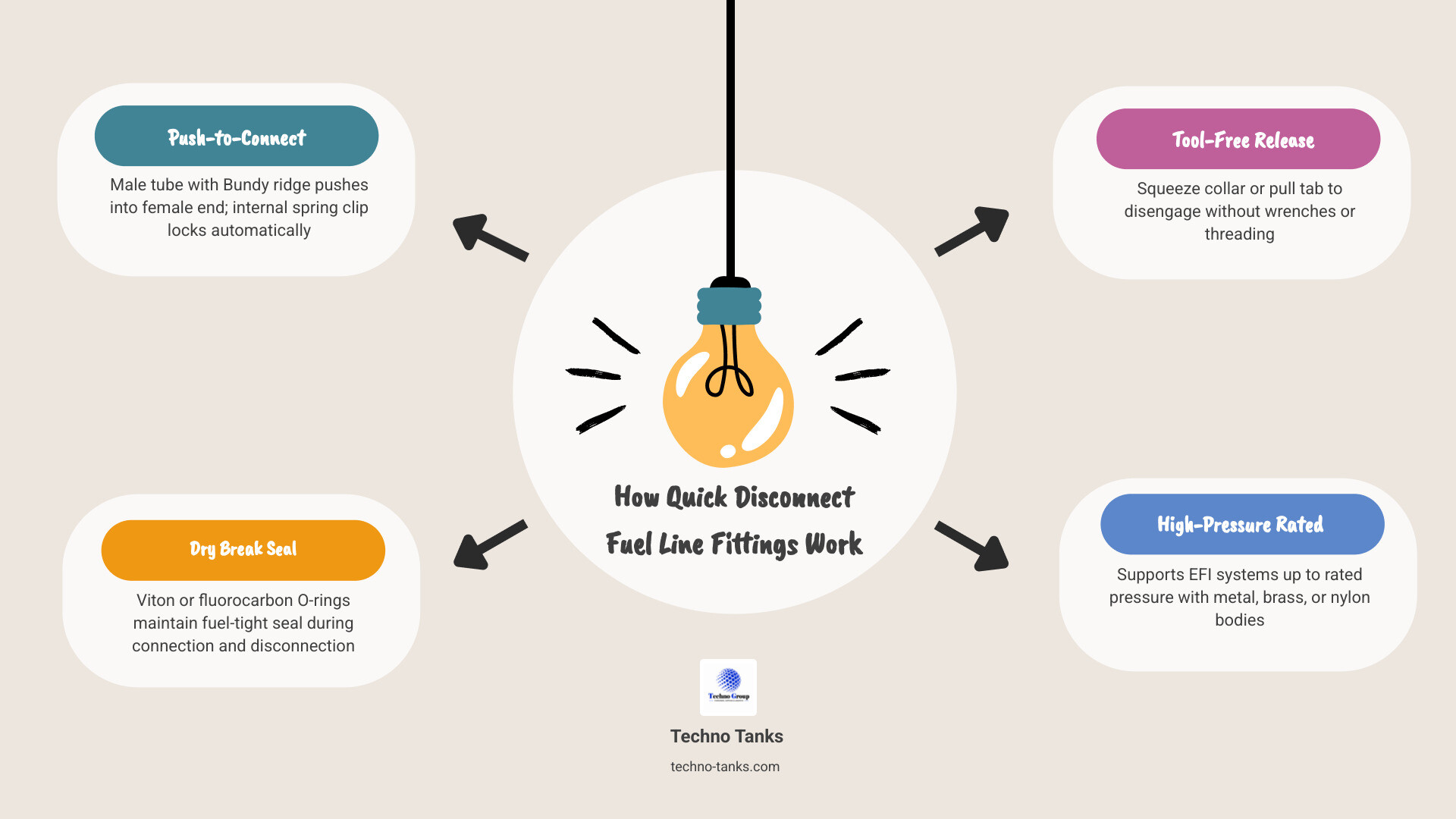
At its core, a quick disconnect fuel line fitting relies on a male and female mating design. When the male end (often a straight metal or nylon tube with a formed retaining ridge, known as a Bundy tube) is pushed into the female receiving end, it slides past an internal locking mechanism. This locking mechanism—typically a spring-loaded metal clip, plastic retainer, or radial ball-bearing collar—snaps down behind the ridge of the male tube, securing it firmly in place against high system pressures.
To understand the mechanics deeper, one must look at how these fittings handle fluid retention during separation. Many high-performance and commercial-grade connectors utilize dry break technology. These designs feature internal, spring-loaded check valves in both the male and female halves. When connected, the valves press against each other, forcing both open to allow unobstructed fuel flow. The moment you release the coupling, the internal springs instantly snap the valves shut before the sealing O-rings clear the mating surfaces. This prevents fuel spray, minimizes dripping, and stops air from entering the fuel lines.
Sealing integrity relies almost entirely on internal elastomeric seals, typically made of Viton (FPM/FKM) or other advanced fluorocarbon elastomers. Viton is preferred in high-pressure Electronic Fuel Injection (EFI) systems because of its exceptional resistance to chemical degradation from modern fuel chemistries, including ethanol-blended gasoline, diesel, and biodiesel.
Under pressure, these seals are compressed radially against the male tube, ensuring a gas-tight and liquid-tight barrier. For detailed insights on how these systems operate under real-world conditions, technicians often consult technical breakdowns such as the guide on How To Work With Late-Model Quick-Disconnect Fuel Lines.
Types, Materials, and Sizing Specifications
Selecting the correct fitting requires matching the physical dimensions, connection angles, and material properties to the specific pressure and chemical demands of your system. A mismatched connector can lead to flow restriction, accelerated wear, or catastrophic pressure loss.
Sizing and Angles of Quick Disconnect Fuel Line Fittings

Fuel line quick disconnects are standardized around specific nominal hose and tube diameters. The most common sizes found in marine and automotive applications are 5/16-inch and 3/8-inch lines, with larger commercial systems scaling up to 1/2-inch lines to accommodate higher volume flow rates.
When adapting modern EFI systems or auxiliary fuel lines to aftermarket hardware, operators frequently use 6AN flare adapters. The “AN” (Army-Navy) standard uses a 37-degree flare sealing surface. Specialty adapters, such as the EVIL ENERGY 6AN to EFI Quick Disconnect Fuel Fitting, allow technicians to transition seamlessly from factory push-on fuel rails to heavy-duty braided lines without risking leaks.
Choosing between a straight and a 90-degree configuration is primarily a matter of space management, bend radius, and strain relief:
- Straight Fittings: Ideal for inline runs where the fuel line has a clear, unobstructed path. They present the lowest restriction to fuel flow.
- 90-Degree Fittings: Used in tight engine bays, bulkheads, or tank connections where a straight line would be forced into a tight bend. Forcing a flexible fuel line into a sharp bend creates mechanical stress, which can lead to kinking, flow restriction, or premature line failure.
In specialized setups, you will also encounter standardized male connections such as the Bundy tube. For example, a heavy-duty Fitting Fuel Line Quick Connector 3/8“ -1/2″ Barb to 12mm (11.80) Bundy Male Tube is commonly employed to bridge the gap between rigid commercial fuel system manifolds and flexible distribution hoses.
Material Selection: Aluminum, Brass, and Nylon
The material of your quick disconnect fitting determines its pressure rating, service life, and resistance to environmental factors like salt spray and temperature extremes.
| Fitting Material | Common Applications | Max Pressure Rating | Key Advantages | Disadvantages |
|---|---|---|---|---|
| 6061-T6 Aluminum | High-pressure EFI, custom fuel rails, high-performance marine | Up to 1,500 PSI | Lightweight, highly corrosion-resistant when anodized, structural strength | Higher cost |
| Chrome-Plated Brass | Outboard marine engines, motorcycle fuel lines, heavy-duty industrial | Up to 250 PSI | Exceptional marine corrosion resistance, highly durable, robust locking tabs | Heavy, moderate flow restriction in smaller sizes |
| Nylon / Thermoplastic | OEM automotive fuel lines, low-pressure return systems | Up to 120 PSI | Economical, completely immune to galvanic corrosion, lightweight | Susceptible to UV degradation, brittle at extreme cold temperatures |
For specialized applications, such as BMW motorcycles or high-end marine auxiliary setups, chrome-plated brass is often the gold standard. Operators frequently refer to resources like the Fuel line quick disconnect fittings reference – BMW MOA Forum to cross-reference dimensions, or source complete rebuild assemblies like the Quick Disconnect Fuel Hose Coupling Kit for BMW models to replace failure-prone factory plastic components with durable metal alternatives.
Selecting Fittings for Steel vs. Nylon Lines in Marine and Commercial Systems
In professional marine and industrial settings, fuel delivery networks are rarely uniform. You will often find rigid steel lines running along structural bulkheads, transitioning to flexible nylon or rubber lines near engines or storage systems to isolate vibration. Connecting these dissimilar materials requires specialized transition fittings.
For instance, when adapting rigid steel tubing to flexible nylon lines, a specialized union like the Dorman Fuel Line Quick Connector That Adapts 5/16 in. Steel To 5/16 in. Nylon Tubing 800-081 is required. This fitting uses a compression or compression-style bite on the steel side, while providing a standardized quick-connect receptacle on the nylon side.
Integrating Auxiliary Fuel Systems and Flexible Bladders
For commercial operators and offshore vessel captains, extending operating range is a frequent necessity. Standard rigid fuel tanks are often limited by vessel geometry. To solve this, operators utilize high-capacity marine fuel bladders or temporary fuel storage systems.
These flexible polyurethane (TPU) bladders require robust, reliable connections that can be quickly joined or isolated during fuel transfer operations. Using high-quality quick-disconnect fittings at the bladder manifold allows operators to connect and disconnect auxiliary lines without introducing air into the engine’s fuel system or spilling fuel into the bilge.
When designing these systems, understanding the interface between your storage vessel and the engine is critical. For a comprehensive overview of how these connections are engineered, see our guide on Everything You Need to Know About Boat Fuel Tank Fittings.
Additionally, for outboard configurations where portable tanks or bladders must be swapped quickly under demanding sea conditions, selecting the correct engine-end coupler is vital. Learn more about optimizing these setups in our technical article, The Best Way to Connect Your Outboard Fuel Line Fast.
For marine outboards, particularly Mercury or Mariner configurations, technicians often rely on OEM-spec hardware such as the CP Performance – 804787Q Quick Disconnect Fuel Line Connector Kit to ensure a secure, vibration-resistant connection at the engine cowl.
Step-by-Step Installation and Removal Guide
Working with pressurized fuel lines demands a disciplined approach. Fuel systems operate under significant pressure, and gasoline or diesel vapor presents an immediate ignition risk if handled incorrectly.
How to Install Quick Disconnect Fuel Line Fittings Safely
- Depressurize the System: Before cutting or disconnecting any line, disable the fuel pump (typically by pulling the fuel pump fuse or relay) and crank the engine for several seconds until it stalls. This relieves residual pressure in the fuel rail.
- Cut and Prep the Lines: If installing a new fitting onto nylon or rubber hose, ensure the cut is perfectly square. A jagged or angled cut will prevent the internal O-rings from sealing evenly. Clean away any burrs or debris.
- Apply Thread Sealant (Where Applicable): For threaded NPT or tapered adapters entering a manifold or tank, apply a fuel-resistant thread sealant paste. Never use standard Teflon tape, as shredded tape fragments can enter the fuel stream and clog fuel injectors.
- Insert and Engage: Push the male end straight into the female quick-connect receptacle. Listen and feel for a distinct, physical “click.” This indicates that the retaining clip has successfully snapped into place behind the retaining ridge.
- Verify Connection: Give the fitting a firm tug in the opposite direction. It should remain locked solid.
- Leak Test: Turn the ignition on (priming the fuel pump) without starting the engine. Inspect the connection closely for any signs of weeping or moisture.
For a visual walkthrough of how to handle various OEM and aftermarket locking styles, watch this instructional video on How to Disconnect Common Fuel Line Fittings on YouTube.
Safe Disconnection and Maintenance Best Practices
- Use the Correct Release Tool: Depending on the fitting style, you may need a scissor-style disconnect tool, a plastic release collar, or a simple pinch-tab tool. Never attempt to pry open locking tabs with a flathead screwdriver, as this will deform the retaining clip and cause the fitting to blow off under pressure later.
- Inspect the O-Rings: Every time a fitting is disconnected, inspect the internal Viton O-rings using a bright light. Look for signs of swelling, cracking, flattening, or tearing. If the seal is compromised, replace the fitting or the internal seal assembly immediately.
- Install Dust Caps: When fuel lines are disconnected—especially on portable marine bladders or auxiliary transfer systems—always install protective dust caps over both the male and female ends. Dirt, salt crust, and grit entering an open fitting will tear the internal seals upon reconnection, leading to immediate leaks.
- Check for Galvanic Corrosion: In marine environments, ensure that aluminum fittings are not in direct contact with stainless steel or copper components without an isolating barrier, as this will rapidly corrode the aluminum.
Frequently Asked Questions About Fuel Line Quick Connectors
What are the signs of a failing quick disconnect fitting?
The most common indicator of a failing fitting is a persistent smell of fuel near the connection point, even if there is no visible pooling. You may also observe “weeping”—a faint sheen of fuel coating the outside of the connector.
Internally, if the retaining clip weakens, you may experience pressure drops in the fuel system, leading to engine hard-starting or lean-running conditions. Physically inspect plastic or nylon fittings for discoloration or micro-cracking caused by UV exposure or engine heat, which indicates the material has become brittle and is prone to sudden fracturing.
Can quick disconnect fittings be used with both gasoline and diesel?
Yes, but only if the fitting materials and internal elastomer seals are rated for both fuel types. Diesel fuel has a different chemical composition and viscosity compared to gasoline, and it often operates under different system pressures.
When utilizing auxiliary fuel bladders, it is critical to match the fitting to the specific fuel type. Ensure your setup uses compatible components, whether you are running diesel fuel bladders or gasoline fuel bladders. Fluorocarbon (Viton) seals are generally compatible with both fuels, but always verify the manufacturer’s specification sheet before installation.
Are special tools required to disconnect these fittings?
It depends on the design. Some quick disconnect fittings feature integrated pinch-tabs or push-button collars that can be operated entirely by hand. Others, particularly OEM automotive style connectors, require specialized, inexpensive disconnect tools (often made of plastic or anodized aluminum) that slide into the fitting sleeve to spread the internal retaining fingers apart.
For high-pressure, commercial-grade transfer systems, tool-free dry break designs are highly recommended to facilitate rapid, spill-free emergency disconnects.
Conclusion
Quick disconnect fuel line fittings are essential components for maintaining a highly efficient, serviceable, and safe fuel delivery system. Whether you are routing lines for a high-pressure EFI engine swap, managing fuel transfer on a commercial vessel, or extending your offshore cruising range using auxiliary systems, choosing the correct fitting is paramount.
For operators requiring dependable, high-capacity fuel storage, pairing these high-quality connectors with robust collapsible fuel tanks provides a seamless, professional-grade solution. If you are configuring a custom vessel setup or require specialized range-extension capabilities, explore our engineered offshore fuel solutions.
Every fuel system has unique demands based on fuel type, pressure, and environmental exposure. To ensure you get the exact hardware and sizing for your application, contact our technical team to request a custom quote.

