
How to Choose the Right Portable Boat Fuel Tank
When we look at outfitting a small vessel, the fuel system is the heart of the operation. Choosing the right portable boat fuel tank isn’t just about how many gallons it holds; it is about how that tank interacts with your boat’s physics.
Several factors should dictate your choice:
- Boat Type: A rigid hull can handle a square tank anywhere, but an inflatable might need a specific shape to fit the bow.
- Engine Size: A small 2.5 HP outboard sips fuel, while a 25 HP or 40 HP engine will drain a small tank quickly.
- Trip Length: Are you just hitting the sandbar, or are you exploring five miles of coastline?
- Deck Space and Weight: Gasoline weighs about 6.3 pounds per gallon. A full 12-gallon tank adds over 75 pounds to your boat – something to consider regarding balance and stability.
For very small boats, a compact rigid portable tank may still be the practical choice. If the requirement shifts from a few gallons to meaningful auxiliary range, compare those tanks with marine fuel bladders from Techno Tanks, which are designed around flexible auxiliary fuel storage rather than small-engine day-tank use.
Portable vs. Permanent Tanks
Most powerboats come with permanent tanks, but many small vessels rely exclusively on portable options. Here is how they stack up:
| Feature | Portable Boat Fuel Tank | Permanent Fuel Tank |
|---|---|---|
| Capacity | Typically 3-12 gallons (up to 50) | 10 to several hundred gallons |
| Installation | DIY, no tools required | Professional installation required |
| Maintenance | Easy to remove, clean, and drain | Difficult to access and clean |
| Mobility | Can be filled at a gas station | Must be filled at a marine fuel dock |
| Material | Mostly HDPE plastic | Aluminum or Stainless Steel |
Best portable boat fuel tank sizes for inflatables and dinghies
For inflatable boats and dinghies, weight and space are your biggest enemies. A portable boat fuel tank in the 3-gallon to 6-gallon range is usually the “sweet spot.”
Many boaters using ultra-small outboards, like the Suzuki 2.5, find that the internal tank is often sufficient for very short trips. However, adding a small external tank provides peace of mind. For these vessels, we often recommend “bow-shaped” tanks. These are specifically engineered with a tapered design to tuck into the triangular space at the front of an inflatable, keeping the deck clear for passengers and gear.
Choosing a portable boat fuel tank for fishing boats and pontoons
If you are running a jon boat or a pontoon, you likely have more floor space but a higher fuel demand. A 6.5-gallon or 12-gallon portable boat fuel tank is the standard here.
A 12-gallon tank is particularly popular for pontoon boats. These tanks are designed to offer a “true” 12-gallon liquid capacity, plus extra space for a 2-cycle oil blend (often around .75 gallons) and a 5% vapor expansion space. This ensures you do not have fuel spitting out of the vent when the sun warms the tank.
When a larger flexible fuel option makes more sense
Sometimes, even a 12-gallon rigid tank is not enough. If you are planning a long-range offshore fishing trip or moving a yacht between ports, you might need much more extra capacity. This is where many operators shift from small rigid tanks to larger temporary fuel solutions.
For those needing significantly more range, a marine fuel bladder can be a practical option. These bladders are made from recyclable thermoplastic polyurethane and can be rolled up when empty, saving massive amounts of deck space. You can learn more about the differences in our guide on Fuel Bladder vs Fuel Tank or see how they are specifically used for Fuel Bladder for Boats. For general portable marine fuel safety guidance, see the U.S. Coast Guard boating safety resources.
For connector selection, see the Techno Tanks 1/2-inch Fuel Line Quick Connector and verify the fitting requirements for your specific fuel system.
Types, Sizes, and Materials Explained
Understanding what your portable boat fuel tank is made of is just as important as its size. In the marine environment, equipment is constantly bombarded by UV rays, salt spray, and physical vibration.
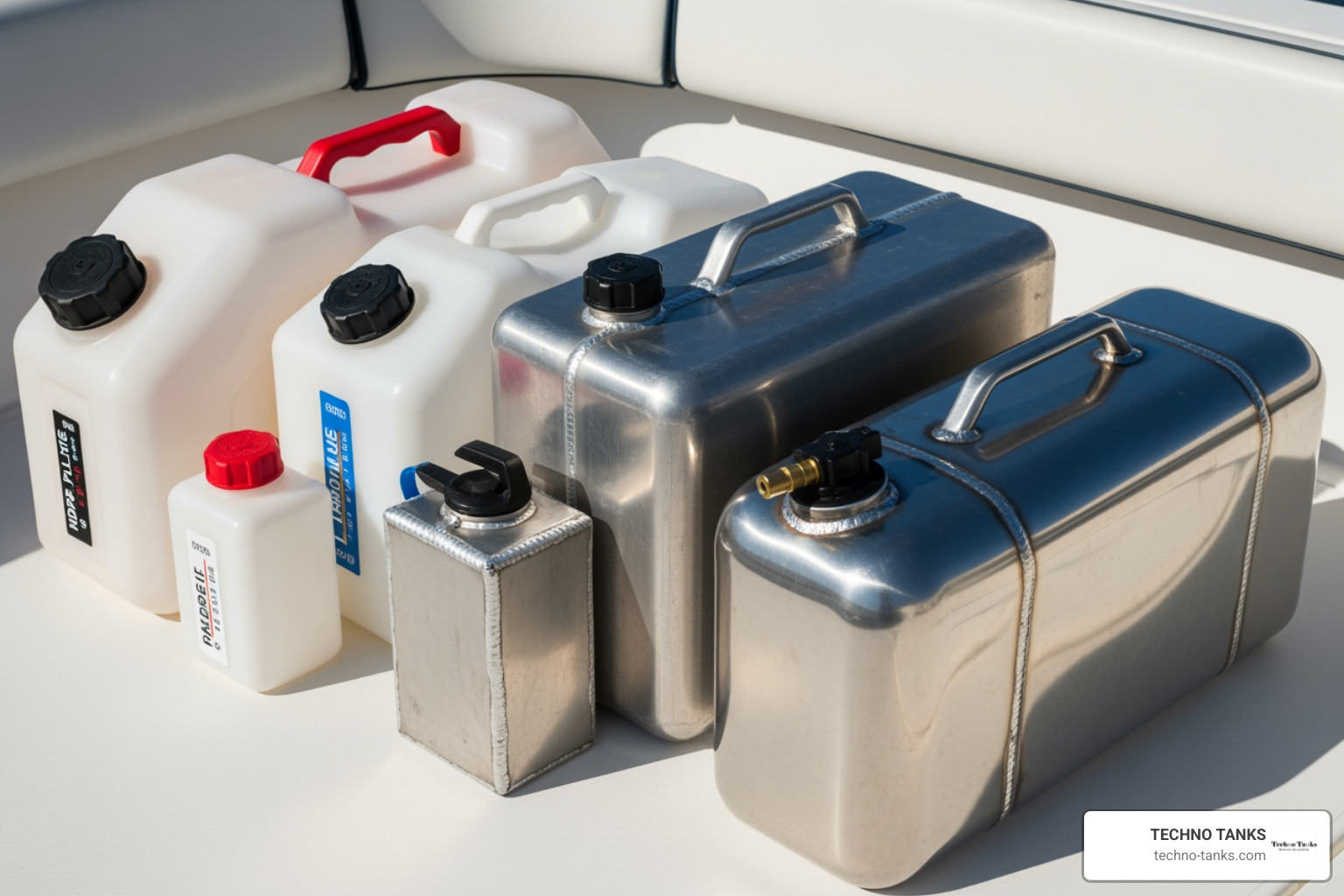
Main types of portable boat fuel tank systems
- Topside Tanks: These are designed to sit on the deck. They usually have rubber feet or molded-in grooves to help them stay put.
- Below-Seat Tanks: These have a lower profile to slide under the bench seats of a rowing or fishing boat.
- Bow Tanks: As mentioned, these are triangular to fit the nose of the boat.
- Auxiliary Tanks: These serve as a secondary source, often connected via a “three-way” valve to the engine.
Common capacities and what they are best for
- Smaller portable tanks: Easier to carry and fit into limited deck space, but provide less range.
- Mid-size portable tanks: Balance additional capacity with greater loaded weight and footprint.
- Larger portable tanks: Require more space and careful securing; confirm vessel capacity, engine requirements, and fuel-system compatibility.
Material differences: HDPE vs. Aluminum vs. Stainless Steel
Most modern portable boat fuel tanks are made from High-Density Polyethylene (HDPE). Quality HDPE tanks use a multi-layer co-extruded construction (often with an EVOH barrier) to prevent gasoline vapors from “permeating” or seeping through the plastic.
- HDPE: Lightweight, rust-proof, and dent-resistant. It’s the most common choice for portability.
- Aluminum: Very strong and used for some larger portable or semi-permanent tanks. It is susceptible to corrosion if not properly coated or if sitting in salt water.
- Stainless Steel: The most durable and expensive. It is heavy, making it less “portable” but excellent for permanent setups.
Safety Standards and What to Verify
Portable marine fuel tanks and fuel lines can be subject to federal evaporative-emission requirements. The U.S. Environmental Protection Agency maintains current information on marine spark-ignition fuel-system requirements and portable fuel-container certification.
Before buying, verify the tank’s manufacturer documentation, intended fuel, capacity, venting or pressure-management design, fuel-line requirements, connector compatibility, and any labeling or standards that apply to your vessel and jurisdiction. Do not assume that an acronym, color, or product category alone proves suitability for your boat.
Portable Fuel Tank Features to Compare
When comparing a portable boat fuel tank, review features that affect fit, monitoring, pressure management, and fuel-line routing:
- Fuel-level indication: A gauge or other clear way to monitor remaining fuel.
- Venting or pressure management: Use the design specified by the tank manufacturer.
- Pickup and outlet design: Confirm that the fuel can be drawn reliably in the tank’s intended orientation.
- Fuel-line and connector compatibility: Match the hose, fitting, connector, and outboard requirements for the specific system.
Installation, Securing, Maintenance, and Storage
Properly managing your portable boat fuel tank is the difference between a smooth afternoon and a mechanical nightmare.
How to install and secure a portable boat fuel tank correctly
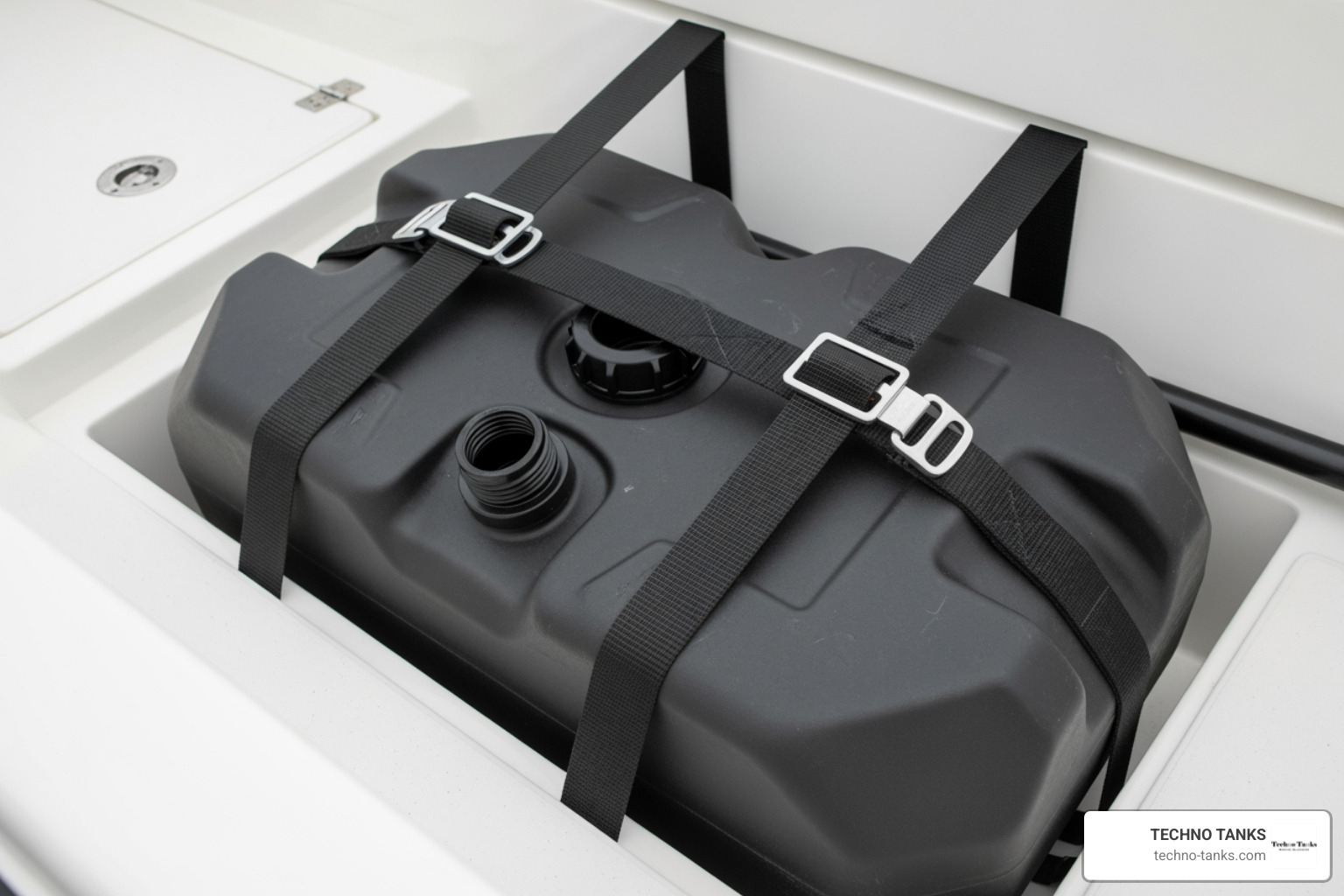
Never leave a fuel tank loose on the deck. A sliding tank can pull on the fuel line, causing a leak or disconnecting the engine at a critical moment.
- Placement: Place the tank in a well-ventilated area. Avoid enclosed lockers unless they are specifically designed for fuel storage with overboard drains.
- Securing: Use nylon straps with stainless steel buckles. Most tanks have “tie-down” grooves molded into the plastic to keep the straps from slipping.
- Connection: Use a high-quality fuel line with a primer bulb. Ensure the “quick-connect” fitting is compatible with your specific engine brand (Mercury, Yamaha, and Suzuki all use different connectors).
Cleaning and storing portable marine fuel tanks the right way
Fuel stability depends on fuel formulation, ethanol content, temperature, storage conditions, time, and whether a stabilizer is used. Follow the engine, fuel, and stabilizer manufacturers’ storage guidance rather than relying on one universal shelf-life number.
- Cleaning: If you suspect debris or water in the tank, drain it completely. Use a small amount of fresh fuel to rinse out the bottom. Always dispose of old fuel at a certified recycling center.
- Winterization: If you are storing the boat for the season, it is often best to drain the tank or fill it completely and add a high-quality fuel stabilizer. For more on this, check out our guide on how and when to winterize your boat marine fuel bladder.
- Bad Fuel: If you find yourself stuck with bad fuel, do not try to “run it through” the engine. This can clog carburetors and damage fuel injectors.
Common fuel system problems and simple fixes
- Engine bogs down: Check the tank vent. If the vacuum valve is stuck or the manual vent is closed, the engine will starve for fuel.
- Fuel line won’t prime: Look for air leaks at the connectors or a cracked primer bulb.
- Water in fuel: This usually happens from condensation in a half-empty tank. Use a fuel-water separator filter if your boat allows for it.
Best Portable Fuel Tank Picks by Use Case
Best for ultra-small outboards and short trips
For the minimalists, a 3.2-gallon tank is the way to go. These are incredibly light (around 3-4 lbs empty) and have a small footprint. They are perfect for small tenders or for sailors who only use their outboard to get in and out of the slip.
Best for all-around small boat use
The 6-gallon to 6.5-gallon class is the gold standard. It offers roughly 4-6 hours of runtime for a medium-sized outboard. Look for models with a built-in handle and a wide base to prevent tipping in choppy water.
Best for longer days and pontoon duty
The 12-gallon tank is for those who don’t want “range anxiety.” These often feature integrated analog gauges and are built with automotive-grade multi-layer HDPE to withstand the higher pressures that come with larger fuel volumes.
Where to Buy and What to Compare Before Purchase
Portable boat fuel tanks are sold through marine retailers, dealerships, and specialized online stores. Prices change by brand, capacity, fittings, gauge, certification or compliance requirements, and included fuel-line hardware, so compare the complete system rather than relying on a static price range.
What to check before you buy
- External dimensions and loaded weight
- Stated usable capacity
- Fuel compatibility
- Fuel-line, primer-bulb, and connector compatibility
- Venting or pressure-management design
- Manufacturer instructions for placement and securing
- Current labeling, documentation, and warranty information
Beyond Portables: The Range Extension Path
If a portable rigid tank does not provide enough capacity, compare temporary fuel storage, fuel transfer bladders, and marine fuel bladders for higher-capacity auxiliary or temporary applications.
The 80-gallon marine fuel bladder is one standard Techno Tanks capacity. Compare its filled dimensions, weight, and intended use in the marine fuel bladder dimensions guide before deciding whether a flexible bladder fits your application.
No matter which portable boat fuel tank you choose, verify the tank, fuel line, fittings, placement, securing method, and manufacturer instructions as one complete fuel system.

