
Why the Right Boat Fuel Tanks Can Make or Break Your Trip
Boat fuel tanks are one of the most critical — and most overlooked — parts of any vessel. Run out of fuel miles offshore, and you’re not just inconvenienced. You’re stranded.
Here’s a quick overview of the most common marine fuel tank options:
| Tank Type | Best For | Key Material | Typical Capacity |
|---|---|---|---|
| Permanent below-deck | Built-in primary storage | XLPE plastic or aluminum | 15–331+ gallons |
| Portable topside | Small boats, short trips | HDPE plastic | Under 20 gallons |
| Custom aluminum | Replacement or upgrade | 5052 or 5086 aluminum | Any size |
| Flexible TPU bladder | Range extension, no hull mods | Thermoplastic polyurethane | 30–3,000 gallons |
Most boat fuel tanks last 15 to 20 years with proper care. But even a well-maintained tank has a fixed capacity — and that’s often the real problem for anglers and cruisers pushing farther offshore.
Whether your current tank is aging, undersized, or simply not cutting it for longer runs, there are more options available in May 2026 than most boat owners realize.
I’m Ivan Jimenez, founder of Digital Ivan and Doral SEO, and I’ve spent years helping marine and industrial brands like Techno Tanks build content systems that connect buyers with the right boat fuel tanks for their needs. This guide will walk you through everything you need to make a confident, informed decision.
Understanding Marine Fuel Storage Solutions
When we talk about boat fuel tanks, we are really talking about the lifeblood of your vessel’s performance. In May 2026, the marine industry has shifted toward higher-efficiency engines that demand cleaner, more reliable fuel delivery. However, even the most efficient outboard can’t get you home if your storage capacity is limited.
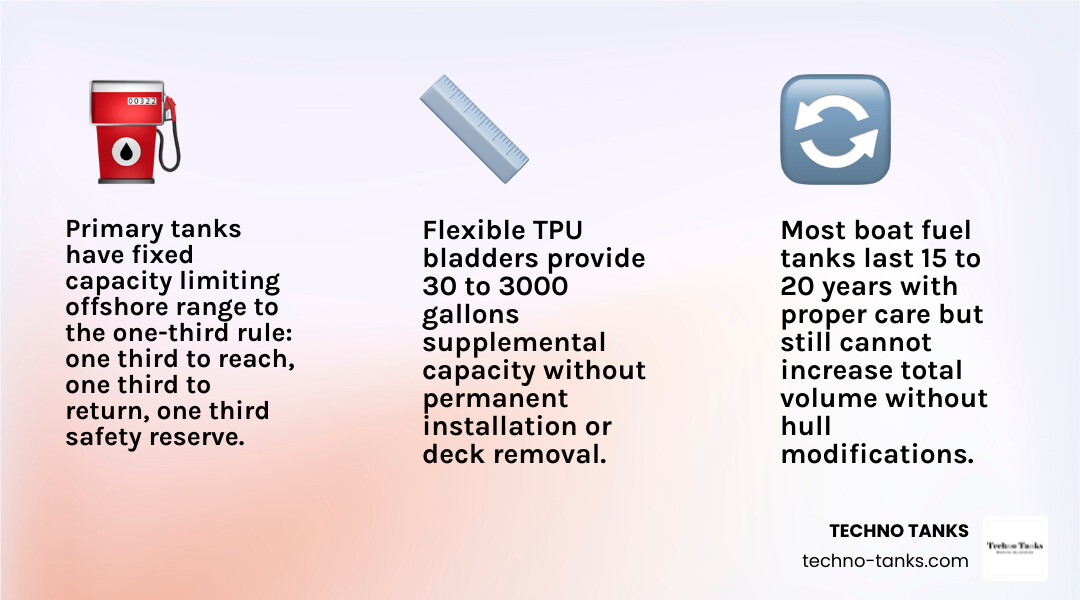
There is a major distinction between primary and supplemental fuel storage. Your primary tank is the one built into the hull—often a permanent below-deck unit made of aluminum or cross-linked polyethylene (XLPE). While these are essential, they have a fixed volume. If you want to fish the canyons or cruise to a remote island, you are often limited by the “one-third rule” (one third to get there, one third to get back, and one third for safety).
This is where supplemental storage, such as flexible fuel bladders, has revolutionized the industry. Instead of being stuck with the factory-installed capacity, boaters can now temporarily increase their range. It’s also vital to understand the difference between total Fuel Tank Capacity vs. Useable Fuel Capacity – continuousWave. Because of the placement of pickup tubes and the physical shape of the hull, you might not actually be able to use every drop in a rigid tank, especially in rough seas.
Whether you are navigating a deep-V offshore hull or a flat-bottom skiff, the way you store fuel matters. Different Most Common Hull Types Boat Gas Tank Bladder setups require different approaches to weight distribution and securing hardware to ensure safety and stability.

Rigid Tanks vs. Flexible Fuel Bladders
For decades, the only real choice for boat fuel tanks was a rigid box. These are typically made of aluminum (often 5052 marine grade) or rotationally molded plastic. While durable, they are a nightmare to replace. If an aluminum tank develops a leak because it was foamed into place, you might have to cut the deck of your boat open—a “hip replacement” for your vessel that costs thousands in fiberglass repair.
Flexible fuel bladders offer a modern alternative. Unlike rigid tanks, they don’t require permanent hull modifications. You can roll them out on the deck, fill them up for the long haul, and as they empty, they collapse. This prevents the “sloshing” effect that can destabilize a boat, as there is no air pocket (ullage) inside the bladder.
| Feature | Rigid Permanent Tanks | Flexible TPU Bladders |
|---|---|---|
| Installation | Permanent, requires deck access | Portable, deck-mounted or compartment fit |
| Portability | Non-portable | Easily folded and stored when empty |
| Maintenance | High (corrosion/condensation risk) | Low (no condensation, easy to clean) |
| Customization | Expensive custom fabrication | Versatile sizing (30–3,000 gallons) |
| Longevity | 15–20 years | Highly durable TPU resists UV and chemicals |
When we look at Fuel Bladder vs Fuel Tank comparisons, the weight distribution advantage of bladders becomes clear. You can place a bladder in the most optimal spot on your deck to keep the bow at the right angle, something you simply cannot do with a fixed tank.
Essential Accessories for Marine Fuel Systems
A fuel tank is only as good as the hardware connected to it. For a complete and safe installation, several components are non-negotiable:
- Sending Units: These monitor your fuel levels. Modern reed-style senders are preferred over old swing-arm styles because they have no moving parts to rust or break.
- Fuel Vents and Valves: Proper venting is critical to prevent pressure buildup. Standard vent fittings typically use a 5/8-inch hose barb.
- Fill Fittings: Most permanent boat fuel tanks use a 1.5-inch hose barb for the fill neck.
- Pickup Tubes: These should be equipped with a screen to prevent debris from reaching your engine.
For those using flexible systems, checking the Fuel Bladder Specs is essential to ensure your fittings (like the 3/8″ NPT ports) are compatible with your existing fuel lines and primer bulbs.
Material Matters: Why TPU Outperforms Traditional Materials
In boat fuel tanks, material is destiny. Traditional materials all have a “kryptonite.”
- Aluminum: Subject to crevice corrosion, especially if water gets trapped against the metal by wet foam.
- Plastic (XLPE): While non-corrosive, older plastic tanks were prone to fuel permeation—that “gas smell” that lingers in the bilge.
- Fiberglass: Older fiberglass tanks can literally be dissolved by modern ethanol-blended fuels (E10/E15).
At Techno Tanks, we utilize Thermoplastic Polyurethane (TPU). This isn’t your average plastic. TPU is a high-strength, recyclable material that offers the best of both worlds: the flexibility of rubber and the durability of hard plastic. It is impervious to the “pitting” that destroys aluminum and the “osmosis” that plagues fiberglass.
Experts like Fuel Tank Installation | Steve D’Antonio Marine Consulting emphasize that the biggest enemy of a fuel tank is the environment it lives in. TPU is naturally resistant to UV rays, salt water, and the microbial growth often found in Diesel Fuel Bladders.
Choosing the Right Solution for Your Vessel
When selecting a tank, you must consider the fuel you’ll be using. Since 2012, regulations have tightened significantly regarding ethanol compatibility. Ethanol is hygroscopic, meaning it attracts water. In an aluminum tank, this water settles at the bottom and starts the corrosion process.
Our TPU tanks are fully compatible with E15 gasoline and biodiesel. They don’t react with the fuel, ensuring that your engine stays free of the gummy deposits that often form in aging metal tanks. If you’re unsure about what size you need, our Fuel Bladder Sizing Guide can help you calculate the weight-to-volume ratio to ensure your boat stays balanced. For many mid-sized center consoles, a 100 Gallons Marine Bladder is the “sweet spot” for doubling your offshore time without overcrowding the deck.
Regulatory Compliance and Safety Standards
Safety isn’t just a suggestion in marine fuel storage; it’s the law. Any boat fuel tanks installed below deck must meet stringent standards set by the American Boat and Yacht Council (ABYC), the National Marine Manufacturers Association (NMMA), and the U.S. Coast Guard (USCG).
Under 33 CFR 183 Subpart J, every permanent tank must have a visible label indicating it has been pressure tested and meets federal requirements. Furthermore, EPA regulations now require “low-permeation” materials. This means the tank must act as a total barrier to hydrocarbon vapors.
If you are working with an older vessel, you might be looking for ways to Convert No-EPA fuel tank to EPA – Boat Design Net. While some people try to retrofit old tanks, it is often safer and more cost-effective to upgrade to a modern, compliant Fuel Bladder for Boats. These systems are engineered to meet modern environmental standards while providing a level of safety that 20-year-old metal boxes simply cannot match.
Installation and Maintenance Best Practices
The #1 reason boat fuel tanks fail prematurely is poor installation. For decades, manufacturers “foamed” aluminum tanks into place using polyurethane foam. While this made the tank stable, it also created a trap for moisture. Once water gets between the foam and the aluminum, the metal can’t “breathe,” leading to rapid corrosion.
When we install or secure fuel systems, we follow these best practices:
- Avoid Foam: If you are replacing a tank, use mechanical hold-downs (straps and brackets) rather than foam.
- Ventilation: Ensure there is airflow around the tank to prevent the buildup of explosive fumes. (Remember: gas fumes are flammable at just 1.4% concentration!).
- Secure the Load: For deck-mounted bladders, use heavy-duty tie-down straps. Fuel is heavy (gasoline weighs about 6 lbs per gallon), and a shifting tank can change your boat’s center of gravity instantly.
- Grounding: Always ensure your metal fittings are properly bonded/grounded to prevent static sparks during refueling.
Check our Marine Bladder Operating Instruction Tips for a step-by-step guide on how to safely fill and secure your supplemental fuel. And if you’re worried about the cost of a full system overhaul, you can find competitive Fuel Bladder Pricing that is often a fraction of the cost of a custom-welded aluminum replacement.
Frequently Asked Questions about Marine Fuel Storage
How do flexible fuel bladders extend a boat’s range?
Flexible bladders act as a “reserve tank” that you only use when you need it. By adding a 300 Gallons Marine Fuel Bladder to your deck, you can effectively double or triple your range. Once the fuel from the bladder is transferred into your main tank via a pump or gravity feed, the bladder is rolled up, and you get your deck space back for fishing.
What are the advantages of bladders over replacing a built-in tank?
Replacing a built-in tank is a massive construction project. It often involves removing consoles, T-tops, and cutting through the deck. With Custom Fuel Bladders, we can design a solution that fits into existing storage lockers or under-seat compartments. This saves you weeks of labor and keeps your boat’s structural integrity intact.
How do I calculate the correct bladder size for my boat?
You need to balance your desire for range with the physical limits of your vessel. A 200 Gallons Marine Bladder adds about 1,200 lbs to your deck. You must ensure your boat’s scuppers stay above the waterline and that the weight is centered. Always consult your boat’s maximum weight capacity plate before choosing a large-capacity bladder.
Conclusion
At Techno Tanks, we believe that your time on the water should be defined by the horizon, not by your fuel gauge. By moving beyond the limitations of traditional boat fuel tanks, we provide boaters with the freedom to explore further and stay out longer.
Our patented, recyclable thermoplastic polyurethane (TPU) tanks are the gold standard for modern marine fuel storage. Available in sizes ranging from 30 to 3,000 gallons, they offer a lightweight, non-corrosive, and environmentally friendly alternative to heavy metal and permeating plastics. Whether you are a tournament angler chasing billfish or a yacht owner planning a transatlantic crossing, our bladders provide the ultimate range extension.
Ready to upgrade your vessel’s capabilities? Explore Marine Fuel Bladders today and see how we can help you go the distance.

