
Why Emergency Marine Fuel Storage Deserves More Attention Than Most Operators Give It
Emergency marine fuel storage is any system — fixed tank, flexible bladder, or containerized unit — used to carry, store, or transfer backup fuel aboard or alongside a vessel when primary fuel capacity is insufficient or at risk.
Quick answer for operators:
| What You Need to Know | Key Point |
|---|---|
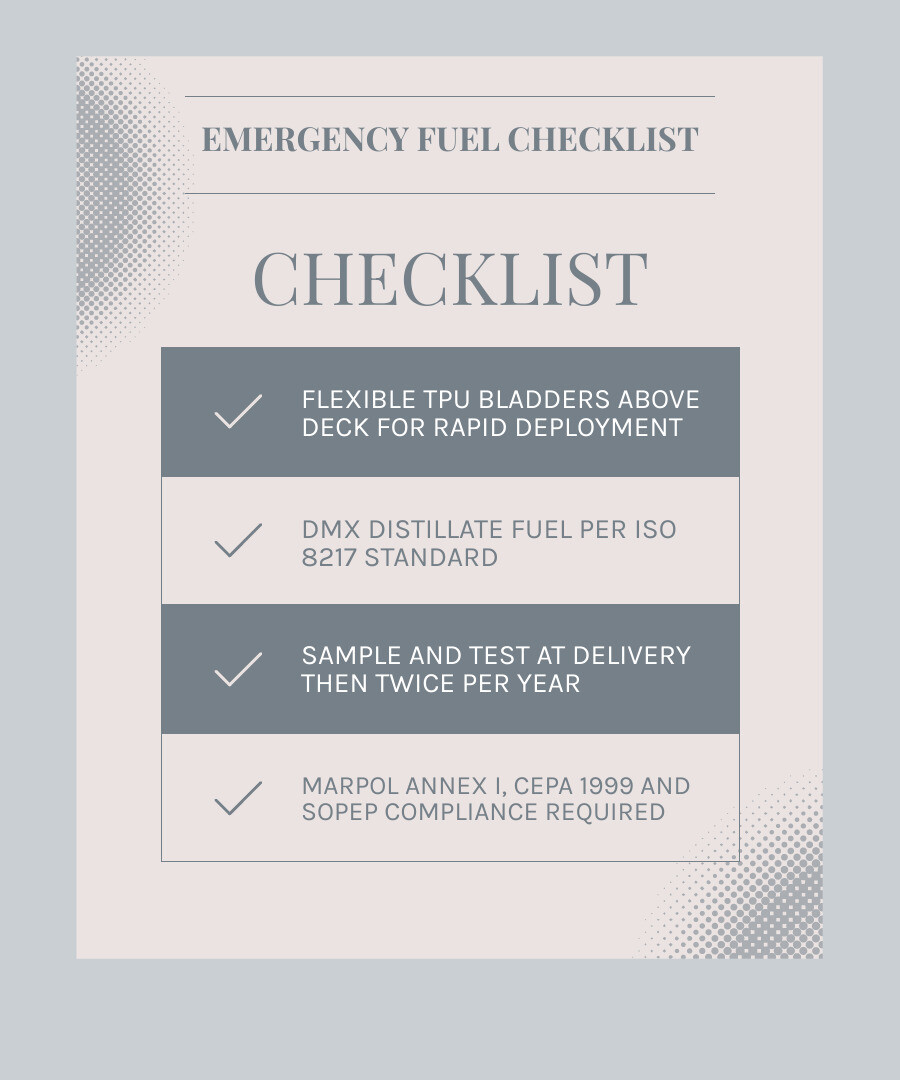
| Best storage type for temporary use | Flexible TPU or mil-spec fabric bladder mounted above deck |
| Fuel grade for emergency equipment | DMX distillate (per ISO 8217) — not standard DMA |
| Minimum testing frequency | At delivery, then at least twice per year |
| Above or below deck? | Above deck — Coast Guard regulations prohibit in-hull bladder locations |
| Primary fire/explosion risk | Gasoline vapor accumulation in the bilge |
| Regulatory triggers | MARPOL Annex I, Small Vessel Regulations, CEPA 1999 storage tank rules |
Most operators run routine checks on their engines, navigation systems, and safety gear. But the fuel sitting in the emergency storage tank? It’s often overlooked — and that’s a serious problem.
Fuel test providers report that they receive very few samples from emergency equipment storage tanks. When those samples are tested, the results frequently show the fuel is not fit for its intended use. That’s not a minor administrative gap. In a genuine emergency, it can be the difference between a controlled evacuation and a catastrophic failure.
There’s also the question of how backup fuel is stored. Permanent rigid tank retrofits are expensive, consume deck space permanently, and create weight distribution headaches. For many boat owners, yacht operators, and commercial marine crews, a flexible marine fuel bladder is a far more practical solution — deployable when needed, stowed flat when not.
This guide covers the full picture: regulations, storage materials, safety risks, fuel quality management, and how to choose the right backup fuel system for your vessel and operation.
Know your emergency marine fuel storage terms:
Regulatory Frameworks and Standards for Emergency Marine Fuel Storage
Operating a vessel or marine facility in 2026 requires navigating a complex web of international, national, and local environmental and safety standards. When dealing with auxiliary or emergency marine fuel storage, compliance is not optional. It directly impacts your vessel’s certification, insurance coverage, and liability.
Small Vessel Regulations and Fuel System Integrity
Under national standards such as the Canadian Small Vessel Regulations, fuel systems must meet rigid construction and safety requirements to prevent leaks and mitigate fire hazards. For vessels over 6 meters in length, stability and structural integrity are paramount. Any auxiliary fuel storage must not compromise the vessel’s buoyancy or stability.
These regulations dictate that:
- Fixed fuel tanks must be certified, permanently marked, and pressure-tested.
- All flexible hoses used in fuel transfer must be specifically marked or tagged for marine fuel compatibility.
- No component of the fuel system may permit leakage, and proper ventilation must be maintained to clear hazardous vapors.
Environmental Protection and Storage Tank Regulations
For shore-based marine fueling facilities, ports, or vessels operating under federal jurisdictions, environmental protection acts like the Canadian Environmental Protection Act (CEPA 1999) enforce strict guidelines.
A historical perspective highlights the necessity of these rules: around 15% of storage tank systems under federal jurisdiction in Canada in 2008 were more than 20 years old, lacking leak detection, corrosion protection, or secondary containment structures. Modern regulations have eliminated these gaps by requiring:
- Secondary Containment: Double-walled construction or physical containment areas capable of holding potential releases.
- Leak Detection: Continuous monitoring, sumps, and precision leak testing.
- Emergency Planning: A comprehensive, written emergency response plan must be active before the first product transfer. This plan must detail site characteristics, emergency team training, response equipment, and public notification protocols.
For more details on managing compliance in sensitive areas, refer to the Marine Fuel Storage Management – National Park Service guidelines and explore The Ultimate Guide to Marine Emergency Fuel Supply Systems.
MARPOL Annex I and SOPEP Compliance
For larger commercial vessels and yachts, international maritime law is governed by the International Maritime Organization (IMO) through MARPOL.
Specifically, MARPOL 73/78 Annex I, Regulation 37 requires every oil tanker of 150 gross tonnage (GT) and above, and every other ship of 400 GT and above, to carry an approved Shipboard Oil Pollution Emergency Plan (SOPEP). If your vessel falls into this category, any auxiliary or emergency fuel storage system must be integrated into your SOPEP, ensuring that spill kits, containment protocols, and reporting procedures are fully aligned.
Evaluating Auxiliary Fuel Solutions: Why Flexible TPU Bladders Outperform Rigid Retrofits
When operators realize they need additional fuel capacity for offshore range extension or emergency reserves, they face a choice: retrofit permanent rigid tanks or utilize temporary flexible fuel bladders.
The Drawbacks of Permanent Rigid Retrofits
Adding permanent steel or aluminum tanks to an existing vessel is a major undertaking.
- High Installation Costs: Retrofitting requires dry-docking, structural modifications, cutting into bulkheads, and extensive welding.
- Permanent Loss of Deck Space: Once installed, rigid tanks permanently occupy valuable deck or cabin space, even when empty.
- Weight Distribution and Trim Issues: Permanent tanks add significant deadweight. When empty, they still alter the vessel’s center of gravity. When partially filled, they can introduce dangerous free-surface effects if not heavily baffled.
The Advantages of Temporary TPU Bladders
Flexible Thermoplastic Polyurethane (TPU) bladders offer a dynamic, high-performance alternative. They conform to the available deck space, require no permanent structural modifications, and can be completely decommissioned and rolled up when not in use.
| Operational Factor | Permanent Rigid Retrofits (Steel/Aluminum) | Temporary TPU Bladders |
|---|---|---|
| Installation Cost | High (requires shipyard labor and structural changes) | Low (no permanent modifications required) |
| Deck Footprint | Permanent; cannot be reclaimed when empty | Temporary; collapses flat and rolls up for storage |
| Weight Impact | Adds continuous deadweight to the vessel | Adds weight only when filled with fuel |
| Deployment Speed | Weeks or months of planning and shipyard work | Rapid deployment; ready in minutes |
| Customization | Difficult and expensive to modify | Easily custom-sized to fit specific deck layouts |
For offshore operators planning extended voyages, choosing the right system is critical. Learn more by reading about the Best Marine Fuel Bladder Tank Options for Offshore Trips.
Material Selection for Emergency Marine Fuel Storage
The material of your emergency storage system determines its durability and safety. High-strength TPU is the gold standard for flexible marine fuel storage.
- Durability and Tensile Strength: Premium bladders are constructed from military-specification, 50-mil thick, 40 oz/sq yd coated fabric. Seams are radio-frequency (RF) welded and reinforced with tape to prevent failure under pressure.
- Fuel Compatibility: The inner polyurethane layer must be chemically compatible with the stored fuel. While some materials are limited to diesel, high-grade TPU bladders offer compatibility with both gasoline and diesel fuel.
- Environmental Resistance: Marine environments expose storage systems to intense UV radiation, saltwater, and extreme temperatures. High-grade bladders feature advanced UV inhibitors and hydrolysis stabilizers to prevent material degradation.
- Stability Features: To prevent fuel sloshing in rough seas, larger bladders can be ordered in baffled configurations, which restrict internal fluid movement and maintain vessel stability.
To understand the handling characteristics of large-scale flexible containers, consult The Big Guide to Large Fuel Bladder Safety and Handling.
Temporary and Mobile Systems in Emergency Marine Fuel Storage
For commercial harbors, remote fueling stations, or large offshore vessels, temporary fuel storage can scale beyond deck-mounted bladders.
- Containerized Fuel Systems: These systems integrate steel storage tanks or high-capacity collapsible bladders inside standard 20-foot ISO containers. For example, some modular setups house multiple bladders inside a single ISO container, yielding up to a 15,000-gallon capacity. These systems comply with ISO shipping standards, allowing them to be transported via standard cargo ships, flatbed trucks, or placed directly on docks without requiring permanent foundations.
- Mobile Steel Tanks: Double-walled steel tanks integrated into containerized frames (built to EN 12285-2 standards) offer plug-and-play fueling. Standard equipment often includes GSM-enabled leak detection, overfill prevention, explosion-proof pumping equipment, and motion-activated LED lighting.
These modular, rapidly deployable systems are ideal for disaster relief, remote construction, or temporary harbor operations. Discover how these systems are deployed for Temporary Fuel Storage and review the technical specifications of containerized systems in the DIESEL TANK specification sheet.
Safety Risks, Mitigation, and Spill Response Procedures
Handling fuel on the water carries inherent risks. A single spark or minor leak can escalate into a severe emergency.
The Threat of Gasoline Vapors
Gasoline and gasoline fumes are the primary cause of boat fires and explosions. Because gasoline vapors are heavier than air, they sink and accumulate in the lowest parts of the vessel, typically the bilge.
To mitigate this risk:
- Never Fill Bladders Below Deck: U.S. Coast Guard regulations prohibit the installation of flexible fuel bladders in below-deck compartments. They must always be secured on an open deck where vapors can naturally dissipate.
- Grounding Against Static: When transferring fuel, static electricity can build up. Always maintain physical contact between the fuel nozzle and the fill pipe to ground the system before starting the transfer.
- Post-Fueling Ventilation: After transferring fuel, wipe up any spills immediately. If your vessel uses an inboard gasoline engine, run the bilge blower for at least four minutes and sniff the bilge for fumes before starting the engine.
For comprehensive docking safety, refer to the FUEL DOCK SAFETY BEST PRACTICES – Maricorp and read the guidelines on NYMPP: Section 4 – Fueling – NY Sea Grant .
Spill Containment and Response
Under MARPOL and national environmental laws, any oil or fuel spill must be addressed immediately. Vessels must carry appropriate spill response gear.
- SOPEP Spill Kits: A standard SOPEP-compliant spill kit (such as a 7-barrel / 1100-liter marine kit) is designed to contain and clean up oil-based spills on the water. These kits contain:
- Oil-Only Absorbent Pads and Rolls: Hydrophobic materials that absorb fuel while repelling water.
- Marine Booms: Floating barriers used to surround and contain a spill on the water’s surface.
- Absorbent Pillows: For high-capacity absorption in tight spaces like bilges or sumps.
- Personal Protective Equipment (PPE): Gloves, goggles, and disposal bags.
If a spill occurs, deploy containment booms immediately to prevent the fuel from spreading, use absorbent pads to recover the fuel, and notify the appropriate maritime environmental authority. For details on compliant spill response setups, view the SPILL STATION, SOPEP 7 BARREL OIL / FUEL MARINE SPILL KIT product page.
If your vessel suffers a mechanical failure or fuel system emergency at sea, be prepared by reading What to Do If Your Boat Breaks Down Out in the Ocean.
Fuel Quality Management and Maintenance Protocols
Stored fuel degrades over time. For emergency equipment, using degraded fuel can lead to filter clogging, power loss, or complete engine failure when you need it most.
Distillate Fuel Specifications: DMA vs. DMX
The ISO 8217 standard defines the specifications for marine distillate fuels. The two most common grades considered for auxiliary or emergency use are DMA and DMX.
- DMA Grade: This is the standard marine distillate fuel. While suitable for active, high-turnover fuel systems, DMA lacks the strict cold-flow and stability specifications required for long-term emergency storage.
- DMX Grade: This grade is specifically formulated for emergency equipment (such as lifeboat engines and emergency generators). It features excellent long-term storage stability and strict cold-flow properties, including a defined Cloud Point specification.
Understanding Cloud Point and Pour Point
As fuel cools, paraffin wax begins to precipitate out of the liquid.
- Cloud Point: The temperature at which wax crystals first become visible. These crystals can quickly clog fuel filters, starving the engine of fuel.
- Pour Point: The lowest temperature at which the fuel continues to flow.
Because emergency equipment is often exposed to extreme cold (such as in North Atlantic winter operations), utilizing DMX grade fuel ensures that the fuel remains fluid and filterable, preventing engine failure during a cold-weather emergency.
Fuel Maintenance Best Practices
To ensure your backup fuel remains fit for purpose:
- Regular Fuel Polishing: Implement a fuel polishing system to continuously filter out water, particulates, and microbial growth from your storage tanks.
- Additives: Utilize high-quality fuel stabilizers and biocides to prevent oxidation and bacterial contamination in short-term or seasonal storage.
- Load Testing: Regularly run emergency generators and engines under actual load — not just idle — to consume older fuel and verify system integrity.
For design standards on emergency fueling infrastructure, consult the Recommended Practices for the Design and Installation of Fueling Systems for Emergency Generators, Stationary Diesel Engines and Oil Burner Systems . For operational advice on preventing fuel spoilage, read Don’t Let It Go Stale: A Guide to Short-Term Fuel Storage.
Frequently Asked Questions about Marine Fuel Safety
What is the recommended fuel grade for emergency marine equipment?
The DMX grade (per ISO 8217) is highly recommended for emergency marine equipment. Unlike standard DMA grades, DMX is specifically designed for long-term storage and features superior cold-flow properties (including a strict Cloud Point specification) to prevent filter clogging in cold climates.
Can flexible fuel bladders be mounted below deck on commercial vessels?
No. Coast Guard and marine construction regulations strictly prohibit mounting flexible fuel bladders in below-deck or in-hull locations. They must be securely lashed above deck on an open area where any potential fuel vapors can safely vent into the atmosphere rather than accumulating in the bilge.
How often should emergency marine fuel be sampled and tested?
Emergency marine fuel should be sampled and tested upon delivery and at least twice per year thereafter. Regular testing identifies water contamination, microbial growth, and fuel degradation before the fuel is introduced to emergency engines.
Conclusion
Managing emergency marine fuel storage is a critical operational requirement for serious mariners, commercial operators, and fleet managers. Neglecting fuel quality, ignoring regulatory standards, or using inadequate storage containers can have severe consequences when emergency power or range extension is needed.
For operators seeking a reliable, space-saving, and highly durable alternative to permanent rigid tanks, Techno Tanks manufactures premium, flexible TPU fuel bladders and collapsible fuel storage systems. Engineered to military-grade specifications, these systems are compatible with both gasoline and diesel, and are available in capacities ranging from 30 to 3,000 gallons.
Because every vessel, regulatory profile, and operational environment is unique, Techno Tanks fuel bladder pricing depends on size, configuration, fuel type, and custom requirements.
To secure your vessel’s range and operational readiness, visit the Techno Tanks Marine Fuel Bladders page, explore the custom fuel bladders options, or use the fuel bladder sizing guide to find the perfect fit. When you are ready to discuss your project scope, request a personalized quote to get precise fuel bladder pricing for your specific application.

