
Why Marine Fuel Safety Is Critical for Every Operator and Decision-Maker
Marine fuel safety is the set of protocols, engineering controls, and operational practices that protect crew, vessels, cargo, and the environment from the hazards of storing, transferring, and using fuel at sea.
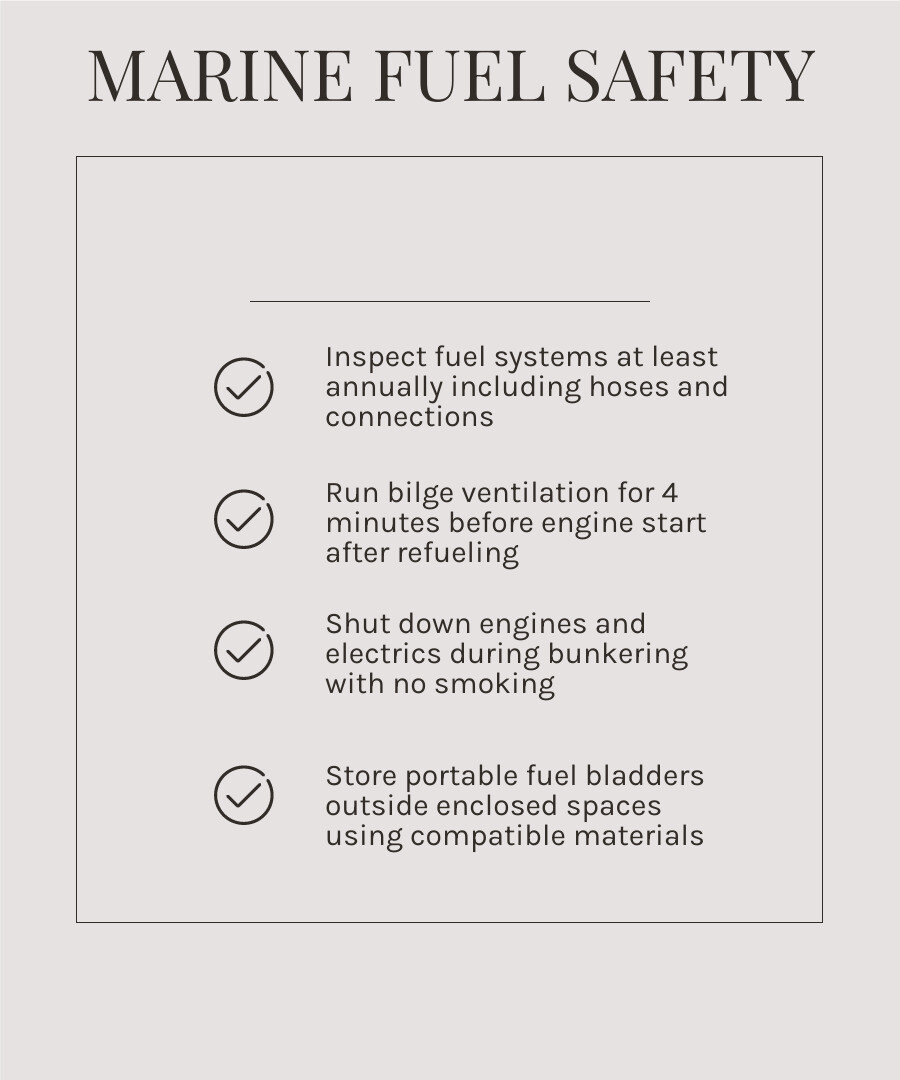
Here is a quick summary of what you need to know:
| Safety Area | Key Requirement |
|---|---|
| Fuel system inspection | At least annually; check hoses, connections, filters, and tanks |
| Bilge ventilation | Run blower for at least 4 minutes before engine start after refueling |
| Bunkering protocols | Shut down engines and electrics; no smoking; stay at pump |
| Portable/flexible fuel storage | Never store in enclosed spaces; use compatible materials |
| Spill and leak response | Isolate source; ventilate; use PPE; follow SOPEP procedures |
| Alternative fuels (ammonia) | Toxicity is the primary hazard; specialized training and barriers required |
| Documentation | MSDS, BDN, and fuel records must be maintained and accessible onboard |
Every year, boat fires and explosions injure hundreds of people and cause millions of dollars in property damage. That figure does not account for the broader operational and environmental costs of fuel incidents at sea — spills, equipment failures, and contamination events that disrupt commercial operations and trigger regulatory scrutiny.
The stakes are rising. The maritime industry is in the middle of a significant fuel transition. Conventional distillates like marine gasoil (MGO) and diesel carry their own well-documented hazards — flash points, hydrogen sulphide risks, and quality control challenges. At the same time, next-generation fuels like ammonia and LNG are introducing entirely new hazard profiles that demand updated engineering, training, and regulatory frameworks.
For operators who rely on flexible fuel bladders and collapsible fuel storage systems for auxiliary capacity, range extension, or temporary fuel transfer, understanding the full picture of marine fuel safety is not optional — it is a core operational responsibility.
This guide covers the complete landscape: from conventional fuel handling and bunkering best practices, to alternative fuel risks, to how flexible fuel bladders fit safely into a broader marine fuel safety system.
Simple marine fuel safety glossary:
The Evolution of Marine Fuel Storage: Conventional vs. Alternative Fuels
Decarbonization is no longer a distant line item on a corporate agenda; it is actively reshaping the global fleet. As the shipping industry works to meet strict greenhouse gas reduction targets, the transition from conventional petroleum-based distillates to low- and zero-carbon alternatives is accelerating.
As of June 2026, the alternative fuel landscape is rapidly maturing. While liquefied natural gas (LNG) has served as the primary transitional fuel for several years, ammonia ($NH_3$) has emerged as one of the most promising zero-carbon pathways for mid- to long-term operations. However, this transition requires a fundamental shift in how we approach marine fuel safety.
Conventional fuels present risks that are primarily managed through fire prevention and spill containment. In contrast, alternative fuels introduce complex chemical hazards. Ammonia, for example, is highly toxic to human life and aquatic ecosystems at very low concentrations. LNG, while less toxic, must be stored under extreme cryogenic conditions and carries severe flammability and explosion risks if leaked into enclosed spaces.
Engineers and operators can no longer rely on traditional structural barriers alone. They must design and manage systems that account for the unique molecular behavior, material compatibility, and environmental impacts of these new energy sources.
Ammonia vs. LNG: Primary Safety Hazards in Next-Generation Propulsion
When comparing ammonia to LNG, the physical and chemical differences dictate completely different risk mitigation strategies:
- Boiling Temperature: Ammonia boils at -33°C, whereas methane (the primary component of LNG) requires cryogenic storage at -162°C. While ammonia is easier to liquefy under moderate pressure or mild refrigeration, a liquid release at ambient temperature will flash rapidly into a toxic gas cloud.
- Flammability and Ignition: Methane has a flammability range of 5.3% to 17% in air and a very low minimum ignition energy of 0.27 mJ, making it highly susceptible to spark ignition. Ammonia is much harder to ignite, with a flammability range of 15% to 28% and a high minimum ignition energy of 40 to 170 mJ. However, in enclosed shipboard spaces where oxygen is present, ammonia still poses a significant combustion risk.
- Expansion Ratio: Liquid ammonia expands 850 times its volume when vaporizing, compared to 600 times for LNG. This high expansion ratio means even a small liquid leak can rapidly overwhelm physical containment and ventilation systems.
- Toxicity: This is the critical differentiator. While LNG is an asphyxiant in high concentrations, ammonia is an active toxin. It is highly corrosive to skin, eyes, and respiratory tracts. It is also classified as acutely toxic to marine life with long-lasting ecological effects.
- Material Compatibility: Ammonia is highly corrosive to copper, zinc, brass, and industrial alloys. It also causes stress corrosion cracking (SCC) in high-strength carbon steels, requiring specialized nickel-steel alloys or stress-relieved containment tanks.
Regulatory Frameworks and Gaps in Alternative Marine Fuel Safety
The rapid commercial interest in alternative fuels has outpaced the development of international regulatory frameworks.
Currently, the International Convention for the Safety of Life at Sea (SOLAS) and the International Code of Safety for Ships Using Gases or Other Low-flashpoint Fuels (IGF Code) serve as the regulatory baselines. However, the IGF Code’s Part A-1 provisions were specifically written for natural gas (methane). Because ammonia is a toxic gas with a higher flashpoint, it does not fit neatly into these existing rules.
To bridge this gap, the International Maritime Organization (IMO) Sub-Committee on Carriage of Cargoes and Containers (CCC 10) recently finalized interim guidelines for the safety of ammonia-fueled vessels. Under current frameworks, ship owners must seek “alternative design approval” from flag states and classification societies to prove their designs achieve an equivalent level of safety.
Industry bodies like the International Association of Classification Societies (IACS) are actively developing Unified Requirements to standardize the control of ammonia releases. Port authorities are also stepping up; the Maritime and Port Authority of Singapore (MPA) has released shipping circulars and initiated feasibility studies to establish standardized, safe bunkering protocols before wide-scale commercial adoption.
Engineering and Operational Risk Mitigation for Marine Fuel Safety
To safely handle highly hazardous alternative fuels onboard, marine engineers employ a “defense-in-depth” strategy. This approach relies on physical separation, redundant barriers, and automated systems to contain hazards at their source.
The core design principle is the double-barrier philosophy, adapted from LNG systems. Any pipe carrying liquid ammonia or high-pressure gas through a ship’s interior must be enclosed within a secondary containment outer pipe or duct. If the primary fuel line fails, the secondary barrier contains the leak and vents the gas to a safe location, preventing toxic vapors from entering machinery spaces or crew accommodations.
Additionally, automated isolation systems are critical. High-speed, fail-safe shutdown valves are integrated throughout the fuel supply system. Linked directly to gas detection arrays, these valves automatically isolate fuel tanks and purge lines with inert nitrogen gas the moment a leak is detected.
Technical Design Solutions: Ventilation, Containment, and Leak Detection
Mitigating alternative fuel hazards on a vessel requires highly specialized technical systems:
- Advanced Ventilation: Mechanical ventilation systems in fuel preparation rooms must operate at high air-change rates. However, ventilation alone is not enough. If ammonia gas is vented against the surrounding wind or ventilation flow, it can envelop the vessel’s decks. Ventilation must be dynamically managed based on real-time wind and atmospheric data.
- Acoustic Cameras and Infrared Gas Detectors: Traditional point-type gas detectors can take too long to register a leak if air currents pull the gas away from the sensor. Modern vessels use acoustic cameras to visually map the high-frequency sound of a pressurized leak in real time, alongside open-path infrared detectors that cover entire compartments.
- Water Spray and Absorption Systems: Water spray systems can dissolve ammonia gas out of the air, knocking down toxic vapor plumes. However, water must never be applied directly to a pool of liquid ammonia, as this triggers a violent reaction that accelerates evaporation.
- Inherently Safer Ship Designs: Modern designs place fuel storage tanks and preparation spaces on open decks or in well-segregated aft compartments, minimizing the risk of toxic gas migrating into crew quarters or main engine rooms.
Risk Assessment Methodologies: HAZID Studies and CFD Simulations
Before a new vessel design or fuel storage system is approved, it must undergo rigorous qualitative and quantitative risk assessments.
HAZID (Hazard Identification) workshops bring together ship designers, operators, classification societies, and equipment manufacturers. These sessions systematically review every component of the fuel system—from bunkering connections to the engine manifold—to identify potential failure modes, such as material degradation, thermal stress, operator error, or vessel motion.
To quantify these risks, engineers use Computational Fluid Dynamics (CFD) simulations. CFD models simulate realistic leakage scenarios in various weather conditions. For example, simulations of a ship-to-ship bunkering operation can show how an ammonia vapor plume behaves, predicting exactly how quickly a leak would cover the deck or drift toward nearby vessels. These simulations are critical for optimizing the placement of gas detectors, emergency ventilation exhaust, and crew evacuation routes.
Safe Handling and Bunkering Protocols for Marine Fuels
Bunkering—the transfer of fuel from a supply source to a vessel—is historically one of the most high-risk operations in maritime transport. Whether transferring conventional distillates or alternative fuels, bunkering requires strict operational discipline.
These operations occur in three primary configurations: ship-to-ship (STS), truck-to-ship (TTS), and terminal-to-ship. Each configuration presents unique challenges. Ship-to-ship transfers require careful mooring and fender management to prevent relative motion from damaging fuel lines. Truck-to-ship transfers, common in smaller commercial operations, require strict exclusion zones and traffic control in busy port areas.
The primary risk during any bunkering operation is the sudden release of fuel due to hose failure, coupling leaks, or unexpected vessel movement. To prevent this, operators must perform a joint risk assessment and establish a clear Simultaneous Operations (SIMOPS) protocol before commencing. SIMOPS guidelines define which shipboard activities must be suspended during fuel transfer to eliminate ignition sources and prevent crew distractions.
Managing Conventional Distillates: Marine Gasoil (MGO) and Diesel Safety
While alternative fuels dominate the headlines, conventional Marine Gasoil (MGO) and marine diesel remain the workhorses of the global fleet. Managing these fuels safely requires strict adherence to international standards.
A critical safety parameter for conventional distillates is the flash point. Under SOLAS regulations, the minimum flash point for fuels used in machinery spaces is 60°C. However, low-quality or contaminated fuels can sometimes fall below this limit, significantly increasing fire risks. Operators must verify the flash point on the Bunker Delivery Note (BDN) and refer to the supplier’s Safety Data Sheet: Marine Gasoil (MGO) before loading.
Another hidden hazard of conventional distillates is Hydrogen Sulphide ($H_2S$). Over time, $H2S$ gas can accumulate in the headspace of storage tanks and fuel bladders. This gas is highly toxic, flammable, and can rapidly desensitize a person’s sense of smell, leading to fatal exposure in enclosed spaces. Crews must test tank atmospheres for $H2S$ and oxygen levels before opening any access hatches or entering storage compartments.
For vessels carrying auxiliary fuel, utilizing dedicated diesel fuel bladders provides a safe, flexible, and space-saving storage solution, provided the system is integrated using high-quality fittings and proper venting.
To prevent fuel contamination and ensure compliance with regional environmental standards, operators must also refer to the Joint Industry Guidance on 0.50%-Sulphur Fuel when switching between fuel grades or operating within Emission Control Areas (ECAs).
Offshore Fuel Transfer and Quality Control Best Practices
Offshore supply vessels (OSVs) operating in harsh environments like the North Sea face extreme conditions during fuel transfers. Maintaining fuel quality is not just an efficiency concern; it is a critical safety factor. If contaminated fuel causes a sudden loss of power while a vessel is positioned next to an offshore platform, the consequences can be catastrophic.
To mitigate these risks, operators follow the comprehensive standards outlined in Delivering Quality Bulk Marine Gasoil to Offshore Installations. Key best practices include:
- Water Management: Storage tanks must be dipped for water content at least monthly and immediately after every delivery. Any detected water must be stripped out right away to prevent microbiological growth.
- Microbiological Testing: Fuel tanks should undergo quarterly testing for microbial contamination. Biocide treatments should only be used as a corrective measure after a confirmed contamination event, not as routine prevention.
- Fuel Rotation: To prevent fuel from degrading or forming wax crystals in cold weather, vessels should follow a strict “oldest stock first” rotation policy. Fuel should not be kept onboard for more than 30 days without re-testing.
- Hose Integrity: Transfer hoses must be dedicated to specific fuel types, pressure-tested annually, and kept capped when not in use to prevent dirt and water ingress.
Integrating Flexible Fuel Bladders into Marine Fuel Safety Systems
When permanent rigid tanks are impractical or insufficient, flexible fuel bladders and collapsible fuel storage systems offer a reliable way to extend range, carry auxiliary fuel, or manage temporary fuel transfers. However, integrating a flexible bladder into a vessel’s fuel system requires the same engineering rigor as any permanent installation.
Unlike rigid steel or aluminum tanks, flexible bladders change shape as they are filled or emptied. This dynamic behavior must be carefully managed to prevent movement, abrasion, or stress on fuel lines during heavy seas. When deployed correctly, a high-quality flexible fuel bladder integrates seamlessly into a vessel’s existing safety systems, providing a secure, space-saving alternative for serious commercial and offshore operations.

Material Compatibility and Sizing for Temporary Fuel Storage
The foundation of flexible fuel bladder safety is material science. Bladders must be constructed from advanced Thermoplastic Polyurethane (TPU) elastomer coatings that are chemically compatible with the specific fuel they will hold.
Using a bladder designed for diesel to store gasoline, or vice versa, can lead to rapid material degradation, delamination, and catastrophic failure. Serious operators should consult a comprehensive resource like The Complete Guide to Marine Bladder Tanks and Storage to understand how different elastomer formulations interact with various fuel types and additives.
Sizing is another critical safety factor. Overfilling a bladder beyond its rated capacity can stress the seams, while underfilling can cause the fuel to slosh excessively, shifting the vessel’s center of gravity. Techno Tanks manufactures custom fuel bladders ranging from 30 to 3,000 gallons, allowing operators to match the bladder’s dimensions precisely to the available deck space or hold.
Understanding the structural and operational trade-offs between rigid and flexible systems is essential; a detailed breakdown can be found in our comparison of a fuel bladder vs fuel tank. For extended blue-water transits, utilizing specialized collapsible marine fuel tanks for extended offshore trips ensures you have the necessary range without permanently sacrificing valuable deck space.
Operational Safety: Deployment, Transfer, and Connection Protocols
Safely operating a flexible fuel bladder requires strict adherence to practical handling procedures:
- Deck Preparation: The deployment area must be completely cleared of sharp edges, weld splatter, and debris. A heavy-duty ground cloth or protective containment bund should always be laid down first to prevent abrasion against the deck.
- Secure Tie-Downs: A flexible bladder must never be allowed to slide. High-strength, marine-grade ratchet straps must be secured to structural deck eyes, utilizing the bladder’s integrated tie-down d-rings. The harness system must accommodate the bladder’s changing shape as fuel is drawn down.
- No-Leak Connections: Standard hose clamps are a common failure point. Operators should utilize specialized, leak-free marine fuel tank quick disconnects and fuel line quick connect adapters to establish secure, dry-break connections that prevent drips during connection and disconnection.
- Static Grounding: Flowing fuel generates static electricity. The bladder’s metal fittings, transfer pump, and the vessel’s hull must be properly bonded and grounded to a common point before any fuel transfer begins.
- Venting and Air Elimination: Air must be purged from the bladder during the initial fill to prevent vapor locks and minimize fuel oxidation.
For step-by-step operational instructions on executing these transfers safely, operators should refer to the technical guide on how to transfer fuel from a fuel bladder. To ensure the system remains reliable over years of service, implement the maintenance protocols outlined in how to extend fuel bladder lifespan with 5 easy changes.
Human Factors, Crew Training, and Emergency Response
Even the most advanced engineering controls and double-barrier systems can be compromised by human error. In marine fuel safety, the human element is often the final and most critical line of defense.
As ships adopt more complex fuel systems, crew competence must evolve alongside the technology. This is especially true for alternative fuels like ammonia, where an operator has only seconds to react to a leak before the atmosphere becomes life-threatening. Safety culture must move away from reactive compliance and toward proactive hazard management, where every crew member is fully aware of the chemical properties and physical behaviors of the fuels onboard.
Bridging the Competence Gap: Crew Training and Chemical Sector Lessons
The maritime industry does not need to reinvent the wheel to manage alternative fuel risks. The land-based chemical sector has safely manufactured, stored, and transported ammonia at scale for nearly a century.
Industrial leaders like Yara Clean Ammonia, which manages a massive global distribution network, provide valuable blueprints for safety management. The maritime sector can adapt these established land-based standards—such as strict isolation protocols, continuous line monitoring, and specialized personal protective equipment (PPE)—for shipboard use.
To standardize this knowledge, classification societies have introduced new guidelines, such as DNV-RP-0699 (“Competence related to the use of ammonia as a fuel”). This recommended practice provides a structured training framework for crew members, ensuring they understand the unique hazard profile of alternative fuels.
Interestingly, seafarer perception is shifting. Recent maritime surveys indicate that over half (58.6%) of respondents are willing to sail on or work with ammonia-fueled vessels, while 24% remain unsure and 12% would not be willing. This highlights the critical role of training: building crew confidence through structured education is the key to successfully adopting next-generation fuels.
Optimizing Emergency Response Plans for Marine Fuel Safety Incidents
When a fuel incident occurs at sea, there is no time to read a manual. Emergency response plans must be optimized, rehearsed, and embedded into the ship’s daily operations.
For ammonia, these plans must be designed around strict toxicity thresholds:
| Ammonia Concentration (ppm) | Exposure Limit / Health Effect | Required Action / PPE |
|---|---|---|
| 5 – 50 ppm | Odor threshold; mild irritation begins | Monitor area; identify source |
| 20 ppm | Occupational exposure limit (8 hours) | Limit exposure; use standard PPE |
| 50 ppm | Short-term exposure limit (15 minutes) | Evacuate non-essential crew |
| 300 ppm | Immediately Dangerous to Life or Health (IDLH) | SCBA required; initiate emergency shutdown |
| 2,700 ppm | AEGL-3 (Life-threatening within 10 minutes) | Immediate evacuation to safe haven |
Optimizing emergency plans requires simulating realistic release scenarios. Crew members must regularly practice donning Self-Contained Breathing Apparatus (SCBA) and evacuating to designated “safe havens”—enclosed, over-pressurized compartments equipped with independent air filtration systems.
For conventional fuel systems, emergency plans should also focus on maintaining propulsion. Having a dedicated marine emergency fuel supply system can make the difference between safely navigating a crisis and being left adrift during an engine room emergency.
Frequently Asked Questions about Fuel Storage and Handling
What are the primary safety hazards of ammonia compared to conventional marine fuels?
Ammonia’s primary hazard is its extreme toxicity to humans and marine life at very low concentrations. Unlike conventional fuels like diesel or marine gasoil, which are primarily flammability hazards, ammonia can be immediately dangerous to life or health (IDLH) at just 300 ppm. While ammonia is much harder to ignite than conventional fuels or LNG, it is highly corrosive to copper, brass, and zinc, and can cause stress corrosion cracking in carbon steel.
How do flexible fuel bladders comply with marine fuel safety standards?
Flexible fuel bladders comply with safety standards by utilizing advanced, fuel-specific Thermoplastic Polyurethane (TPU) materials that offer complete chemical compatibility with gasoline or diesel. When integrated into a vessel’s safety system, they must be deployed with heavy-duty containment bunds, secure multi-point tie-down harnesses to prevent movement in heavy seas, static grounding connections, and leak-free quick-disconnect fittings.
What emergency protocols should be in place for marine fuel leaks?
For conventional fuel leaks, the protocol is to immediately isolate the fuel source, shut down nearby electrical systems to eliminate ignition sources, run bilge ventilation for at least four minutes, and apply absorbent materials. For toxic alternative fuels like ammonia, the protocol requires immediate activation of automated shutdown valves, donning SCBA gear, utilizing water sprays to knock down vapor clouds, and evacuating crew to over-pressurized safe havens.
Conclusion
As the maritime industry navigates a complex transition toward a zero-carbon future, the core principles of marine fuel safety remain unchanged: rigorous engineering, strict operational protocols, and continuous crew training. Whether your vessel is running on conventional marine gasoil or preparing for next-generation alternative fuels like ammonia, managing your fuel storage with high-quality, reliable equipment is critical to protecting your crew and your investment.
For operators requiring auxiliary fuel capacity, temporary fuel transfer systems, or custom range-extension solutions, Techno Tanks manufactures high-performance flexible fuel bladders and collapsible fuel storage systems designed to meet the demanding conditions of marine and offshore operations. Built from heavy-duty, fuel-compatible TPU and available in sizes from 30 to 3,000 gallons, our solutions provide the flexibility you need without compromising on safety.
Every vessel has unique layout, capacity, and operational requirements. To ensure your temporary or auxiliary fuel storage system is engineered perfectly for your application, contact our technical team to discuss your project scope and request a custom quote.
Explore our dedicated Techno Tanks Marine Fuel Bladders page to find the ideal safe fuel solution for your next voyage.

