
Why Collapsible Marine Fuel Tanks Are the Smarter Choice for Extended Offshore Trips
Collapsible marine fuel tanks — also called fuel bladders or flexible fuel bladders — are portable, flexible containers engineered to store and transfer gasoline or diesel aboard vessels without permanent structural modification.
Here is a quick answer for operators evaluating this option:
- What they are: Flexible, foldable fuel storage containers made from fuel-resistant TPU-coated fabric
- Capacity range: Typically 30 to 300+ gallons for marine applications, with custom sizes available
- Where they are used: Secured above deck per U.S. Coast Guard guidelines — not in-hull
- Key advantage: When empty, they collapse flat and reclaim most of the storage space they occupied
- Fuel compatibility: Diesel or gasoline — not interchangeable in the same bladder due to material chemistry
- Who uses them: Offshore yacht operators, commercial fishing crews, expedition vessels, and emergency-response teams needing extended range or backup fuel capacity
Every serious offshore operator eventually confronts the same constraint: your vessel’s permanent tanks determine your range ceiling. Extending that ceiling traditionally meant major structural work — custom rigid tank fabrication, hull modifications, or permanent installation by a marine professional.
Flexible fuel bladders change that equation entirely.
A 150-gallon marine fuel bladder weighs approximately 34 lbs empty and folds down to fit inside a box roughly the size of a carry-on bag. Filled, it becomes a secured, load-bearing fuel reserve that can be tied down to deck fittings using D-ring anchor points — ready to extend your operational range without touching your vessel’s existing fuel system.
This guide covers everything an operator needs to evaluate, select, deploy, and maintain a collapsible fuel bladder for offshore use: materials, sizing, safety, regulatory compliance, and fuel compatibility.
Understanding Collapsible Marine Fuel Tanks and How They Work
At its core, a collapsible fuel bladder functions on a dynamic volume principle. Unlike traditional rigid tanks, which maintain their shape regardless of how much fuel they contain, a flexible bladder shrinks as fuel is discharged. This simple mechanical difference eliminates the need for internal air vents that introduce ambient moisture, salt spray, and condensation into the fuel supply.
When fuel is drawn from the bladder, the atmospheric pressure collapses the flexible walls around the remaining liquid. This action prevents the formation of fuel vapors and minimizes the risk of fuel degradation during long transits. For a deeper dive into how these systems integrate into a boat’s fuel architecture, consult The Complete Guide to Marine Bladder Tanks and Storage.
For offshore vessels, this technology provides a critical range-extension option. Instead of carrying heavy, rigid plastic drums or metal containers that remain bulky even when empty, operators can fold or roll the empty bladder and store it in a dry, vented locker. This reclaims up to 90% of the deck space previously occupied by the fuel reserve.
Comparing Permanent Onboard Rigid Tanks vs. Collapsible Auxiliary Bladders
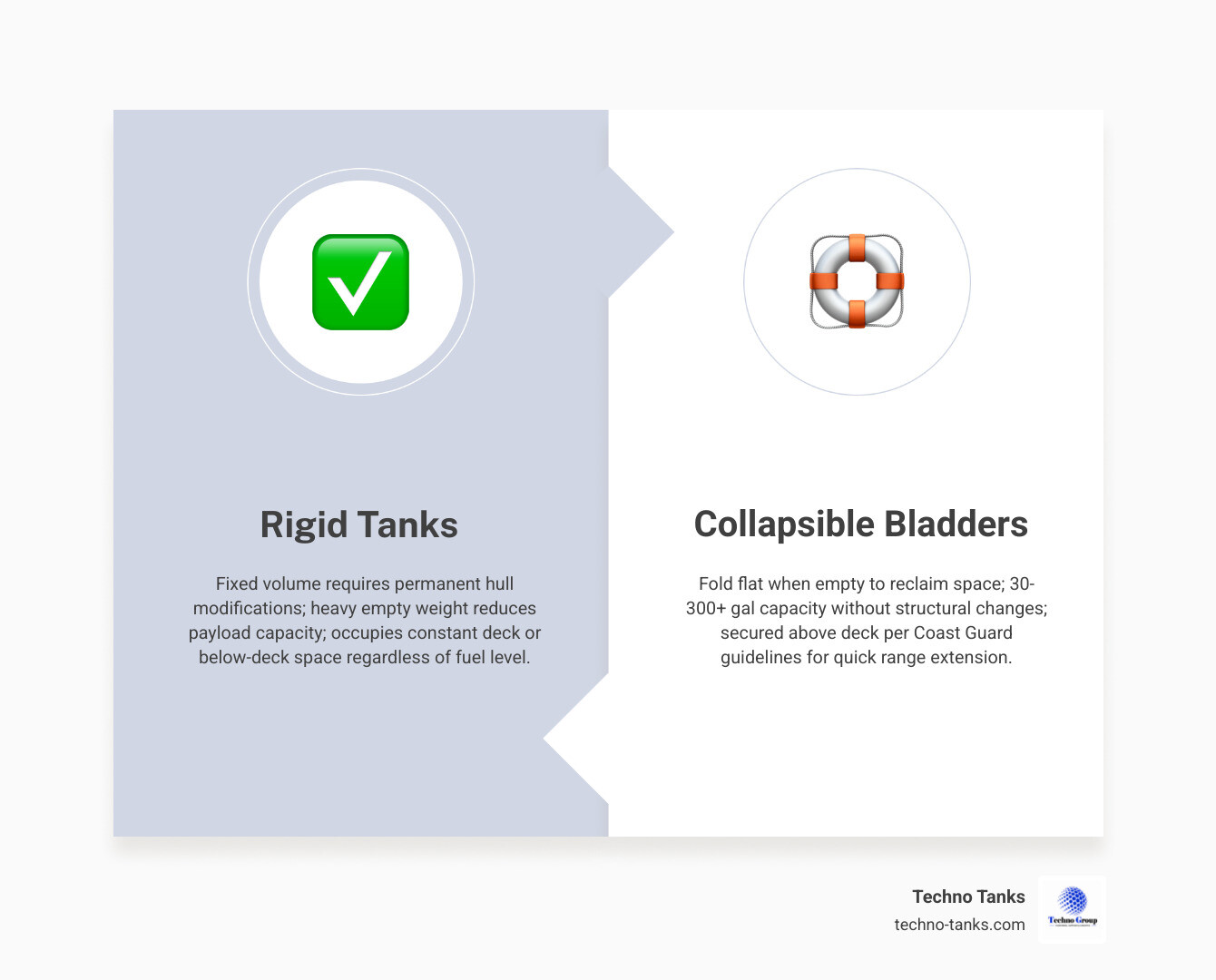
To understand the operational advantages of Collapsible Fuel Tanks, it is helpful to compare them directly to permanent rigid tank expansions and standard portable rigid tanks.
| Operational Feature | Permanent Rigid Tank Expansion | Standard Portable Rigid Tanks | Collapsible Auxiliary Bladders (Techno Tanks) |
|---|---|---|---|
| Structural Modification | High (Requires hull cutting, welding, or fiberglass work) | None | None |
| Empty Weight Impact | Permanent deadweight (adds to hull weight at all times) | Moderate (Rigid plastic/metal containers retain dry weight) | Low (Extremely lightweight; e.g., a 50-gallon model weighs ~30 lbs) |
| Space Recovery | 0% (Permanent loss of hull or storage space) | 0% (Empty drums/cans take up the same volume as full ones) | Up to 90% (Folds flat and stores in a small locker when empty) |
| Installation Complexity | Professional shipyard labor required | Simple (Tie-down strap or rack) | Simple (D-ring tie-downs to existing deck cleats) |
| Capacity Scalability | Fixed volume | Limited (Typically 1 to 50 gallons max per container) | High (Standard sizes from 30 to 300 gallons; custom up to 3,000 gallons) |
Standard portable rigid tanks are often limited in capacity and cumbersome to secure on deck. For a comprehensive comparison of portable options, see Everything You Need to Know About Portable Marine Tanks.
When comparing a Fuel Bladder vs Fuel Tank, the primary differentiator for offshore transits is payload optimization. Carrying permanent rigid tanks means hauling deadweight even on short, nearshore trips where maximum fuel capacity is unnecessary. A collapsible bladder allows operators to scale their fuel capacity on a trip-by-trip basis.
Material Engineering: TPU vs. PVC in Marine Environments
The durability of a collapsible marine fuel tank depends entirely on its material composition. In the marine industry, two primary materials are used: Thermoplastic Polyurethane (TPU) and Polyvinyl Chloride (PVC).
For professional marine and commercial applications, TPU is the industry standard. PVC-coated fabrics are often more cost-effective for occasional, short-term fluid storage, but they possess significant limitations in harsh marine environments. PVC can become stiff and brittle in cold temperatures, and it exhibits higher fuel permeability over time. Furthermore, UV exposure accelerates the degradation of PVC, leading to micro-cracking and a higher risk of structural failure.
In contrast, high-quality TPU fabric is engineered to withstand extreme environmental stress. It remains highly flexible across a wide temperature range (-30°C to +70°C) and features low fuel-permeability ratings. This ensures that fuel vapors do not escape through the fabric, preventing hazardous fume buildup on deck.
Modern TPU bladders are manufactured using Radio Frequency (RF) welding. This process uses electromagnetic energy to fuse the fabric layers at the molecular level, creating seams that are actually stronger than the parent material itself. This construction easily handles the physical stresses of offshore transits.

Chemical Compatibility of Collapsible Marine Fuel Tanks
A critical aspect of material engineering is chemical compatibility. TPU formulations must be precisely matched to the specific hydrocarbon chemistry of the fuel being stored:
- Polyester-based TPU: Highly resistant to diesel fuel, bio-diesel, and standard lubricants.
- Polyether-based TPU: Engineered specifically for gasoline, ethanol, and methanol blends.
Using the wrong TPU formulation can lead to catastrophic failure. For instance, storing gasoline in a polyester-based TPU bladder will cause the inner liner to dissolve over time, compromising the tank’s structural integrity and contaminating the fuel.
Operators must specify their intended fuel type prior to selecting a bladder. For custom range requirements, Get a Grip on Your Range with Custom Boat Fuel Bladders provides detailed guidance on matching material chemistry to your vessel’s propulsion system. For dedicated fuel types, you can also explore specialized Diesel Fuel Bladders or Gasoline Fuel Bladders to ensure absolute chemical compatibility.
Key Benefits of Flexible Fuel Storage for Offshore Vessels
Deploying a flexible Temporary Fuel Storage solution offers several distinct operational advantages for offshore vessels:
- Elimination of Fuel Vapor Space: As fuel is drawn from the bladder, the tank collapses. Because there is no empty space (headspace) inside the bladder, air cannot enter. This eliminates the risk of condensation forming inside the tank, which is a primary cause of water contamination and microbial growth in diesel fuel.
- Saltwater Corrosion Resistance: Traditional metal auxiliary tanks are highly susceptible to galvanic and atmospheric corrosion in saltwater environments. TPU bladders are completely impervious to rust, salt fog, and chemical corrosion.
- Mitigation of the Free-Surface Effect: When a rigid tank is partially full, the fuel sloshes from side to side with the motion of the vessel. This “free-surface effect” can destabilize a boat in heavy seas. A flexible bladder collapses tightly around the fuel, minimizing fluid movement. For larger capacities, space-saver models feature internal baffles to restrict fuel surge and maintain vessel stability.
- Lightweight Profile: A standard 300-gallon marine fuel bladder weighs only about 41.5 lbs when empty. Compared to rigid metal or plastic auxiliary tanks of equivalent capacity, this represents a massive reduction in dry weight, improving overall fuel efficiency. For lighter vessels, Inflatable Fuel Tanks for Lightweight Marine Adventures offers a deep look into weight-saving strategies.
Operational Guidelines: Installation, Transfer, and Maintenance
To ensure safety and longevity, operators must follow strict protocols when installing, transferring fuel from, and maintaining collapsible marine fuel tanks.
Deck Placement and Securing Protocols
Collapsible fuel bladders must always be placed above deck in a well-ventilated area. They should never be installed in enclosed, below-deck compartments or in-hull locations.
The bladder must be positioned on a flat, clean surface free of sharp objects, fasteners, or debris that could abrade the TPU fabric. Secure the bladder using heavy-duty, load-rated tie-down straps attached to the integrated D-rings on the tank. The straps should be anchored to structural deck cleats or robust pad eyes.
Note: A full 300-gallon bladder weighs over 1,800 lbs (based on fuel weighing approximately 6 lbs per gallon). In rough seas, unsecured loads of this magnitude represent a severe safety hazard to both the vessel and the crew.
Fuel Transfer Protocols
When transferring fuel from the bladder to the vessel’s main tanks, gravity-fed or siphon systems are the simplest and safest methods. If a pump is required, operators must use a compatible, marine-grade pump. For gasoline transfers, only explosion-proof, ignition-protected pumps should be used. For a step-by-step breakdown of safe transfer procedures, see How to Transfer Fuel from a Fuel Bladder and explore dedicated Fuel Transfer Bladders setups.
Best Practices for Maintaining Collapsible Fuel Bladders
Proper maintenance directly impacts the lifespan of a flexible fuel bladder. While high-quality TPU is highly durable, salt exposure, UV radiation, and physical abrasion will take a toll over time.
- UV Protection: When deploying a bladder for extended offshore trips in tropical environments, consider using a UV-resistant protective cover or canvas wrap to shield the TPU fabric from direct sunlight.
- Rinsing and Cleaning: After each trip, rinse the exterior of the bladder with fresh water to remove salt crystals, which can act as an abrasive.
- Purging and Drying: Before folding the bladder for long-term storage, purge all remaining fuel. You can extract almost every drop by gently rolling the bladder from the outer edges toward the discharge fitting. Allow the interior to dry completely, and store the collapsed unit in a cool, dry, and well-ventilated locker.
- Inspection: Regularly inspect the dual-action aluminum flanges, gaskets, and valves for any signs of wear, dry-rot, or physical damage.
For more detailed maintenance strategies, refer to How to Extend Fuel Bladder Lifespan with 5 Easy Changes.
Regulatory Compliance and Safety Standards
Operating auxiliary fuel systems requires compliance with established marine safety standards. The U.S. Coast Guard (USCG) maintains strict guidelines regarding portable fuel containers and auxiliary fuel storage.
Specifically, USCG regulations prohibit the installation of flexible fuel bladders below deck or in-hull on recreational and commercial vessels. Because bladders are non-rigid, they cannot meet the structural venting and fire-resistance standards required for permanent, below-deck fuel tanks. Therefore, bladders must always be secured on an open deck where any fuel vapors can dissipate naturally into the atmosphere.
Furthermore, operators should ensure that their portable systems comply with environmental standards. For more context on portable tank regulations, refer to Your Guide to Portable Fuel Tank Marine Safety and Use , About Your EPA Certified Fuel Tank – West Marine , and the Legal requirements on portable fuel tanks – continuousWave discussion.
Frequently Asked Questions about Flexible Marine Tanks
Can a single bladder hold both diesel and gasoline interchangeably?
No. Polyester-based TPU is compatible with diesel, while polyether-based TPU is designed for gasoline. Using gasoline in a diesel bladder will degrade the internal polymer chains, leading to structural failure and fuel contamination. Always use dedicated bladders for each fuel type. For more on this, read Bladder Tanks for Boats 6 Common Myths About Their Drawbacks.
Do collapsible fuel bladders float if they fall overboard?
Yes. Marine fuel (gasoline or diesel) is roughly 2/3 the density of seawater, which provides natural buoyancy. If a secured bladder accidentally goes overboard, it will float on the surface, making recovery possible. In emergencies, an empty bladder can also be lightly inflated with air to serve as an auxiliary flotation device.
How do you secure a full bladder in rough seas?
A full bladder must be secured using its integrated D-ring tie-down points and heavy-duty, marine-grade ratchet straps. Ensure the straps are tensioned evenly to prevent the bladder from shifting. Baffled “space-saver” models are highly recommended for rough offshore transits, as they restrict internal fuel movement and minimize the impact on the vessel’s center of gravity. For initial setup instructions, see the Beginners Guide to Fuel Bladders for Boats.
Conclusion
For offshore operators, commercial mariners, and yacht captains, collapsible marine fuel tanks represent a highly practical, reliable, and space-saving solution for range extension. By eliminating the permanent weight, high cost, and structural modifications associated with rigid tank expansions, flexible TPU bladders offer unmatched operational flexibility.
Techno Tanks manufactures heavy-duty, military-grade flexible fuel bladders designed to withstand the harshest marine environments. With capacities ranging from 30 to 3,000 gallons, as well as custom-engineered configurations, Techno Tanks provides tailored Offshore Fuel Solutions to meet your exact vessel specifications.
Because fuel bladder pricing depends on size, fuel type, configuration, application, custom requirements, and project scope, we recommend that operators request a personalized quote.
Ready to optimize your vessel’s range for your next offshore transit? Explore our Fuel Bladder Sizing Guide or Contact Us today to request a quote tailored to your specific fuel storage and transfer requirements.

