
The Small Fitting That Keeps Your Fuel System Safe and Simple
A fuel line quick connect adapter is a push-to-lock fitting that joins two sections of fuel line without threads, clamps, or special tools. Here is a fast reference for the most common types:
| Type | Common Sizes | Typical Use |
|---|---|---|
| Straight quick connect | 1/4″, 5/16″, 3/8″ | EFI fuel rails, hardline splices |
| 90-degree quick connect | 5/16″, 3/8″ | Tank outlets, tight routing |
| Barb-to-quick-connect | 1/4″-3/8″ | Nylon or rubber hose connections |
| AN-to-quick-connect | -6AN, -8AN | Performance and braided hose builds |
| ORB/UNF-to-quick-connect | 9/16-18 UNF | OEM hardline to aftermarket fittings |
| Reducer/union | Mixed sizes | Line repair, size transitions |
These fittings show up in almost every modern fuel system – from EFI engine bays to motorcycle tanks to marine applications. And if you run a boat and need to connect a portable or auxiliary fuel tank, the right adapter can make the difference between a quick, leak-free setup and a dangerous one.
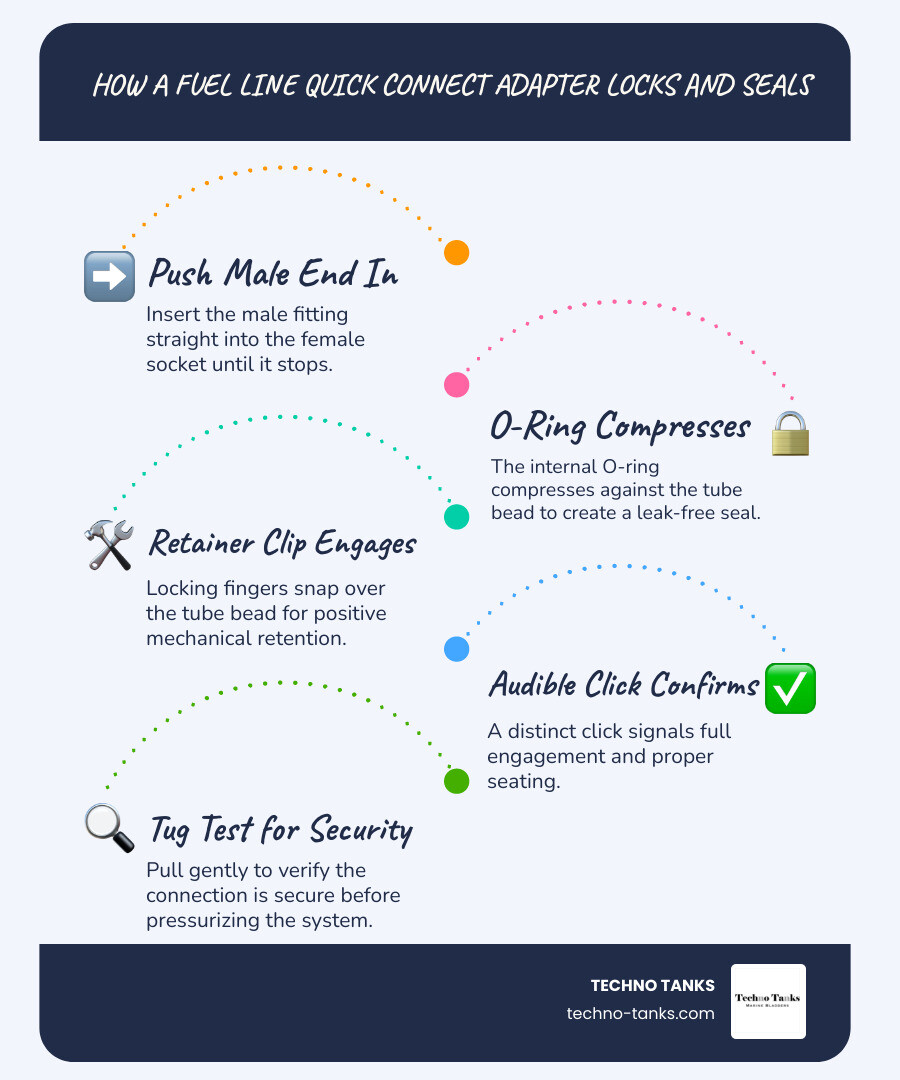
The appeal is straightforward. You push the male end into the female socket until it clicks, and an internal O-ring and retaining clip lock it in place. No wrenches. No hose clamps. No guesswork. Removal is just as fast – press a release tab and pull.
Yet choosing the wrong size or style is a common and costly mistake. Across automotive and marine forums, broken fittings and fuel leaks almost always trace back to the same root causes: wrong diameter, mismatched end style, or a worn O-ring that nobody noticed.
This guide walks you through every major type, size standard, and material option – so you can identify exactly what you need before you buy.
I’m Ivan Jimenez, founder of Digital Ivan and Doral SEO, and I’ve spent years building authority content for technical product categories – including fuel system components like the fuel line quick connect adapter – helping buyers navigate complex specs with confidence. Let’s start with the basics of how these fittings actually work.
Fuel line quick connect adapter word guide:
What Is a Fuel Line Quick Connect Adapter and How Does It Work?
A fuel line quick connect adapter is a fitting designed to join a fuel line to another line, a hard tube, a fuel rail, or a threaded adapter using a push-to-connect locking system. Most designs follow the same basic layout:
- A male tube end with a bead or shaped retaining surface
- A female socket with an internal retainer clip or locking fingers
- One or more internal O-rings that create the seal
- A release mechanism for service
In practical terms, you line up the fitting, push it together, and the retainer snaps over the male end. That snap is what keeps the connection from backing off under fuel pressure or vibration.
Many automotive quick connects are built around SAE J2044-style dimensions and sealing principles, especially for modern EFI fuel systems and fuel rail connections.
How a fuel line quick connect adapter seals fuel without threads
The seal does not come from tightening threads. It comes from the O-ring inside the female connector. As the male tube slides in, it passes through the O-ring, which compresses around the tube outer diameter.
Then the locking fingers or retainer clip engage the bead on the tube. That creates two different jobs inside one fitting:
- The O-ring stops fuel from leaking
- The retainer prevents separation
That division of labor is why quick connects can be so reliable when properly matched. There is no hose clamp crushing rubber unevenly and no threaded joint depending on sealant or torque feel.
Why OEMs and retrofit builders use a fuel line quick connect adapter
Quick connects became popular for good reasons:
- Faster assembly on production lines
- Easier service in cramped engine bays
- More repeatable sealing than improvised clamp connections
- Strong performance in EFI systems where pressure matters
- Easy replacement of damaged sections instead of whole assemblies
For retrofit builders, they also make it easier to adapt OEM hardlines to braided hose, nylon tube, or marine fuel plumbing without reinventing the entire system.
Main Types and Configurations of Fuel Line Quick Connect Adapters
Not all quick connects are shaped the same, and shape matters more than many buyers expect.

The main configurations include:
- Straight fittings
- 45-degree fittings
- 90-degree fittings
- Male and female adapter ends
- Unions
- Reducers
- Double quick connects
- Sensor-port adapters
Straight, 45°, and 90° quick-connect layouts
Straight fittings are the default choice when the hose or tube can run in a direct line. They are common on fuel rails, filter connections, and repair splices.
A 45-degree fitting helps when you need to change direction gently without a tight bend radius. It is useful in firewall routing or around intake components.
A 90-degree fitting is the hero of tight spaces. You often see it near tank outlets, under motorcycle tanks, and in crowded underhood packaging. It can reduce hose kinking, but it also becomes a common failure point if cheap plastic elbows are stressed during installation.
Barb-to-quick-connect, tube-to-quick-connect, ORB-to-quick-connect, and AN adapters
This is where adapter selection gets real.
- Barb-to-quick-connect: connects a quick connect end to a rubber or thermoplastic hose barb
- Tube-to-quick-connect: connects to steel, Bundy, or nylon fuel line
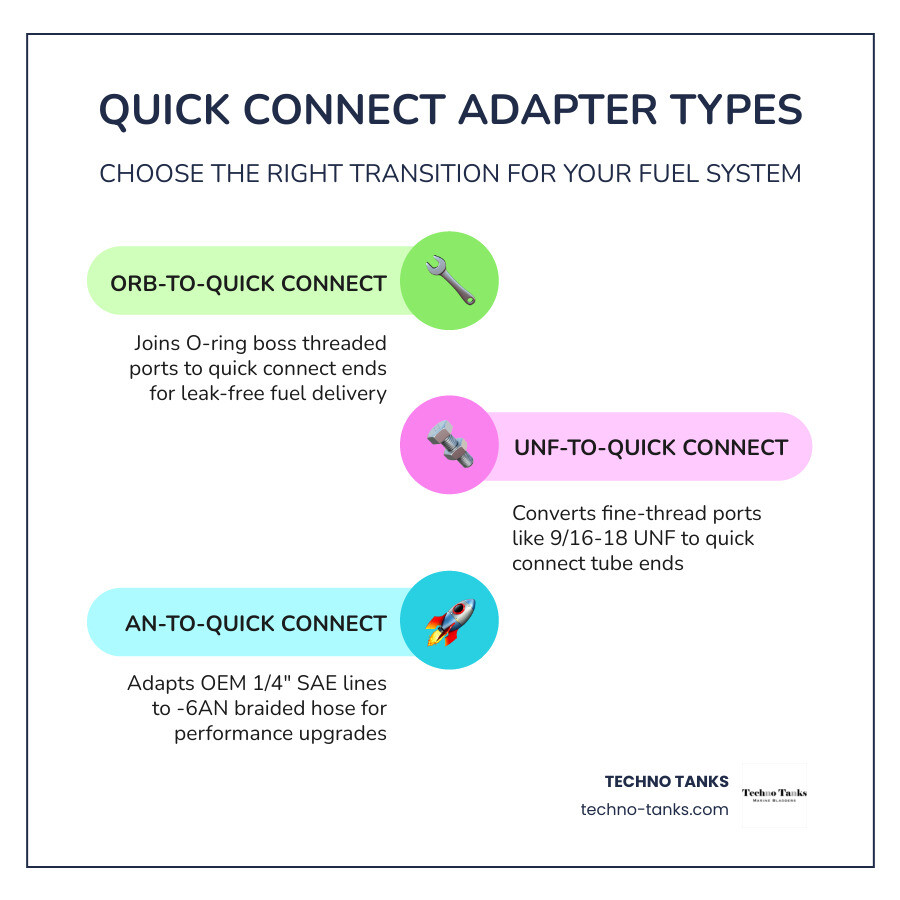
- ORB-to-quick-connect: joins O-ring boss threaded ports to a quick connect end
- UNF-to-quick-connect: used where a fine thread interface is required
- AN-to-quick-connect: converts OEM-style quick connect lines to aftermarket AN hose systems
For example, adapters exist that join OEM 1/4-inch SAE quick-connect lines to -6AN braided hose, which is common in performance fuel system upgrades. Others adapt 9/16-18 UNF or similar threaded interfaces to quick connect tube ends.
Male vs female ends, unions, reducers, and repair fittings
You will also need to understand end style and line transition.
- Male quick connect ends insert into female sockets
- Female quick connect sockets receive the male tube end
- Unions join two same-size lines
- Reducers step from one size to another
- Repair fittings replace only the damaged connector section
- Double-connect fittings use quick connects on both ends
Repair fittings are especially useful because they let you replace a broken connector instead of an entire fuel line assembly. That can save money and downtime, which is why these products remain popular in both professional shops and DIY repairs.
Sizes, Standards, and Material Options to Know Before You Buy
The most common quick connect sizes are:
- 1/4 inch
- 5/16 inch
- 3/8 inch
- 1/2 inch
You will also find metric sizes on some applications, along with AN flare and threaded conversions.
| Size or Standard | Where You Often See It | Typical Pairing |
|---|---|---|
| 1/4″ SAE quick connect | Small hardlines, some firewall fuel feeds | -6AN adapter, nylon tube |
| 5/16″ quick connect | Common EFI supply and return lines | Steel or nylon repair connectors |
| 3/8″ quick connect | Higher-flow EFI and diesel applications | Sensor adapters, fuel rail connections |
| 1/2″ quick connect | High-flow feed systems | -10AN conversions |
| -6AN | Performance hose systems | 1/4″ or 5/16″ quick connect adapters |
| -8AN | Higher-flow performance setups | 3/8″ quick connect transitions |
| -10AN | Large feed lines | 1/2″ quick connect transitions |
| 9/16-18 UNF | Some threaded adapter interfaces | Tube or quick-connect conversion |
SAE J2044, AN flare, metric, and imperial sizing explained
SAE J2044 is the standard most buyers run into when dealing with automotive quick connects. It defines important dimensional and performance features for push-connect couplings used in fuel and vapor systems.
That matters because a fitting can look close and still be wrong.
AN sizing is different. A -6AN fitting is not the same thing as a 6/16-inch quick connect. AN refers to a flare-based hose and fitting system, not a push-connect tube diameter. So if you are adapting OEM hardline to braided hose, you need to match both sides separately:
- Quick-connect side by tube size and standard
- AN side by thread and hose size
Metric and imperial systems can also overlap awkwardly, which is why caliper measurements and spec sheets are your friend.
Plastic vs aluminum vs composite quick connects
Common materials include plastic, composite, aluminum, and internal stainless spring components.
Plastic quick connects are common in OEM systems because they are lightweight, cost-effective, and corrosion-resistant. Many work very well, but cheap or aged plastic can become brittle after years of heat cycling.
Aluminum adapters are popular for performance and retrofit builds. They are stronger, often better for repeated service, and commonly used for AN conversions. Anodized aluminum also improves corrosion resistance.
Composite fittings can offer a good middle ground with low weight and improved toughness.
Look closely at seals too. Viton is a common gasket and O-ring material in fuel-rated connectors because it handles fuel exposure and heat better than many basic elastomers.
Temperature, pressure, and fuel-chemistry compatibility
Fuel fittings do not live easy lives. They deal with:
- Pressure cycling from EFI systems
- Heat soak under the hood
- Cold-start contraction and expansion
- Gasoline, diesel, and ethanol blends
- Moisture and salt exposure in marine environments
If you are using ethanol-blended fuel or E85-compatible components, verify that the seal material and fitting body are rated for it. Some aftermarket adapters specifically support gasoline and ethanol blends up to E85, but never assume all do.
For marine use, corrosion resistance matters even more. Salt air and humidity punish low-quality hardware. If the fitting sits near deck hardware, outboards, or auxiliary fuel plumbing, choose materials and seals designed for that environment.
How to Choose the Right Fuel Line Quick Connect Adapter for Your Application
Choosing the right adapter comes down to five checks:
- The actual line size
- The mating end style
- The routing angle
- The fuel and environment
- The quality level

Matching line size, end style, and routing constraints
Start by measuring the hardline outer diameter, not guessing from memory. A caliper is ideal.
Then identify the other side of the connection:
- Hose barb?
- Female quick connect?
- Male quick connect?
- ORB port?
- UNF thread?
- AN flare?
Finally, look at routing. If a straight fitting forces the hose into a kink or puts tension on the connector, choose a 45-degree or 90-degree layout instead. A fitting should sit naturally, not like it is doing yoga against its will.
Choosing for automotive EFI, diesel, motorcycles, and marine fuel systems
Automotive EFI systems need fittings that can handle pressure, heat, and vibration. Diesel systems may need larger sizes and robust seals, especially where sensor integration is involved.
Motorcycle applications often involve tight spaces under the tank, where 90-degree quick connects are common. These should be handled carefully because elbows can crack if the tank is lowered onto a misaligned line.
Marine fuel systems add another layer: corrosion, movement, and exposure. If you are building or upgrading a boat fuel setup, we recommend understanding the full fitting ecosystem, not just the connector itself. Our guides on boat fuel tank fittings and connecting outboard fuel lines fast are a good next step.
For longer-range marine use, the adapter also needs to work with the broader fuel storage system. That is especially true when connecting auxiliary tanks or transfer setups. If you are comparing storage formats, see our guide on fuel bladder vs fuel tank and learn more about our fuel transfer bladders.
What quality signals matter most before purchase
Before buying, check for:
- Clear size callouts
- Material specs for body and O-rings
- Pressure and fuel compatibility details
- Secure clip design and clean molding or machining
- Dual O-rings where applicable
- Good kit completeness for repair jobs
- Warranty support
Market demand also shows how widespread these fittings are. Online marketplaces now show over 2,000 results for fuel line quick connects, which tells us this is no niche part. It is a mainstream repair and upgrade category. Assorted kits and repair connectors also continue to sell in volume, which reflects how often damaged connectors are replaced instead of full lines.
Installation, Removal, and Leak Prevention Best Practices
Quick connects are simple, but fuel systems deserve respect. Always work safely.
Basic precautions:
- Depressurize the fuel system first
- Disconnect the battery when appropriate
- Wear safety glasses
- Keep ignition sources away
- Clean around fittings before opening the system
- Cap or cover open lines to keep out dirt
You can also watch a general installation walkthrough here: Install Quick Connect Fuel Line Fittings AND Vacuum … – YouTube
Step-by-step installation for a leak-free connection
- Relieve fuel pressure according to the equipment or vehicle procedure.
- Inspect the male tube and female socket for damage, dirt, or old O-ring fragments.
- Confirm size and end-style match before assembly.
- Apply a light fuel-compatible lubricant to the O-ring if the manufacturer allows it.
- Align the fitting straight and push it in fully.
- Listen or feel for the click.
- Check visual engagement if the design allows it.
- Perform a gentle tug test to confirm lock.
- Re-pressurize the system and inspect carefully for leaks.
Do not force a connector at an angle. Misalignment can cut the O-ring, damage the clip, or crack an elbow fitting.
Safe removal methods and the right tools
Some quick connects release by squeezing tabs. Others need a small disconnect tool that depresses the retainer.
Best practices:
- Clean the fitting before removal
- Use the correct release method
- Push slightly inward before releasing to unload the clip
- Do not pry with screwdrivers
- Pull straight out once released
- Cap open lines immediately
If you are dealing with a stubborn fitting, stop and reassess. Excess force is how plastic connectors become two connectors.
Common failure modes and how to prevent them
The most common quick connect failures are surprisingly predictable:
- Cracked 90-degree elbows from stress
- Cut or flattened O-rings
- Broken retaining clips
- Wrong-size adapters that almost fit
- Heat-aged plastic embrittlement
- Misalignment during installation
- Hose tension pulling on the connector
- Dirt damaging the sealing surface
Preventive steps are simple:
- Measure before buying
- Use the proper angle
- Avoid side-loading the fitting
- Replace worn seals
- Keep fittings clean
- Use fuel-rated components only
- Inspect old plastic carefully before reusing it
Performance, Service Life, and Where to Source Reliable Adapters
When the right fitting is used correctly, quick connects perform very well in real service.
They are designed to withstand:
- Continuous fuel exposure
- Pressure pulses
- Vibration from engines and road or hull movement
- Repeated heat and cold cycles
- Tight packaging in serviceable locations
For marine setups, corrosion resistance and seal quality are especially important because moisture never really takes a day off.
How quick connects compare with hose clamps and threaded fittings
Quick connects offer several advantages over traditional clamps or threaded joints:
- Faster assembly
- More repeatable installation
- No clamp over-tightening
- Better packaging in tight spaces
- Faster service and replacement
- Cleaner transitions between hardline and flexible line
Threaded fittings still have an important place, especially in custom systems, and hose barbs still work well when matched to proper hose and clamps. But for service speed and OEM-style packaging, quick connects are hard to beat.
Where to source reliable adapters and verify fitment
Reliable sourcing starts with documentation. Look for sellers or manufacturers that provide:
- Detailed spec sheets
- Clear line-size and standard references
- Fuel compatibility notes
- Warranty or return terms
- Repair and installation documentation
- Photos that clearly show both ends
Good product listings should clearly specify exact transitions, such as 1/4-inch steel to 5/16-inch nylon tube, or explain the details of an SAE quick-connect to -6AN conversion.
If you want a purpose-built marine option from us, see our Fuel line quick connector.
Frequently Asked Questions about Fuel Line Quick Connect Adapters
Can I replace just the broken connector instead of the entire fuel line?
Often, yes. Repair connectors, unions, and adapter sections are widely available for replacing only the damaged end or transition point. This is one reason quick connect repair parts are so popular. Just make sure the replacement matches:
- Line size
- Tube material
- End style
- Fuel type
- Pressure requirements
If the hose or hardline itself is damaged, replace the affected section too.
Are fuel line quick connects safe for high-pressure EFI and marine use?
Yes, if they are correctly specified and properly installed. Quick connects are widely used in EFI systems specifically because they can handle pressure, vibration, and temperature cycling when built to the right standard.
For marine use, the same rule applies with extra attention to corrosion resistance, movement, and fuel compatibility. In other words, the connector is only as safe as its rating, installation, and environment.
How do I know if I need a 1/4″, 5/16″, 3/8″, or AN adapter?
Measure the fuel line outer diameter on the quick-connect side. Then identify the mating side separately.
Remember:
- 1/4″, 5/16″, 3/8″, and 1/2″ usually refer to the quick-connect tube size
- AN sizing refers to a different fitting system
- Threads such as 9/16-18 UNF need their own match
- Vehicle or equipment fitment guides can help, but direct measurement is safest
When in doubt, compare your line and port to the product drawing or spec sheet before ordering.
Conclusion
The right fuel line quick connect adapter makes fuel plumbing faster, cleaner, and safer. The wrong one creates leaks, stress, and frustration in a hurry.
Our buying checklist is simple:
- Measure the line correctly
- Match the exact end style
- Choose the right angle for routing
- Confirm fuel and temperature compatibility
- Inspect O-rings, clips, and material quality
- Follow safe installation and leak-check steps
Whether you are repairing an EFI fuel line, adapting a hardline to AN hose, or building a more dependable marine fuel setup, the key is choosing parts that match the system instead of forcing a near-fit solution.
If you are ready to upgrade your setup, explore our Fuel line quick connector and our broader marine fuel solutions. At Techno Tanks, we build products for dependable fuel handling on the water, including flexible marine fuel bladders in recyclable TPU for extended range and practical onboard fuel management.

