
Why the Right Marine Fuel Tank Quick Disconnect Makes or Breaks Your Fuel System
A marine fuel tank quick disconnect is a push-to-connect, tool-free coupling that links a portable or auxiliary fuel tank to an engine’s fuel line — and disconnects cleanly without spilling fuel or drawing air into the system.
Quick answer for serious operators:
| Question | Short Answer |
|---|---|
| What does it do? | Connects/disconnects a fuel tank to an engine line without tools or spills |
| How does it work? | Double shut-off valves seal both sides on disconnect |
| Who needs it? | Any operator using portable, on-deck, or auxiliary fuel bladders |
| Key sizes | 3/8″ barb, 1/2″ NPT — match to your hose ID and engine demand |
| Best material | 316 stainless steel or nickel-plated brass with Viton O-rings |
| Regulatory status | Not always legally mandated, but strongly recommended for safe fuel management |
Most fuel system failures — leaks, air intrusion, engine starvation — trace back to a poor connection at the tank. For operators running flexible fuel bladders as auxiliary or extended-range fuel sources, the quick disconnect is the most critical point in the entire system. Get it wrong, and you’re looking at engine cutouts, fuel contamination, or an on-deck spill at the worst possible moment.
This guide covers everything decision-makers need: how these fittings work, how to size and select them, how to install and maintain them, and how they integrate with marine fuel bladders for reliable offshore performance.
For a Techno Tanks bladder setup, compare these selection criteria directly with the Fuel Line Quick Connector. The right choice still depends on the hose, thread/interface, fuel type, valve, and engine requirements for the complete system.
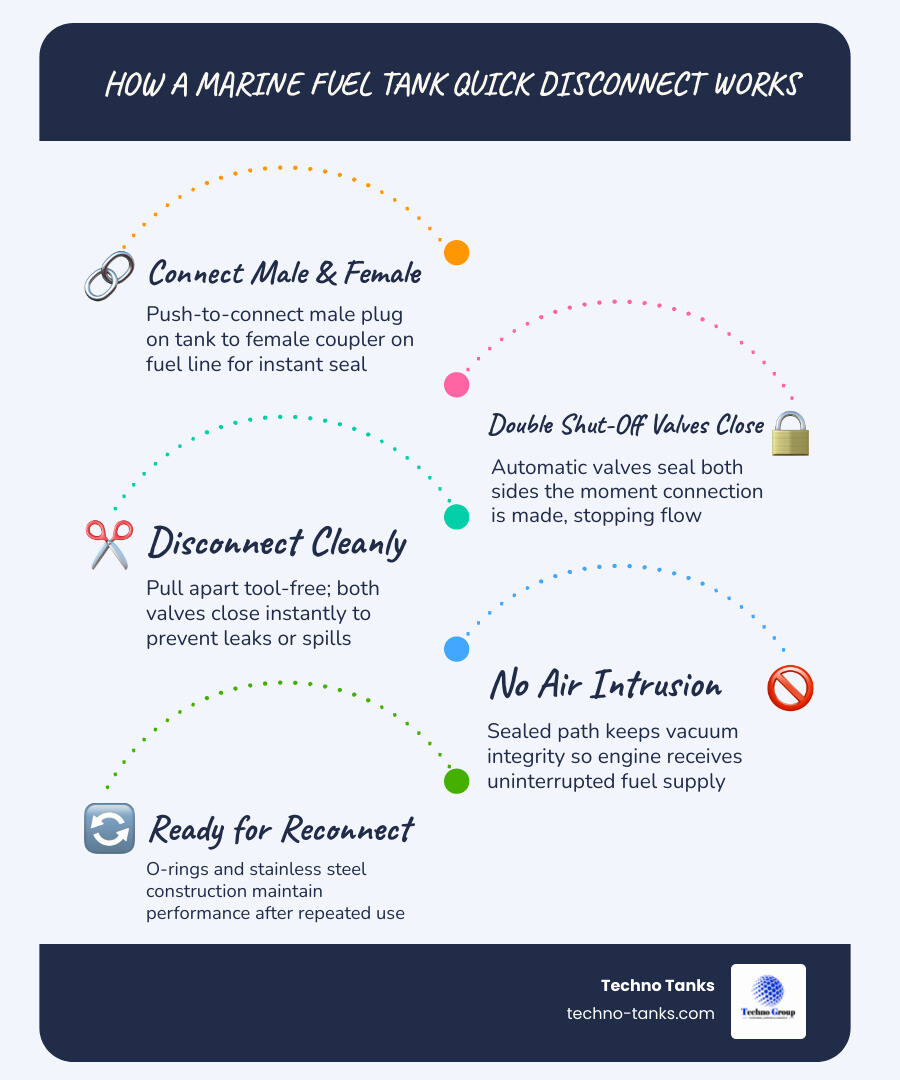
What is a Marine Fuel Tank Quick Disconnect and How Does It Work?
At its core, a marine fuel tank quick disconnect is a high-precision, two-piece coupling system consisting of a male plug (often mounted on the tank or valve assembly) and a female coupler (attached to the fuel delivery line). This design enables rapid, tool-free connection and disconnection of fuel lines under demanding marine conditions.
Unlike standard industrial pneumatic fittings, marine-grade fuel disconnects are engineered with internal spring-loaded poppet valves in both the male and female halves. When connected, the two poppets press against each other, compressing the internal springs and opening a clear, unobstructed path for fuel flow dynamics.
Upon disconnection, the spring mechanism instantly forces both poppets back into their sealed seats. This “double shut-off” or “dry-break” action ensures that fuel remains locked inside the hose and the tank, preventing vacuum loss on the engine side and eliminating fuel spillage on deck.
These fittings typically feature National Pipe Thread (NPT) connections on the threaded ends to mate securely with tank withdrawal tubes, valves, or manifold systems. To understand how these components fit into the broader context of vessel fuel architecture, see our comprehensive guide on Everything You Need to Know About Boat Fuel Tank Fittings.
Sizing and Selecting a Marine Fuel Tank Quick Disconnect
Selecting the correct fitting size is not just a matter of making things fit; it is a critical safety and performance decision. If a fitting is too restrictive, it causes a pressure drop that leads to fuel starvation, cavitation, and potential engine damage—especially in high-horsepower outboards or high-flow diesel transfer applications.
Common sizing configurations include:
- 1/4-inch NPT Threads: Frequently found on smaller portable tanks and low-horsepower outboard connections, such as standard Honda TANK OUTLETS – L1272 – Larand Marine Products setups.
- 3/8-inch Hose Barbs: The industry standard for most recreational and commercial outboard fuel lines, ensuring adequate flow for engines up to 300+ horsepower.
- 1/2-inch NPT / High-Flow Connectors: Preferred for heavy-duty diesel fuel transfer, high-volume auxiliary refueling systems, and large flexible fuel bladders.
When matching hose inner diameter (ID) to engine fuel demands, always size the quick disconnect to match or exceed the hose ID. For example, if you are running a 3/8-inch fuel line to support a high-horsepower engine, do not restrict the flow by using a narrow 1/4-inch quick disconnect at the tank. For reliable, high-volume transfer, heavy-duty options like the Quicksilver Quick Disconnect – Tank End Fitting-Fuel or the Quicksilver Quick Disconnect-Tank End – Quicksilver 30185Q3 – Fuel Connectors and Elbows – Fuel System – Engine/Mechanical – Boatersland Marine provide robust, high-flow connections that prevent fuel starvation.
Materials Used in Marine Fuel Tank Quick Disconnect Construction
The marine environment is incredibly hostile to metals and polymers. Saltwater, UV exposure, high vibration, and chemical solvents will rapidly degrade sub-par materials.
- 316 Marine-Grade Stainless Steel: This is the gold standard for commercial and offshore applications. It offers maximum resistance to pitting and crevice corrosion in saltwater environments, high structural strength under mechanical stress, and absolute chemical compatibility with both gasoline and diesel.
- Nickel-Plated Brass: A highly durable, cost-effective alternative. Precision-machined brass fittings plated with nickel resist corrosion exceptionally well and provide a spark-free connection, which is vital when handling gasoline.
- Viton (FKM) Gaskets and O-Rings: The choice of sealing material is paramount. Standard Nitrile (Buna-N) seals degrade rapidly when exposed to modern ethanol-blended gasolines (such as E10 or E15) and aromatic compounds in diesel. Viton gaskets maintain their elasticity, structural integrity, and chemical resistance under extreme temperature ranges and constant fuel exposure.
Avoid cheap, non-marine plastic quick disconnects. Over time, UV exposure and fuel contact make plastic brittle, leading to sudden cracks, catastrophic fuel leaks, or air intrusion that can leave your vessel stranded.
Quick Disconnects vs. Traditional Barbed Fittings
Many older or permanent fuel systems rely on traditional barbed fittings secured with worm-gear hose clamps. While functional for permanent, static installations beneath the deck, barbed setups fall short when managing temporary, on-deck, or auxiliary fuel storage.

Using hose clamps and barbs for portable or temporary tanks requires tools, damages the fuel hose over repeated installations, and inevitably spills fuel during removal. Furthermore, if a fuel line is severed or damaged downstream, a barbed fitting provides no automatic shut-off, allowing fuel to siphon or pump freely onto the deck.
| Feature / Metric | Quick Disconnect Fitting | Traditional Barbed Fitting & Hose Clamp |
|---|---|---|
| Connection Speed | Instant, tool-free (push-to-connect) | Slow, requires screwdrivers or nut drivers |
| Spill Prevention | Automatic double shut-off (dry-break) | None; hose must be pinched or drained |
| Flow Rate Efficiency | High (when sized correctly to match hose ID) | High (unrestricted, but prone to hose kinking) |
| Tool Requirements | None | Screwdriver, hose cutters, pliers |
| Durability under Vibration | Excellent (locking sleeve prevents backing off) | Moderate (screws can back out over time) |
| Hose Wear & Tear | Zero (hose remains permanently clamped) | High (repeated removal degrades hose ends) |
| Emergency Separation | Immediate (slide-back collar) | Extremely slow (must cut hose or undo clamp) |
Safety and Regulatory Compliance for On-Deck Fuel Systems
Deploying auxiliary fuel systems requires a strict understanding of marine safety standards. The United States Coast Guard (USCG) and the American Boat and Yacht Council (ABYC) maintain rigorous guidelines to prevent onboard fires and fuel system failures.
According to ABYC H-24 standards, fuel systems must withstand high vibration, shock, and thermal stress. The USCG distinguishes between “portable” and “permanent” fuel systems based on capacity and mounting. Generally, fuel tanks under 7 gallons are classified as portable. Larger tanks or auxiliary systems (such as high-capacity deck bladders) must be secured appropriately.
When configuring these systems, the use of quick disconnects allows the tank or bladder to remain classified as a temporary, tool-free removable system. For permanent installations, federal law requires anti-siphon protection—such as anti-siphon valves—to prevent fuel from siphoning into the bilge if a line is severed below the fuel level.
For detailed technical perspectives on how regulators and marine surveyors view these connections, refer to the industry discussions on Fuel Hose Connection To On-Deck Fuel Tanks – continuousWave .
Emergency Jettison and Fire Safety Advantages
In extreme offshore emergencies—such as an onboard fire, severe hull damage, or the immediate need to jettison weight—the ability to isolate and detach fuel sources instantly is life-saving.
If an on-deck auxiliary fuel bladder or temporary tank must be discarded, trying to loosen hose clamps under stress is impossible. A high-quality marine fuel tank quick disconnect allows the operator to slide back the locking collar and detach the auxiliary tank in less than two seconds.
Because of the dry-break valve design, the fuel line leading to the engine bay instantly seals, preventing fuel from draining onto the hot deck. This technology is heavily leveraged in commercial shipping and fuel terminal transfers, utilizing advanced designs like those found in the Quick & Dry Disconnect systems.
Furthermore, in larger commercial vessels, quick-closing emergency valves, such as the Quick Closing Valve Straight Hydraulic Pnuematic Mechanical | Dikkan Valve , are used to isolate fuel lines remotely in case of fire, demonstrating the critical nature of rapid-isolation hardware in marine safety.
Installation, Maintenance, and Troubleshooting
Proper installation is the foundation of a leak-free marine fuel system. Follow these steps to ensure a secure, airtight connection:
- Thread Preparation: When screwing the male NPT quick-disconnect plug into your tank’s withdrawal valve, always use a fuel-resistant liquid thread sealant (such as Teflon paste rated for petroleum). Never use standard white Teflon tape, as fragments can shred, enter the fuel stream, and clog engine fuel injectors.
- Hose Attachment: Secure the female coupler to the fuel hose using high-quality, marine-grade 316 stainless steel hose clamps (preferably solid-band Oetiker clamps rather than slotted worm-gear clamps, which can cut into the hose).
- O-Ring Lubrication: Before the first connection, apply a light film of clean engine oil or fuel-resistant silicone grease to the male plug’s Viton O-ring. This prevents the seal from pinching, tearing, or binding during insertion.
- Confirming Connection: Push the female coupler firmly onto the male plug until you hear a distinct “click.” Pull back gently on the collar to verify that the locking mechanism is fully engaged.
For a deeper dive into optimizing your fuel line setup for speed and reliability, read our guide on The Best Way to Connect Your Outboard Fuel Line Fast.
How do I prevent air intrusion in my marine fuel tank quick disconnect?
Air intrusion is the silent killer of marine engines—particularly two-stroke and modern high-pressure common-rail diesel engines. Even a microscopic gap in the quick disconnect can allow the fuel pump to draw air instead of fuel. This leans out the fuel mixture, causing engine sputtering, loss of power, or complete fuel starvation.
To prevent air intrusion:
- Inspect O-Rings Regularly: The primary source of vacuum leaks is a dry, cracked, or deformed O-ring inside the female coupler or on the male plug. Replace these seals annually.
- Verify Primer Bulb Placement: Ensure your fuel primer bulb is installed downstream of the quick disconnect (between the disconnect and the engine filter). Squeezing a primer bulb placed upstream can over-pressurize the connection and cause fuel to spray out, while a downstream bulb creates a vacuum that pulls the connector tight.
- Eliminate Side-Loading: If the fuel hose hangs at a sharp angle from the quick disconnect, the constant leverage can warp the internal poppet valve or pull the connector off-center, breaking the airtight seal. Use 90-degree elbow adapters if necessary to ensure a straight, stress-free connection.
Compatibility Issues Across Engine Brands and Hose Sizes
One of the most frustrating aspects of marine fuel systems is the lack of standardization across engine manufacturers. Mercury, Yamaha, Evinrude/Johnson, Honda, and Suzuki all use proprietary quick-disconnect designs.
- Mercury/Quicksilver: Typically uses a dual-prong style or a unique twist-lock collar.
- Yamaha: Utilizes a distinct rectangular dual-pin locking configuration.
- Honda: Employs a round, chrome-plated plug with a specific locking groove.
Attempting to force mismatched connectors together will ruin the internal seals and lead to immediate fuel leaks or air locks. To resolve this, operators should standardize their on-deck connections.
The most efficient method is to install universal female NPT threads on your fuel bladders or auxiliary tanks, and use high-quality adapters to convert your engine-specific fuel lines to a uniform, heavy-duty stainless steel quick-connect standard. This ensures that no matter what engine or fuel line configuration you run, your tank connections remain identical and secure.
Integrating Quick Disconnects with Flexible Fuel Bladders
For offshore operators, yacht captains, and commercial vessels requiring extended range, flexible fuel bladders offer an elegant, space-saving alternative to rigid auxiliary tanks. When full, they provide hundreds of gallons of extra fuel capacity; when empty, they roll up tightly to be stored in a dry locker.
Integrating a marine fuel tank quick disconnect with a Techno Tanks collapsible fuel bladder creates a seamless, safe auxiliary fuel system. Because fuel bladders collapse as they drain, they do not require traditional venting setups that can let in moisture.
Using a high-flow, 1/2-inch stainless steel quick disconnect on the bladder’s discharge valve allows operators to connect the bladder directly to the vessel’s fuel manifold or engine fuel line without tools. Once the fuel transfer is complete, the operator can disconnect the line instantly without spilling a drop of fuel on deck, roll up the empty bladder, and stow it away safely.
To learn the safest, most efficient methods for routing and transferring fuel from these systems, refer to our operational walkthrough on How to Transfer Fuel from a Fuel Bladder.
Frequently Asked Questions
Are quick disconnect fittings required by the USCG?
No, the USCG does not explicitly mandate the use of quick disconnect fittings on all marine fuel systems. However, they are highly recommended and widely used on portable and auxiliary on-deck fuel tanks.
Using a quick disconnect allows a deck-mounted fuel tank or bladder to remain classified as a “temporary” system, simplifying compliance with permanent fuel system installation regulations (such as rigid metal piping and permanent venting). If your vessel undergoes a USCG Auxiliary safety inspection, having clean, leak-free, marine-grade quick disconnects is a major point in your favor.
Can I use a quick disconnect fitting with a diesel fuel bladder?
Yes, provided you select the correct materials. Diesel fuel has different chemical properties than gasoline and requires high-flow rates to feed fuel injection systems that constantly return fuel to the tank.
For diesel fuel bladders, you must use high-flow quick disconnects (such as 1/2-inch NPT fittings) constructed from 316 stainless steel or nickel-plated brass, equipped with genuine Viton seals. Avoid standard yellow brass or plastic fittings, which can restrict flow and degrade when exposed to modern diesel blends.
What are the signs of a failing quick disconnect fitting?
The most common signs of a failing or worn quick disconnect fitting include:
- Engine Sputtering at High RPM: This indicates fuel starvation, often caused by a vacuum leak (air intrusion) at the connector O-ring.
- Wet Fuel on the Connector Body: If you notice a film of fuel on the fitting after disconnecting, the internal spring-loaded poppet valve is failing to seat properly.
- Difficulty Engaging the Locking Collar: Salt buildup, corrosion, or physical wear can cause the locking ball bearings or spring collar to seize, preventing a secure, locked connection.
Conclusion
A high-quality marine fuel tank quick disconnect is a small but critical component that safeguards your vessel’s fuel system integrity, prevents costly environmental spills, and ensures reliable engine performance during long offshore runs. When extending your vessel’s range, don’t let a cheap fitting be the single point of failure.
At Techno Tanks, we design military-grade, flexible fuel bladders and custom fuel storage solutions engineered to withstand the harshest offshore environments. Whether you need to carry auxiliary fuel for a long-distance transit or require a heavy-duty fuel transfer setup, our systems are built for safety, durability, and ease of use.
Because every vessel and mission is unique, we recommend requesting a customized quote tailored to your specific fuel storage, transfer, and sizing requirements. Explore Techno Tanks Marine Fuel Bladders today to find the perfect heavy-duty hardware and flexible storage solutions for your next voyage.

