
What Is a Diesel Fuel Bladder — and Why Operators Use Them
A diesel fuel bladder is a flexible, collapsible container engineered to store and transport diesel fuel safely — without the weight, cost, or permanence of a rigid tank.
Quick answer for buyers:
| Question | Answer |
|---|---|
| What is it? | A collapsible, flexible tank made from fuel-resistant materials like polyester TPU |
| What is it used for? | Range extension, backup fuel storage, temporary fuel depots, fuel transfer |
| Who uses them? | Marine operators, commercial vessels, offshore crews, industrial sites, emergency response teams |
| Key advantage | Folds flat when empty — reclaims deck or storage space |
| Capacity range | From ~30 gallons up to 20,000+ gallons |
| Fuel compatibility | Diesel, biodiesel, and other hydrocarbons (material must match fuel type) |
If you need more range, a flexible backup supply, or a practical alternative to installing permanent rigid tanks — a diesel fuel bladder is worth understanding in detail.
These tanks have been used in serious working environments for decades: ocean-crossing yachts, commercial workboats, remote mining operations, and disaster relief logistics. The core appeal is consistent — you get high-capacity fuel storage that takes up almost no space when it’s not in use.
Unlike a steel or aluminum tank bolted into a hull, a diesel fuel bladder can be deployed quickly, repositioned as needed, and stored flat when empty. For operators managing range, payload, or space constraints, that flexibility has real operational value.
This guide covers everything you need to make an informed decision: materials, construction, sizing, marine and industrial applications, safe handling, and how to request the right bladder for your specific use case.
Understanding Flexible Fuel Bladders vs. Rigid Tanks
When expanding fuel capacity, operators historically faced a single choice: install more rigid metal or plastic tanks. While permanent tanks are suitable for baseline fuel needs, they introduce significant disadvantages when used for temporary or auxiliary storage.
The primary difference lies in adaptability. A rigid tank occupies the same physical footprint and adds the same structural weight whether it is carrying 500 gallons of diesel or sitting completely empty. This static design reduces payload efficiency and permanently consumes valuable deck or cargo space.
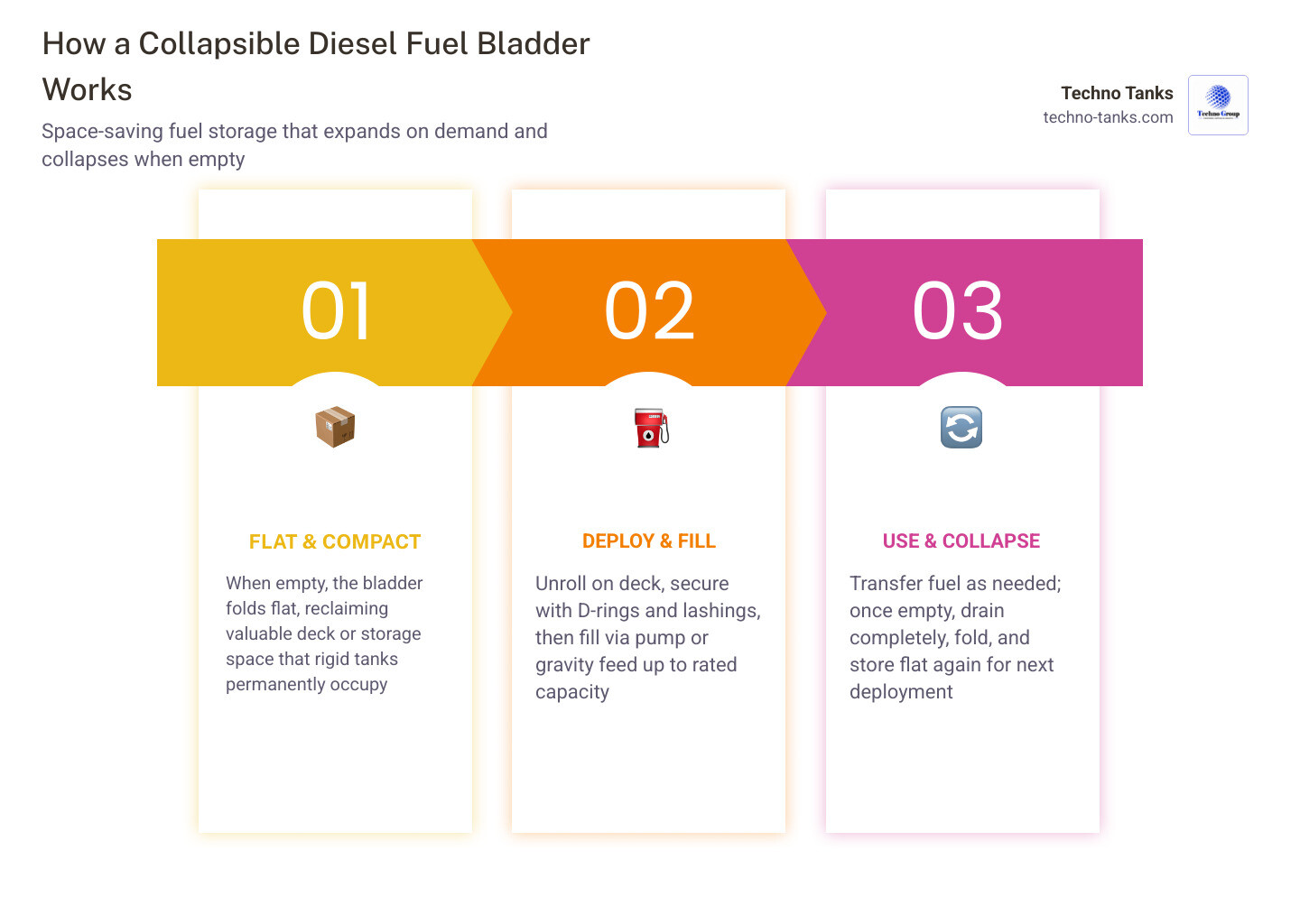
In contrast, a diesel fuel bladder is dynamic. It expands as it is filled and collapses completely as fuel is drawn down. Once empty, it can be rolled or folded flat, reclaiming up to 90% of the space it occupied when full.
To understand how these systems compare for auxiliary storage, consider the key operational metrics:
| Operational Metric | Rigid Steel/Aluminum Tanks | Flexible Fuel Bladders |
|---|---|---|
| Weight Efficiency | Heavy; adds permanent structural deadweight to the vessel or vehicle. | Lightweight; empty bladders typically weigh only a fraction of equivalent metal tanks. |
| Space Utilization | Fixed footprint; permanently occupies deck, cargo, or hold space. | Collapsible; folds flat when empty to reclaim up to 90% of deck space. |
| Installation Complexity | High; requires structural modifications, welding, and permanent plumbing. | Low; rapidly deployable on flat surfaces without permanent modifications. |
| Capital Expense | High; custom metal fabrication and structural integration are costly. | Moderate; offers a highly cost-effective alternative for range extension. |
| Corrosion Risk | High; susceptible to rust, weld cracking, and condensation buildup. | Non-corrosive; synthetic materials resist environmental and fuel-induced degradation. |
For a deeper dive into how flexible systems stack up against traditional setups, explore our comparison of Fuel Bladder vs Fuel Tank.
Engineering and Material Specs of a Diesel Fuel Bladder
A reliable flexible tank is not simply a heavy-duty plastic bag. It is a highly engineered system designed to withstand hydrostatic pressure, dynamic movement, UV exposure, and constant contact with aggressive hydrocarbons.
To ensure safety and longevity, top-tier manufacturers build these systems using advanced polymer chemistry and robust construction techniques. For a complete breakdown of technical tolerances, review our Fuel Bladder Specs page.
Material Selection for a Diesel Fuel Bladder
The choice of base polymer is critical because different fuels interact with polymers in distinct ways. For diesel storage, Polyester TPU (Thermoplastic Polyurethane) is the industry standard.
Polyester TPU offers exceptional resistance to the chemical makeup of diesel fuel, biodiesel, and fuel oils. It prevents fuel molecules from permeating the fabric, eliminating fuel odors and preventing the material from softening, swelling, or cracking over time.
Note: It is crucial to match the bladder material to the exact fuel type. While Polyester TPU is engineered for diesel, Polyether TPU is typically used for gasoline. Interchanging these fuels in a non-compatible bladder can cause the inner layer to dissolve, leading to catastrophic failure.

High-quality bladders feature a multi-layer composite fabric:
- Outer Protective Layer: Formulated with UV inhibitors and hydrolysis stabilizers to withstand extreme sun, saltwater, and weather exposure.
- High-Tensile Scrim: A heavy-duty woven polyester base fabric that provides the structural tensile strength needed to hold thousands of pounds of liquid without stretching or tearing.
- Inner Barrier Layer: A thick, fuel-impermeable TPU coating that contains the diesel fuel and prevents chemical degradation.
Construction Methods and Seam Integrity
The seams are the most critical points of any flexible tank. Standard sewing or adhesive gluing is insufficient for holding bulk fuel under dynamic conditions. Instead, industrial-grade bladders utilize Radio Frequency (RF) Welding (also known as high-frequency welding).
RF welding uses electromagnetic energy to agitate the molecules within the TPU layers, fusing them together at the molecular level. This process creates a single, continuous piece of material. The resulting fused seams are actually stronger than the surrounding fabric itself.
Advanced manufacturing also incorporates Double-Layer Welding or taped-seam reinforcement. This technique adds an extra layer of structural material over the fused seam, providing up to 99% leak prevention even under severe dynamic stress, such as fuel sloshing in heavy seas or off-road transport.
Sizing, Capacity, and Pricing of Collapsible Tanks
Because operational requirements vary widely, collapsible fuel bladders are manufactured in a broad range of capacities and footprints.
Standard and Custom Sizing Options
Standard capacities typically range from small auxiliary marine bladders to massive industrial pillow tanks:
- 30 to 250 Gallons: Ideal for sportfishing boats, small workboats, and pickup truck beds.
- 300 to 1,000 Gallons: Used for commercial vessel range extension, small remote generators, and agricultural fueling.
- 1,500 to 20,000+ Gallons: Designed for industrial fuel farms, remote mining sites, military logistics, and disaster relief.
For applications with strict deck space limits or unique compartment shapes, standard dimensions may not fit. In these cases, operators turn to Custom Fuel Bladders designed to match specific deck layouts, utilizing low-profile “space saver” footprints to maximize stability and volume.
To determine the ideal capacity and dimensions for your application, refer to our comprehensive Fuel Bladder Sizing Guide.
Cost Considerations and Value Proposition
When evaluating the cost of a diesel fuel bladder, it is helpful to look at standard market benchmarks. For general reference, standard commercial flexible fuel tanks typically scale as follows:
- 150 Gallon Bladder: ~$1,100 – $1,600
- 500 Gallon Bladder: ~$2,100 – $2,800
- 1,000 Gallon Bladder: ~$2,800 – $3,500
- 5,000 Gallon Bladder: ~$6,600 – $7,500
- 20,000 Gallon Bladder: ~$13,900 – $15,000
(Note: Actual pricing varies based on custom fittings, fabric thickness, baffled configurations, and specific certifications.)
At Techno Tanks, pricing is tailored to the unique parameters of your project, including size, fuel type, configuration, and custom engineering requirements. Because of this, we recommend that buyers request an accurate quote directly. You can view our pricing philosophy and request a customized estimate on our Fuel Bladder Pricing page.
The value proposition of a flexible bladder becomes clear when compared to the total cost of ownership of a rigid tank. Installing a permanent metal tank requires significant capital for custom fabrication, hull modifications, structural reinforcement, and plumbing.
Furthermore, when a rigid tank is empty, it continues to cost money by adding permanent deadweight and reducing fuel efficiency. A collapsible bladder eliminates these ongoing operational costs, providing a much higher return on investment for temporary or seasonal range extension.
Operational Performance in Marine and Industrial Applications
From remote land-based projects to demanding offshore passages, flexible bladders deliver reliable performance across a variety of demanding environments.
Marine Deployment and Stability
In marine settings, auxiliary fuel is vital for reaching distant fishing grounds or completing long-distance deliveries. To learn more about these specialized systems, visit our Marine Fuel Bladders section.
Operating a vessel with a fuel bladder on deck requires careful attention to stability and liquid movement. When a flexible tank is only partially filled, the fuel can shift rapidly from side to side as the vessel rolls. This is known as the free surface effect, and it can severely compromise vessel stability.
To mitigate this risk, operators should follow these best practices:
- Fill and Empty Completely: The safest way to manage a bladder is to keep it either 100% full or 100% empty. Avoid running a bladder at half-capacity for extended periods.
- Use Baffled Configurations: For applications where partial fills are unavoidable, select a bladder with internal baffles to restrict fuel movement.
- Secure with Tie-Downs: Always secure the bladder using heavy-duty D-rings and high-strength lashing straps rated for the full weight of the fuel. A 300-gallon bladder weighs over 2,100 lbs when full; unsecured, it represents a major safety hazard.
- Follow Coast Guard Guidelines: Keep temporary fuel bladders secured above deck. This ensures proper gravity fuel transfer, safe venting, and easy cleanup in the event of a spill.
For detailed advice on selecting and securing marine systems, see our guide on Fuel Bladder for Boats.
Industrial and Emergency Fuel Storage
On land, large-capacity collapsible fuel tanks serve as temporary fuel depots for remote mining, construction, and disaster relief.
When deploying large-scale fuel storage, compliance with environmental regulations is critical. Under SPCC (Spill Prevention, Control, and Countermeasure) and EPA guidelines, operators must use secondary containment systems. This typically involves placing the fuel bladder inside a heavy-duty containment berm capable of holding the bladder’s entire volume plus a safety margin for rainwater.
These temporary fuel setups can be deployed in minutes with minimal site preparation, providing a highly reliable and compliant solution for backup generators and remote fleet fueling. For more details, consult our resource on Temporary Fuel Storage and review the regulatory requirements on the EPA SPCC Regulation page.
Best Practices for Handling, Transfer, and Maintenance
Proper handling is the key to maximizing the lifespan of your fuel bladder and ensuring safe operation.
Safe Fuel Transfer Procedures
Transferring diesel from a flexible bladder to your vessel’s main tanks or industrial equipment must be done systematically. For a complete walkthrough, read our guide on How to Transfer Fuel from a Fuel Bladder.
Key steps for a safe transfer include:
- Gravity and Siphon Feed: Whenever possible, position the bladder higher than the receiving tank to allow gravity or a simple siphon to do the work. This eliminates the need for electrical pumps and minimizes the risk of static sparks.
- Pump Selection: If a pump is required, ensure it is rated for diesel fuel transfer. For marine environments, use pumps with explosion-proof motors.
- Venting: Ensure the bladder’s vent valve is open during both filling and draining to prevent vacuum collapse or over-pressurization.
- Purging the Bladder: To get every drop of fuel out, roll the bladder from the outer edges toward the discharge valve. Because the tank collapses as it empties, it will not “glug” or trap air in the fuel line.
- Grounding: Always ground all transfer equipment to dissipate static electricity before starting the fuel transfer.
For specialized high-volume transfers, operators rely on dedicated Fuel Transfer Bladders designed with high-flow Camlock fittings and heavy-duty ball valves.
Maintenance, Storage, and Lifespan of a Diesel Fuel Bladder
While high-quality Polyester TPU bladders are extremely durable, proper maintenance will significantly extend their service life:
- UV and Weather Protection: Although fabrics include UV stabilizers, prolonged exposure to harsh tropical sun can eventually degrade any polymer. When the bladder is full and deployed on deck, use a light-colored canvas cover or select a bladder with a reflective white matte finish to reduce heat absorption.
- Cleaning and Drying: After use, drain the bladder completely, flush it with clean water if necessary (following local environmental laws for fuel residue disposal), and allow it to dry completely.
- Folding and Storage: Fold or roll the dry, empty bladder carefully, avoiding sharp creases that could stress the material over time. Store the folded bladder in a cool, dry, and well-ventilated locker away from sharp objects and rodents.
Frequently Asked Questions about Diesel Fuel Bladders
Why is TPU preferred over other materials for diesel fuel bladders?
Polyester TPU (Thermoplastic Polyurethane) is the preferred material because of its exceptional chemical compatibility with diesel fuel and hydrocarbons. It provides high tensile strength, excellent abrasion resistance, and prevents fuel molecules from permeating the fabric. Unlike cheaper PVC materials, TPU remains highly flexible in extreme cold (down to -50°C) and does not degrade or leach chemicals into the fuel over its 8 to 15-year service life.
How do you secure a diesel fuel bladder on a moving vessel deck?
A diesel fuel bladder must be secured using high-strength lashing straps attached to the bladder’s integrated heavy-duty D-rings and anchored to structural deck tie-down points. It is best to transport bladders either 100% full or completely empty to eliminate the “free surface effect” (fuel sloshing), which can destabilize the vessel. Never allow the bladder to rub against sharp edges or abrasive deck surfaces; use a protective ground mat underneath the bladder if the deck is rough.
What is the expected operational lifespan of a heavy-duty diesel fuel bladder?
A premium Polyester TPU fuel bladder has an expected operational lifespan of 8 to 15 years, depending on how it is handled, maintained, and stored. Factors that extend lifespan include minimizing unnecessary UV exposure, avoiding over-pressurization during filling, cleaning and drying the bladder before long-term storage, and storing it in a dedicated, vented locker when not in use.
Conclusion
For serious operators, commercial captains, and industrial managers, a diesel fuel bladder represents a highly practical, cost-effective, and flexible alternative to permanent rigid fuel tanks. Whether you are planning a long-distance ocean crossing, setting up a temporary fuel depot in a remote area, or managing auxiliary fuel logistics, these collapsible systems deliver the range and adaptability you need without sacrificing valuable space.
By selecting high-quality Polyester TPU materials, utilizing proper RF welding construction, and following safe handling and lashing procedures, you can depend on your flexible storage system for years of trouble-free service.
To explore the ideal solution for your specific application, read our comprehensive resource on Why You Should Use Techno Tanks and Marine Fuel Bladder for Marine Bulk Liquids or consult The Complete Guide to Marine Bladder Tanks and Storage.
Ready to discuss custom dimensions, capacities, or specific project requirements? Visit our dedicated Diesel Fuel Bladders page or contact our engineering team today to request a custom quote.

