
Why Saddle Fuel Tank Placement Changes Everything Below Deck
A saddle fuel tank is one of the most effective ways to add fuel capacity below deck without throwing off your boat’s balance — but only when it’s placed correctly.
Quick answer: What is a saddle fuel tank?
| Feature | Details |
|---|---|
| Shape | Twin-lobe or curved design that straddles a structural member or keel |
| Common materials | Marine aluminum, 304/316 stainless steel, polyethylene |
| Typical capacity range | 7 gallons per side (small craft) up to 300+ gallons (larger vessels) |
| Primary advantage | Splits fuel load port and starboard for balanced weight distribution |
| Common applications | Fishing boats, cruisers, workboats, adventure motorcycles, heavy trucks |
| Key standards (marine) | ISO 21487, CE/UKCA marking, ABYC H-24 |
If you’ve ever returned to the dock early because you ran dry — or felt your hull list to one side as fuel burned off — tank placement is likely the problem, not just capacity.
Most boat owners focus on how many gallons they can carry. Few think about where those gallons sit and what happens to trim, roll, and handling as the tank empties. That’s where saddle-style layouts offer a real advantage over simple rectangular or single-centerline tanks.
This guide breaks down how saddle fuel tank designs work below deck, how they compare to other placement options, and what to look for before you buy or upgrade.
I’m Ivan Jimenez, founder of Digital Ivan and Doral SEO, and I’ve spent years building content systems for industrial and marine sectors — including hands-on research into fuel storage solutions like the saddle fuel tank for clients such as Techno Tanks. That experience shapes every comparison and recommendation you’ll find in this guide.
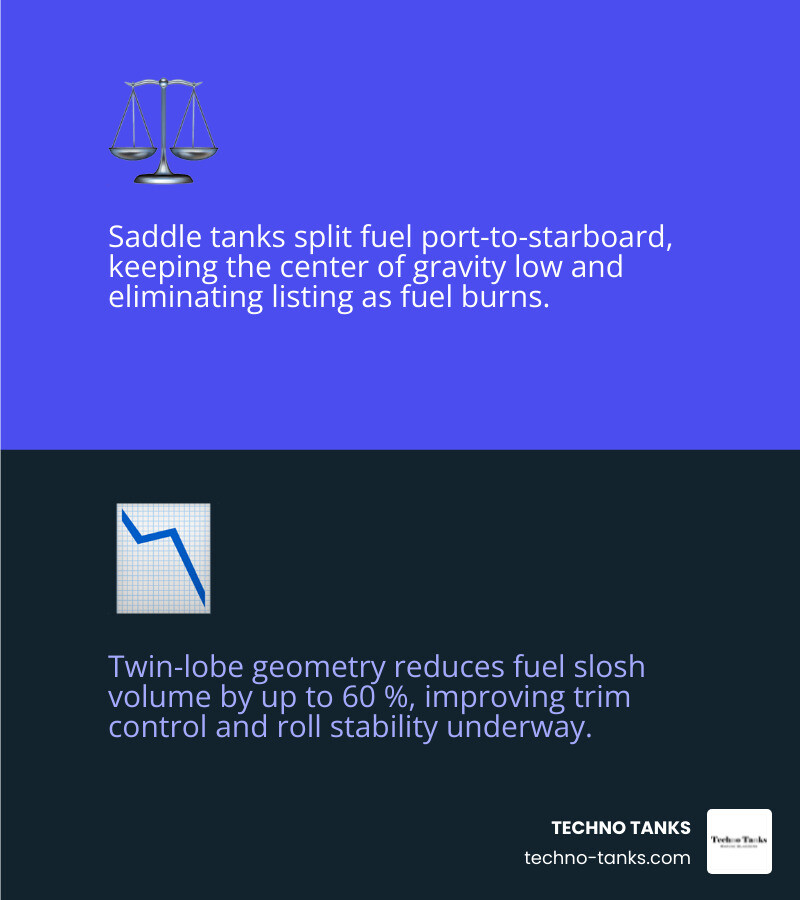
Simple saddle fuel tank glossary:
What a Saddle Fuel Tank Is and Why Placement Matters
When we talk about a saddle fuel tank, we are referring to a specific geometry designed to hug the contours of a vehicle or vessel. In heavy-duty trucks, these are the cylindrical or rectangular tanks you see hanging off the frame rails. In the marine world, they serve a much more “invisible” but critical role below the deck.
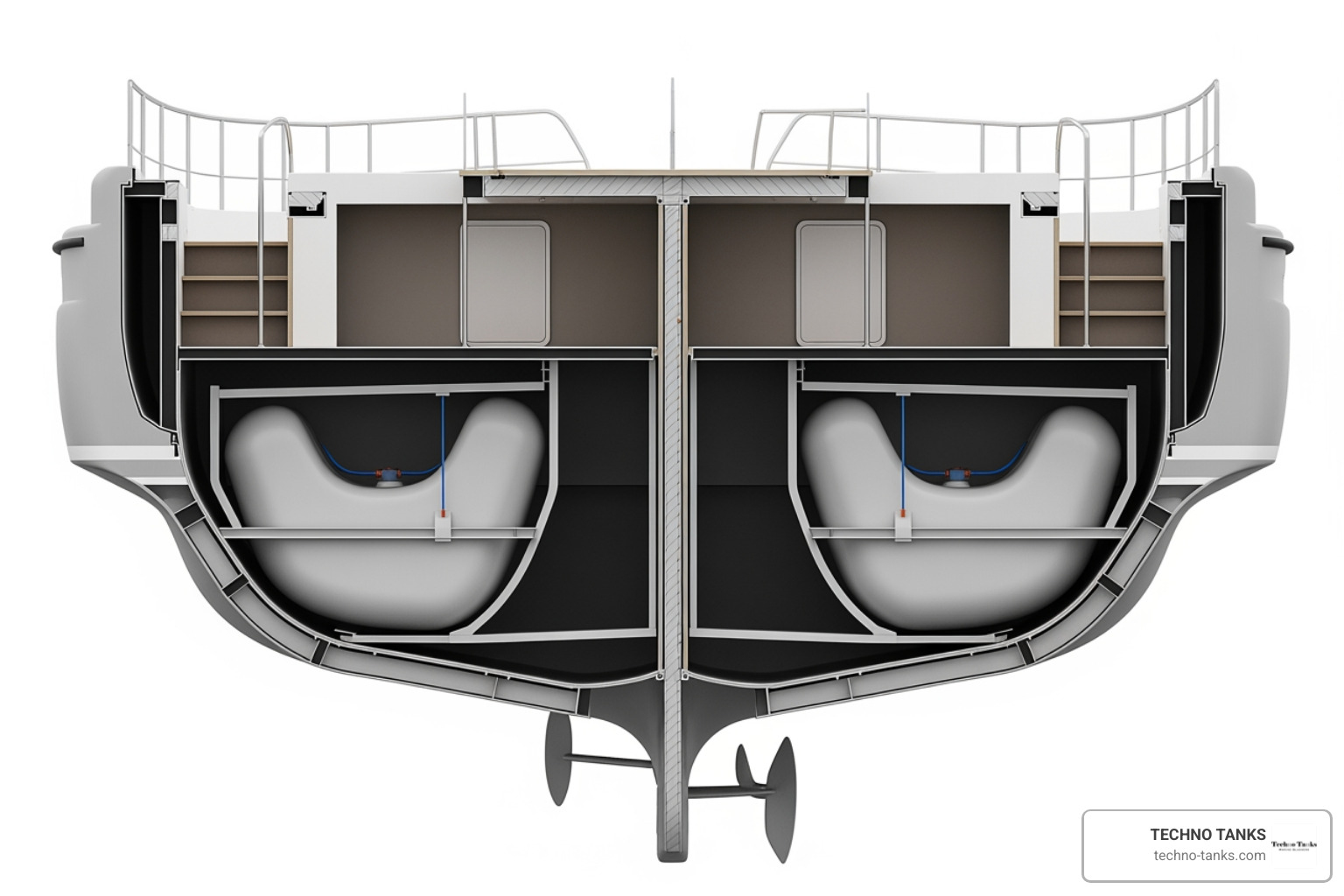
A saddle fuel tank setup typically consists of two tanks – one on the port side and one on the starboard side – connected by a manifold or transfer system. This side-mounted layout is a departure from the traditional centerline tank, which sits directly over the keel. While a centerline tank is great for keeping weight in the middle, it often competes for space with the engine, cabin soles, or storage lockers.
How a saddle fuel tank differs from rectangular and custom-fit below-deck tanks
Unlike a standard rectangular “belly tank” that sits flat in the bilge, a saddle fuel tank is often shaped to match the deadrise (the angle) of the hull. This twin-lobe approach allows us to utilize the narrow, outboard spaces of the bilge that would otherwise go to waste.
Key differences include:
- Geometry: Rectangular tanks require a flat “floor” in the bilge. Saddle tanks are often tapered or angled to fit snugly against the hull sides.
- Baffling: Because saddle tanks are narrower and longer, the internal baffling must be designed to prevent fuel from rushing forward or backward during rapid acceleration or heavy swells.
- Deck Clearance: By moving fuel to the sides, we can often lower the cockpit floor, providing more “headroom” or “toe-room” in the boat’s interior.
Why saddle fuel tank layouts can improve balance in certain hulls
Stability is the name of the game in boat design. A single large tank in the center of the boat can create a “free surface effect” where fuel sloshes from side to side, actually making the boat less stable. By splitting that capacity into a saddle fuel tank configuration, we lock the weight into two distinct zones.
This layout improves port-starboard balance significantly. If you have a heavy galley on the port side, you can slightly offset the fuel load on the starboard side to keep the boat level at rest. Furthermore, keeping the fuel low and outboard can actually dampen the roll of the boat in some hull designs, providing a more stable platform for fishing or cruising. For a technical background on why liquid movement matters, the concept is closely related to the free surface effect.
Where Saddle Fuel Tanks Are Used in Marine Fuel Storage
While the term “saddle tank” is famous in the automotive world – specifically the controversial 1973-87 GM pickup design where tanks were mounted outside the frame rails – their application in the marine industry is much more focused on safety and range extension.
Common marine use cases for a saddle fuel tank below deck
We see these tanks most often in offshore fishing boats and long-range cruisers. In these vessels, deck space is a premium. By utilizing asymmetrical compartments on either side of the engine room, builders can pack in hundreds of gallons of diesel or gasoline without sacrificing the main walkway.
Custom installations often include:
- Range Extension: Adding auxiliary saddle tanks to a factory setup to reach distant fishing grounds.
- Workboats: Maintaining a clear center deck for hauling gear or cargo while keeping fuel tucked away.
- Inland Craft: Using shallow-profile saddle tanks to maintain a low draft in skinny water.
For those looking to maximize their specific hull shape, checking out custom marine fuel tanks is often the best route to ensure every inch of bilge space is used efficiently.
Typical capacities and dimensions for marine installs
Capacities for a saddle fuel tank vary widely depending on the application. In the vintage automotive world, you might find tanks as small as 7 gallons per side. In modern marine applications, the numbers are much higher:
- Small craft: 7 to 15 gallons per side for compact installations.
- Standard Marine: 50 to 160 liters tanks are common for smaller to mid-sized boats.
- Larger custom installs: 100 to 300+ gallons depending on hull volume and mission profile.
When flexible fuel storage is a better fit than rigid saddle layouts
Rigid metal or plastic tanks are useful in many permanent builds, but they have a major drawback: you cannot easily fit a large rigid tank through a small inspection hatch. This is where flexible fuel storage can be the better choice.
At Techno Tanks, we specialize in flexible marine fuel bladders. These are made from patented, recyclable thermoplastic polyurethane (TPU). Unlike a rigid saddle fuel tank, a bladder can be rolled up, inserted through a small opening, and then filled to expand into the available space.
This is a game-changer for:
- Awkward Spaces: Bilges with complex curves where a rigid tank would leave space unused.
- Weight Savings: TPU is significantly lighter than stainless steel or aluminum.
- Temporary Range: If you only need extra fuel for one big trip a year, a bladder is easier to manage than a permanent tank install.
To understand how to size these for your boat, see our fuel bladder sizing guide or read our deep dive into fuel bladder vs fuel tank comparisons.
Materials, Construction, and Core Specifications to Compare
Choosing the right material for your saddle fuel tank is a decision that will affect the boat for the next 20 years. In the marine environment, corrosion is the enemy.
Material choices: aluminum vs stainless steel vs polyethylene vs flexible TPU
- 5083 Marine-Grade Aluminum: This is the industry standard. It is lightweight and offers excellent resistance to saltwater. However, it is susceptible to galvanic corrosion if it comes into contact with stainless steel fittings without proper insulation.
- 304/316 Stainless Steel: 304 is often used for inland, freshwater boats. 316 is the marine-grade choice for saltwater. It is incredibly strong but much heavier and more expensive than aluminum.
- High-Density Polyethylene (HDPE): These are plastic tanks. They are immune to corrosion and very durable, though they can sometimes allow slight fuel vapor permeation over long periods.
- Flexible TPU: Techno Tanks’ preferred material for flexible fuel bladders. It is recyclable, highly puncture-resistant, and does not face the weld-cracking issues that can affect rigid tanks in high-vibration environments.
Key specs to review before you buy
When you are looking at a saddle fuel tank, do not just look at the gallon count. Check these specifications:
- Wall Thickness: For aluminum, you want at least 1/8 in. or 3/16 in. for larger tanks.
- Fittings: Look for 1.5-inch BSP/NPT for fillers and 3/8-inch for fuel feeds and returns.
- Inspection Hatch: A 200 mm (8-inch) hatch is valuable for inspection and cleaning access where applicable.
- Anti-Siphon Valves: Required by the USCG for gasoline engines to prevent fuel from siphoning into the bilge if a line breaks.
Rigid vs. Flexible saddle fuel tank options
| Feature | Rigid Aluminum Tank | Flexible TPU Bladder |
|---|---|---|
| Installation | Requires deck removal or large hatches | Fits through small access ports |
| Durability | Subject to weld cracks/corrosion | Puncture resistant and flexible |
| Weight | Heavy | Ultra-lightweight |
| Customization | High (welded to shape) | High (expands to fill void) |
| Sustainability | Recyclable | Recyclable (Techno Tanks TPU) |

Installation, Compliance, and Safety Requirements
Installation is where most saddle fuel tank systems succeed or fail. Because these tanks sit on the sides of the boat, they are subject to different forces than a centerline tank.
Best practices for installing a saddle fuel tank below deck
- Support and Padding: Never bolt a metal tank directly to a frame. Use neoprene strips or support pads to allow for expansion and to prevent crevice corrosion where water gets trapped between the tank and the hull.
- Mounting Straps: Use heavy-duty stainless steel straps with rubber liners.
- Venting: Each tank needs its own vent, routed to reduce the chance of fuel discharge during hard motion or refueling.
- Bonding: Metal tanks must be electrically bonded to the boat’s grounding system to reduce static risk during fueling and to help manage galvanic corrosion.
Marine standards and what compliance actually covers
If you are buying a tank in May 2026, it must meet modern standards. In the US, look for ABYC H-24 and USCG compliance. In Europe and the UK, tanks must have CE or UKCA marking and meet ISO 21487 standards. For reference, the American Boat and Yacht Council publishes widely used safety standards for marine systems.
Compliance ensures the tank has undergone:
- Pressure Testing: Usually 3 PSI for several hours.
- Impulse Testing: Some standards require repeated pressure cycles to ensure the tank will tolerate wave and vibration loads.
- Fire Resistance: The tank must withstand a fire test without leaking for the required duration.
Safety considerations for side-mounted fuel tank layouts
The history of the saddle fuel tank includes some important lessons from automotive side-mounted designs, where impact vulnerability became a major safety issue.
In a boat, we face a similar concern from side impacts such as docking mishaps or collisions. To reduce risk, marine saddle tanks should be:
- Mounted inside structural stringers whenever possible.
- Baffled internally to reduce the hammer effect of fuel sloshing against the tank walls.
- Constructed with rupture-resistant materials appropriate for the vessel and installation envelope.
Pricing, Maintenance, and How to Choose the Right Setup
How much should you expect to pay for a saddle fuel tank in 2026? Pricing is driven by material costs and fabrication complexity.
Typical price ranges by size and construction
- Small Polyethylene Tanks (7-15 gallons): $200 – $600.
- Mid-Sized Aluminum/Stainless (40-100 gallons): $800 – $1,800.
- Larger custom marine systems: Pricing varies significantly based on material, fittings, certification, and fabrication complexity.
- Custom Marine Bladders: Prices vary by size but often offer a lower total cost of installation because you may not need major structural work to fit them.
Maintenance and inspection checklist for long-term safety
We recommend a full inspection every six months:
- Check for “White Powder”: On aluminum tanks, this indicates corrosion.
- Scent Test: If you smell raw gas, check the vent lines and the sender flange gasket first.
- Strap Tension: Ensure the tank has not shifted. A shifting tank can wear a hole through its own side.
- Baffle Noise: If you hear a clunk when the boat moves, an internal baffle may have broken loose.
- Clean the Bilge: Standing water against the bottom of a saddle fuel tank is a leading cause of premature failure.
Choosing between rigid saddle tanks and range-extension alternatives
If you are building a new boat, a permanent saddle fuel tank integrated into the hull can be a strong choice. But if you are retrofitting an older boat or need to fuel your wanderlust for a specific long-range trip, a flexible bladder is often the more logical investment.
For those cruising the islands or heading offshore for tuna, having extra capacity without the permanent weight and maintenance of a metal tank can be a major advantage. You can explore more info about custom fuel solutions to see how these fit into your specific mission profile.
Frequently Asked Questions About Saddle Fuel Tank Selection
What size saddle fuel tank do I need for my boat?
Calculate your engine’s fuel burn at cruise speed and multiply it by the number of hours you want to stay out, then add a 10-20% safety reserve. Measure your bilge compartments carefully, leaving at least 1-2 inches of clearance on all sides for expansion and airflow.
Is a rigid or flexible saddle fuel tank better for stability?
Flexible tanks (bladders) are often better for stability because they “collapse” as fuel is used. This eliminates the “free surface effect” (sloshing) that happens in a half-empty rigid tank.
How much does a custom marine saddle fuel tank cost in 2026?
A custom-fabricated aluminum tank for a 50-foot yacht will likely run between $2,500 and $5,000 depending on the complexity of the baffles and the number of fittings. TPU bladders offer a competitive price point with much easier installation.
Conclusion
Planning your fuel storage is about more than just fitting the biggest “bucket” possible into your boat. By choosing a saddle fuel tank layout, you are making a conscious decision to prioritize stability, trim, and safety. Whether you go with a traditional rigid aluminum setup or a modern, flexible TPU bladder from Techno Tanks, understanding the physics of fuel placement will keep your vessel level and your range extended.
If you’re ready to upgrade your boat’s range without the headache of major structural modifications, check out Techno Tanks fuel storage solutions to see how our patented materials can change the way you cruise.

