
Yacht Fuel Range Planning: Know Your Baseline Before Adding Capacity
Yacht fuel range is one of the most important numbers any boat owner needs to know before leaving the dock. Get it wrong, and you’re not just stranded — you’re in danger.
Here’s a quick answer based on vessel size:
| Yacht Type | Typical Size | Approximate Fuel Range |
|---|---|---|
| Small motor yacht | 30–50 ft | 200–400 nautical miles |
| Mid-size motor yacht | 50–80 ft | 500–1,000 nautical miles |
| Superyacht | 80–200+ ft | 1,000–3,000+ nautical miles |
| Expedition yacht | 70–250+ ft | 3,000–6,000+ nautical miles |
| Sailing yacht (motoring) | Any | 100–150 nm/day |
These numbers assume efficient cruising speeds and calm conditions. Real-world range drops fast when you push the throttle or run into rough weather.
A 40-foot cruiser with a 1,000-liter tank, running at 10 knots and burning 40 liters per hour, covers roughly 250 nautical miles before needing a refuel. A 75-foot expedition yacht with a 20,000-liter tank can stretch that to around 1,600 nautical miles at 12 knots. The difference is tank size, hull design, and how you drive the boat.
If you’ve ever come back from a fishing trip riding on fumes — or cut a cruise short because the gauge dropped faster than expected — you already know why understanding your range matters.
If your calculated range leaves too little margin for the route you actually run, the next question is whether temporary auxiliary capacity makes sense. See offshore fuel bladder solutions for flexible fuel-storage options designed around marine range extension, then size the system against your vessel, route, fuel consumption, and operating conditions.
I’m Ivan Jimenez, founder of Digital Ivan and Doral SEO, where I build authority content systems for technical and marine industries, including in-depth research on yacht fuel range and vessel efficiency for clients like Techno Tanks. In the sections ahead, we’ll break down exactly how to calculate your range, what eats into it, and how to carry more fuel safely without modifying your boat.
Understanding Yacht Fuel Range and Consumption Rates
To master your yacht fuel range, we first have to speak the language of the engine room. In the maritime world, we don’t talk about “miles per gallon” in the same way we do with cars. Instead, we focus on Gallons Per Hour (GPH) or Liters Per Hour (LPH).
Why? Because water provides constant resistance. Unlike a car that can coast on a highway, a yacht is always working against the medium it’s in. Your fuel consumption is tied directly to how hard the engine works to overcome that resistance.
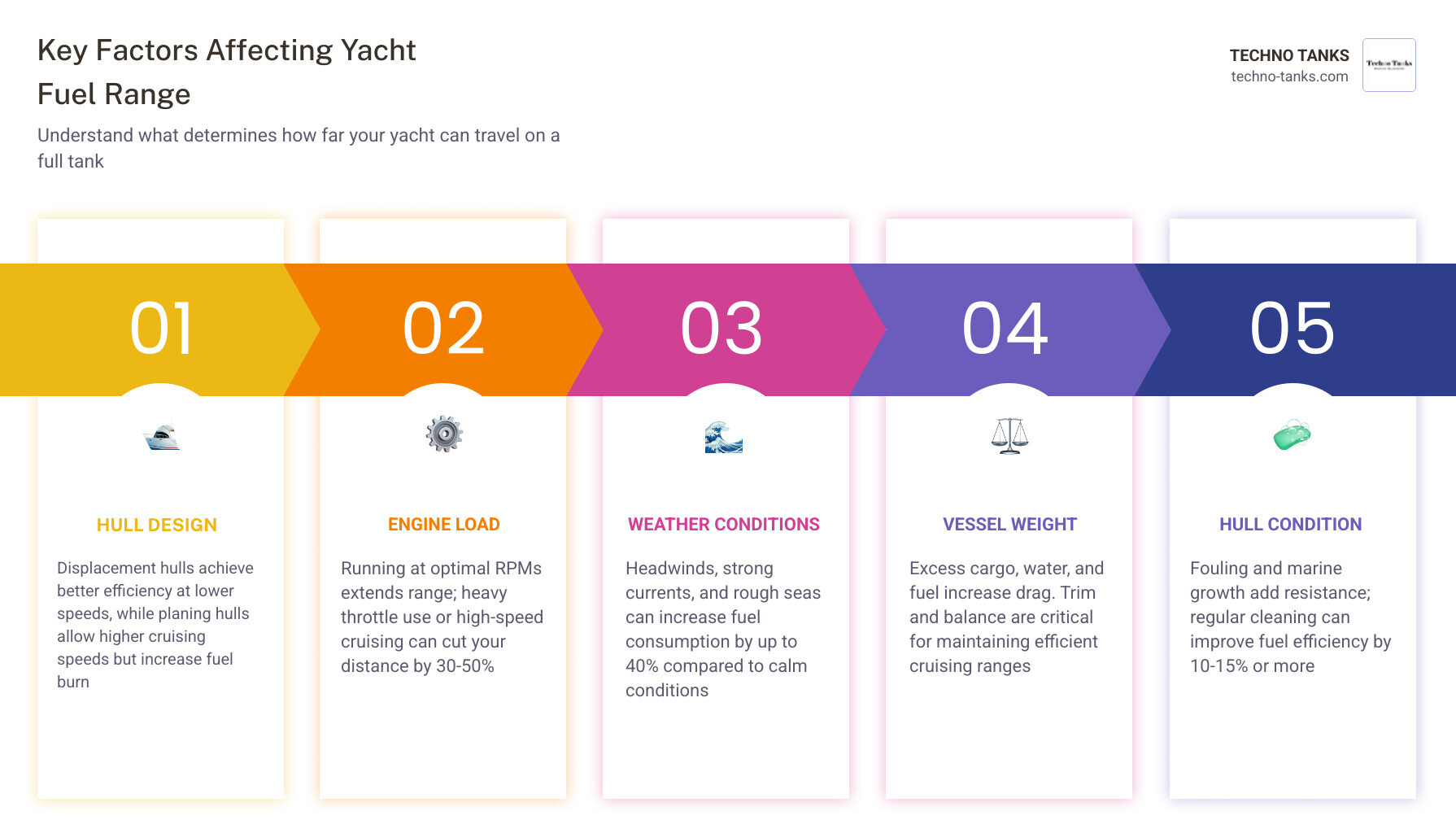
The Role of Hull Design
Hull design is perhaps the biggest factor in determining how much fuel you’ll burn.
- Displacement Hulls: Found on trawlers and large superyachts, these move through the water. They are incredibly efficient at lower speeds (hull speed) but have a “speed ceiling.”
- Planing Hulls: Common on sportfishers and smaller motor yachts, these are designed to rise up and skim on top of the water. They burn a massive amount of fuel to get “on plane,” but once there, they can cover distance quickly.
- Semi-Planing Hulls: A middle ground, offering more speed than a displacement hull while remaining more stable than a pure planing hull.
For a deeper look at which hull might suit your needs, check out our guide on the Top 5 Power Boats to Consider.
According to the Yacht Fuel Capacity and Consumption Guide, a 100ft motor yacht typically burns between 50 and 80 GPH at cruising speed. If you push that same yacht to its maximum speed, that number can easily double, illustrating how sensitive range is to the captain’s right hand.
Average Yacht Fuel Range by Vessel Size
As we move into May 2026, the technology behind marine engines has improved, but the physics of moving a heavy object through water remains the same. Size matters because it dictates how much fuel you can carry.
- Small Yachts (30–50 ft): These are often used for coastal hopping. A 35-foot motor yacht usually manages about 200–300 miles in a day. With a standard tank of roughly 300 gallons, they are perfect for weekend trips but require careful planning for anything crossing an ocean.
- Medium Yachts (50–80 ft): These vessels bridge the gap between coastal cruising and serious offshore work. You can expect a range of 500 to 1,000 nautical miles. A 75-foot yacht with an 11,000-liter tank can often reach 1,500 nautical miles if kept at a conservative pace.
- Superyachts (80–200+ ft): Once you cross the 100-foot mark, fuel capacities explode. We’re talking about tanks that hold 10,000 to 50,000 gallons. These vessels are designed for trans-oceanic crossings, often boasting a yacht fuel range of 3,000+ nautical miles.
- Expedition/Explorer Vessels: These are the “overlanders” of the sea. Built with massive displacement hulls and humongous fuel reserves, some can travel 6,000 nautical miles without seeing a dock.
For a more detailed breakdown of these distances, the resource How Far Can A Yacht Travel? provides excellent updated benchmarks for 2026.
Calculating Your Yacht Fuel Range for Long Voyages
Calculating your range isn’t just about looking at a gauge; it’s about math and safety margins. The basic formula is: Distance (D) = Speed (S) x Time (T).
However, to find your range based on fuel, you need to know your GPH at a specific RPM.
- Determine Burn Rate: If you burn 20 GPH at 10 knots.
- Check Capacity: You have a 400-gallon tank.
- Calculate Total Hours: 400 / 20 = 20 hours of runtime.
- Calculate Total Range: 20 hours x 10 knots = 200 nautical miles.
The Golden Rule of Fuel: The 1/3 Rule or the 20% Margin Never plan to use 100% of your fuel. We always recommend a 10% to 20% safety margin. This accounts for unexpected head-on currents, rougher seas than forecasted, or having to run the generator longer than planned. If your math says you can go 200 miles, plan your trip as if you can only go 160.
To help you figure out how much extra capacity you might need for a specific trip, refer to our Fuel Bladder Sizing Guide.
Factors That Impact Fuel Efficiency and Distance
Efficiency is a moving target. What worked on a calm Tuesday might not work on a choppy Friday.
The “Speed Penalty”
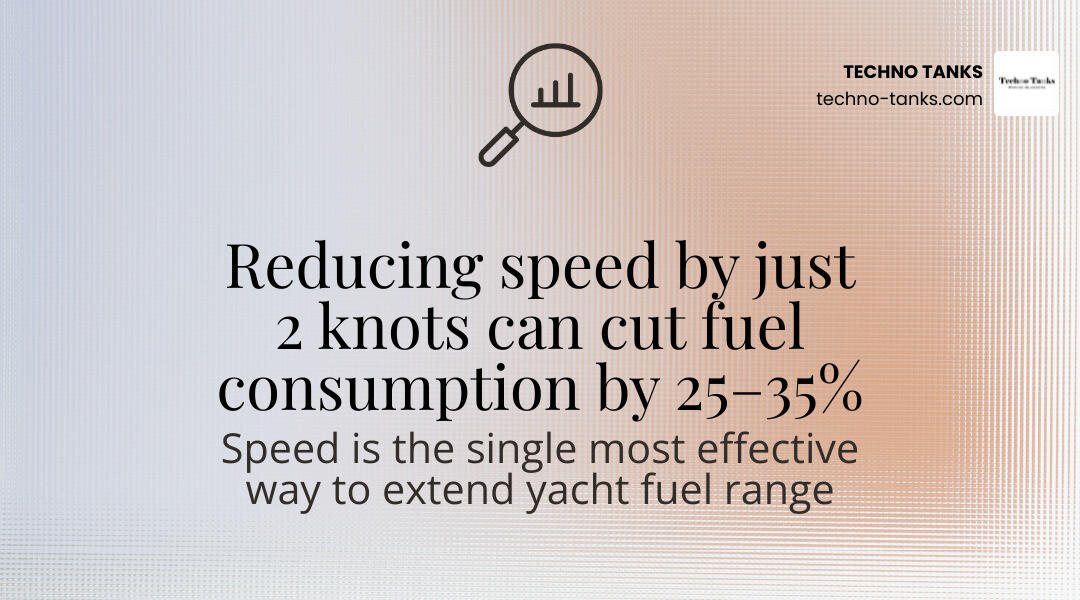
Speed has an exponential relationship with fuel burn. On many yachts, slowing down by just 2 knots can cut your fuel consumption by 25–35%. This is the single most effective way to extend your yacht fuel range.
Environmental Factors
- Sea State: Pounding into 4-foot waves requires significantly more throttle to maintain speed than cruising on “glass.” Adverse conditions can increase fuel use by up to 30%.
- Wind Resistance: On large yachts with high superstructures, a strong headwind acts like a sail in reverse.
- Hull Fouling: Algae, barnacles, and “slime” create drag. A dirty hull can decrease your efficiency by 15–20%. Annual antifouling is a fuel-saving investment.
Weight Management
Every extra pound requires energy to move. Carrying full water tanks, heavy tenders, and unnecessary gear adds up. For smaller yachts, weight reduction can improve efficiency by 5–10%.
For more technical insights on how these variables interact, Yacht Fuel | Efficiency Insights offers a deep dive into modern telemetry and performance tracking.
Engine Type and Modern Propulsion Systems
The “heart” of your yacht dictates how thirstily it drinks. In 2026, we see a wide variety of propulsion technologies.
- Diesel Reliability: Diesel remains the king of the ocean. It’s safer (less flammable than gas) and more energy-dense. Modern common-rail diesel engines are about 15–20% more efficient than those from the early 2000s.
- Hybrid Systems: Growing in popularity, hybrid yachts use electric motors for low-speed maneuvering and “hotel loads” (lights, AC), switching to diesel for cruising. This can reduce overall fuel consumption by 15–30%.
- Gas Turbines: Found on some ultra-high-speed superyachts, these are powerful but incredibly thirsty, sometimes burning over 1,000 gallons per hour at full tilt.
If you are looking for a vessel that won’t break the bank at the pump, you might find inspiration in our list of the Top 5 Inexpensive Yachts in 2022. While the market has evolved, these models remain benchmarks for efficiency.
The Economics of Refueling in 2026
Fuel is typically the largest variable cost in yachting, representing 8–12% of a vessel’s annual operating budget. For charter yachts, that can climb to 25%.
As of May 2026, marine diesel prices generally fluctuate between $4.00 and $7.00 per gallon, depending heavily on where you are.
- USA (East/Gulf Coast): Often the most affordable due to infrastructure.
- Mediterranean: Expect to pay 50–70% more per gallon than in the US.
- Remote Islands: Prices can skyrocket due to the cost of barging fuel to distant docks.
The “Hidden” Burn: Generators and Hotel Loads
When calculating your yacht fuel range, don’t forget the “hotel load.” Your air conditioning, refrigeration, and electronics run off generators. A large yacht generator can burn 3–8 GPH. If you’re at anchor for three days, you might burn 150+ gallons without ever moving the propellers.
To get a better handle on these costs, the Yacht Fuel Cost Calculator is an essential tool for budgeting your next season. For our Spanish-speaking readers, we also have a guide on Los 5 Mejores Barcos a Potencia a Considerar that touches on economical power options.
Strategies to Extend Your Range and Optimize Performance

If you want to go further, you have two choices: burn less or carry more.
Optimization Tips:
- Slow Down: Find your “sweet spot”—usually around 70–80% of maximum RPM.
- Clean the Bottom: A clean hull is a fast hull.
- Propeller Pitch: Ensure your props are optimized for your typical cruising load.
- One-Engine Cruising: On twin-engine yachts, running one engine at low speeds can sometimes save fuel, though you must be careful about “windmilling” the idle prop.
For many, the best way to extend range is through auxiliary storage. Our Marine Fuel Bladders are designed specifically for this. They allow you to carry hundreds (or thousands) of extra gallons on deck, which are consumed first. Once empty, the bladder is rolled up, and you continue on your internal tanks.
Learn more about these options in our guide on Popular Marine Fuel Bladder Sizes and Their Uses.
Using Auxiliary Storage to Reach Remote Destinations
Imagine wanting to fish the remote banks of the Bahamas or cross the Pacific. Often, the factory fuel tank just isn’t enough. This is where the “range extension” mindset comes in.
Using a fuel bladder isn’t just about convenience; it’s about safety. It gives you the “buffer” needed to reach remote fuel docks that might be closed or out of service when you arrive. However, there are differences in how you store fuel. We’ve broken down the pros and cons in our Fuel Bladder vs Fuel Tank comparison.
Frequently Asked Questions about Yacht Fuel
How much fuel does a 100ft yacht burn per hour?
At a standard cruising speed (approx. 12 knots), a 100ft displacement yacht burns about 50–80 gallons per hour. If it’s a planing hull moving at 20+ knots, that consumption can jump to 120 GPH or more.
How far can a yacht go on one tank?
It varies wildly by size. A small 35-foot cruiser might go 250 nautical miles, while a 150-foot superyacht can travel over 3,500 nautical miles—enough to cross the Atlantic Ocean.
What is the most efficient cruising speed for a motor yacht?
For most vessels, “displacement speed” (around 8–10 knots) is the most efficient. For planing hulls, there is a “sweet spot” just after the boat levels out on top of the water, usually between 20 and 25 knots. Avoiding “plowing” (the speed between displacement and planing) is key, as this is where fuel is wasted most.
Conclusion
Mastering your yacht fuel range is the key to true freedom on the water. Whether you’re planning a coastal hop or a trans-oceanic expedition, understanding the math of GPH, the physics of hull drag, and the economics of the fuel dock will make you a more confident captain.
At Techno Tanks, we specialize in helping you push those boundaries. Our flexible fuel bladders are made from patented, recyclable thermoplastic polyurethane, offering a durable and eco-friendly way to carry between 30 and 3,000 extra gallons of fuel. When the standard tanks aren’t enough to get you to that remote fishing spot or across that stretch of open ocean, we provide the extra reach you need.
Ready to extend your horizons? Explore Marine Fuel Bladders today and see Why You Should Use Techno Tanks and Marine Fuel Bladder for Marine Bulk Liquids to ensure your next voyage is limited only by your imagination, not your fuel gauge.

