
What You Need to Know Before Your First Long Passage
Long range cruising means something specific: weeks at sea, hundreds or thousands of miles from the nearest marina, relying entirely on your vessel, your systems, and your planning.
It is not an extended weekend trip. It is not coastal hopping with an overnight stop. It is a fundamentally different relationship with the ocean — and with your boat.
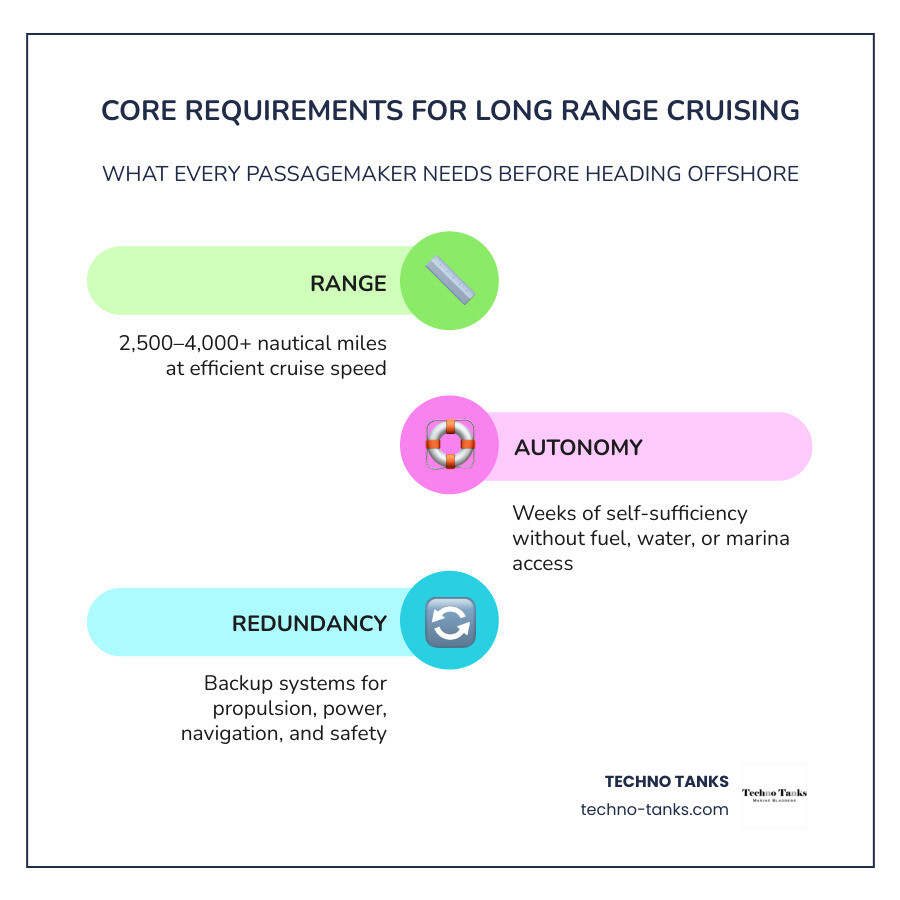
Here is what defines true long range cruising at a glance:
| Requirement | What It Means in Practice |
|---|---|
| Range | 2,500–4,000+ nautical miles at efficient cruise speed |
| Autonomy | Weeks without fuel, water, or marina access |
| Redundancy | Backup systems for propulsion, power, and navigation |
| Seakeeping | Stable, predictable motion in open ocean conditions |
| Storage | Enough fuel, water, food, and spares for the passage |
| Self-sufficiency | Everything you need must be on the boat |
If your current setup falls short in any of those areas, a long passage will expose it — usually at the worst possible moment.
The gap between thinking you have enough range and actually having enough range is where most problems begin. A boat that feels fine on a day trip can become a serious liability 600 miles offshore.
I’m Ivan Jimenez, founder of Digital Ivan and Doral SEO, where I build content systems that help people find the right answers before they make costly decisions — including in long range cruising. The research and systems thinking I apply every day translate directly into helping boat owners cut through the marketing noise and understand what truly matters for extended offshore passages.
What Defines True Long Range Cruising?
A true passagemaker is built around endurance, not marina glamour. We define long range cruising as offshore travel where the boat must remain safe, functional, and livable for extended periods without outside support.
What counts as a true long-range cruising yacht?
A real long-range cruiser typically delivers about 2,500 to 4,000 nautical miles at efficient cruise speed, with some expedition-class yachts reaching well beyond that. That number matters because it shifts a boat from “comfortable traveler” to “ocean-capable machine.”
Just as important as raw range are these traits:
- Predictable motion offshore
- Fuel and water capacity sized for weeks away
- Storage for food, parts, tools, and safety gear
- Backup systems for core functions
- Enough load-carrying ability to stay efficient when fully provisioned
In other words, range on a brochure is not enough. The boat has to carry that range in the real world, after you add people, dinghy gear, spare filters, canned food, and the mysterious extra 40 pounds of “just in case” stuff every cruiser somehow acquires.
How long range cruising differs from coastal and performance yachts
Coastal cruisers are usually optimized for shorter hops, easier access to fuel docks, and lighter loads. Performance yachts often prioritize top speed. That can be fun, but speed and endurance often pull in opposite directions.
Long-range cruisers usually favor:
- Displacement or semi-displacement efficiency
- Lower fuel burn at moderate speeds
- Better service access
- Stronger structures and weather protection
- More tankage and heavier systems
- Greater comfort in rough water
A planing yacht may sprint quickly, but a passagemaker is built to keep going when conditions are less polite. Offshore, top speed matters far less than fuel economy, seakeeping, and fatigue reduction.
The mission profile that should drive every buying decision
Before looking at brands, layouts, or shiny appliances, we should define the mission.
Ask:
- Are we a cruising couple or a family?
- Will we live aboard full time or cruise seasonally?
- Are we island hopping, making canal transits, or planning ocean passages?
- Do we want shallow-water access, expedition capability, or maximum comfort at anchor?
- Are we willing to cruise at 7 to 9 knots if it buys us serious range?
The right boat for a couple doing long seasonal passages is not always the right boat for a family with kids, and neither is necessarily the right boat for a luxury-focused owner who wants crew support and higher average speeds.
Design Features That Make a Yacht Offshore-Ready
Hull types, efficiency, and stability for long range cruising
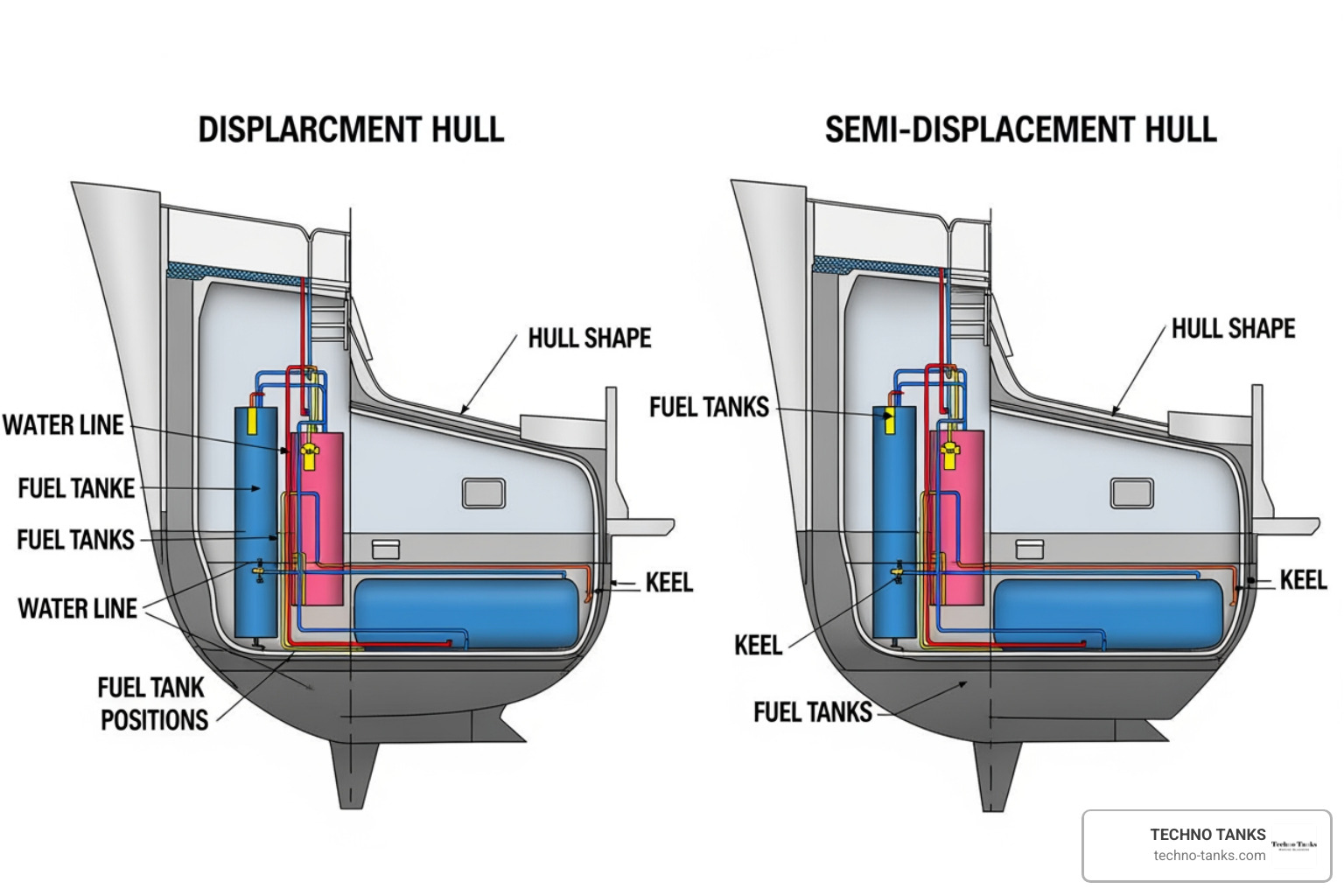
Hull form is the heart of offshore capability.
Full-displacement hulls are the classic long-range solution. They move efficiently at lower speeds, carry weight well, and usually offer kind, predictable motion. Semi-displacement hulls can add speed flexibility, though usually with some fuel-burn penalty. Catamarans bring a different formula: wide beam, big interior volume, shallow draft, and often excellent efficiency for their size.
Each has tradeoffs:
- Full-displacement monohulls: excellent range, tracking, and load carrying
- Semi-displacement monohulls: more speed options, still capable if well designed
- Catamarans: more living space, flatter running angles, propulsion redundancy, but sensitive to loading and, in sailing cats, bridgedeck clearance
For power and sailing cats intended for offshore work, bridgedeck clearance matters a lot. Too little clearance can lead to repeated slamming, which is exhausting for crew and hard on the structure.
Redundancy, access, and reliability in real offshore use
Offshore, backup systems are not optional. They are the plan.
We want redundancy in:
- Navigation: primary plotter, paper charts, handheld GPS
- Communications: VHF, satellite device, EPIRB
- Bilge management: electric pumps plus manual backup
- Power: alternators, battery reserve, charging redundancy
- Propulsion where possible
- Steering and autopilot backups
Good offshore boats also make maintenance possible underway. Filters, pumps, strainers, and valves should be reachable without dismantling half the interior. Labeled manifolds, isolation valves, and clean hose runs are not glamorous, but they are exactly what matters when something fails at 2 a.m.
Storage, weight distribution, and tankage that actually work at sea
A yacht can look spacious at the dock and still perform poorly when loaded for passage.
Good offshore storage follows a few simple rules:
- Heavy items low
- Dense items near the centerline where practical
- Spares organized by system
- Frequently used gear easy to reach
- Wet gear separated from dry stores
Fuel and water tanks should be properly baffled to limit free-surface effect. Holding capacity also matters more than many buyers realize, especially on longer legs or in remote cruising areas.
For owners considering extra fuel capacity, marine fuel bladders can be a smart way to increase usable range without permanent structural changes.
Range extension options beyond built-in tanks
Many crews discover that the boat they love is almost right for their intended voyage. “Almost” is not a comforting word offshore.
Range can be extended with:
- Auxiliary fuel tanks
- Flexible fuel bladders
- Portable marine tanks
- Careful reserve planning
- Conservative cruise speeds
This is where Techno Tanks fits naturally into the long-range conversation. We manufacture flexible marine fuel bladders in recyclable TPU, available in 30 to 3000 gallons, giving owners a practical way to add temporary or mission-specific fuel capacity.
If we need added capacity for a crossing, remote island leg, or extended fuel gap, it is worth exploring custom fuel bladders and broader offshore fuel solutions.
Essential Systems for Long Range Cruising Independence

Power generation and battery strategy for long range cruising
Modern long-range cruising is increasingly about electrical autonomy as much as fuel autonomy.
A typical cruising boat can consume 150 to 200 amp-hours per day for refrigeration, lighting, navigation, communications, fans, and watermaking. Add air conditioning and that number can climb fast.
A sensible offshore power strategy may include:
- Solar array
- Lithium battery bank
- Engine alternator charging
- Inverter/charger
- Properly sized genset
- Manual fallback options where possible
Research from bluewater catamaran design sources suggests that 800W of solar is a useful floor, while 1,200W or more is better for true independence. Lithium banks are increasingly favored because they offer more usable capacity and faster charge acceptance than AGM.
Fuel, water, and waste systems for weeks away from marinas
Range is not just about how much fuel we can carry. It is about how well we manage it.
Best practices include:
- Cruise at the boat’s most efficient RPM, not its ego RPM
- Build in a 15 to 20 percent reserve
- Use fuel polishing and good filtration
- Track burn by engine hour and actual conditions
- Account for current, growth on the hull, and weather detours
Water systems matter just as much. A watermaker can dramatically increase autonomy, but only if the power system and maintenance routine support it. For planning, one gallon of water per person per day is a good basic minimum before adding cooking, washing, and comfort margin.
Waste systems need equal attention. Long legs demand realistic holding capacity and practical pump-out strategy.
For more planning help, see Going the Distance Without Running Your Yacht Dry and the Fuel Bladder Sizing Guide.
Navigation, communication, and emergency backups
A true offshore setup should not depend on any single electronic screen.
We recommend carrying:
- Primary chartplotter
- Backup chartplotter or tablet
- Paper charts for critical regions
- Handheld GPS
- AIS
- Radar
- Depth sounder
- Satellite communicator or sat phone
- EPIRB
- VHF radio
For longer routes, many cruisers also value SSB or satellite weather capability. Offshore communication is about more than convenience. It is part of weather routing, emergency readiness, and peace of mind.
Safety equipment and beginner-ready maintenance habits
The best safety gear is the gear we inspect, know how to use, and can reach fast.
Core equipment includes:
- Liferaft
- Jacklines and tethers
- Fire suppression systems
- Ditch bag
- Emergency steering provisions
- Medical kit
- Flares and signaling gear
- Bilge alarms and pumps
Maintenance habits matter just as much as equipment. Keep a written log. Inspect belts, clamps, hoses, strainers, steering gear, and electrical connections regularly. Carry spares for likely failures, not fantasy engine rebuilds at sea.
Comparing the Best Long-Range Cruiser Types and 2025-2026 Benchmarks
Monohull vs catamaran for comfort, efficiency, and safety
Here is the simple version: neither is universally better. The better choice depends on mission, loading, and crew preference.
| Type | Advantages | Tradeoffs |
|---|---|---|
| Monohull | Predictable offshore motion, strong load-carrying, often better heavy-weather feel | More roll at anchor, less interior volume, deeper draft |
| Catamaran | Big living space, flatter motion, shallow draft, twin-engine redundancy | Load sensitivity, wider beam, bridgedeck design becomes critical |
Catamarans often win on liveaboard space and anchor comfort. Monohulls often win on heavy-weather confidence and simpler marina logistics. A well-designed offshore cat can be a serious passagemaker, but it has to be evaluated on hull behavior, load tolerance, and systems design, not just salon square footage.
What current 2025-2026 benchmark yachts show about range and capability
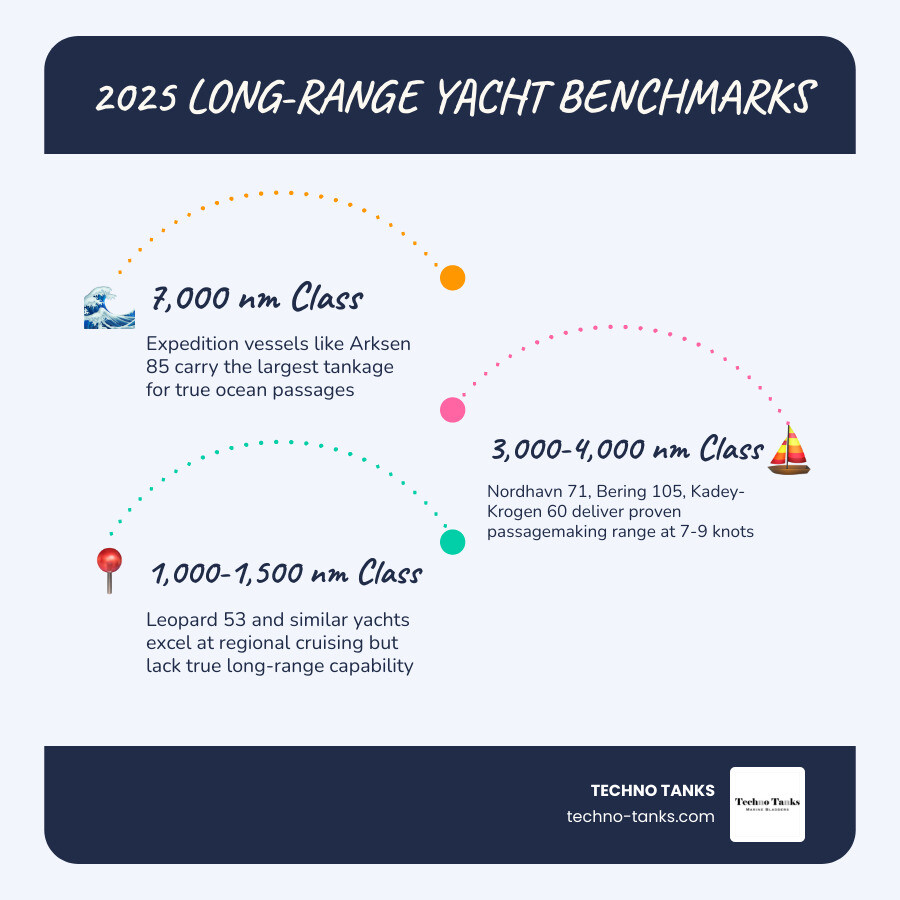
Current benchmarks show a wide spread in what “long-range” means.
At the expedition end:
- Arksen 85: about 7,000 nautical miles
- Bering 105: more than 4,000 nautical miles with 13,208 gallons of fuel
- Kadey-Krogen 60 Open: more than 4,005 nautical miles at around 7 knots
- Marlow 90V: more than 3,500 nautical miles at 9 knots, with much higher top speed available
In the strong passagemaker category:
- Nordhavn 51 and 71: around 3,000 nautical miles at 7 to 8 knots
- ILIAD 62: more than 3,500 nautical miles at 6 knots
- Grand Banks 85: close to 3,000 nautical miles
In the lighter long-distance and hybrid-oriented category:
- Leopard 53: about 1,180 nautical miles at 9.5 knots
- Silent 62 3-Deck: designed around solar-electric operation with a 16.8kW solar array and 286kWh battery bank, aiming for near-unlimited range in the right operating profile
The lesson is simple: not every boat marketed for adventure belongs in the same class. A 1,100 to 1,500 nautical mile yacht may be excellent for regional cruising, but it is not the same thing as a 3,000-plus nautical mile passagemaker.
How builders optimize hulls, storage, and systems for offshore reliability
Across the best offshore boats, we see recurring design themes:
- Reinforced structures and offshore build standards
- Protected helm stations with good visibility
- Walkaround decks and safe handholds
- Ventilated storage to reduce mold
- Acoustic insulation for rest and watchkeeping
- Tankage integrated low in the hull
- Easy access to filters, pumps, and service points
The details matter. A quiet pilothouse, dry deck movement, and accessible engine room can do more for offshore quality of life than another glossy entertainment screen ever will.
Emerging trends shaping the future of long range cruising
The future of long range cruising is increasingly hybrid, solar-assisted, and efficiency-focused.
Trends to watch in 2026 include:
- Larger factory solar arrays
- Lithium-first electrical systems
- Hybrid propulsion on select catamarans and explorer yachts
- Hydro-regeneration on some sailing platforms
- Sustainable interior materials
- Recycled aluminum in expedition builds
- Zero-emission anchoring for longer periods
These developments do not remove the need for diesel range planning yet, but they do reduce generator time, improve autonomy, and make life at anchor quieter.
How to Evaluate a Yacht Before You Commit
What to inspect during dock visits
A dock visit tells us whether the boat was designed to be serviced, not just sold.
Check:
- Engine room access
- Tank inspection ports and hose routing
- Labeling on fuel and water manifolds
- Locker drainage
- Ventilation in cabins and machinery spaces
- Deck hardware backing and condition
- Handholds where people actually move underway
- Freezer and pantry capacity
- Watch berth practicality
If we cannot reach a fuel filter without yoga and regret, that is useful information.
How to run a meaningful sea trial offshore and underway
A proper sea trial should test the boat at realistic cruise settings, not just wide-open throttle.
We want to observe:
- Actual cruise RPM and fuel burn
- Visibility from helm while seated and standing
- Autopilot performance
- Handling in quartering or beam conditions if available
- Noise and vibration levels
- Backing and close-quarters control
- Engine temperatures and system alarms
- Roll behavior at displacement speed
Ask for real numbers, not brochure poetry. Offshore suitability lives in behavior, not adjectives.
Layout and lifestyle choices for couples, families, and luxury-focused owners
Layout should match the crew and the mission.
Couples often prioritize:
- One comfortable owner cabin
- Good watch berth access
- Manageable systems
- Large freezer and practical galley
Families often need:
- Separate bunks
- Extra storage
- More refrigeration
- Safe deck circulation
- Multiple sheltered seating zones
Luxury-focused owners may want more private cabins and entertaining space, but should still evaluate whether the layout works underway. Beautiful islands in the galley mean less if no one can cook safely at sea.
Provisioning, budgeting, and beginner passage planning
Beginners should keep planning conservative and simple.
Start with:
- Water at a minimum of one gallon per person per day
- Food with a 15 to 20 percent contingency
- Fuel reserve of at least 15 to 20 percent
- Weather windows, not wishful thinking
- Realistic daily mileage based on efficient cruise speed
- Medical and repair kits sized to the route
Provision by routine, not panic. Build meals around durable staples, easy-watch snacks, and a few morale boosters. Coffee counts as a safety item in some crews. We are not here to judge.
Frequently Asked Questions About Long Range Cruising
What is a realistic cruising range for long-distance passagemaking?
A realistic range is the usable range after reserve, weather margin, fouling losses, and loading penalties. That number is often lower than the brochure figure.
For true passagemaking, many experts consider 2,500 to 4,000 nautical miles at efficient speed the meaningful benchmark. Real-world owner reviews also show how advertised figures can shrink when reserve fuel is properly protected.
Is a catamaran or monohull better for long range cruising?
It depends on what we value most.
Choose a monohull if we prioritize:
- Traditional passagemaking feel
- Load carrying under heavy stores
- Predictable behavior in rough offshore conditions
Choose a catamaran if we prioritize:
- Living space
- Shallower draft
- Flatter motion
- Twin-engine redundancy
The best answer is the one that supports the mission. For helpful real-world perspective on offshore cat use, see owner-tested offshore catamaran lessons.
What should beginners prioritize first: range, systems, or layout?
Mission first, then systems, then layout polish.
A beautiful layout cannot compensate for weak autonomy. We suggest prioritizing:
- Safe and realistic range
- Simple, maintainable systems
- Backup capability
- Comfortable offshore living
- Nice-to-have amenities last
For more on what separates true passage-makers from coastal boats, this overview of passagemaker design factors explained is useful.
Conclusion
Long range cruising is really a systems problem disguised as an adventure dream. The right hull, the right speed, the right storage, and the right backups all matter. But one of the biggest make-or-break factors is still fuel security.
That is why smarter range extension deserves a place in the planning process. At Techno Tanks, we build flexible marine fuel bladders from patented, recyclable TPU in sizes from 30 to 3000 gallons, helping crews add mission-specific capacity without committing to a major permanent tank modification.
If we are planning farther horizons and want more confidence in our fuel strategy, explore marine fuel bladders. The ocean is already unpredictable enough. Our fuel plan should not be.

