
Understanding Fuel Bladder Sizing / Capacity: Geometric vs. Usable Volume
Fuel bladder sizing and capacity is one of the most practical decisions a marine operator, expedition crew, or commercial fuel-transfer user will make before any serious offshore run or deployment.
Get it right and you have the exact fuel volume you need — in the right footprint, at the right weight, ready to deploy. Get it wrong and you’re either short on range or carrying a bladder too large for your deck, your weight limits, or your compartment.
Here’s a quick reference to orient you before we go deeper:
| Bladder Size | Typical Use Case |
|---|---|
| 25 – 80 gallons | Day boats, water sports, short offshore runs, emergency reserve |
| 100 – 150 gallons | Fishing charters, tour boats, range extension on mid-size vessels |
| 200 – 300 gallons | Long-distance cruising, commercial operators, expedition range |
| 300+ gallons (custom) | Superyacht tenders, offshore staging, industrial and military use |
The right size isn’t just about gallons. It also depends on:
- Available deck or compartment space
- Vessel weight limits and center of gravity
- Fuel type (gasoline, diesel, or water)
- Trip duration and autonomy requirements
- Transfer method (gravity-fed vs. pump)
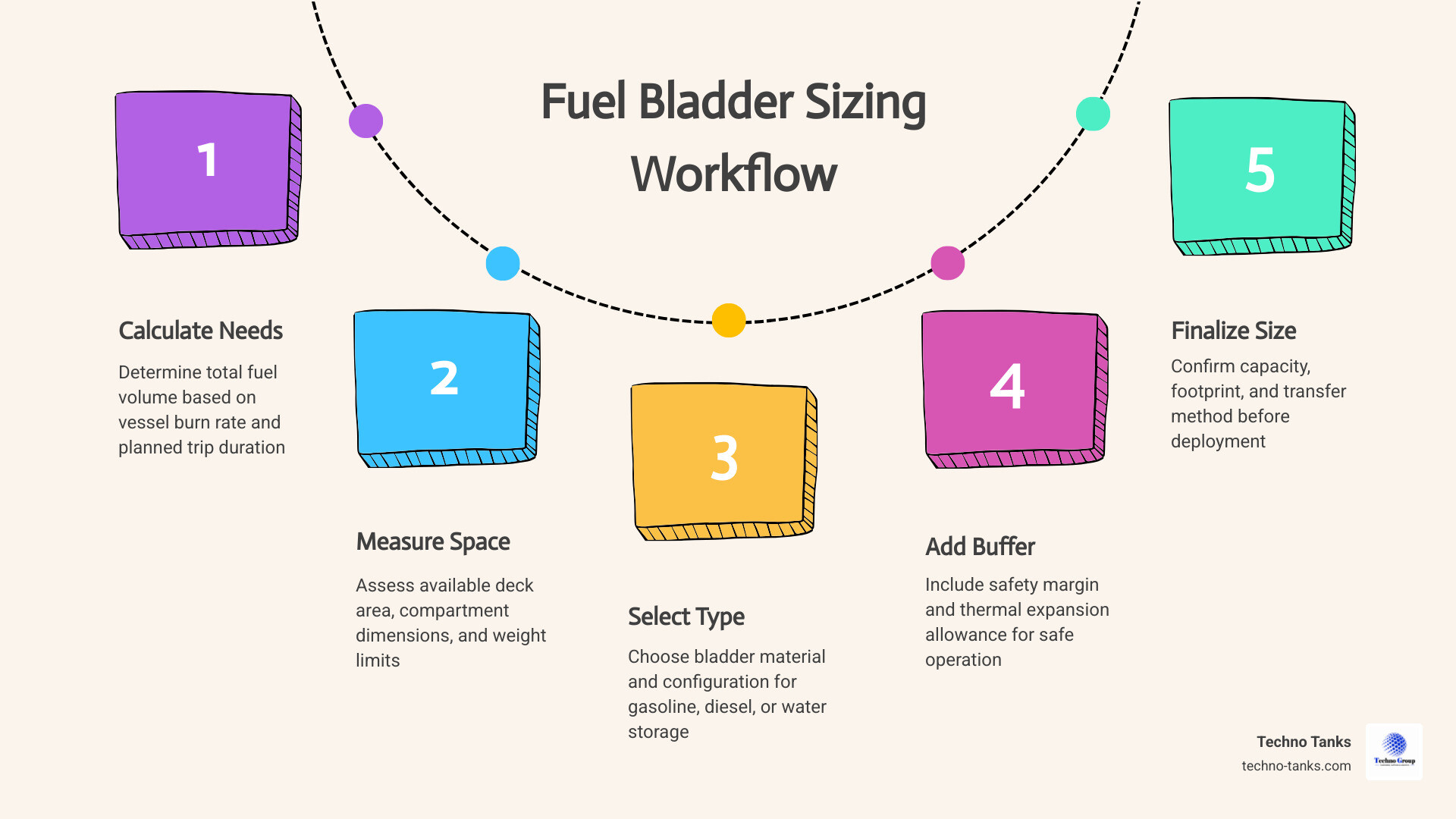
This guide walks through the full sizing process — from calculating required capacity to choosing the right bladder configuration and material for your specific operation.
When evaluating a flexible containment system, operators must distinguish between different definitions of volume. Much like commercial road transport logistics — where cargo capacity is split into geometric, legal, and usable limits as detailed in How Much Does a Tank Trailer Hold? A Manufacturer’s Capacity Guide for Fuel, Water, Milk, Chemical, and LPG | HUAYU Trailer – Semi Trailer Manufacturer — flexible fuel bladders have distinct operational volume thresholds.
- Geometric Capacity: This is the absolute physical volume of the bladder when fully expanded under laboratory conditions. It represents the maximum theoretical limit of liquid the textile envelope can hold before structural failure or over-pressurization occurs.
- Usable (Net) Capacity: This is the actual volume of fuel that can be safely loaded and drawn from the bladder during real-world operations. It is typically 85% to 95% of the geometric volume. This reduction accounts for structural constraints, pump suction limits, physical deck contours, and safety allowances.
- Ullage (Outage) Allowance: Liquid hydrocarbons expand and contract significantly with temperature variations. To prevent structural damage from thermal expansion, a safety margin of air/vapor space (ullage) must be maintained. For example, gasoline expands by approximately 1% for every 15°F rise in temperature. Without a dedicated 5% to 10% ullage space, a bladder filled to 100% geometric capacity at dawn could rupture by mid-afternoon.
For a deeper dive into how these volume layers interact during offshore operations, consult The Complete Guide to Marine Bladder Tanks and Storage.
Sizing Methodology: Calculating Required Capacity for Marine and Commercial Operations
Determining the ideal Fuel Bladder Sizing / Capacity is a precise engineering exercise. Sizing a system based on guesswork leads to either dead weight on deck or an operational range deficit.
To calculate the required capacity, operators must analyze three primary variables:
- Consumption Patterns: The hourly fuel burn rate of the propulsion or power generation systems under realistic operational loads (typically calculated at 75% load).
- Autonomy Days: The duration of the trip or mission before refueled access is available.
- Safety Buffer: A reserve margin (typically 25% for standard operations, and up to 50% for critical offshore or remote missions) to account for adverse weather, head currents, or auxiliary power demands.
To establish precise baseline consumption patterns, operators should monitor fuel flow meters over extended runs rather than relying solely on factory engine curves.
Mathematical Sizing for Extended Vessel Range
To calculate the exact auxiliary capacity required to achieve a specific range extension, use the following formula:
$$\text{Required Auxiliary Fuel (gal)} = \left( \frac{\text{Target Range (nm)}}{\text{Cruising Speed (knots)}} \times \text{Fuel Burn Rate (gal/hr)} \times (1 + \text{Safety Buffer}) \right) – \text{Main Tank Usable Capacity (gal)}$$
Practical Sizing Example:
A vessel plans an offshore transit of 600 nautical miles (nm).
- Cruising Speed: 10 knots (total transit time of 60 hours)
- Fuel Burn Rate: 8 gallons per hour (diesel)
- Main Tank Usable Capacity: 400 gallons
- Safety Buffer: 25% (1.25 multiplier)
$$\text{Total Fuel Required} = 60 \text{ hours} \times 8 \text{ gal/hr} \times 1.25 = 600 \text{ gallons}$$
$$\text{Required Auxiliary Capacity} = 600 \text{ gallons} – 400 \text{ gallons} = 200 \text{ gallons}$$
In this scenario, a 200-gallon auxiliary bladder is required to safely complete the voyage with an adequate safety margin. For budget-conscious operators looking to optimize their vessel’s range without permanent, expensive structural modifications, auxiliary solutions like those discussed in Boat Range Extender Tanks That Won’t Sink Your Budget provide a highly cost-effective alternative.
Fuel Bladder Sizing / Capacity Factors: Deck Space, Weight, and Distribution
Calculating the required fuel volume is only the first step; the physical realities of the vessel or transport platform must support that volume.
- Deck Space Constraints: A bladder must fit entirely within the flat, unobstructed deck area of the vessel. Overhanging any gunwale, hatch, or structural edge introduces friction points that can wear through the polyurethane fabric.
- Weight Limits and Center of Gravity: Fuel is heavy. Diesel weighs approximately 7.1 lbs per gallon (0.85 kg/L), while gasoline weighs roughly 6.1 lbs per gallon (0.73 kg/L). Loading a 300-gallon diesel bladder adds over 2,100 lbs of shifting payload to the deck. This weight must be positioned to avoid compromising the vessel’s stability, trim, or list.
- Tie-Down and Securing Systems: Dynamic forces at sea subject deck cargo to high G-forces. Every bladder must be secured using heavy-duty, marine-grade tie-down straps anchored to structural deck points. This prevents the bladder from sliding, which can cause structural damage or destabilize the vessel. For guidance on securing auxiliary systems safely, see Get a Grip on Your Range with Custom Boat Fuel Bladders.
Marine Fuel Bladder Configurations and Capacity Ranges
Flexible fuel bladders are designed in various configurations to balance capacity requirements with deck space limitations.
Standard Pillow Style vs. Space Saver Footprints
The two primary configurations for deck-mounted marine bladders are Pillow Style and Space Saver models.
- Pillow Style Bladders: These are low-profile, wide-footprint bladders. Their low center of gravity makes them incredibly stable in rough seas, but they consume a significant amount of flat deck space.
- Space Saver Bladders: These utilize a taller, more vertical profile, consuming up to 40% less deck space than a pillow bladder of equivalent capacity. They are ideal for vessels with narrow walkways, cockpit spaces, or busy work decks.
To evaluate these configurations for smaller auxiliary applications, see The Ultimate Guide to 30 Gallon TPU Tanks and Bladders.
| Capacity (Gallons) | Configuration | Nominal Dimensions (L x W x H in) | Approximate Filled Footprint (Sq. Ft.) |
|---|---|---|---|
| 50 | Pillow Style | 40″ x 50″ x 9″ | 13.8 |
| 50 | Space Saver | 32″ x 32″ x 14″ | 7.1 |
| 100 | Pillow Style | 50″ x 64″ x 12″ | 22.2 |
| 100 | Space Saver | 44″ x 44″ x 16″ | 13.4 |
| 300 | Pillow Style | 64.5″ x 96″ x 15″ | 43.0 |
| 300 | Space Saver | 60″ x 60″ x 20″ | 25.0 |
Custom Sizing for Specialized Marine Compartments
When standard footprints do not fit, custom-engineered bladders can be designed to match specialized compartments. Yacht tenders, catamaran hulls, and commercial vessels often have uniquely shaped voids, bilge spaces, or forward lockers that can be utilized for auxiliary fuel storage.
Custom sizing allows operators to maximize fuel capacity by utilizing otherwise wasted space, keeping the deck clear and maintaining a lower center of gravity. To explore custom integration options, review The Best Custom Marine Fuel Tanks to Keep You Cruising.
Material Selection and Medium-Specific Sizing Requirements
The material used to construct a flexible bladder dictates its longevity, environmental resistance, and fluid compatibility.
- Thermoplastic Polyurethane (TPU): This is the premium material choice for hydrocarbon storage. TPU offers exceptional resistance to microbial attack, UV degradation, and chemical breakdown from gasoline and diesel. It has an operational lifespan of 8 to 12 years in harsh marine environments.
- Fuel-Resistant PVC: A more economical material option, suitable for shorter-term deployments or static land-based applications. PVC bladders typically have an operational lifespan of 5 to 8 years.
- Contact Time Considerations: The duration of fluid contact affects material choice. Standard PVC is rated for temporary contact (1 to 3 years), while heavy-duty industrial TPU alloys can handle continuous fuel contact for 7 to 10+ years without material degradation.
Fuel Bladder Sizing / Capacity Differences: Gasoline, Diesel, and Water Compatibility
Sizing requirements vary significantly depending on the specific medium being stored:
- Gasoline: Highly volatile and prone to rapid thermal expansion. Gasoline bladders require strict compliance with safety guidelines, such as those found in [PDF] FIA STANDARD GUIDELINES SAFETY FUEL BLADDERS. They must feature specialized vapor-tight, EPA-compliant venting systems to handle pressure build-up safely.
- Diesel: Less volatile than gasoline but more dense, meaning weight distribution and structural support are critical.
- Potable Water: Requires FDA-compliant, food-grade TPU to prevent taste contamination and microbial growth. Water is also denser than both gasoline and diesel (8.34 lbs/gal), meaning weight limits are reached at lower volumetric capacities.
For a comparison of compact, highly portable options for small vessels, see Never Run Dry with These 30 Gallon Boat Bladders.
Multi-Compartment and Baffled Bladder Dynamics
When carrying large volumes of liquid, dynamic movement (sloshing) can severely impact vessel stability and vehicle handling. This phenomenon is known as the Free Surface Effect.
- Baffled Bladders: Internal fabric baffles restrict the rapid lateral movement of fuel, reducing dynamic weight transfer by up to 60%. This is highly recommended for bladders over 150 gallons deployed on high-speed or deep-V hulls.
- Multi-Compartment Systems: Dividing auxiliary storage into multiple smaller bladders (or a single multi-compartment bladder) provides operational redundancy and allows operators to isolate fuel types. This configuration also allows users to empty one compartment completely, eliminating partial-load slosh.
To understand how auxiliary volume and baffle dynamics affect vessel performance, read Fueling Your Dreams with an 80 Gallon Boat Tank.
Frequently Asked Questions about Fuel Bladder Sizing
How does fuel density affect the weight and capacity limits of a bladder?
Fuel density directly dictates the maximum weight payload of your vessel or vehicle. Because diesel is denser than gasoline, a 300-gallon bladder filled with diesel weighs roughly 2,130 lbs, whereas the same volume of gasoline weighs approximately 1,830 lbs. When operating near gross weight limits, you must calculate capacity based on weight, not just physical volume.
What is the recommended safety margin (ullage) for flexible fuel bladders?
The standard recommended safety margin is 5% to 10% of the bladder’s total volume. This space must be left empty during filling to allow for thermal expansion of the fuel as ambient temperatures rise throughout the day.
How do regional weight regulations impact large-scale fuel bladder transport?
For large-scale commercial fuel transport or staging, regional road regulations place strict limits on gross vehicle weight. In the United States, interstate transport is capped at 80,000 lbs gross weight (unless specialized permits are obtained). In the European Union, limits range from 40 to 44 tonnes, while Australian road trains can handle up to 130 tonnes. These weight limits dictate the maximum volume of fuel that can be legally transported in a single bladder deployment.
Conclusion
Selecting the correct Fuel Bladder Sizing / Capacity requires balancing your range requirements, physical space constraints, weight limits, and material compatibility.
Techno Tanks manufactures flexible fuel bladders and collapsible fuel storage systems designed to meet the demands of marine and commercial operators. Our heavy-duty TPU bladders provide a safe, space-saving alternative to permanent rigid tanks, with capacities ranging from 30 to 3,000 gallons.
Because every application has unique requirements, Techno Tanks pricing depends on your specific size, fuel type, configuration, and project scope. For an accurate, tailored recommendation and pricing:
- Review our Fuel Bladder Sizing Guide
- Contact our engineering team today to request a custom quote based on your operational requirements.

