
Why Choosing the Right Fuel Tank Suppliers Can Make or Break Your Operation
If you’re sourcing from fuel tank suppliers, here’s a quick-reference overview of the top factors to evaluate before you buy:
| What to Evaluate | Why It Matters |
|---|---|
| Tank type (rigid vs. flexible) | Flexible TPU bladders are lighter, portable, and need no major vessel modifications |
| Capacity range | Flexible TPU systems typically cover 30 to 3,000 gallons for marine and remote use |
| Certifications | Look for material safety, EPA compliance, and fuel compatibility standards |
| Material | Flexible TPU is ideal for portability, durability, and recyclability |
| Accessories included | Pumps, gauges, vents, hoses, and fittings affect total system cost |
| Lead time and shipping | Stock availability and freight options vary widely between suppliers |
| Warranty and support | Top suppliers offer technical assistance and multi-year limited warranties |
Running out of fuel mid-trip is more than an inconvenience — it can be a real safety risk on open water or remote terrain. The challenge most boat owners and field operators face isn’t finding a fuel tank. It’s finding the right one from a supplier who understands your specific situation.
The fuel storage industry covers a wide range of products — from heavy permanent infrastructure to lightweight flexible bladders that fit on a boat deck without a single structural modification. Modern suppliers specialize in materials like thermoplastic polyurethane (TPU) that are collapsible, portable, and recyclable.
Knowing what separates a good supplier from a great one takes a little research — and that’s exactly what this guide is for.
I’m Ivan Jimenez, founder of Digital Ivan and Doral SEO, where I build content and authority systems for industrial and technical brands — including work with fuel tank suppliers and storage solution companies like Techno Tanks. I’ll walk you through the most important considerations so you can source confidently and skip the guesswork.
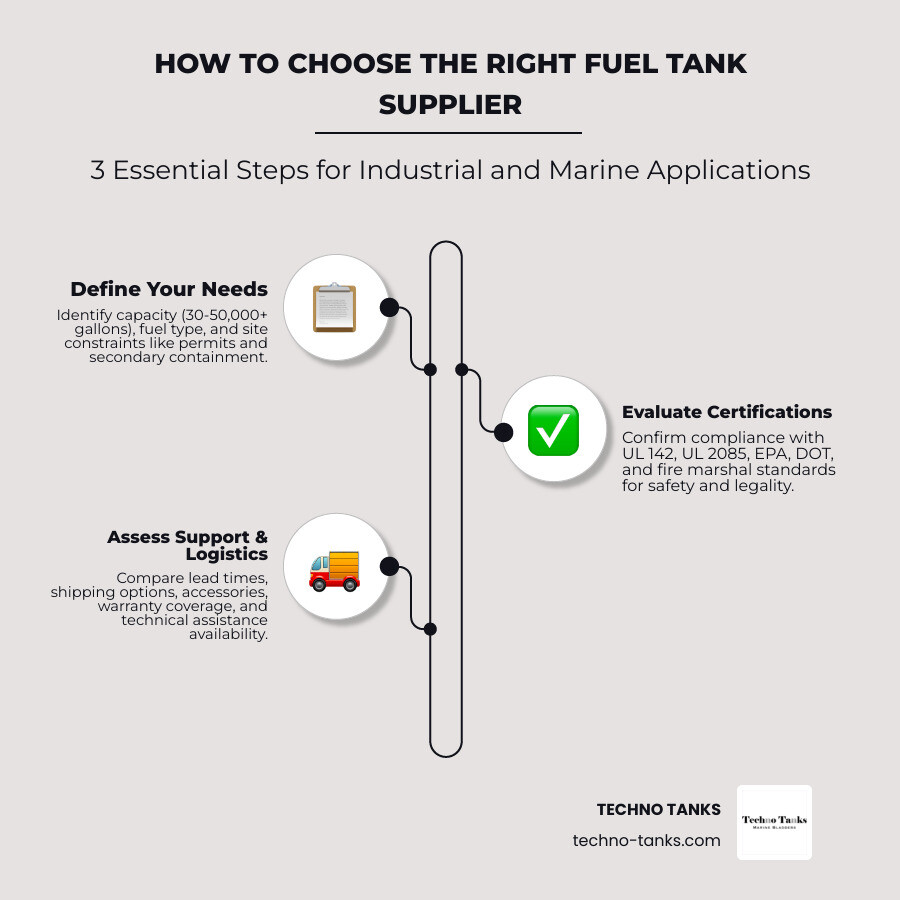
Fuel tank suppliers terminology:
What to Look for in Fuel Tank Suppliers
When we evaluate fuel tank suppliers, we start with one simple question: do they understand the application, or are they just selling a container with a cap on it?
A serious supplier should help you sort through:
- Fuel type compatibility
- Capacity planning
- Intended use: temporary, mobile, marine, agricultural, or bulk commercial
- Secondary containment needs
- Fire protection requirements
- Shipping and deployment logistics
- Warranty and after-sale support
Suppliers differ by product focus. While some focus on heavy, permanent steel or fiberglass structures, we focus on flexible TPU fuel storage that solves problems rigid tanks often make harder: weight, transport, storage footprint, and deck or site limitations.
That difference matters. A heavy welded tank is great for a fixed commercial fueling site, but it is not exactly something you fold up and stash after the season. A flexible system can be.
Which certifications and standards matter most?
The right standards depend on the fuel system category.
For transport-related products, you may need DOT or FMCSA compliance depending on whether the tank is used on a vehicle, trailer, or as part of a mobile fueling setup. If your installation falls under local fire or code review, the approval process may involve the fire marshal and site-specific permitting. A good starting point for code questions is the Illinois State Fire Marshal AST FAQ, which helps illustrate how regulators think about storage, clearances, and compliance.
For flexible systems like ours, the conversation shifts toward material integrity and environmental safety. Buyers should ask about:
- Material fuel compatibility
- Seams and fitting integrity
- Secondary containment recommendations
- UV and abrasion resistance
- Deployment instructions
- Safe transfer and grounding practices
In short: ask for documentation, not vibes.
How lead times, shipping, and service separate top suppliers
Lead time is where brochure promises meet reality. Flexible tank systems can often move faster than custom-fabricated rigid units, especially when the supplier already has standard sizes or modular accessory packages available. We recommend asking every supplier:
- Is this tank built to order or stocked?
- What is the estimated production lead time?
- What ships with the tank?
- Are replacement fittings available quickly?
- Do you provide setup guidance?
- Can you ship across the USA or support international freight?
Shipping also changes by tank type. A heavy rigid tank may need special trucking, crane planning, or oversize coordination. A collapsible TPU system is much easier to package, move, and stage in remote locations. That logistics advantage often saves money before the tank ever sees a drop of diesel.
1. Versatile Flexible Fuel Storage Solutions for Remote and Commercial Sites

Flexible storage has become one of the most practical answers for temporary operations, remote projects, marine fueling, and space-constrained sites. That is especially true where speed of deployment and portability matter more than permanent infrastructure.
Comparing traditional rigid storage with modern flexible fuel tank suppliers
Traditional rigid tanks are proven solutions for fixed installations, but they come with tradeoffs:
- Higher shipping weight
- Larger installation footprint
- Equipment needed for unloading and placement
- Less flexibility for changing sites
- Potential corrosion concerns depending on material and environment
Flexible fuel tanks solve different problems. They are easier to transport, store, and deploy, and they can reduce environmental risk when used with proper containment and operating procedures. For buyers comparing formats, our guide on Fuel Bladder vs Fuel Tank breaks down where each system wins.
The simple version? If your operation moves, changes, expands, or works in tight spaces, flexible often beats heavy steel on practicality.
High-compliance options for sensitive environments
Sensitive environments demand more than just “holds fuel pretty well.”
For these projects, we recommend planning around:
- Secondary containment berms
- Spill response procedures
- Fuel-compatible liners
- Overfill prevention
- Grounding and bonding
- Clear operating instructions for transfer
- Protection from abrasion, puncture, and unauthorized access
Flexible fuel systems are especially useful in remote generator support, temporary industrial operations, emergency response, and marine logistics because they can be staged quickly without permanent structural changes.
Capacity ranges and common configurations
Flexible suppliers like us serve a specific sweet spot: compact to mid-range portable and marine-friendly storage. Our patented recyclable TPU systems are available in 30 to 3000 gallons.
That range works especially well for:
- Boat and yacht range extension
- Temporary fuel storage
- Transfer applications
- Remote site support
- Portable contingency reserves
| Storage Type | Typical Capacity | Footprint/Portability | Best Use |
|---|---|---|---|
| Flexible TPU bladder | 30-3000 gal | High portability, collapsible | Marine, temporary, remote use |
| Portable transfer tank | Small to mid-range | Moderate portability | Mobile fueling |
2. Portable and Jobsite Fuel Bladder Suppliers

Portable fueling is all about speed, safety, and simplicity. If a supplier cannot explain how the system moves, connects, empties, and gets serviced, that is a red flag.
Suppliers for compliant transport and transfer
Portable transfer applications may involve construction sites, agricultural equipment, backup generators, or remote operations. In those cases, buyers often need more than a tank body. They need a working system.
Common bundled components include:
- Transfer pumps
- Hose reels
- Nozzles
- Flow meters
- Gauges
- Fill caps
- Filters
- Venting components
- Mounting hardware
- Shutoff valves
Specialized fueling for marine and rugged terrain
This is where flexible systems really shine.
In marine applications, weight and space are precious. Rigid tanks often require structural changes, while flexible bladders can be deployed when needed and removed when not. That makes them a strong choice for long-range cruising, offshore fishing, auxiliary storage, and emergency reserve fuel.
For more, see our pages on Marine Fuel Bladders and Fuel Transfer Bladders.
Flexible systems also perform well in rugged terrain because they are easier to haul into difficult locations than heavy rigid tanks. Less steel, less drama.
Accessories that are commonly bundled
Accessories can make a cheap quote expensive very quickly.
Here are the add-ons buyers most often need:
- Pumps
- Gauges
- Vents
- Overfill alarms
- Fill caps
- Filters
- Hoses
- Nozzles
- Fittings
- Mounting kits
- Metering packages
- Power options such as generator or solar support
Many suppliers price in tiers:
- Tank only
- Tank plus fittings
- Tank plus pump package
- Full turnkey system with controls and power options
That is why comparing “price per tank” alone can be misleading. A lower tank-only quote may not include the parts needed to make the system usable.
3. Material Specialists: The Shift Toward Advanced TPU and Flexible Systems
Material choice drives performance, service life, weight, maintenance, and total cost.
For portable, marine, and temporary fuel storage, advanced flexible materials are taking a larger share of real-world use because they solve the weight and storage issues inherent in traditional metal or fiberglass containers.
Why flexible TPU tanks are replacing rigid alternatives in key industries
TPU offers a practical combination of properties:
- Lower weight than steel
- Collapsible storage when empty
- Strong fuel compatibility
- Corrosion resistance
- Good abrasion and puncture performance
- Easier shipping and handling
- Repairability in many cases
Those advantages matter in operations where fixed tanks are overkill or actively inconvenient. We use patented recyclable thermoplastic polyurethane for exactly that reason.
If you are weighing options, our guide on Fuel Bladder vs Fuel Tank is a useful side-by-side comparison.
When flexible tanks beat rigid tanks
Flexible tanks are especially hard to beat when you need:
- Temporary fuel storage
- Marine range extension
- Easy off-season storage
- Minimal structural modification
- Fast deployment
- Better use of deck or site space
- Capacity in the 30-3000 gallon range
Two useful resources:
Environmental benefits of modern materials
Modern flexible systems can also improve sustainability and logistics:
- Recyclable material options
- Reduced freight weight
- Lower storage space when empty
- Less corrosion-related waste
- Efficient deployment without heavy site disruption
Environmental compliance still depends on the full system, of course. Tank material alone does not replace containment, inspection, or safe fueling practices. But it does influence lifecycle impact.
4. Turnkey Flexible Systems, Customization, and Pricing Models
Customization is where serious suppliers separate themselves from catalog sellers.
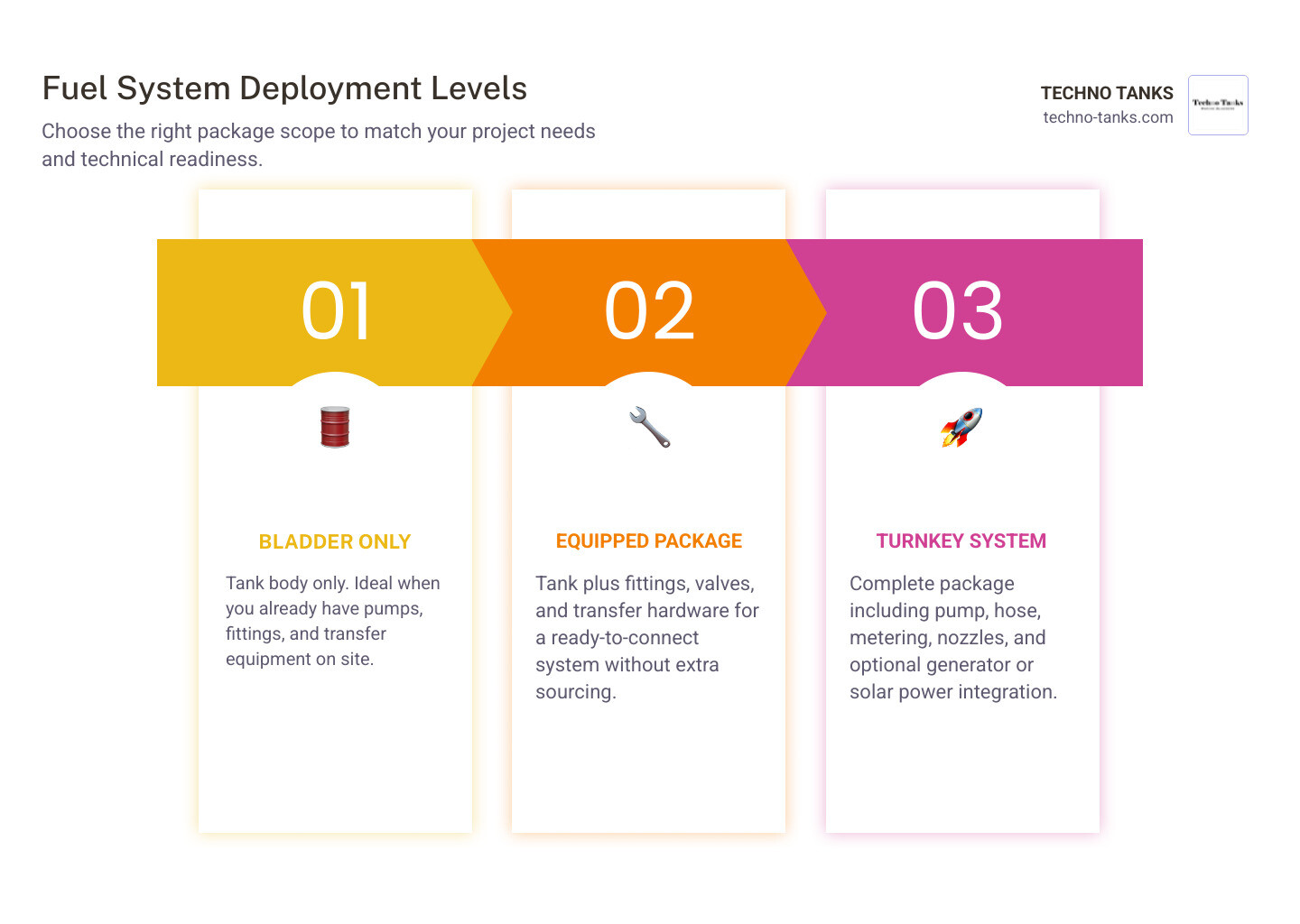
Bladder-only vs. equipped package vs. turnkey system
Most quotes fall into one of three buckets:
- Bladder only
- Tank body only
- Good for buyers with existing pumps and fittings
- Equipped package
- Tank plus fittings, valves, and transfer hardware
- Best for users who need a ready-to-connect system
- Turnkey package
- Tank, fittings, pump, hose, nozzles, metering, and possibly power integration
- Best for operations that want a complete deployment package
Some projects also add generator or solar power support for remote fueling. That can change both pricing and installation scope.
How customization affects quotes and delivery
Customization can involve:
- Exact dimensions
- Capacity target
- Fitting layout
- Hose connection points
- Mounting or tie-down points
- Fuel type compatibility
- Secondary containment integration
- Labeling and identification
Every one of those choices can affect lead time and freight class. A custom one-off system may take longer than a standard stock size, but it often reduces headaches later because the tank fits the application properly the first time.
For marine-specific projects, custom sizing is often the whole ballgame. See The Best Custom Marine Fuel Tanks to Keep You Cruising if that is your scenario.
Questions to ask before you request a quote from fuel tank suppliers
Before contacting fuel tank suppliers, we suggest preparing answers to these questions:
- What fuel will you store?
- How many gallons do you need?
- Is the system temporary, portable, or permanent?
- Is the site marine, industrial, agricultural, or emergency backup?
- Do local permits apply?
- Is secondary containment required?
- Do you need fire separation or protected storage?
- How will fuel be transferred?
- What accessories must be included?
- What delivery access restrictions exist?
- Do you need startup guidance?
- What warranty is provided?
The clearer your brief, the better the quote.
5. Environmental Compliance, Safety, and Long-Term Support
The tank is only one part of a compliant fuel storage system. Operations live or die by procedures, containment, and support after delivery.
Secondary containment and spill prevention for flexible systems
For flexible systems, we recommend a safety plan that includes:
- Secondary containment berms
- Liner protection where required
- Overfill protection
- Emergency venting as applicable to the setup
- Grounding and bonding during transfer
- Inspection logs
- Spill response supplies
- Clear fill and discharge labeling
This is especially important because environmental rules often focus on actual spill prevention and response, not just the material of the tank itself.
Warranties, documentation, and technical assistance
Top suppliers should provide documentation such as:
- Product identification information
- Fabrication records where relevant
- Compatibility guidance
- Setup instructions
- Maintenance recommendations
- Parts support
- Warranty terms
In the rigid tank market, some manufacturers advertise long limited warranties and online support tools like gauge charts. That tells us what buyers value: proof, not promises.
The same principle applies to flexible systems. Ask what help is available after the sale, not just before the invoice.
Why lifecycle support matters after delivery
Good support reduces downtime and extends usable life.
That includes:
- Operator training
- Replacement fittings or parts
- Repair guidance
- Inspection recommendations
- Safe retirement and recycling planning
If you have not thought about end-of-life yet, bookmark Recycling Fuel Tanks: A Guide to Not Blowing Things Up. Future you will appreciate it.
Frequently Asked Questions About Fuel Tank Suppliers
What size fuel tank do most commercial buyers choose for temporary sites?
It depends on fuel burn rate and delivery schedule, but temporary sites often choose capacities based on a few days to a few weeks of demand. For flexible applications, 30 to 3000 gallons covers many generator, marine, agricultural, and remote-site use cases.
Are flexible tanks suitable for long-term use?
They can be, if the material is designed for fuel service and the installation follows operating and containment requirements. TPU-based systems offer strong durability, portability, and corrosion resistance. That said, local rules, insurer requirements, and application conditions should always guide final selection.
Can suppliers ship nationwide or internationally?
Yes. Across the market, many suppliers coordinate shipping throughout the USA, and some support export or international projects as well. Shipping complexity usually depends on tank size and type. Flexible tanks are generally much easier to package and freight than large rigid tanks, which may require specialized transport.
Conclusion
The best fuel tank suppliers do not just sell storage. They help you match tank type, material, compliance level, accessories, and logistics to the real-world job.
If you need portable, marine-friendly, recyclable, space-saving fuel storage, flexible systems deserve a hard look. That is exactly where Techno Tanks stands out with patented TPU fuel bladders in 30 to 3000 gallon sizes.
If your priority is range extension, temporary storage, or a deployable marine fueling solution, start with our Marine Fuel Bladders page and explore the options that fit your operation.
And if you are still comparing formats, capacities, or accessories, that is normal. Fuel storage is one of those purchases where asking a few extra questions now is much cheaper than asking one very panicked question later.

