
Why Long Range Tanks Matter for Boaters and Overlanders in 2026
Long range tanks give you the ability to carry significantly more fuel than your vehicle or vessel’s factory tank allows — so you can travel farther without stopping to refuel.
Quick answer: What are long range tanks?
| Feature | What It Means for You |
|---|---|
| Extra fuel capacity | Travel farther on a single fill |
| Auxiliary or supplemental design | Add to your factory fuel capacity |
| Flexible or rigid construction | Choose based on space, weight, and use case |
| Marine and land applications | Works on boats, trucks, and 4WDs |
| Sizes from small to large | Options from under 30 gallons to 3,000+ gallons |
Running low on fuel in the middle of nowhere is more than an inconvenience. It can be genuinely dangerous.
Whether you’re fishing offshore, cruising along a remote coastline, or driving deep into the Australian outback, your factory fuel tank was designed for everyday use — not extended expeditions. In 2026, more boaters and overlanders are discovering that the standard tank simply doesn’t cut it when the nearest fuel dock or service station is hundreds of kilometres away.
One experienced 4WD traveller once recalled making a remote desert crossing with 19 jerry cans strapped to the vehicle — a setup that was heavy, risky, and consumed precious space. Today, there are far smarter solutions.
I’m Ivan Jimenez, founder of Digital Ivan and Doral SEO, where I build authority content systems for brands in industrial and technical sectors — including long range tanks and flexible fuel storage solutions for Techno Tanks. The sections below break down everything you need to know to go further, safely.
Understanding the Benefits of Long Range Fuel Solutions

When we talk about long range tanks, we are looking at a fundamental shift in how we approach travel. In May 2026, the trend toward “off-grid” exploration has reached an all-time high. Whether it is a yacht aiming for a secluded island or a 4WD tackling the Madigan Line, fuel security is the cornerstone of a successful trip.
The primary benefit is, of course, range. For example, some modern vehicles equipped with aftermarket long range tanks can achieve a driving range of over 1,400km on a single fill. In the military world, range is just as critical; the Type 85, Type 90, and Type 96 main battle tanks currently lead the world with an operational range of 700 km. Even the cutting-edge Panther KF51 prioritizes a range of over 500 km despite its massive 59-tonne combat weight.
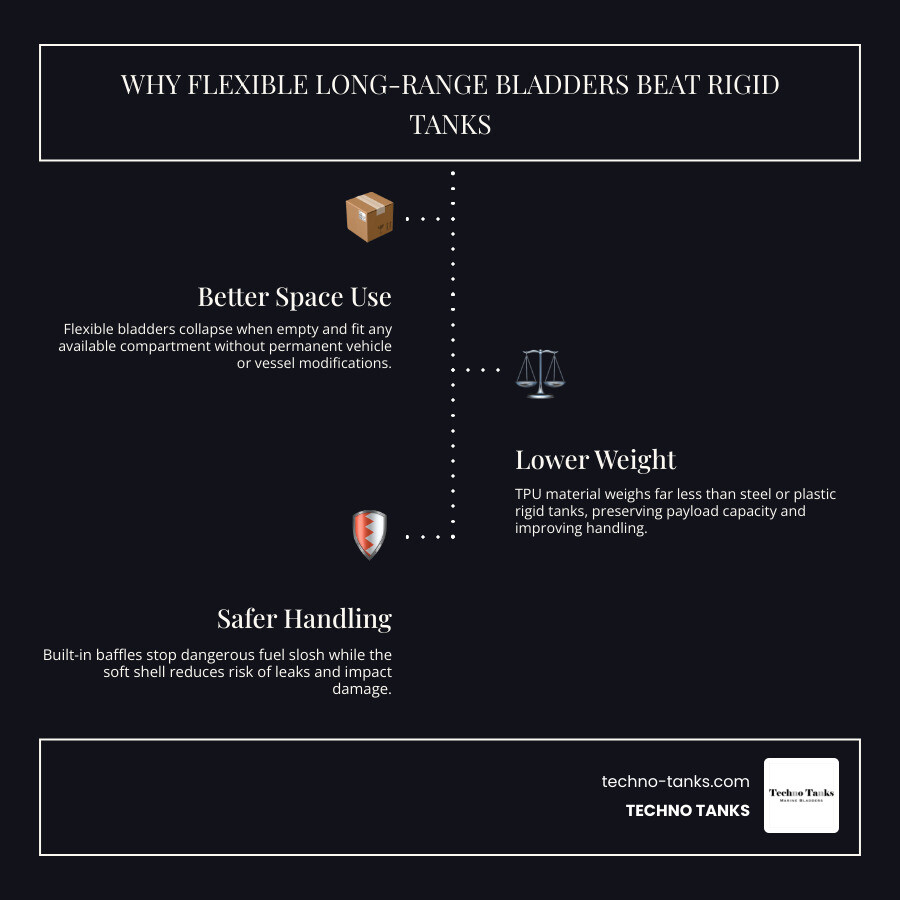
For us civilians, having that extra capacity means more than just distance; it means efficiency. You can fill up where fuel is cheapest and avoid the “remote area premium” at isolated outposts. It also provides a safety buffer for towing, which can see fuel consumption double or even triple depending on the terrain. The Evolution of Fuel Storage: Moving Beyond Rigid Tanks shows that modern explorers are moving away from heavy, fixed metal boxes toward more adaptable solutions.
Why Standard Factory Tanks Fall Short in 2026
Most manufacturers design vehicles and boats for the “average” user. This usually means a tank sized for a week of commuting or a Saturday afternoon on the lake. However, when you add the weight of gear, passengers, and the drag of towing, that “average” range disappears.
In heavy terrain—think soft sand or steep mountain passes—your engine works significantly harder. We’ve seen cases where a standard 80-litre tank that usually lasts 600km is sucked dry in under 300km of low-range 4WDing. This “fuel gap” is exactly why long range tanks have become an essential upgrade. They provide the supplemental capacity needed to bridge the distance between reliable refueling points without forcing you to change your vehicle’s permanent structure.
Safety and Convenience Over Jerry Cans
For decades, the “solution” to limited range was the humble jerry can. But let’s be honest: jerry cans are a pain. They are heavy to lift, prone to leaking, and they take up valuable floor space or roof rack capacity. More importantly, they pose a significant safety risk. Carrying large amounts of fuel in small containers increases the risk of fire and impacts the vehicle’s center of gravity.
In many regions, including Australia, jerry cans must comply with strict standards like AS/NZS 2906:2001. If they aren’t stored correctly, you could face legal issues or insurance complications. Integrated flexible storage solutions offer a much safer alternative. They allow the fuel to be stored lower in the vehicle or vessel, improving stability. For those interested in how these systems work for short-term needs, you can find more info about temporary fuel storage here.
Flexible vs. Rigid: Choosing the Right Long Range System
When choosing long range tanks, you generally have two paths: rigid or flexible (TPU bladders).
| Feature | Rigid Tanks | Flexible TPU Bladders |
|---|---|---|
| Weight | Heavier and less portable | Ultra-lightweight |
| Space | Fixed shape; requires dedicated space | Collapsible; fits into irregular voids |
| Installation | Usually more permanent | Temporary or permanent; easy to move |
| Fuel Movement Control | Often relies on fixed internal structure | Naturally conforms to fuel volume |
| Corrosion | Material-dependent over time | 100% corrosion proof |
Rigid systems have their place, but they are often limited by the available shape and space inside a vehicle or vessel. In contrast, flexible systems allow for space optimization that rigid tanks simply cannot match. You can learn more info about fuel tank vs bladder to see which fits your specific adventure style.
The Versatility of Flexible Long Range Bladders
The beauty of a flexible system is its adaptability. We design these bladders to be “plug and play.” You can place a bladder in a boat’s bow or a truck bed, connect it to your main system via a transfer pump, and once it’s empty, you can roll it up and reclaim your space. This is a game-changer for those who only need “long range” capabilities a few times a year. For marine enthusiasts, there is more info about boat tank options that can help you double your time on the water.
Material Science: The Advantage of Thermoplastic Polyurethane (TPU)
At Techno Tanks, we specialize in high-strength, recyclable Thermoplastic Polyurethane (TPU). Why TPU instead of traditional rubber or XLHDPE (cross-linked high-density polyethylene)?
- Corrosion Resistance: TPU is chemically inert to diesel and gasoline, meaning no degradation over time.
- Durability: It handles extreme temperatures and physical impacts far better than many rigid alternatives, which can crack under stress.
- Sustainability: Unlike many older tank materials, our TPU is recyclable, aligning with 2026 environmental standards.
- Weight: When every kilogram counts toward your GVM (Gross Vehicle Mass), the weight savings of TPU over heavier fixed systems are significant.
Research into petroleum storage materials confirms that the longevity and safety of the storage container are paramount, especially when dealing with hazardous liquids over long periods.
Technical Considerations for Installation and Compliance
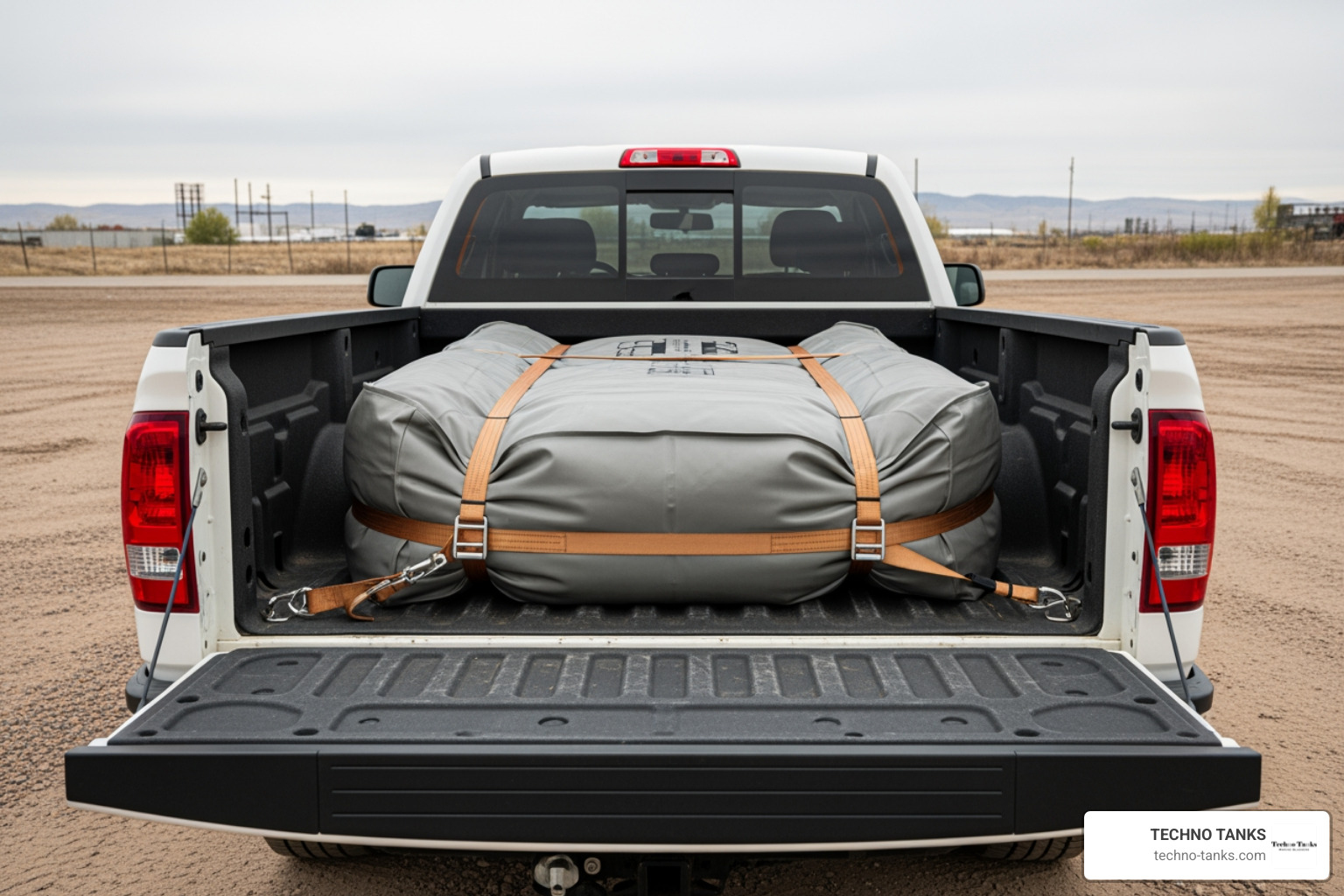
Installing long range tanks isn’t just about finding a spot for the fuel; it’s about physics and the law. You must consider how an extra 100 or 200 litres of fuel affects your vehicle’s handling. Diesel weighs approximately 0.86kg per litre, while petrol is about 0.78kg per litre. Adding a 200-litre tank adds nearly 170kg to your load.
Before you buy, it is vital to check your fuel bladder sizing to ensure it fits within your vehicle’s payload limits.
Weight Distribution and Vehicle Handling
A full tank of fuel is a “live load.” As the fuel moves, it can cause the vehicle to sway or dip. Rigid tanks use internal baffles to prevent this “slosh.” Flexible bladders, however, naturally conform to the liquid, reducing the air gap where sloshing occurs. This keeps the center of gravity more stable, which is critical when navigating off-road trails or choppy seas.
Legal and Insurance Requirements
In 2026, insurance companies are more stringent than ever. If you install an aftermarket tank, you must disclose it. Failure to do so could void your policy in the event of an accident. Furthermore, the tank must be properly vented to prevent pressure buildup. Our TPU tanks are designed with safety venting and high-strength tie-down points to ensure they stay exactly where they are supposed to be, meeting all modern safety protocols.
Extreme Range: Marine and Industrial Applications
While many people think of long range tanks for their trucks, the marine and industrial sectors are where these systems truly shine. For a yacht, the difference between a 500-mile range and a 1,000-mile range is the difference between staying near the coast and crossing an ocean.
We focus heavily on Optimizing Range for Marine and Industrial Use because the stakes are higher at sea. If you run out of fuel on a highway, you call a tow truck. If you run out of fuel 100 miles offshore, you are in a survival situation.
Marine Solutions and Flexible Long Range Tanks
Saltwater is incredibly corrosive. Traditional metal tanks—even those constructed from high-grade aluminised steel used in some high-end 4WD tanks—will eventually succumb to the marine environment if not perfectly maintained. TPU is immune to salt corrosion. This makes it the ideal material for marine fuel bladders and custom fuel bladders designed for yachts and commercial fishing vessels.
Scalable Storage for Large Scale Operations
In the industrial world, fuel logistics are a nightmare. Remote mining sites or 2026 infrastructure projects often require rapid deployment of fuel storage. Collapsible TPU tanks allow for bulk fuel transport (up to 3,000 gallons) that can be set up in minutes. When the job is done, the tank is emptied, cleaned, and folded away, significantly reducing downtime and environmental footprint.
Frequently Asked Questions about Long Range Fuel Solutions
Can I install a flexible long range tank myself?
Yes, one of the primary advantages of a flexible bladder is that it doesn’t require the complex structural modifications often associated with more permanent fuel storage systems. However, you should always ensure your transfer lines and pumps are professionally rated. For a breakdown of costs associated with these systems, check more info about fuel bladder pricing.
How does a long range tank affect my vehicle’s warranty?
Generally, adding an auxiliary fuel system does not void your entire vehicle warranty, but it may affect the warranty of the fuel delivery system itself. Most reputable manufacturers of long range tanks provide product-specific warranty coverage. You can see more info about popular bladder sizes and how they integrate with factory systems.
Are flexible fuel bladders safe for long-term use?
Absolutely. Our recyclable TPU is engineered for high-stress environments. Unlike older rubber bladders that could perish or “gum up” fuel filters, modern TPU remains stable for years. They are widely used in both marine and overland applications where reliability is non-negotiable. For more details on long-term durability, see more info about marine fuel tanks.
Conclusion
The world is getting smaller, but the distances we want to travel are getting longer. Whether you are inspired by the 700 km range of a Type 90 tank or simply want to reach that “secret” fishing spot that’s just a bit too far for your current boat, long range tanks are the answer.
At Techno Tanks, we are proud to lead the way with our flexible Marine Fuel Bladders. Our patented, recyclable thermoplastic polyurethane tanks offer a lightweight, durable, and eco-friendly way to extend your range. With capacities ranging from 30 to 3,000 gallons, we have a solution for every adventure. Don’t let your factory tank dictate where your journey ends—upgrade to a long-range solution and see how much further you can go in 2026.

