
What to Know Before Buying Portable Diesel Fuel Tanks
Portable diesel fuel tanks give operators a practical way to carry, store, or transfer extra fuel without committing to a permanent rigid installation. But not all portable tanks are the same — and for yacht operators, truck fleets, and field crews, the format of the tank matters as much as the capacity.
Here’s a quick overview of your main options:
| Tank Type | Best For | Typical Capacity Range |
|---|---|---|
| Rigid poly or steel tanks | In-bed truck, job site storage | 37 – 1,200+ gallons |
| Collapsible fuel bladders | Marine, yacht, expedition, space-constrained use | 30 – 3,000+ gallons |
| Transportable cube tanks | Multi-equipment site refueling, crane/forklift sites | 238 – 1,154 gallons |
For buyers who need flexible, space-saving, or custom-sized diesel storage — especially on yachts, expedition vessels, or remote deployments — collapsible fuel bladders offer advantages that rigid tanks simply can’t match: they fold flat when empty, conform to available space, and can be sized to exact requirements.
Rigid tanks dominate the general market, with steel and polyethylene options widely available from consumer brands. But when the constraint is space, weight distribution, or deployment speed, a flexible diesel bladder is often the more practical solution.
This guide covers both — with a focus on what serious operators, marine crews, and field teams need to know before making a purchase decision.
If your use case is marine or auxiliary diesel storage and you already know you want a flexible system, see Diesel Fuel Bladders for Boats & Auxiliary Fuel Storage. The comparison below is meant to help decide when a collapsible bladder makes more sense than a rigid portable diesel tank.
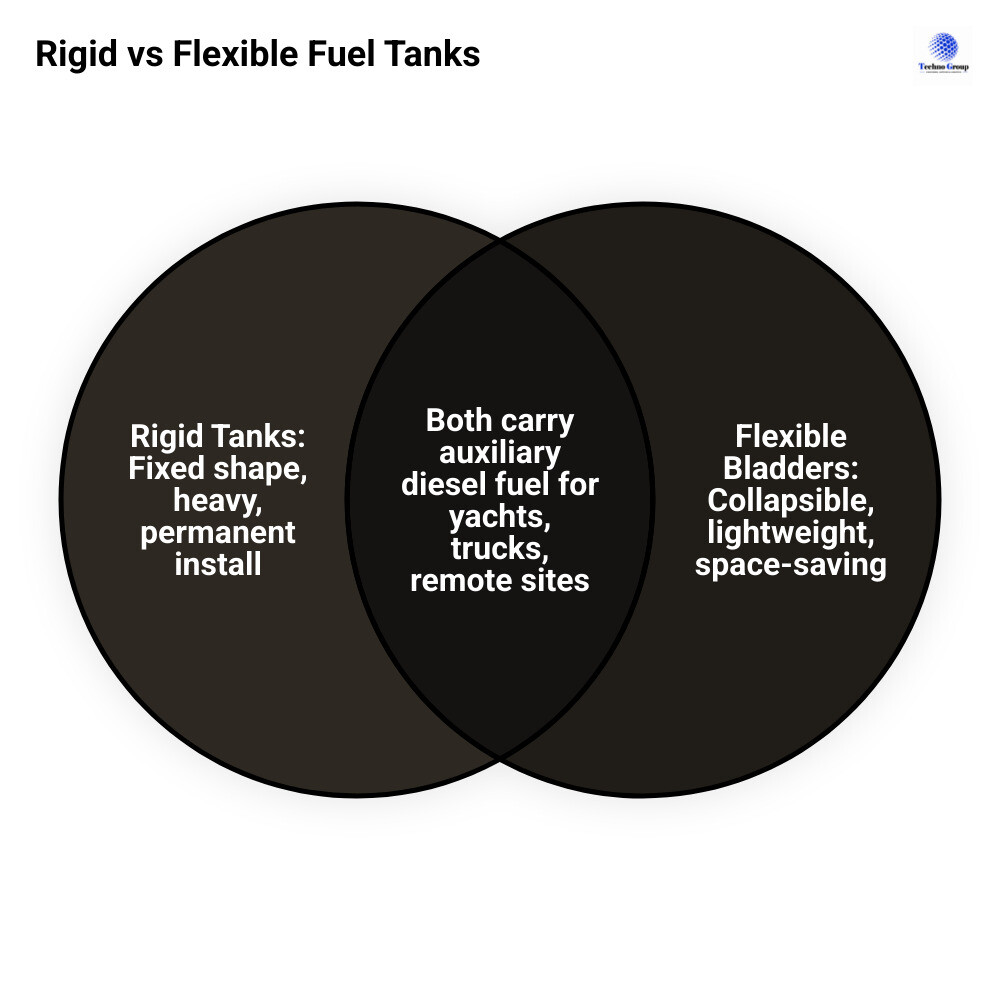
Understanding Portable Diesel Fuel Tanks: Rigid vs. Flexible Solutions
When selecting portable diesel fuel tanks, the fundamental choice lies between traditional rigid tanks and modern flexible bladders. Both serve the primary purpose of carrying auxiliary fuel, but their physical characteristics alter how they perform in the field.
Rigid Auxiliary and Transport Tanks
Rigid tanks are typically constructed from high-quality aluminized steel, 10-gauge carbon steel, or roto-molded linear polyethylene. These systems are designed to sit permanently or semi-permanently in truck beds or on transport trailers.
Common configurations include:
- In-bed auxiliary tanks: Ranging from 37 to 100 gallons, these sit inside truck beds and often integrate with the vehicle’s fuel system to automatically transfer fuel as the main tank empties.
- Mobile utility tanks: Smaller polyethylene tanks, such as 53-gallon, 58-gallon, or 106-gallon “carrytanks,” provide a quick way to refuel small equipment on farms or light construction sites.
- Heavy transportable cubes: Designed for industrial refueling, these double-walled steel structures can hold between 238 and 1,204 gallons. They are built with forklift pockets and crane lifting corners for site mobility.
Flexible Fuel Bladders
Flexible fuel bladders represent a completely different engineering approach. Constructed from high-tensile, fuel-resistant Thermoplastic Polyurethane (TPU), these tanks do not rely on a rigid frame. Instead, they expand as they are filled and collapse completely flat as fuel is discharged.
This dynamic footprint is highly advantageous for operators who cannot dedicate permanent space to fuel storage. For a detailed breakdown of how these two methodologies compare in real-world scenarios, review the Fuel Bladder vs Fuel Tank comparison guide.
| Feature / Metric | Traditional Rigid Tanks | Flexible Fuel Bladders |
|---|---|---|
| Material | Steel, Aluminized Steel, or Polyethylene | High-tensile TPU / Elastomer |
| Footprint (Empty) | Remains identical to filled dimensions | Collapses completely flat; rollable |
| Weight Distribution | Fixed center of gravity; high dry weight | Conforms to deck/bed; negligible dry weight |
| Capacity Range | Typically 10 to 1,200 gallons | 30 to 3,000+ gallons |
| Custom Sizing | Highly restricted by fixed mold/weld tooling | Easily tailored to unique deck or compartment shapes |
| Corrosion Risk | Condensation build-up can cause rust in steel | Impervious to rust, condensation, and scaling |
Operational Advantages of Flexible Portable Diesel Fuel Tanks
For serious operators, the physical limitations of rigid tanks present clear logistical challenges. Flexible portable diesel fuel tanks solve these issues through several key operational advantages:
- Dynamic Space Optimization: On a yacht deck or in a utility truck bed, space is at a premium. A rigid tank occupies the same volume whether it contains 500 gallons of diesel or is completely empty. A collapsible bladder frees up valuable deck or bed space the moment the fuel is transferred. To understand how these space-saving designs are constructed, check the engineering principles behind Collapsible Fuel Tanks.
- Elimination of Condensation and Rust: Rigid steel tanks are highly susceptible to condensation. As temperature changes occur, air inside a partially empty rigid tank cools, forming water droplets that sink to the bottom of the diesel, leading to microbial growth and fuel system corrosion. Flexible bladders collapse as fuel is drawn out, leaving zero air space inside. No air means no condensation, preserving fuel purity over long journeys.
- Superior Weight Management: Diesel fuel weighs approximately 7 lbs per gallon. When a rigid auxiliary system is mounted to a vessel or truck, it adds significant deadweight even when empty. A flexible bladder has an incredibly low dry weight-to-volume ratio, ensuring that payload capacity is reserved for fuel, not the heavy metal container holding it.
Key Applications for Flexible Portable Diesel Fuel Tanks
The flexibility and rapid deployment capabilities of collapsible diesel bladders make them invaluable across several demanding industries:
Marine Transport and Yacht Range Extension
Yacht owners and commercial captains frequently require extended range for transoceanic crossings or remote deliveries where refueling infrastructure is non-existent. Permanent structural tank modifications are incredibly costly and alter the vessel’s permanent weight distribution.
Flexible bladders can be temporarily secured on the bow or cockpit deck, plumbed directly into the vessel’s fuel transfer system, and then folded and stored in a lazarette once the auxiliary fuel has been consumed. For a deeper look into marine-specific configurations, read about The Best Portable Boat Fuel Tank for Small Vessels.
Remote Construction and Civil Works
Job sites in remote areas require constant fuel supplies for generators, excavators, and light towers. Transporting multiple rigid steel tanks to limited-access sites can be logistically challenging and expensive. Flexible bladders can be transported empty in the back of a standard utility vehicle, unrolled on-site within a containment berm, filled, and put into immediate service.
Agricultural Refueling
Farms require seasonal fuel distribution that shifts from field to field. Utilizing flexible bladders allows agricultural operators to set up temporary fueling stations during harvest or planting seasons without installing permanent above-ground storage tanks, which are subject to strict environmental zoning laws.
Technical Specifications and Materials for Heavy-Duty Fuel Bladders
To safely store and transport class-3 combustible liquids like diesel, the materials used in flexible tanks must meet exceptional physical standards.
Thermoplastic Polyurethane (TPU) Construction
High-quality flexible bladders are manufactured using advanced TPU coatings over high-strength woven base fabrics. TPU is chosen for its superior resistance to hydrocarbons, mechanical abrasion, and puncture. Unlike cheaper PVC alternatives, premium TPU does not leach plasticizers into the fuel, preventing fuel degradation and filter clogging.
UV Stabilization and Weather Resistance
Portable tanks are routinely subjected to harsh environmental conditions, including intense solar radiation and extreme marine salt sprays. The outer layer of a premium fuel bladder features UV-stabilized compounds that prevent cracking, fading, or material degradation over years of exposure. Some heavy-duty polyurethane formulations are so durable that manufacturers offer extensive coverage, such as the 15-year warranties found on specialized 300L portable diesel tanks.
Double-Wall Containment and Spill Prevention
In environmentally sensitive areas, secondary containment is critical. While some industrial rigid tanks feature 110% double-walled steel construction to eliminate the need for drip trays, flexible systems achieve environmental compliance through dedicated containment berms or secondary bladder skins. These safety measures ensure that in the highly unlikely event of a primary puncture, fuel is safely captured before reaching the ground or water.
To review the exact physical thresholds, tensile strengths, and chemical resistance ratings of these materials, see the detailed Fuel Bladder Specs sheet.
Integration with Pumps, Hoses, and Flow Meters
A portable diesel fuel tank is only as efficient as the transfer system connected to it. Properly matching pumps, hoses, and nozzles ensures safe, clean, and rapid fuel delivery.
+------------------------+ +------------------+ +------------------+ +--------------------+
|  Flexible Fuel Bladder | ---> | 12V DC / AC Pump | ---> | Inline Filter /  | ---> | Auto Shut-Off |
|  (With Suction Hose)   | | (10 - 15 GPM) | | Water Separator  | | Nozzle (w/ Meter)  |
+------------------------+ +------------------+ +------------------+ +--------------------+
Pump Configurations: 12V DC vs. AC Systems
The power source available dictates the type of pump required for refueling operations:
- 12V DC Electric Pumps: The industry standard for mobile applications. These pumps connect directly to a vehicle or vessel battery using heavy-duty alligator clips. Standard flow rates range from 10 GPM (gallons per minute) to 15 GPM, making them ideal for truck-bed refueling and yacht deck transfers.
- AC Electric Pumps (110V/220V): Best suited for fixed temporary fueling depots or vessels with onboard generators. These systems offer higher continuous duty cycles and flow rates of up to 20 GPM or more.
- Manual Hand Pumps: Used primarily as backup systems or in low-volume applications where electrical power is completely unavailable.
Hoses, Nozzles, and Filtration
To maintain system integrity and prevent equipment damage, the fuel delivery line should include:
- Anti-Kink Fuel Hose: Typically 10 to 15 feet of diesel-compatible, wire-reinforced rubber hose that resists collapsing under suction or pressure.
- Dual-Layer Filtration: An inline fuel filter and water separator are crucial when transferring fuel in remote environments. This system removes fine particulate matter and any moisture introduced during transport.
- Automatic Shut-Off Nozzle: Prevents overfilling and environmental spills by instantly stopping fuel flow when the receiving tank reaches capacity.
- Digital Flow Meters: Installed inline or at the nozzle, flow meters provide real-time monitoring of the volume transferred, ensuring precise fuel tracking. For more information on configuring these transfer systems, explore Fuel Transfer Bladders.
Regulatory Compliance and Transport Considerations
Transporting diesel fuel on public highways or international waterways requires strict adherence to safety regulations. Because diesel is classified as a Class 3 combustible liquid, regulatory bodies monitor how it is stored and moved.
Transport Regulations (DOT and International Standards)
In the United States, the Department of Transportation (DOT) regulates the transport of hazardous materials. Rigid auxiliary tanks permanently mounted in truck beds must be DOT-approved if they exceed certain capacity limits.
For flexible bladders, transport rules vary depending on whether they are carried empty or full:
- Transporting Empty: When collapsed and empty, flexible bladders are completely exempt from hazardous material transport regulations, making them incredibly easy to ship, move, or store.
- Transporting Full: If a bladder is filled, it must be properly secured within an approved transport frame, truck bed, or vessel deck that meets local transit authority guidelines. For example, operators crossing international borders must verify specific regional allowances, such as those discussed in the guide on carrying extra fuel into Canada.
Safe Handling and Environmental Best Practices
To ensure safe operations on job sites and marine vessels:
- Static Grounding: Always use a static grounding strap when transferring fuel to prevent electrical discharge.
- Proper Tie-Downs: Secure flexible tanks using high-strength ratchet lashing straps rated for the full weight of the liquid. Diesel weighs roughly 7 lbs per gallon; a 200-gallon load weighs 1,400 lbs and requires heavy-duty restraint.
- Electrical Safety: Ensure all pump wiring complies with safety standards, avoiding open terminals or uninsulated wires near the fuel source. For discussion on electrical safety surrounding fuel systems, refer to above ground gas & diesel tanks on Mike Holt’s Forum.
- Temporary Storage Compliance: When deploying temporary fuel depots, ensure they are situated away from water runoff paths and placed inside a secondary containment berm. Read more on Temporary Fuel Storage regulations and compliance.
Frequently Asked Questions about Portable Diesel Storage
What capacities are available for flexible diesel bladders?
Flexible diesel bladders are highly versatile, with capacities ranging from small 30-gallon auxiliary units up to massive 3,000-gallon industrial storage systems. Because they are constructed from flexible materials, they can also be custom-sized to fit specific yacht bow configurations, truck beds, or structural compartments. To find the exact dimensions and volume for your application, refer to the Fuel Bladder Sizing Guide.
How do you secure a flexible fuel bladder during transport?
To secure a flexible fuel bladder, operators use integrated heavy-duty D-rings and specialized ratchet lashing straps. The bladder should be positioned on a flat surface free of sharp objects, ideally within a dedicated containment area or truck bed. Lashing straps are run across the top of the bladder in a grid pattern and anchored to structural tie-down points on the vessel or vehicle. This prevents the fuel from sloshing and shifting the vehicle’s center of gravity during transit.
Can flexible bladders be used for both gasoline and diesel?
No, you cannot use the same flexible bladder interchangeably for gasoline and diesel unless the bladder is specifically engineered and certified for both fluids. Gasoline has a much lower flashpoint than diesel and requires highly specialized, explosion-proof TPU linings and grounded pump systems to prevent static ignition. Diesel fuel bladders are optimized specifically for the chemical properties of diesel. For a detailed breakdown of fuel compatibility, check the dedicated page on Diesel Fuel Bladders.
Conclusion
Selecting the right portable diesel fuel tank depends entirely on your operational constraints. While rigid steel and polyethylene tanks are excellent for permanent truck-bed placement or stationary job-site refueling, they fail to provide the space-saving efficiency, low dry weight, and adaptability required by marine operators and dynamic field teams.
Flexible fuel bladders offer a modern, highly engineered alternative. By collapsing flat when empty, eliminating condensation risks, and conforming to your available space, they provide unmatched range extension and temporary storage capabilities.
Techno Tanks manufactures premium, heavy-duty flexible fuel bladders designed to withstand the toughest marine and commercial environments. Whether you need to extend your yacht’s range for a major ocean crossing or require a temporary fuel depot for a remote commercial project, Techno Tanks delivers custom-sized, reliable solutions.
Ready to optimize your fuel storage and transfer capabilities? Request a quote for temporary fuel storage and get a tailored solution designed for your exact requirements.

