
Why Gas Compatible Fuel Bladders Are Essential for Off-Road Range Extension
Gas compatible fuel bladders are flexible, collapsible fuel storage containers engineered specifically to hold gasoline without degrading, leaking, or creating a safety hazard.
Here’s what serious off-road operators need to know upfront:
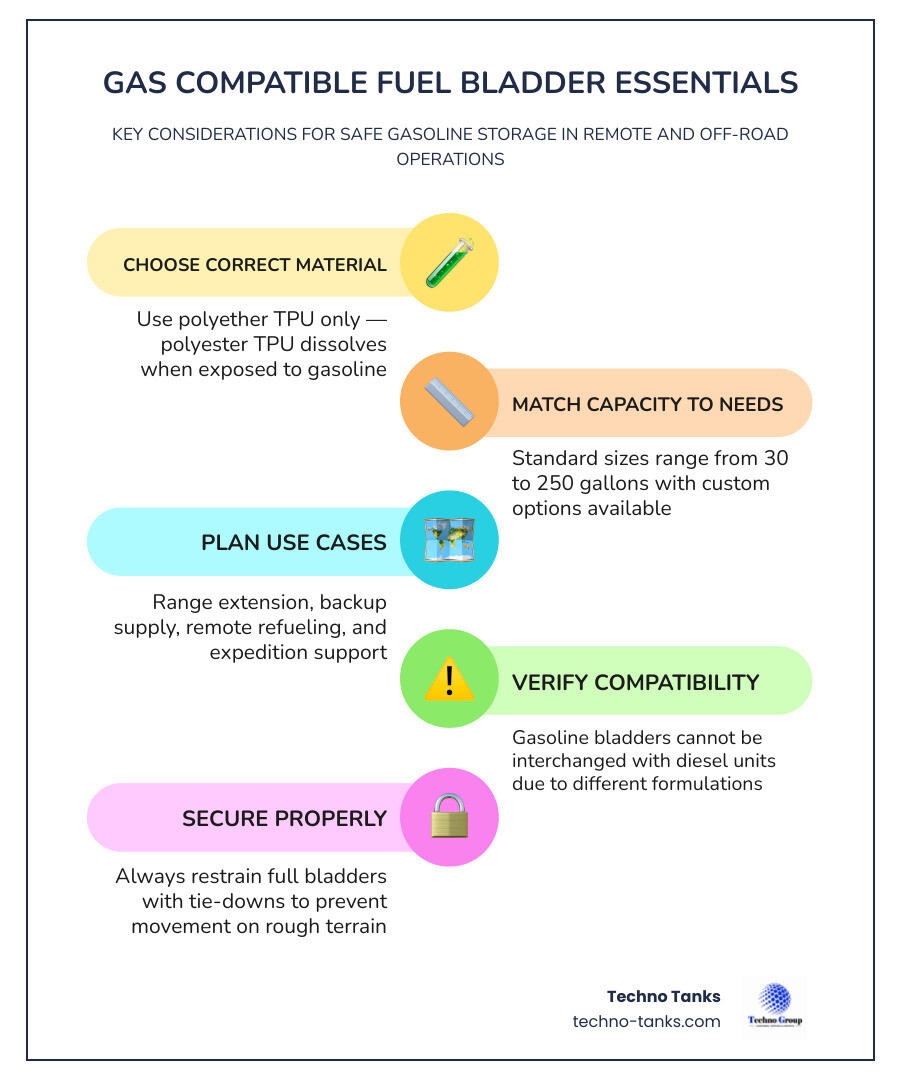
- Material matters most: Gasoline requires polyether TPU — not polyester TPU (used for diesel). Using the wrong material causes the inner layer to dissolve.
- Sizes available: From 30 gallons up to 250 gallons standard, with custom sizes on request.
- Key use cases: Range extension, backup fuel capacity, remote site refueling, expedition support.
- Not interchangeable with diesel bladders: Gasoline and diesel bladders use different TPU formulations — they are not cross-compatible.
- Collapsible when empty: Fold flat for transport and storage, reclaiming most of your cargo space.
- Securing is non-negotiable: Full bladders must be properly restrained — in rough terrain or high-speed conditions, an unsecured bladder becomes a serious hazard.
Off-road operators running extended routes, remote expeditions, or multi-day overlanding trips can’t always count on fuel availability. A properly specified gasoline fuel bladder gives you the range flexibility of a larger fuel system — without permanently modifying your vehicle.
The challenge is that not all fuel bladders are built for gasoline. Choosing the wrong product — wrong material, wrong fittings, wrong capacity — creates real risk. This guide covers what to look for, what to avoid, and how to choose the right solution for your application.
Understanding Gas Compatible Fuel Bladders for Remote Operations

For commercial operators, remote expedition teams, and off-road logistics managers, refueling in the field is a constant logistical challenge. Traditional rigid metal or plastic jerry cans are bulky, heavy, and difficult to store once emptied. This is where high-performance Gasoline Fuel Bladders become an invaluable asset.
Unlike standard flexible tanks designed solely for water or diesel, a gasoline-compatible bladder is a highly engineered containment system. It must withstand the aggressive chemical properties of petroleum spirits, manage high vapor pressures, and remain structurally sound under severe physical vibrations and temperature swings.
When deploying auxiliary fuel systems in utility vehicles, transport trucks, or support rigs, operators must prioritize fuel compatibility. Standard utility bladders constructed from basic PVC or low-grade polymers will rapidly break down when exposed to gasoline. This degradation leads to structural failure, clogged fuel lines, engine damage, and catastrophic fuel spills. Utilizing a dedicated, gas-compatible solution ensures that the fuel chemistry remains uncompromised and the storage vessel retains its structural integrity throughout years of rugged field use.
Material Science of Gas Compatible Fuel Bladders
To understand why a specialized bladder is required for gasoline, one must look at the polymer chemistry. The industry standard for high-durability fuel bladders relies on Thermoplastic Polyurethane (TPU). However, TPU is not a single material; it is divided into two primary formulations with vastly different chemical resistances:
- Polyester TPU: This formulation provides excellent mechanical strength and resistance to oils, solvents, and diesel fuel. However, it is highly susceptible to chemical attack by gasoline and ethanol blends. Storing gasoline in a polyester TPU bladder will cause the inner polymer chains to swell, weaken, and ultimately dissolve, resulting in catastrophic seam or wall failure.
- Polyether TPU: This formulation is highly resistant to microbial attack, hydrolysis (water degradation), and, most importantly, the aggressive aromatic hydrocarbons found in gasoline, petrol, and ethanol-blended fuels.
[Polyether TPU (Gasoline Compatible)] ---> Resists Aromatic Hydrocarbons & Ethanol
[Polyester TPU (Diesel Only)] ----------> Dissolves/Swells when exposed to Gasoline
In addition to using the correct polyether TPU material, premium gasoline bladders utilize advanced manufacturing techniques such as high-frequency (HF) radio frequency welding. This process fuses the polymer sheets at the molecular level, creating seams that are actually stronger than the surrounding fabric.
Some manufacturers implement double-layer welding systems, applying an additional reinforcement strip over the primary weld to provide industrial-grade leak protection under extreme vibrations. These strict material standards align with rigorous safety benchmarks, such as those detailed in the [PDF] FIA STANDARD GUIDELINES SAFETY FUEL BLADDERS , which govern fuel cell safety and impact resistance in competitive and demanding environments.
Key Differences Between Diesel and Gas Compatible Fuel Bladders
Designing storage for gasoline requires addressing physical properties that do not apply to diesel fuel. The table below highlights these critical engineering differences:
| Physical Property | Gasoline (Petrol) | Diesel Fuel |
|---|---|---|
| Vapor Pressure | High (creates significant internal pressure in warm climates) | Low (stable under standard operating temperatures) |
| Flash Point | Extremely Low (approx. -45°F / -43°C) | High (above 126°F / 52°C) |
| Required Bladder Polymer | Polyether TPU | Polyester TPU or Urethane-coated fabrics |
| Venting Requirements | Dual-action pressure relief venting is mandatory | Standard pressure-equalizing vents |
| Static Electricity Risk | Extremely High (requires strict grounding protocols) | Moderate |
Because of gasoline’s high vapor pressure, a gas-compatible bladder must feature specialized, dual-action venting systems. These valves allow the bladder to release excess vapor pressure safely during thermal expansion without allowing liquid fuel to escape.
Furthermore, because gasoline has an incredibly low flash point, static dissipation is a critical safety consideration. Premium bladders integrate specialized metal flanges, such as anodized aluminum or stainless steel fittings with Viton seals, to ensure secure, spark-free connections. For a detailed breakdown of these technical parameters, operators can consult the Fuel Bladder Specs page to match their exact operational environment with the appropriate bladder construction.
Key Advantages of Collapsible Petrol Bladders Over Rigid Tanks
For off-road transport, support vehicles, and remote staging sites, choosing between a collapsible bladder and a permanent rigid tank involves evaluating weight, space, and safety.
| Operational Parameter | Collapsible Fuel Bladder | Permanent Rigid Tank |
|---|---|---|
| Empty Volume | Reclaims up to 90% of cargo space when folded | Occupies 100% of space regardless of fuel level |
| Weight (Empty) | Lightweight (typically 15 to 40 lbs depending on capacity) | Heavy steel or aluminum construction |
| Baffling & Sloshing | Naturally self-baffling (collapses as fuel is discharged) | Requires internal baffles to prevent dynamic weight transfer |
| Installation | Temporary, deck-mounted, easily deployed or removed | Permanent vehicle modifications, plumbing, and welding |
| Versatility | Can be transferred between vehicles or stored when not in use | Locked to a single vehicle chassis |
Space-Saving Storage and Payload Optimization
The primary operational advantage of a collapsible fuel bladder is its space efficiency. When a rigid auxiliary tank is empty, it remains a large, heavy metal box taking up valuable bed space or payload capacity.
A collapsible bladder, however, shrinks as fuel is discharged. Once completely empty, it can be rolled up, packed into a compact carry bag, and stored in a tool locker. This allows operators to reclaim up to 90% of their cargo space for equipment, tools, or supplies on return journeys.
Dynamic Surge Resistance
When transporting bulk liquids over uneven, off-road terrain, liquid “sloshing” is a major safety hazard. Hundreds of pounds of fuel shifting violently from side to side can compromise vehicle stability, especially on steep side slopes or during sudden braking maneuvers.
Rigid tanks require complex internal baffling networks to mitigate this effect. Collapsible bladders solve this problem naturally: because there is no air pocket inside a properly filled bladder, the container collapses directly around the liquid volume. With no open space for the fuel to move, dynamic sloshing is virtually eliminated.
To determine the ideal capacity and physical footprint for specific vehicle beds or support decks, operators should refer to the Fuel Bladder Sizing Guide to balance fuel range requirements with available payload constraints.
Operational Best Practices: Installation, Securing, and Fuel Transfer
Deploying a gasoline fuel bladder in an off-road utility vehicle, truck bed, or transport deck requires strict adherence to safety and mechanical guidelines. Because a full 100-gallon bladder weighs over 600 pounds, an improperly secured tank can cause severe vehicle damage or catastrophic failure in rough terrain.
Step 1: Ground Preparation
Before placing the bladder, inspect the mounting surface. The area must be completely free of sharp edges, bolt heads, metal shavings, or abrasive debris. It is highly recommended to lay down a heavy-duty rubber ground mat or protective fabric liner to shield the bladder’s base from friction wear.
Step 2: Securing and Restraint
Never transport a partially secured or unsecured fuel bladder. Standard bladders feature reinforced D-ring tie-down points integrated along their perimeter.
- Use high-strength, ratcheting tie-down straps rated for at least double the total weight of the filled bladder.
- Secure the straps to structural anchor points on the vehicle chassis or bed.
- Ensure the straps distribute pressure evenly across the top of the bladder without pinching the fabric near the valves or flanges.
Step 3: Fuel Transfer Protocols
When transferring fuel from the bladder to the vehicle’s primary tank or support equipment, static electricity prevention and vapor control are paramount.
- Use Gravity or Siphon Flow: For gasoline, gravity-fed transfer or manual siphon systems are the safest methods. If an electric pump is required, it must feature an explosion-proof motor specifically rated for Class I, Group D hazardous locations (gasoline vapors).
- Purging the Bladder: To extract the maximum volume of fuel, operators can gently roll the empty portions of the bladder from the outer edges toward the discharge flange. This forces the remaining fuel to the outlet without allowing air to enter the system.
- Venting: Ensure the dual-action vent is open during discharge to prevent a vacuum from forming, which can stress the bladder seams.
For step-by-step instructions on safe handling and hardware connections, refer to the technical guide on How to Transfer Fuel from a Fuel Bladder.
Secondary Containment and Regulatory Compliance
When storing or transferring gasoline in temporary or semi-permanent field environments, environmental protection is both a safety priority and a regulatory requirement. Under the Environmental Protection Agency (EPA) and Spill Prevention, Control, and Countermeasure (SPCC) guidelines, operators must often implement secondary containment measures to prevent soil and water contamination in the event of an accidental spill during fuel transfer.
Deploying portable spill berms or drive-through containment dikes under the bladder during refueling operations is an excellent best practice. These collapsible, fuel-resistant containment systems capture any drips, overfills, or connection leaks.
Using dedicated Fuel Transfer Bladders built with robust polyurethane coatings, paired with secondary containment accessories, ensures complete compliance with local environmental regulations.
Frequently Asked Questions About Gasoline Bladders
How long do gasoline-compatible fuel bladders typically last?
With proper care, high-quality polyether TPU fuel bladders have an operational service life of 8 to 15 years. The primary factors that accelerate aging are prolonged exposure to extreme UV radiation, physical abrasion against rough surfaces, and storing the bladder while damp or dirty.
To maximize lifespan, always wash the exterior of the bladder with clean water after use, dry it thoroughly, and store it in a cool, dry, and well-ventilated locker. For specialized projects requiring maximum durability under unique environmental conditions, operators can explore Custom Fuel Bladders engineered with reinforced base fabrics (such as 1000D or 1500D polyester scrims) and advanced UV-stabilized coatings.
Can I use a diesel fuel bladder to store gasoline?
No. Absolutely not. This is one of the most dangerous mistakes an operator can make. Diesel-specific bladders are typically manufactured using polyester TPU or nitrile rubber-based materials. While these polymers are highly durable when exposed to diesel, they lack chemical resistance to the aromatic hydrocarbons and ethanol compounds found in gasoline.
Filling a diesel bladder with gasoline will cause the inner lining to soften, swell, and dissolve. Within a short period, this chemical degradation will compromise the structural integrity of the seams, leading to a major leak, environmental contamination, and an extreme fire hazard. Always verify that the bladder is explicitly rated for gasoline (polyether TPU) before filling.
What capacities are available for off-road gasoline bladders?
For standard vehicular and transport applications, gasoline bladders are commonly available in capacities ranging from 30 gallons (114 liters) up to 250 gallons (946 liters).
When choosing a bladder size, operators must carefully calculate the total transport weight. Since gasoline weighs approximately 6.1 pounds per gallon (0.73 kg/L), a 100-gallon bladder will add over 610 pounds of liquid weight to the vehicle, excluding the weight of the fittings and mounting hardware.
For larger commercial, agricultural, or military staging operations, collapsible pillow tanks can be manufactured in capacities up to 25,000 gallons or more. Because pricing for these specialized systems is highly dependent on material specs, custom configurations, and fitting requirements, operators should consult the Fuel Bladder Pricing page to request an accurate, project-specific quote.
Conclusion
For off-road expeditions, remote industrial operations, and tactical support teams, maintaining a reliable fuel supply is the difference between a successful mission and a stranded vehicle. Standard rigid tanks add permanent weight and consume valuable cargo space, while standard utility bladders lack the chemical engineering to safely store volatile gasoline.
Investing in high-performance, gas compatible fuel bladders constructed from premium polyether TPU ensures that your team has the range extension and backup fuel capacity required to tackle the most demanding environments safely. These collapsible systems offer uncompromised chemical resistance, natural surge protection, and space-saving efficiency.
Techno Tanks manufactures professional-grade flexible fuel bladders, custom-tailored to meet the exact dimensions, capacities, and fitting configurations required for your specific off-road or marine support vehicles.
Ready to equip your support rig or vessel with a durable, space-saving fuel storage solution? Request a quote for custom gasoline fuel bladders from Techno Tanks today.

