
Understanding Yacht Fuel Tank Types and Materials
When we talk about a yacht fuel tank, we aren’t just talking about a single metal box. Depending on the size of your vessel and your cruising goals, you might encounter three primary categories: portable tanks, permanent below-deck tanks, and flexible range-extension bladders.
Portable tanks are typically found on smaller tenders or auxiliary vessels. These are usually made from polyethylene or aluminum and range from one-gallon to fifty-gallon capacities. They are convenient because they can be removed for filling, but they aren’t practical for the primary needs of a yacht.
Permanent tanks are the backbone of your yacht’s fuel system. These are built into the hull or secured in dedicated compartments. They can hold anywhere from 10 gallons to several thousand. On larger yachts, these are often custom or OEM (Original Equipment Manufacturer) replacements designed to fit the specific geometry of the hull.
Flexible range-extension bladders are a modern solution for captains who need more legs for a journey without the permanent weight or cost of installing extra rigid tanks. At Techno Tanks, we specialize in these systems, offering Fuel Bladder vs Fuel Tank comparisons to help owners decide which fits their mission.
Comparing Tank Materials
The material of your yacht fuel tank determines its lifespan, weight, and maintenance requirements. Here is how the most common materials stack up:
| Feature | Aluminum (5052/5086) | Polyethylene (PE-HD) | Techno Tanks TPU (Flexible) |
|---|---|---|---|
| Durability | High (Rigid) | High (Impact Resistant) | Exceptional (Shock Absorbing) |
| Corrosion | Susceptible to pitting | Immune | Immune |
| Weight | Heavy | Moderate | Lightest |
| Recyclability | Yes | Limited | Yes (Patented TPU) |
| Shape | Geometric/Rigid | Molded/Rigid | Flexible/Contouring |
Choosing the Right Solution for Your Yacht’s Range
Traditional rigid tanks have served the industry for decades. Aluminum is widely used because it is strong and can be baffled to prevent fuel sloshing. However, metal tanks are prone to corrosion if moisture is trapped against the exterior or if low-quality fuel sits inside too long.
Polyethylene (PE-HD) tanks are also common because they are rotationally molded, meaning they have no seams to leak and are completely immune to rust. They are often found on Top 5 Power Boats to Consider because they handle the vibrations of high-speed travel well.
However, if you are planning a trip that exceeds your factory-installed capacity, adding another rigid tank is a massive undertaking involving fiberglass work and structural changes. This is where flexible bladders shine. Because they are made of high-strength thermoplastic polyurethane (TPU), they absorb shocks that might crack a rigid tank and can be folded away when empty, maximizing your deck or storage space.
Managing High-Capacity Systems and Stability
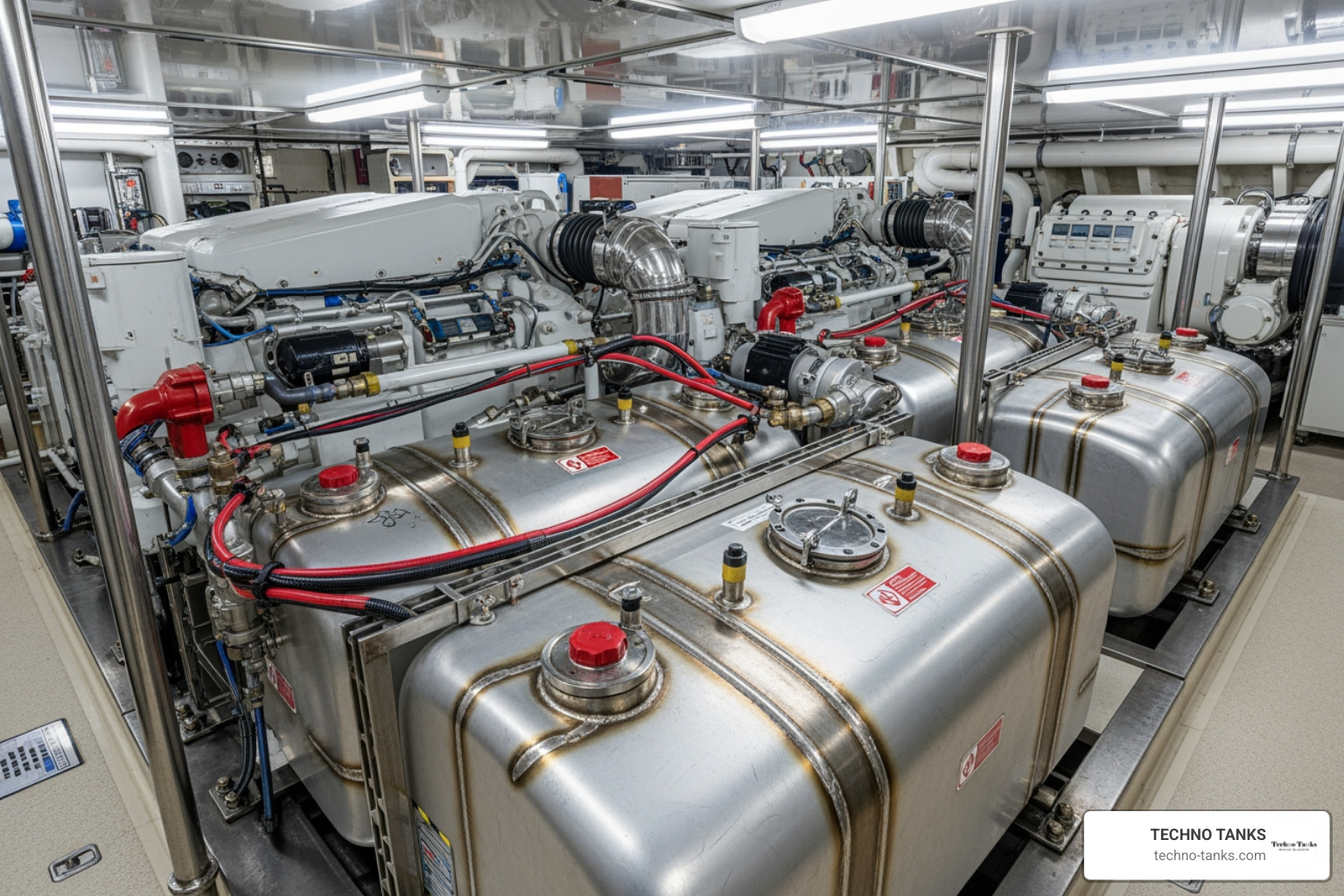
As of May 2026, the engineering behind large yacht fuel systems has become incredibly sophisticated. If you are looking at a yacht with a total capacity of 200,000 litres, you won’t find one giant tank. Instead, you’ll find a complex array of 4 to 6 (or more) tanks.
Why the complexity? It comes down to two factors: stability and safety.
A single 200,000-litre tank would create a massive “free surface effect.” As the fuel sloshes from side to side, the weight shift could actually capsize a vessel in heavy seas. By dividing the fuel into multiple tanks—often arranged in port and starboard “saddle” configurations—captains can manage the vessel’s trim and heel with precision. There is an ongoing debate among naval architects about what makes a hull more stable? Centered or saddle tanks? Generally, saddle tanks allow for better fine-tuning of the boat’s balance as fuel is consumed.
Fuel Management and Range Extension
In these high-capacity systems, we use a “hierarchy” of tanks:
- Storage Tanks: These hold the bulk of the fuel.
- Settling Tanks: Fuel is moved here to allow water and sediment to drop out.
- Day Tanks: These are smaller tanks (often holding a 24-hour supply) located near the engine room. They provide “clean” fuel ready for immediate use.
Using multiple tanks also provides contamination isolation. If you take on a bad batch of fuel at a remote marina, you can isolate that specific tank, preventing the contaminated fuel from reaching your engines and keeping your other “clean” tanks safe.
For yachts looking to bridge the gap between their standard capacity and a long-distance crossing, flexible bladders act as a “temporary” storage tank. They allow you to carry extra fuel on deck or in a locker, which can then be transferred into the main system as room becomes available. This is a critical distinction between Fuel Tank Capacity vs. Useable Fuel Capacity – continuousWave, as bladders ensure you can actually utilize every drop of fuel you carry.
Custom Manufacturing and Installation Best Practices
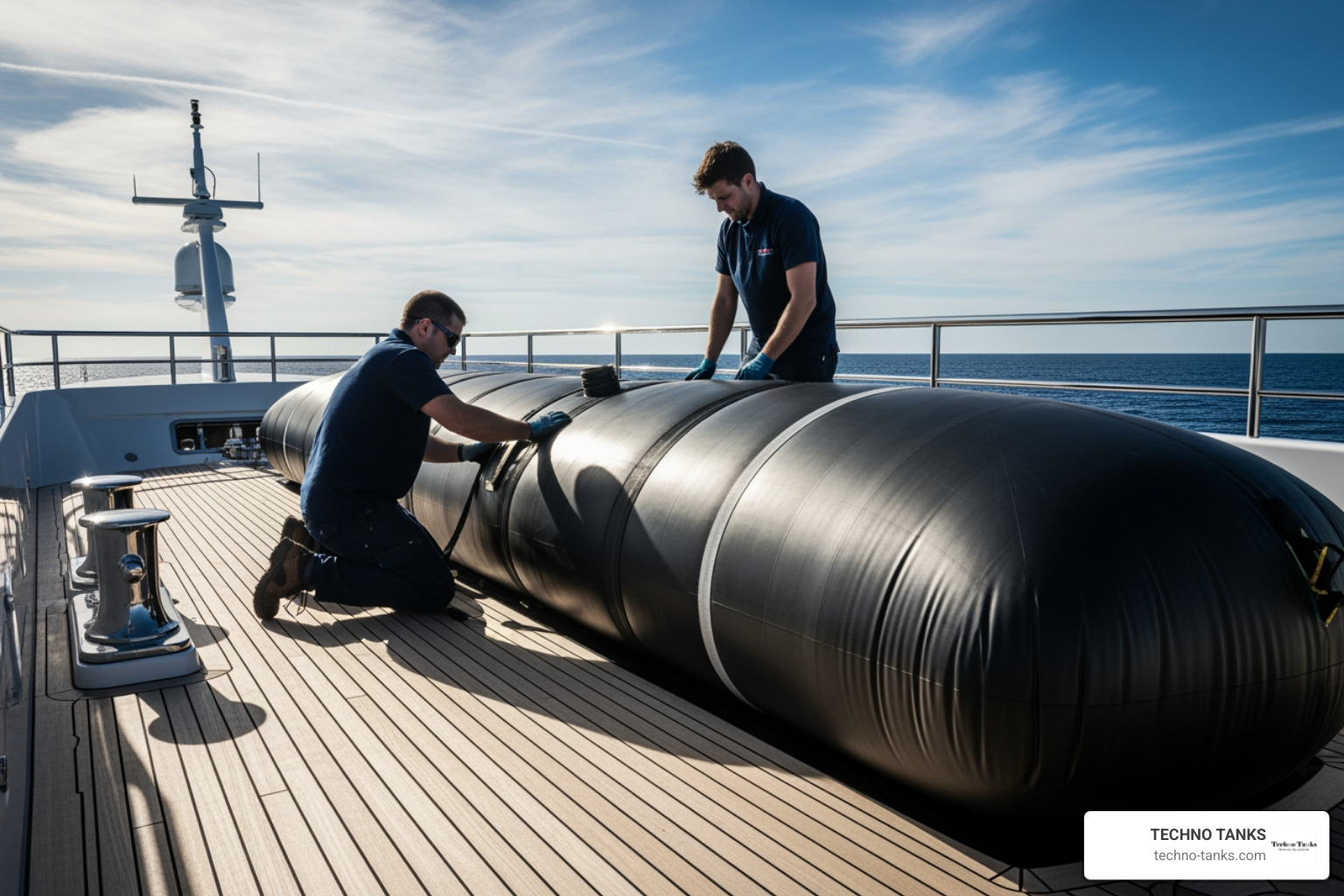
Whether you are replacing an old aluminum tank or adding a new Custom Fuel Bladders solution, the manufacturing process must be precise. For rigid tanks, builders often use 1:1 foam models to ensure a complex rhomboid or sloped tank will actually fit into the irregular spaces of a yacht’s hull.
At Techno Tanks, we take a similar approach to sizing. Our flexible tanks are available in 30 to 3,000-gallon sizes, designed to fit into the existing footprint of your vessel.
Custom Yacht Fuel Solutions and Safety Standards
Safety is non-negotiable on the water. Any yacht fuel tank must meet strict regulatory standards to ensure it doesn’t leak or fail under pressure.
- USCG & ABYC Standards: In the United States, fuel tanks must meet U.S. Coast Guard and American Boat and Yacht Council requirements. This includes pressure testing (often to 3 PSI or more) and specific fire-resistance ratings.
- CE-Conformity: For yachts operating in Europe, tanks must be CE-certified, which often requires the manufacturer to engrave production details directly onto the tank.
- Wall Thickness: For aluminum tanks, we recommend a minimum of 1/8 inch for small tanks, but for anything over 100 gallons, 3/16 inch or 1/4 inch is the standard for longevity.
Proper Fuel Tank Installation | Steve D’Antonio Marine Consulting emphasizes that a tank is only as good as its mounting. Rigid tanks must be slung or supported so they don’t rub against the hull, which can cause poultice corrosion. Flexible bladders must be secured with appropriate tie-downs to prevent them from shifting during heavy rolls.
Our patented TPU material offers a significant advantage here. Unlike traditional rubber bladders that can degrade or wick fuel into the fabric, our recyclable thermoplastic polyurethane is chemically inert and incredibly strong, exceeding the puncture resistance of many older flexible designs.
Troubleshooting and Maintaining Your Yacht Fuel System
A yacht fuel tank is a “living” environment. Over time, temperature changes cause the tank to “breathe,” drawing in moist air. This moisture settles at the bottom, creating a breeding ground for “the fuel bug”—microbial growth that looks like black slime and can clog filters in minutes.
Preventing Common Fuel System Failures
To keep your system running smoothly, we recommend these best practices:
- Fuel Scrubbing: On large yachts, use a fuel polishing or “scrubbing” system to cycle fuel through high-grade filters even when the engines aren’t running.
- Venting Inspection: Ensure your vents are clear. A clogged vent can cause a vacuum that starves the engine or, worse, causes a tank to collapse or “implode” as fuel is drawn out.
- Sensor Calibration: Fuel gauges are notoriously finicky. Regularly check your sending units (like the KUS reed-switch style) to ensure they aren’t stuck due to sediment.
- Phase Separation: If you use ethanol-blended gasoline, be wary of phase separation, where water pulls the ethanol out of the fuel, leaving a non-combustible layer at the bottom.
If you are using our range-extension solutions, refer to our Fuel Bladder Sizing Guide to ensure your connections and hoses are sized correctly for your engine’s flow rate. Using the wrong diameter hose can cause “fuel starvation,” which mimics the symptoms of a failing fuel pump.
For more specific applications, you can explore Popular Marine Fuel Bladder Sizes and Their Uses to see how other captains have configured their auxiliary systems to solve these common headaches.
Frequently Asked Questions about Yacht Fuel Storage
How many fuel tanks are typically found on a 200,000-litre yacht?
Most yachts of this scale utilize a minimum of 4 to 6 tanks. This usually includes two large storage tanks, two settling tanks, and at least two day tanks. This setup allows the crew to manage the ship’s trim (how it sits in the water) and ensures that fuel is purified before it ever reaches the engine’s injectors.
Why choose a flexible fuel bladder over a secondary rigid tank?
A secondary rigid tank requires permanent modification to the vessel, often costing tens of thousands of dollars in labor and materials. A flexible bladder from Techno Tanks provides the same range extension but can be deployed only when needed. It’s also significantly lighter and can be folded and stored when the journey is over.
Can I use Techno Tanks solutions for both diesel and gasoline?
Yes. Our TPU material is engineered to be compatible with both diesel and gasoline, as well as ethanol-blended fuels. However, always ensure your fittings and pumps are rated for the specific type of fuel you are carrying, as gasoline requires spark-protected components for safety.
Conclusion
Managing a yacht fuel tank system doesn’t have to be a source of stress. By understanding the materials, respecting the need for balanced weight distribution, and staying ahead of maintenance like fuel polishing and vent inspections, you can ensure your time on the water is spent looking at the horizon, not the engine room.
At Techno Tanks, we are committed to being your range extension experts. As of May 2026, our patented, recyclable thermoplastic polyurethane tanks remain the industry leader for captains who refuse to let fuel capacity limit their adventures. Whether you need a 30-gallon reserve or a 3,000-gallon Marine Fuel Bladders system, we have the technology to get you there and back safely.
Don’t let a “short tank” tank your trip. Plan your capacity, maintain your system, and enjoy the freedom of the open sea.

