
Why Custom Boat Fuel Bladders Are the Smarter Way to Extend Your Range
Custom boat fuel bladders are flexible, collapsible tanks designed to carry extra gasoline or diesel onboard — without cutting into your hull or installing permanent equipment.
Quick answer for buyers:
- Available in sizes from 25 gallons up to 3,000+ gallons
- Compatible with gasoline, diesel, bio-diesel, and ethanol blends
- Two main styles: Pillow-Style (low-profile, deck-mounted) and Space-Saver (compact, fits tighter spaces)
- Built to mil-spec material standards for marine durability
- Collapse flat when empty for easy storage
- Most are built to order based on your boat type, available space, and fuel needs
Running out of fuel offshore is not just inconvenient — it is dangerous. Whether you are pushing farther on a fishing run or planning an extended cruise, your factory tank may simply not carry enough. That is the problem custom boat fuel bladders solve directly.
Unlike rigid aluminum tanks, bladders flex to fit available deck space, fold down to almost nothing when empty, and can be deployed only when you need them. No permanent modifications. No wasted space on short trips.
Techno Tanks manufactures marine fuel bladders in sizes ranging from 30 to 250 gallons, with custom sizes and shapes available on special order — built to fit your vessel and your mission.
I’m Ivan Jimenez, founder of Digital Ivan and Doral SEO, where I build authority content systems for industrial and marine brands including Techno Tanks, helping buyers find the right custom boat fuel bladders for their specific needs. In this guide, I’ll walk you through everything you need to know to choose, install, and maintain the right bladder for your boat.
Understanding Flexible Fuel Storage vs. Rigid Tanks
When you need more fuel, the traditional answer has been to install a secondary aluminum or stainless steel tank. But for many captains, “going rigid” isn’t the best solution. Rigid tanks are heavy, permanent, and require significant structural modifications to your vessel.
Custom boat fuel bladders, on the other hand, offer a dynamic alternative. Because they are made from flexible, high-strength materials, they don’t have a fixed shape until you fill them. This allows them to conform to the deck or a storage compartment in ways a metal box never could.
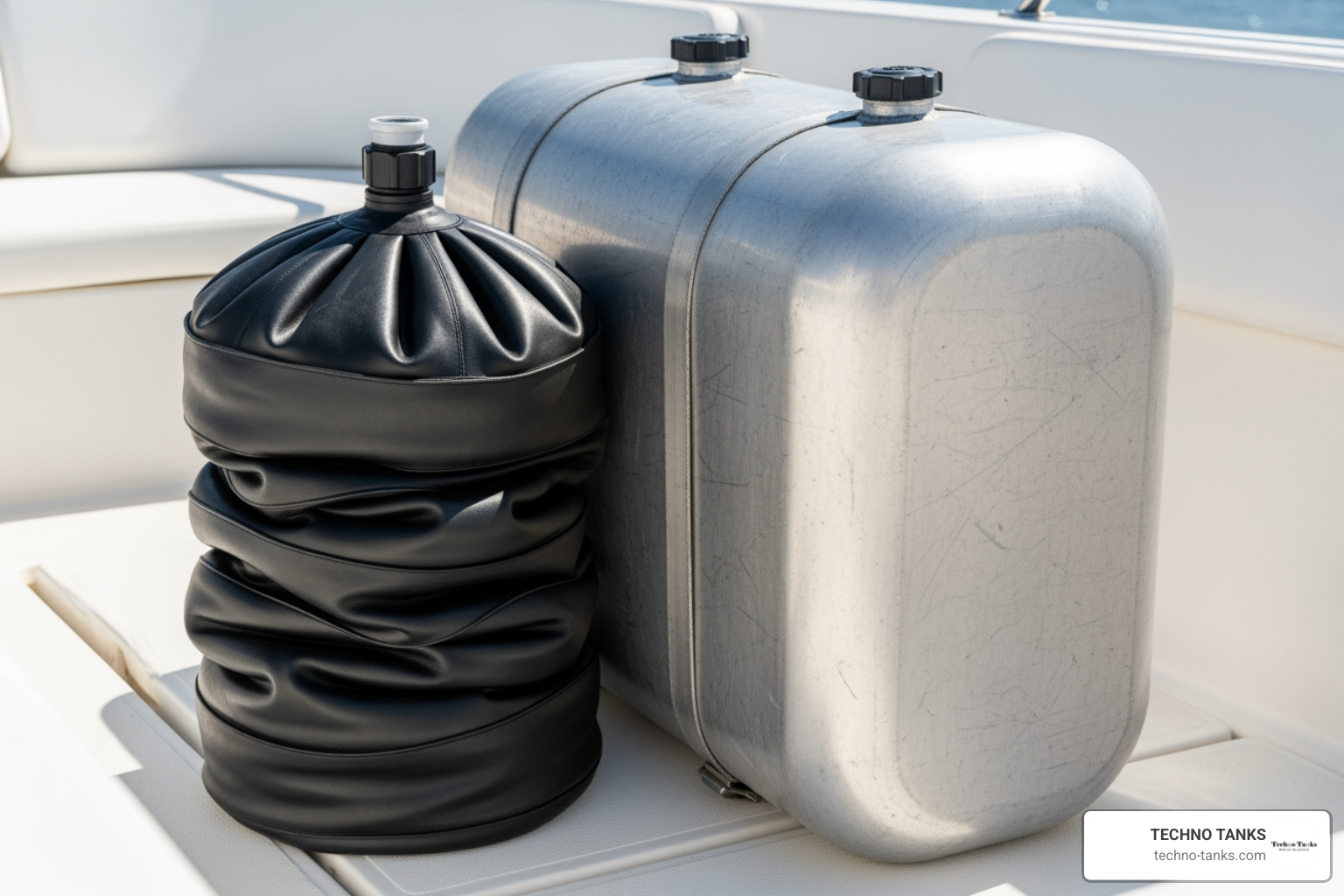
The primary difference lies in the Fuel Bladder vs Fuel Tank debate:
- Weight: An empty aluminum tank adds dead weight to your boat 100% of the time. A bladder weighs a fraction of that and can be removed when not in use.
- Portability: You can’t exactly “stow” a metal tank in a locker when it’s empty. Collapsible Fuel Tanks can be rolled up and stored in a vented area, returning your deck space to you for fishing or socializing once the fuel has been transferred.
- Installation: Metal tanks often require cutting fiberglass and professional welding. Bladders are “plug-and-play” solutions that secure to existing D-rings or cleats.
Advantages of Temporary Fuel Storage
The beauty of custom boat fuel bladders is their versatility. You might only need that extra 100 gallons once or twice a year for a crossing to the Bahamas or a long-range tournament. On those days, you roll out the bladder. For the rest of the year, your boat remains light and agile.
Using Temporary Fuel Storage also serves as a fantastic insurance policy. If your primary fuel system becomes contaminated, having a clean, isolated supply in Fuel Transfer Bladders can be a literal lifesaver. It allows you to bypass fouled lines and keep your engines running.
Performance in Marine Conditions
You might wonder if a “bag” of fuel can really handle the salt, sun, and slamming of the open ocean. High-quality Marine Fuel Bladders are engineered specifically for this. They are treated with UV inhibitors to prevent sun damage and hydrolysis stabilizers to resist the humid, salty air.
For readers who want a broader technical reference on marine operating environments, the United States Coast Guard is a useful external resource for boating safety guidance.
One of the coolest features? Buoyancy. Fuel is roughly 2/3 the density of water. This means a full bladder will float if it somehow ends up overboard. In extreme emergencies, an empty bladder can even be filled with air to provide significant emergency flotation for the craft or personnel.
Material Standards and Safety for Custom Boat Fuel Bladders
Not all “flexible tanks” are created equal. When you are sitting on 200 gallons of highly flammable gasoline, you want the best engineering possible. At Techno Tanks, we use a patented thermoplastic polyurethane (TPU) with directional molecule technology. This isn’t just a fancy term; it means the fabric is designed to be incredibly flexible while maintaining immense tensile strength.
According to Fuel Bladder Specs, high-end bladders often use mil-spec coated fabrics. These materials are tested to withstand extreme vibrations, shocks, and impacts that would cause a rigid tank to crack at the welds.
Fuel Compatibility and Permeation
A common concern with flexible materials is “permeation” — the smell of fuel “leaking” through the fabric. Modern custom boat fuel bladders utilize advanced barrier layers to keep permeation to an absolute minimum.
Our Custom Fuel Bladders are designed to be compatible with:
- Gasoline: Including high-aromatic blends.
- Diesel: Standard and #2/#4 fuel oils.
- Bio-Diesel: Highly resistant to the chemical properties of bio-fuels.
- Ethanol Blends: From E10 all the way to E100.
Sizing and Capacity for Custom Boat Fuel Bladders
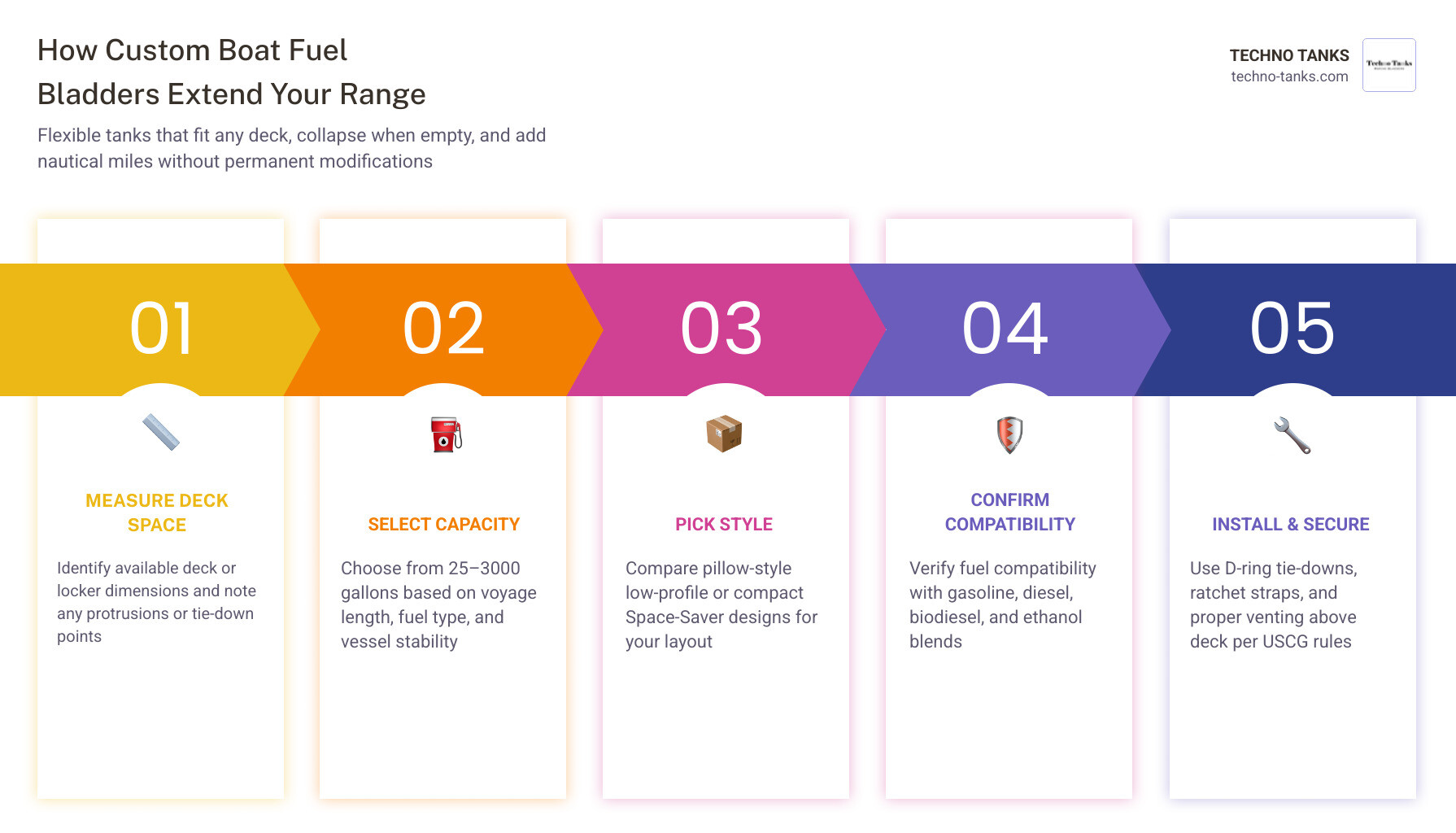
Whether you have a 25-foot center console or a 150-foot superyacht, there is a bladder size for you. Standard sizes often range from 25 to 300 gallons, but the “custom” in custom boat fuel bladders means we can scale up to 3,000 or even 5,000 gallons for commercial or long-range expedition vessels.
To get the perfect fit, we recommend using a Fuel Bladder Sizing Guide to measure your available deck space. We can even use CAD templates to design a bladder that fits into odd-shaped fish boxes, live wells, or storage compartments. For more on how captains use different volumes, check out Popular Marine Fuel Bladder Sizes and Their Uses.
Choosing Your Configuration: Pillow-Style vs. Space-Saver
When ordering, you generally have two primary form factors to choose from. Each has a specific job to do on your boat.
| Feature | Pillow-Style Bladder | Space-Saver Bladder |
|---|---|---|
| Profile | Very low-profile, wide footprint | Taller, compact footprint |
| Stability | Excellent; stays put in rough seas | Good; requires tighter containment |
| Best Use Case | Open deck space, bow or cockpit | Tight compartments, fish boxes |
| Storage | Folds flat like a blanket | Rolls up tightly |
| Capacity Range | 25 to 3,000+ Gallons | 25 to 500 Gallons |
The Pillow-Style is the classic choice for Marine Fuel Bladders. Its wide base spreads the weight of the fuel across a larger area of your deck, which is better for the structural integrity of your boat. The Space-Saver is ideal when you need to tuck the bladder into a specific “niche,” like between a console and a gunwale.
Above-Deck vs. Below-Deck Considerations
This is a big one. You might be tempted to hide your Custom Fuel Bladders inside the hull to keep the deck clear. However, Coast Guard regulations generally do not permit in-hull locations for flexible fuel bladders.
Installing above-deck is safer for several reasons:
- Venting: Fumes can dissipate into the open air rather than accumulating in a bilge.
- Gravity Transfer: Being higher than the main tank allows for easier fuel transfer.
- Inspection: You can immediately see if there is an issue or a spill during filling.
Customization Options and Pricing
When you move away from “off-the-shelf” sizes, you open a world of hardware options. You can specify the number of pickups, returns, and the type of valves (1/2 inch or 1 inch ball valves are common).
According to Fuel Bladder Pricing, costs vary based on capacity and material. A small 25-gallon pillow bladder might start around $700, while a 300-gallon reinforced version can exceed $1,700. Custom shapes and mil-spec materials will add to the lead time, which usually sits around 2 weeks for standard custom builds.
Installation and Maintenance for Optimal Performance
Installing a bladder is straightforward, but it must be done with respect for the weight involved. Remember: fuel weighs about 6-7 lbs per gallon. A 100-gallon bladder weighs nearly 700 lbs!

Always fill the bladder exactly where you intend to use it. Trying to move a full bladder is nearly impossible and dangerous. For the best flow, we recommend using Fuel Transfer Bladders with a simple gravity or siphon setup. While 12V or 24V diesel pumps are available, gravity is the most reliable (and cheapest) “pump” on the ocean.
Securing and Storing Custom Boat Fuel Bladders
Even if a full bladder feels stable, you must tie it down. In high seas, the “slosh” factor can create immense kinetic energy that can shift the bladder and damage your boat’s railings or gunwales.
- Securing: Use the built-in D-rings and high-quality ratchet straps. Criss-cross the straps to create a “cradle” effect.
- Cleaning: After use, rinse the exterior with fresh water and mild soap to remove salt.
- Storing: Ensure the interior is purged of fuel, let the bladder dry completely, and store it in a cool, dry, vented locker.
Safety Compliance and Buoyancy
Safety isn’t just a suggestion; it’s a standard. High-quality bladders are often manufactured under ISO 9001:2015 quality guidelines. This ensures that every seam is reinforced and every fitting is pressure-tested.
Some custom builds even include internal foam baffling. This is used for explosion suppression and to reduce fuel sloshing in high-performance or racing applications. Because of the inherent buoyancy of fuel, these tanks won’t sink your boat if they are washed overboard—they’ll actually act as a buoy!
Frequently Asked Questions about Marine Bladders
Can I mount my fuel bladder below deck?
Coast Guard regulations generally do not permit in-hull locations for flexible fuel bladders. Above-deck installation is the industry standard because it allows for safer venting of fumes, easier gravity-fed fuel transfer, and immediate access in case of a spill during the refueling process.
Will the fuel bladder float if it falls overboard?
Yes, absolutely. Gasoline and diesel fuel have a density that is approximately 2/3 that of seawater. Because the fuel is lighter than the water it displaces, the bladder will remain buoyant. In an emergency, an empty bladder can even be inflated with air to serve as a flotation device.
How do I ensure I get every drop of fuel out?
The most effective way to purge all fuel is to “roll” the bladder. As the fuel level gets low, start at the end furthest from the outlet and slowly roll or fold the bladder toward the fitting. This pushes the remaining liquid toward the pickup, ensuring minimal waste.
Conclusion
At TECHNO TANKS, we believe your adventures shouldn’t be limited by the size of your factory fuel tank. Our custom boat fuel bladders are engineered with patented TPU technology to give you the durability of a rigid tank with the flexibility of a collapsible one.
Whether you are looking for a standard 30-gallon range extender or a 3,000-gallon custom solution for a commercial vessel, our recyclable, mil-spec tanks are backed by a 5-year warranty to give you peace of mind on the water. Don’t let your fuel gauge dictate your fishing spots. Start planning your next offshore adventure today and take control of your range.

