
Why Every Boat Owner Needs to Understand Auxiliary Fuel Systems
Quick answer: What is an auxiliary fuel system?
| Question | Answer |
|---|---|
| What is it? | A secondary fuel supply added to a vessel to extend range or provide emergency reserve |
| Main types | Transfer system (fills main tank) or direct-feed system (feeds engine directly) |
| Who needs it? | Boaters on long offshore trips, fishing runs, or remote cruising routes |
| Common forms | Rigid tanks, in-bed/in-hull tanks, or flexible fuel bladders |
| Key safety rule | Always vent properly, prevent vapor lock, and never run the primary tank completely dry |
An auxiliary fuel system is one of the most practical safety upgrades a boat owner can make — yet it remains one of the most misunderstood.
If you’ve ever watched your fuel gauge drop faster than expected, miles from the nearest marina, you already know the anxiety. Offshore fishing trips, extended cruises, and passages through remote anchorages all share the same vulnerability: running short on fuel with nowhere to stop.
The stakes at sea are higher than on a highway. A truck that runs out of fuel pulls over. A boat that runs out of fuel drifts.
There’s an old saying in aviation that captures this perfectly:
“The only time you can have too much fuel is when your airplane is on fire.”
The same logic applies on the water. Having a reliable backup fuel supply isn’t paranoia — it’s seamanship.
I’m Ivan Jimenez, founder of Digital Ivan and Doral SEO, and I’ve spent years building authority content for industrial and technical sectors, including in-depth research into auxiliary fuel system design, safety standards, and regulatory frameworks. In this guide, I’ve combined FAA advisory guidance, real-world product knowledge, and marine-specific considerations to give boat owners a clear, practical resource they can actually use.
Essential auxiliary fuel system terms:
What an Auxiliary Fuel System Is and When Boat Owners Need One
At its core, an auxiliary fuel system is any secondary setup designed to carry and deliver fuel beyond the capacity of the vessel’s factory-installed main tanks. For many, this is an “emergency reserve,” but for serious offshore enthusiasts, it is a tool for endurance planning.
Whether you are heading to the Bahamas from Florida or chasing tuna 80 miles offshore, your fuel margin is your lifeline. A headwind that wasn’t in the forecast or a choppy sea state can easily increase your burn rate by 20-30%. Without an auxiliary supply, you are at the mercy of the elements.
Transfer vs. direct-feed auxiliary fuel system approaches
When we design these systems, we generally look at two different delivery methods. Each has its own design requirements and integration complexity.
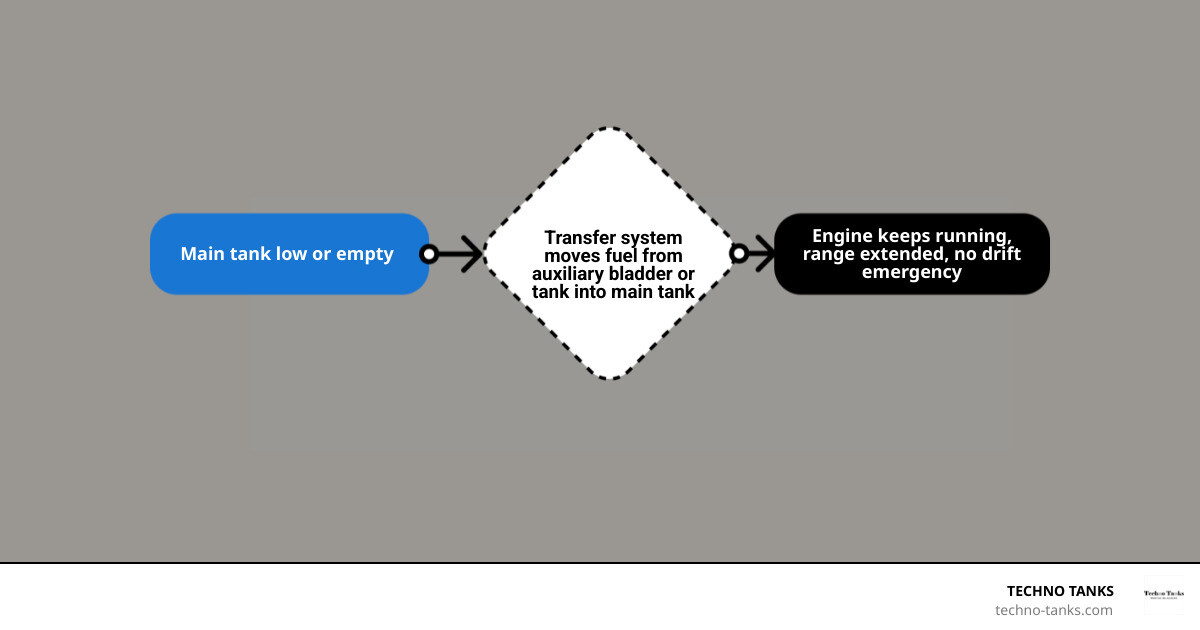
- Transfer Systems: These are the most common and generally safer for most boaters. The auxiliary tank acts like a “refill” for your main tank. Using a low-pressure pump, you move fuel from the auxiliary storage into the main tank as levels drop.
- Direct-Feed Systems: These supply fuel directly to the engine or generator. While they offer true redundancy (if your main tank is contaminated, you can switch to the clean auxiliary supply), they are more complex. They require dedicated supply and return lines and more careful management of the operator workload to prevent air from entering the fuel rails.
| Feature | Transfer System | Direct-Feed System |
|---|---|---|
| Primary Goal | Refilling main tanks | Engine redundancy/Emergency supply |
| Complexity | Low to Moderate | High |
| Failure Risk | Low (Pump failure just stops transfer) | High (Air in lines can stall engine) |
| Return Lines | Usually not required for the aux tank | Required for modern diesel engines |
Common marine use cases for backup fuel
We see a wide variety of scenarios where an auxiliary fuel system becomes essential. Passagemaking is the obvious one—if you’re crossing an ocean or cruising remote coastlines, you need the range. Sportfishing is another; “running and gunning” to find the fish consumes massive amounts of fuel.
Furthermore, many large yachts use auxiliary setups for:
- Tenders: Refueling smaller boats without returning to a dock.
- Generators: Keeping the AC and lights on during long remote anchorages.
- Weather Detours: Having the extra 50-100 gallons needed to go around a storm front rather than through it.
Why flexible fuel bladders are a practical option for temporary reserve fuel
For many boat owners, a permanent metal tank isn’t feasible due to space or weight constraints. This is where flexible fuel bladders shine. They offer a temporary installation that can be deployed on the deck or in a cockpit for a specific trip and then folded away when the trip is over.
Unlike rigid tanks, bladders collapse as they empty, eliminating the “free surface effect” (the dangerous sloshing of liquid that can affect boat stability). This makes them an incredibly space-efficient way to carry an emergency reserve without permanently altering the vessel’s layout.
Design and Placement Rules for a Safe Auxiliary Fuel System
Installing an auxiliary fuel system isn’t as simple as strapping a tank to the deck. You have to consider the vessel’s center of gravity and trim. Adding 500 lbs of fuel to one side of the boat can create a dangerous list or change how the hull handles following seas.

Structural support, restraints, and crashworthiness principles
We can learn a lot from aviation standards like AC 25-8 – Auxiliary Fuel System Installations. In a “survivable” impact or heavy sea state, the tank must stay put. This means using high-strength restraint points and abrasion guards.
If you are using a deck-mounted bladder, it must be secured with heavy-duty webbing to prevent it from sliding. If it’s a rigid tank in a cargo area, it should have a barrier to prevent other gear from crushing the fuel lines. A fitting factor of at least 1.15 should be applied to all support attachments to ensure they can handle the dynamic loads of a boat slamming into waves.
Where fuel bladders and lines should not go
Safety is about what you don’t do. Never place an auxiliary fuel system or its components in:
- Engine Spaces: The heat is a major ignition risk.
- Battery Compartments: Sparks and fuel vapor are a deadly mix.
- Bilge Low Points: You don’t want fuel lines submerged in corrosive bilge water.
- Walkways: Tripping hazards are one thing; stepping on a fuel line is a recipe for a leak.
Hose routing, vent routing, and protection from heat or engine failures
Hoses should be routed away from exhaust runs and sharp edges. We recommend using fire-rated sleeves and anti-chafe wrapping at any point where a hose passes through a bulkhead.
Crucially, the vent routing must include a “loop” that rises above the fill level to prevent siphoning or water ingress. Every system should have a manual shutoff valve at the tank exit, allowing you to isolate the fuel supply instantly in an emergency.
Integrating an Auxiliary Fuel System With the Existing Boat Fuel Setup
Integration is where most DIY projects go wrong. You have to ensure the auxiliary fuel is compatible with your main system and that your pickup points don’t introduce air into the engine.
Connecting an auxiliary fuel system without starving the engine
The safest way to integrate is the “transfer to main” concept. By pumping fuel into the main tank, you avoid messing with the engine’s high-pressure supply lines. If you choose a direct-feed setup, you must ensure the pump is sized correctly.
A common issue in aviation is vapor lock. This happens when a pump draws air, usually from an empty aux tank, into the lines. In a boat, this can stall your engine at the worst possible moment, like when you’re trying to time a harbor entrance. Always switch back to your main tanks before the auxiliary is bone dry.
Compatibility checks for engines, materials, and fuel quality
Most marine auxiliary systems discussed here are diesel focused. Gasoline auxiliary setups demand much stricter vapor-control and ignition-protection measures because gasoline vapors are far more volatile.
When choosing materials, ensure your hoses are rated for the fuel type, especially with ethanol-blended gasoline. Our tanks at Techno Tanks use patented, recyclable thermoplastic polyurethane (TPU), which is highly resistant to chemical breakdown and much more durable than standard rubber or low-grade plastics.
Manual vs automatic transfer systems and control logic
You have two main choices for controlling the flow:
- Manual Switches: Simple and reliable. You press a button, the pump runs. You have to watch the gauge so you don’t overfill the main tank.
- Automatic Transfer: These systems can be configured to start and stop transfer based on tank levels. This reduces operator workload but adds complexity with level sensors and fail-safe logic.
Safety Features and Failure-Mode Protections Every System Needs
Every auxiliary fuel system needs multiple layers of protection. This starts with proper venting and vacuum relief to prevent the tank from collapsing as fuel is drawn out.

Preventing vapor lock, overpressure, and fuel contamination
To prevent contamination, use high-quality water separators and filters between the auxiliary and main tanks. This ensures that any condensation or “tank bottom” debris from the auxiliary supply doesn’t reach your engine.
Overpressure can happen if a tank is filled in the cool morning and then sits in the hot afternoon sun. A pressure relief valve is essential to prevent the tank or bladders from rupturing.
Essential components for emergency shutdown and fault isolation
If a hose fails, you need a way to stop the flow. We recommend:
- Check Valves: To prevent backflow.
- Breakaway Fittings: If a deck-mounted bladder is somehow swept overboard, these fittings seal the lines so you don’t dump your entire fuel supply into the ocean.
- Bonding and Grounding: To prevent static electricity buildup during fuel transfer.
Inspection points that catch problems before they become emergencies
Don’t wait for a smell of diesel to check your system. Your monthly inspection should include:
- Checking hose age (rubber degrades over time).
- Looking for seepage at fitting joints.
- Listening for unusual pump noise (a sign of impending failure).
- Ensuring vent lines are clear of salt crust or insect nests.
Regulations, Documentation, and Operating Procedures
While the USCG has specific rules for permanent fuel systems, auxiliary setups often fall into a “gray area.” However, following the ABYC (American Boat and Yacht Council) standards is the best way to ensure your insurance covers you in the event of an accident.
What aviation rules teach us about designing an auxiliary fuel system
The FAA’s AC 25-8 provides a “gold standard” for safety. It emphasizes that auxiliary tanks in “cargo areas” (like your boat’s cockpit or deck) must be designed to withstand emergency landing loads (or in our case, heavy sea impacts). They also suggest that placards and instrument markings should clearly state the “usable fuel” versus “total capacity.”
Road-vehicle rules that highlight fuel-type restrictions
It is worth noting that in the automotive world, NHTSA interpretations and DOT/EPA regulations have essentially banned gasoline auxiliary tanks for aftermarket installation. This is a strong hint for boaters: while gasoline bladders exist, they require much more stringent safety protocols than diesel systems.
Operating procedures, checklists, and manual updates for crews
Your crew should have a Standard Operating Procedure (SOP) for fuel transfer.
- Takeoff/Landing Rule: In planes, you must be on main tanks for takeoff and landing. On a boat, you should be on main tanks when navigating inlets, heavy seas, or docking.
- Timing: Switch to your auxiliary supply during the “level flight” portion of your trip—when you are cruising at a steady RPM in open water.
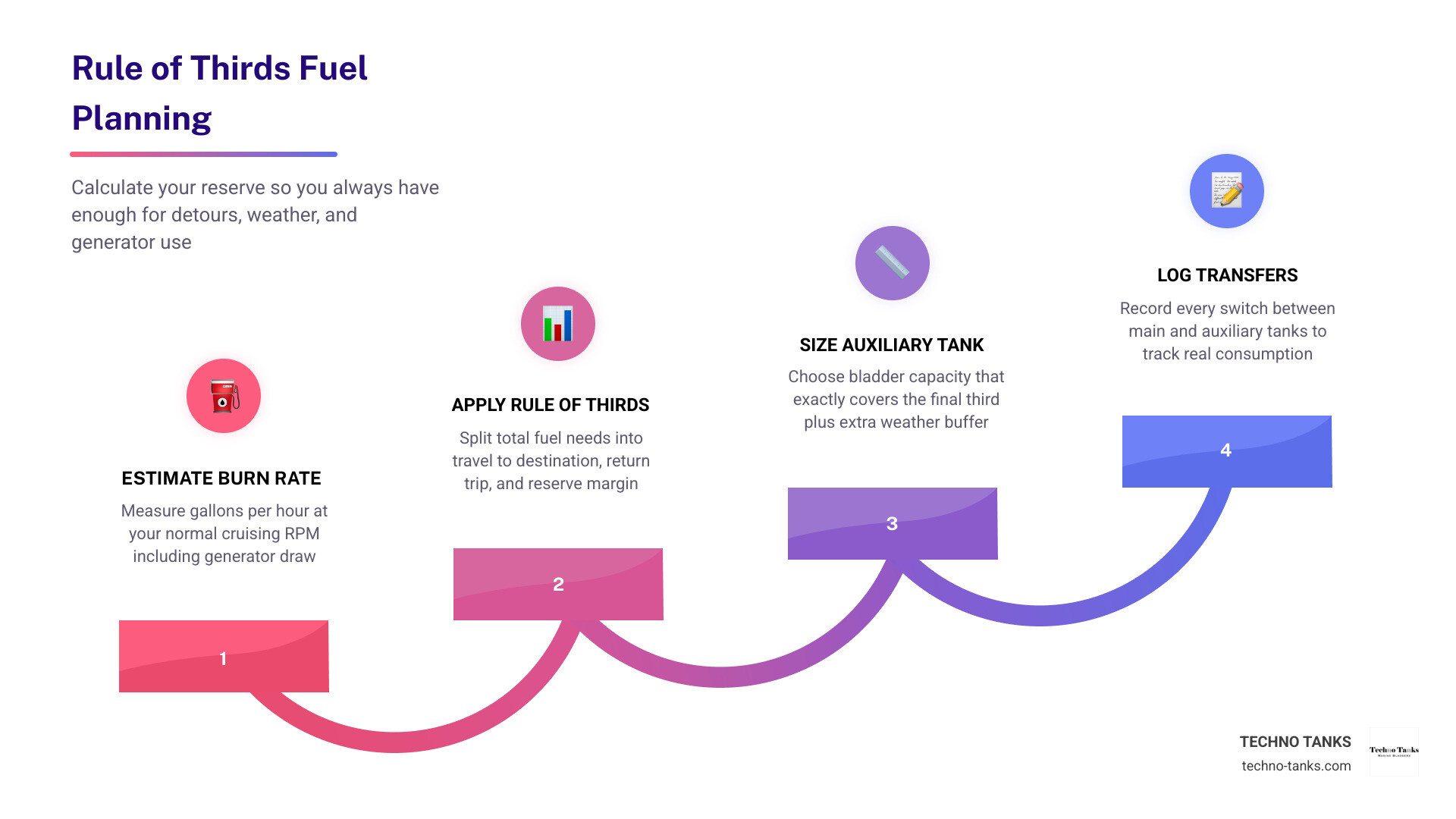
- Logbook: Always record when a transfer starts and stops to help track your actual burn rate.
How to Size, Maintain, and Use a Marine Emergency Fuel Reserve
Sizing your auxiliary fuel system is about math, not guesswork. You need to know your Gallons Per Hour (GPH) at your typical cruising speed.
Sizing the reserve for your range and real-world burn
A good rule of thumb is the “Rule of Thirds”: One-third of your fuel to get there, one-third to get back, and one-third in reserve. If your main tanks only cover the first two, your auxiliary system needs to cover that final third.
We offer fuel bladder sizing guides that help you calculate the exact dimensions needed for capacities ranging from 30 to 3000 gallons. Remember to account for generator draw if you plan on anchoring out!
Maintenance and inspection schedule for reliable deployment
An auxiliary fuel system that fails when you need it is worse than having no system at all.
- Monthly: Test the transfer pump for 30 seconds.
- Annual: Inspect the interior of the tank/bladder for microbial growth (algae).
- Every 2.5 Years: For certain transport tanks, a pressure re-test is required by federal law (49 CFR 180.352).
Best practices for safe fueling, transfer, and emptying
Always use a dedicated funnel with a mesh filter when filling an auxiliary tank. Ensure the boat is bonded to the fuel dock to prevent static sparks. When emptying the system, monitor your gauges closely. As the aviation experts warn, running a tank dry can cause air ingestion that prevents you from restarting the engine even after you switch tanks.
For more on choosing the right size, check out our guide on popular marine fuel bladder sizes and their uses.
Frequently Asked Questions about Auxiliary Fuel Systems
Is a transfer system safer than a direct-feed setup on a boat?
Generally, yes. A transfer system is simpler. If the transfer pump fails, you still have whatever is in your main tank. In a direct-feed system, a failure in the auxiliary plumbing can cause the engine to stall immediately, which is much more dangerous in a heavy sea.
Where is the safest place to install an emergency auxiliary fuel system?
The best place is on the deck, near the centerline, and as low as possible to maintain stability. It should be away from engine heat, protected from sharp objects, and secured with high-strength straps that can handle at least 1.5 times the weight of the full tank.
How often should a marine auxiliary fuel system be inspected?
You should perform a visual inspection before every major trip. A more thorough “seasonal” service should be done annually, checking all hose clamps, looking for UV damage on flexible bladders, and testing the fuel quality for water or sediment.
Conclusion
An auxiliary fuel system is the ultimate “peace of mind” upgrade for any offshore boater. Whether you’re extending your fishing range or ensuring you have enough reserve to wait out a storm, the right setup makes all the difference.
At Techno Tanks, we specialize in helping boaters go further. Our patented, recyclable TPU fuel bladders are designed to be the toughest, most reliable temporary fuel solutions on the market. From 30-gallon reserves to 3000-gallon ocean-crossing setups, we have the expertise to help you fuel your wanderlust safely. Don’t let your fuel gauge dictate your adventure—take control of your range today.

