
Why Offshore Fuel Bladder Systems Are the Smarter Choice for Range and Flexibility
Offshore fuel bladder systems are collapsible, flexible fuel storage tanks designed to carry additional gasoline or diesel aboard vessels without requiring permanent rigid tank installation.
Quick answer — what they are and who needs them:
| Factor | Detail |
|---|---|
| What they are | Flexible, collapsible containers that store and transfer fuel aboard vessels |
| Common capacities | 25 gallons up to 5,000+ gallons |
| Best for | Range extension, backup fuel, temporary storage, auxiliary capacity |
| Key users | Offshore operators, commercial crews, expedition vessels, work boats |
| vs. rigid tanks | No permanent installation, folds flat when empty, space-efficient |
| Typical materials | TPU-coated polyester, urethane-coated fabric, mil-spec options |
If you need more range, backup fuel capacity, or a flexible alternative to a fixed tank — without cutting into your vessel’s structure — a marine fuel bladder is worth serious consideration.
Every offshore operator eventually faces the same problem: your fixed tank capacity determines your operational range, and that range may not be enough. Whether you’re running an extended offshore fishing trip, a commercial work boat mission, or a long-distance passage, a permanent rigid tank can’t adapt to your changing fuel needs. Bladder systems can.
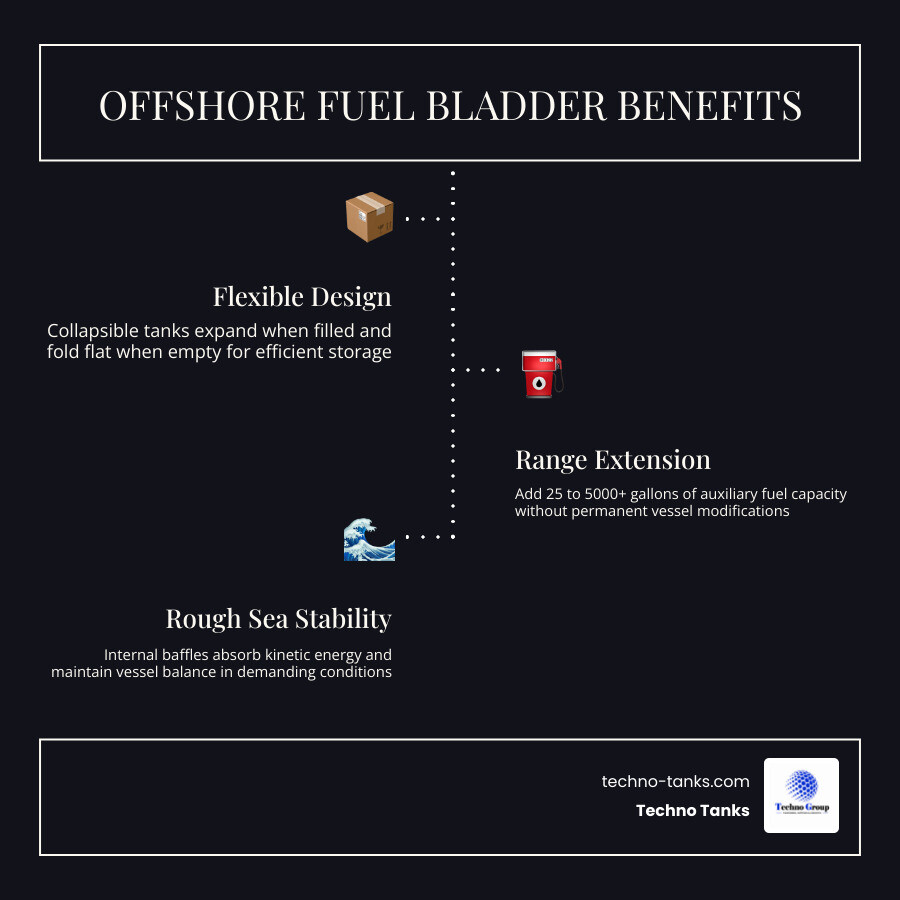
These systems have evolved well beyond simple portable containers. Today’s offshore fuel bladder systems are engineered with military-grade materials, precision-welded seams, internal baffling for rough-sea stability, and custom-fit geometries — built to perform where conditions are demanding and failure is not an option.
What Are Offshore Fuel Bladder Systems?
At their core, offshore fuel bladder systems are heavy-duty, collapsible containers designed to safely store and transport liquid hydrocarbons in marine environments. Unlike rigid aluminum, stainless steel, or polyethylene tanks, these flexible containers expand as they are filled and collapse completely flat as they are emptied.
The fundamental difference lies in their dynamic footprint. A traditional rigid marine tank occupies the exact same volume of physical space whether it is holding 500 gallons of diesel or is completely empty. For vessels where deck space or below-deck compartment volume is at a premium, this is highly inefficient.
Flexible bladders solve this structural limitation. They are constructed using advanced Thermoplastic Polyurethane (TPU) or urethane-coated fabrics, which are RF-welded (radio frequency) to create high-strength, leak-proof seams. When empty, a bladder can be rolled up or folded flat, recovering up to 90% of the deck or storage space it occupied when full.
For a detailed breakdown of how these two storage methods compare under real-world conditions, operators can consult our comprehensive guide on Fuel Bladder vs Fuel Tank.
Pillow-Style vs. Custom-Engineered Offshore Fuel Bladder Systems
When selecting a system, operators generally choose between two primary design configurations: standard pillow-style bladders and custom-engineered space-saver systems.
- Pillow-Style Bladders: These are the traditional, low-profile auxiliary tanks commonly seen secured to vessel decks. When filled, they resemble a large, pressurized pillow. They are highly economical, easy to deploy, and ideal for wide-open deck spaces where height is not a limiting factor.
- Custom-Engineered Space-Saver Bladders: These bladders are designed with specific geometries to fit into tight, non-standard, or irregularly shaped compartments. Rather than expanding equally in all directions, space-savers utilize internal structural engineering to maintain a more vertical or boxed profile, maximizing volume within a smaller footprint.
| Feature | Standard Pillow-Style Bladder | Custom-Engineered Space-Saver |
|---|---|---|
| Primary Location | Open deck areas, flat hatches | Tight compartments, bow lockers, under-seat areas |
| Footprint Efficiency | Moderate (requires wider surface area) | High (maximized vertical-to-horizontal ratio) |
| Profile | Very low-profile, wide | Box-like, taller, compact footprint |
| Typical Capacities | 25 to 5,000+ gallons | 30 to 3,000 gallons (tailored to space) |
| Best Use Case | Bulk deck storage for long-range transits | Below-deck integration, restricted deck layouts |
For specialized industrial or commercial operations, Techno Tanks can develop custom-conforming shapes that integrate directly with existing vessel framing to maximize available space.
Key Benefits of Collapsible Fuel Storage for Offshore Vessels
For offshore vessels, work boats, and commercial transport craft, the integration of collapsible fuel storage provides several operational advantages:
- Auxiliary Fuel Capacity & Range Extension: The most immediate benefit is the elimination of “range anxiety.” Carrying auxiliary fuel in a flexible bladder allows vessels to undertake extended transits or remain on-station at offshore platforms far longer without returning to port to refuel. Operators planning long voyages can read more about managing these requirements in our guide on Range Anxiety: Top Solutions for an Extended Cruising Range and explore the core principles of long-distance fuel planning in Fuel for Thought: The Essentials of Long Range Cruising.
- Dynamic Weight Distribution: As fuel is consumed from the bladder, the tank collapses. This prevents the formation of “free-surface effect” (the sloshing of liquid in a partially filled rigid tank), which can severely compromise vessel stability in rolling seas.
- Deck Space Recovery: Once the auxiliary fuel has been transferred to the vessel’s main tanks, the bladder is rolled up and stowed away. The deck space is immediately reclaimed for cargo, equipment, or operational crew movement.
- Temporary Fuel Storage: For missions requiring temporary fuel transport—such as supplying remote generators, supporting offshore platforms, or conducting ship-to-shore transfers—flexible bladders provide a rapidly deployable, highly portable solution that can be removed from the vessel entirely when the mission is complete.
Mitigating Fuel Slosh with Advanced Baffling Systems
One of the greatest hazards of transporting large volumes of liquid on an open deck is the dynamic kinetic energy generated by moving fuel. In rough seas, hundreds of gallons of fuel shifting rapidly from side to side can create destabilizing forces capable of listing or capsizing a vessel.
To mitigate this risk, high-quality offshore fuel bladder systems feature advanced internal baffling systems.
These internal baffles are flexible, perforated chambers or walls welded inside the bladder. They allow fuel to flow slowly between chambers to ensure even draining, but they break up the kinetic energy of rapid surges during heavy pitching and rolling. By dampening the internal wave action of the fuel, baffling systems ensure the vessel maintains its center of gravity and predictable handling characteristics in turbulent offshore conditions.
Material Specifications, Installation, and Maintenance
The reliability of a marine fuel bladder depends entirely on its material science. Because these tanks are exposed to harsh hydrocarbons internally and extreme marine elements externally, standard PVC or low-grade plastics are entirely unsuitable.
High-performance bladders are constructed from heavy-duty, military-specification Thermoplastic Polyurethane (TPU) or urethane-coated high-tenacity polyester fabrics. The selection of the specific TPU formulation is critical and depends on the fuel type:
- Polyester TPU: Exceptionally resistant to diesel fuels, jet fuels, and industrial oils. It provides outstanding puncture resistance and high tensile strength.
- Polyether TPU: Formulated specifically for gasoline and ethanol-blended fuels. Polyether TPU prevents the chemical degradation and swelling that gasoline can cause in standard polyurethane materials.
Using the incorrect material can lead to internal delamination and catastrophic failure. Additionally, the fabric must feature advanced UV inhibitors and hydrolysis stabilizers to prevent degradation from constant exposure to intense sunlight, saltwater, and extreme temperatures ranging from -30°C to +70°C. All seams must be 100% radio-frequency (RF) welded to ensure the molecular bond of the fabric is stronger than the material itself.
For a complete breakdown of material selections and storage safety, read The Complete Guide to Marine Bladder Tanks and Storage.
Regulatory Compliance for Offshore Fuel Bladder Systems
Operating offshore requires strict adherence to safety and environmental regulations. When deploying auxiliary fuel systems, operators must ensure their equipment and installation methods align with recognized standards:
- USCG 33 CFR 183.510: United States Coast Guard regulations dictate strict guidelines for marine fuel systems, focusing heavily on fire resistance, venting, and secure installation. Operators should review the current federal requirements in 33 CFR Part 183, Subpart J and confirm how they apply to the specific vessel, fuel type, and installation method. Notably, USCG regulations prohibit the installation of temporary fuel bladders below deck or in-hull on recreational and certain commercial vessels due to vapor accumulation risks.
- ABYC H-24: The American Boat & Yacht Council standards provide rigorous testing and installation protocols for gasoline and diesel fuel systems, ensuring all fittings, hoses, and venting systems can withstand marine vibrations and corrosion.
- ISO 21487:2012: This international standard specifies requirements for permanently installed and auxiliary fuel tanks on small craft, focusing on pressure testing and structural integrity.
Adhering to these standards is not merely a matter of legal compliance; it is a fundamental safety requirement for protecting the vessel, its crew, and the marine environment. For more information on emergency fuel systems and compliance, refer to The Ultimate Guide to Marine Emergency Fuel Supply Systems.
Best Practices for Installation and Securing
Proper installation is the difference between a successful voyage and a hazardous deck emergency. When deploying an offshore fuel bladder, operators should adhere to the following best practices:
- Deck Preparation: Ensure the deck area is completely clear of sharp objects, protruding bolt heads, or abrasive surfaces. Use a heavy-duty protective underlayment mat beneath the bladder.
- Securing the Bladder: Never rely on the weight of a full bladder to keep it in place. A 300-gallon bladder weighs over 2,000 lbs and will slide in rough seas. Secure the bladder using heavy-duty ratchet straps rated for the dynamic load of the filled tank, anchoring them to the integrated stainless steel or aluminum D-ring tie-down points welded along the bladder’s perimeter.
- Filling Location: Always fill the bladder in its final operational location. Trying to move or lift a filled fuel bladder is highly dangerous and can damage the tank’s structural integrity.
- Fuel Transfer Methods: For safer operation, gravity-feed or siphon systems are preferred for transferring fuel to the vessel’s main tanks. If using pumps, ensure they are specifically rated for marine fuel transfer and feature explosion-proof motors.
- Venting: Ensure the bladder’s integrated vent valve is clear and functioning to prevent vacuum collapse during fuel extraction or over-pressurization during filling.
To explore specific product options and detailed deck-mounting configurations, read Don’t Get Stranded: Best Marine Fuel Bladder Tank Options for Offshore Trips.
Extreme Marine Environment Performance and Custom Engineering
In heavy commercial marine applications-such as offshore oil and gas support, subsea ROV operations, and platform logistics-fuel storage must perform under extreme hydrostatic pressures and high-salinity environments.
Specialized subsea bladders are engineered to withstand deep-sea deployment, acting as fluid compensators or storage reservoirs for offshore platforms and unmanned underwater vehicles. These systems require custom-engineered fittings, such as dual-action aluminum or stainless steel flanges equipped with compatible seals to help reduce corrosion risk and chemical leakage.
Whether a vessel requires a compact deck tank for a sport-fishing run or a multi-thousand-gallon containerized system for industrial fuel transport, custom engineering ensures the bladder conforms to the precise spatial and chemical requirements of the job. You can review specialized commercial applications in our guide to Offshore Fuel Solutions.
Frequently Asked Questions about Offshore Fuel Bladders
Can a single bladder hold both diesel and gasoline interchangeably?
No. This is a critical safety and material issue. Polyester TPU is chemically formulated to handle diesel, jet fuel, and oils, whereas polyether TPU is required to safely contain gasoline and ethanol. Filling a diesel-rated bladder with gasoline will dissolve the inner liner, leading to material degradation, fuel contamination, and catastrophic leaks. Always specify your exact fuel type when ordering a bladder.
Can I mount my fuel bladder below deck?
Under US Coast Guard regulations and ABYC safety standards, temporary or flexible fuel bladders must not be mounted below deck or in enclosed, unvented hull compartments. Above-deck mounting is required to ensure proper gravity fuel transfer, prevent the accumulation of explosive fuel vapors, and allow for immediate visual inspection and clean-up in the event of an accidental spill during filling.
How do I safely store a fuel bladder when not in use?
To maximize the lifespan of your bladder, follow these maintenance steps:
- Drain completely: Purge all remaining fuel by rolling the empty bladder from the outer edges toward the drain fitting.
- Rinse and clean: If storing long-term, rinse the exterior with fresh water to remove salt residue, and allow it to dry completely.
- Fold flat: Fold or roll the dry bladder flat. Do not crease the material sharply.
- Store safely: Store the folded bladder in a cool, dry, and well-ventilated locker away from direct sunlight, extreme heat, and pests.
Conclusion
Choosing the right offshore fuel bladder system is a balancing act of material science, spatial planning, and strict safety compliance. For serious offshore operators, commercial crews, and long-range cruisers, these systems provide a reliable, space-saving alternative to heavy, permanent rigid tanks.
Techno Tanks manufactures high-durability, flexible fuel bladders and custom collapsible storage systems ranging from 30 to 3,000 gallons. Engineered with heavy-duty TPU fabrics, advanced RF-welded seams, and optional internal baffling, our solutions are built to withstand the harshest offshore conditions.
Because every vessel layout, fuel type, and operational range requirement is unique, pricing for Techno Tanks systems depends on size, configuration, and custom project specifications.
To find the perfect fit for your vessel and request an accurate, project-specific quote, contact our engineering team today at Offshore Fuel Solutions.

