
Why Extended Cruising Range Is the Most Important Number on Any Long Passage
Extended cruising range is the single factor that determines how far you can go — and how safely you can get back.
Before we dive in, here are the fastest ways to extend your cruising range on the water:
| Solution | Best For | Effort |
|---|---|---|
| Flexible fuel bladders | Quick capacity boost, no major refit | Low |
| Custom marine fuel tanks | Permanent integrated range upgrade | Medium-High |
| Compact backup fuel bladders | Fishing trips, short-range emergency margin | Low |
| Speed reduction (75% throttle) | Immediate efficiency gain, any vessel | None |
| Hull maintenance (clean bottom) | Up to 20% range improvement | Low-Medium |
| Watermaker + solar install | Reduces port stops, extends self-sufficiency | Medium |
Running out of fuel offshore is not just inconvenient. It’s dangerous.
Yet it happens constantly — because boat owners trust the brochure number, not the real-world one. A 35-foot motor yacht rated for 400 nautical miles on a full tank can fall well short of that in a headwind, with a loaded boat, and a hull that hasn’t been cleaned in six months.
The gap between theoretical range and actual range is where problems live.
Whether you’re island-hopping the Mediterranean, heading offshore for a week of fishing, or planning a serious bluewater passage, knowing how to extend and protect your cruising range is what keeps you moving — and safe.
I’m Ivan Jimenez, founder of DIGITAL IVAN and DORAL SEO, and I’ve spent years building content systems for industrial and marine companies — including deep research into what boat owners actually need when planning for extended cruising range. This guide cuts through the noise and focuses on practical solutions you can act on, no matter your vessel type or trip profile.
What Extended Cruising Range Really Means on the Water
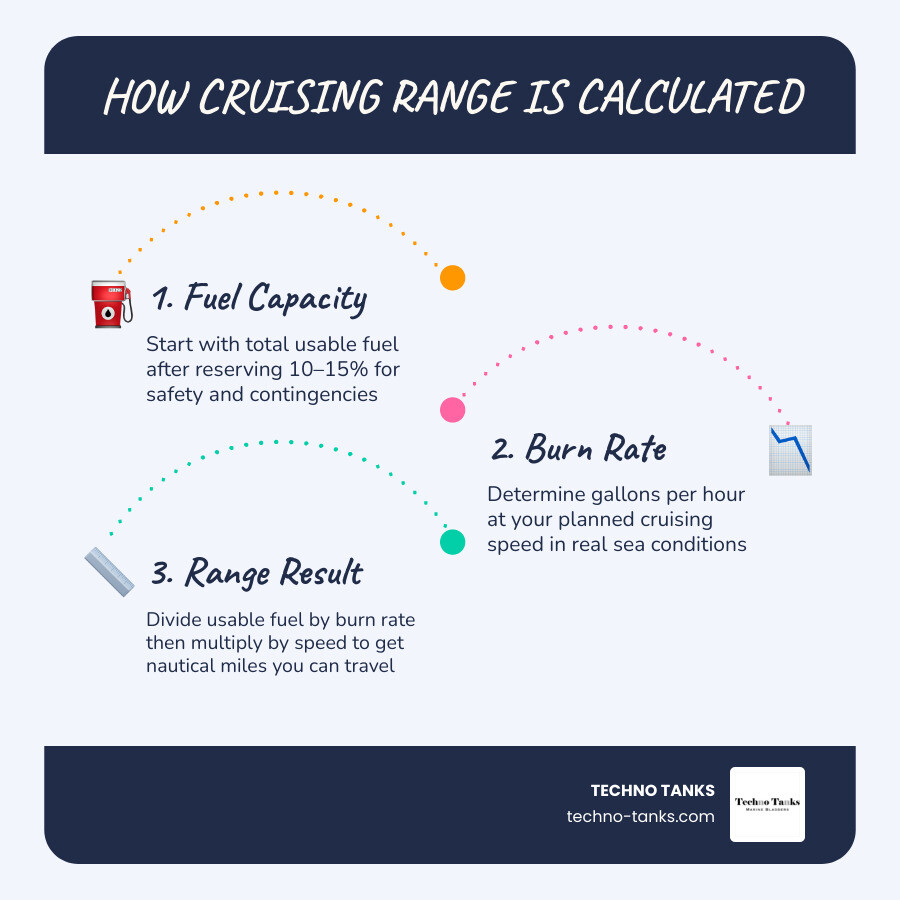
Cruising range is the distance a vessel can travel on its available energy supply. For boats, that usually means nautical miles on usable fuel, not total fuel. The difference matters.
A proper range calculation starts with:
- Total fuel capacity
- Minus unusable fuel
- Minus reserve fuel
- Multiplied by real burn rate at your intended speed
That last part is where many plans go sideways. A boat may have enough fuel on paper, but not enough at the speed, load, and conditions actually expected.
Displacement-speed boats usually produce the best range because they move through the water efficiently. Planing boats can cover distance quickly, but usually at a big fuel penalty. Semi-displacement boats sit in the middle and can be a smart compromise for owners who want flexibility.
Why extended cruising range matters for yachts, powerboats, and remote travel
For yachts and powerboats, range is about more than distance. It is about freedom, weather options, and safety.
If we are:
- Crossing a long offshore leg, we need enough fuel for the route plus a diversion
- Island-hopping, we need margin for marina closures, rough weather, and detours
- Fishing remotely, we need enough fuel to run out, drift, troll, and return with confidence
- Cruising self-sufficiently, we need fewer shore stops for fuel, water, and power
The same concept appears in other transport sectors too. Transit fleets use extended-range systems to keep vehicles on longer duty cycles. For example, New Flyer announced an extended-range hydrogen bus option that adds up to 120 miles through added hydrogen storage, showing the same basic truth: more onboard energy means more flexibility and fewer forced stops. See NFI’s New Flyer launches extended range option for Xcelsior CHARGE FC™ hydrogen fuel cell-electric bus | NFI Group.
The difference between brochure range and real-world extended cruising range
Brochure range assumes ideal conditions. Real water has other ideas.
Actual range is reduced by:
- Headwinds
- Rough sea state
- Foul current
- Heavy payload
- Dirty hulls and props
- Poor engine tune
- Generator use and hotel loads
- Conservative reserve planning
Research on island-hopping trips notes that headwinds can cut effective range by 15% to 25%, and larger waves add drag that pushes fuel burn up further. A loaded cruising boat can also see fuel use rise by 10% to 15%. That is why we should treat theoretical range as a ceiling, not a promise.
Top Fuel Storage Solutions for an Extended Cruising Range
If the goal is to find more range, fuel capacity is usually the first lever to pull. Not always the cheapest, but often the most direct.
| Solution Type | Best Use Case | Capacity Range | Main Benefit |
|---|---|---|---|
| Flexible fuel bladders | Seasonal trips, temporary range boost | 30-3000 gallons | Fast added capacity without major refit |
| Custom marine fuel tanks | Permanent upgrade | Build-specific | Integrated long-term solution |
| Compact backup bladders | Fishing, tender ops, emergency reserve | Small capacity | Easy reserve margin and portability |
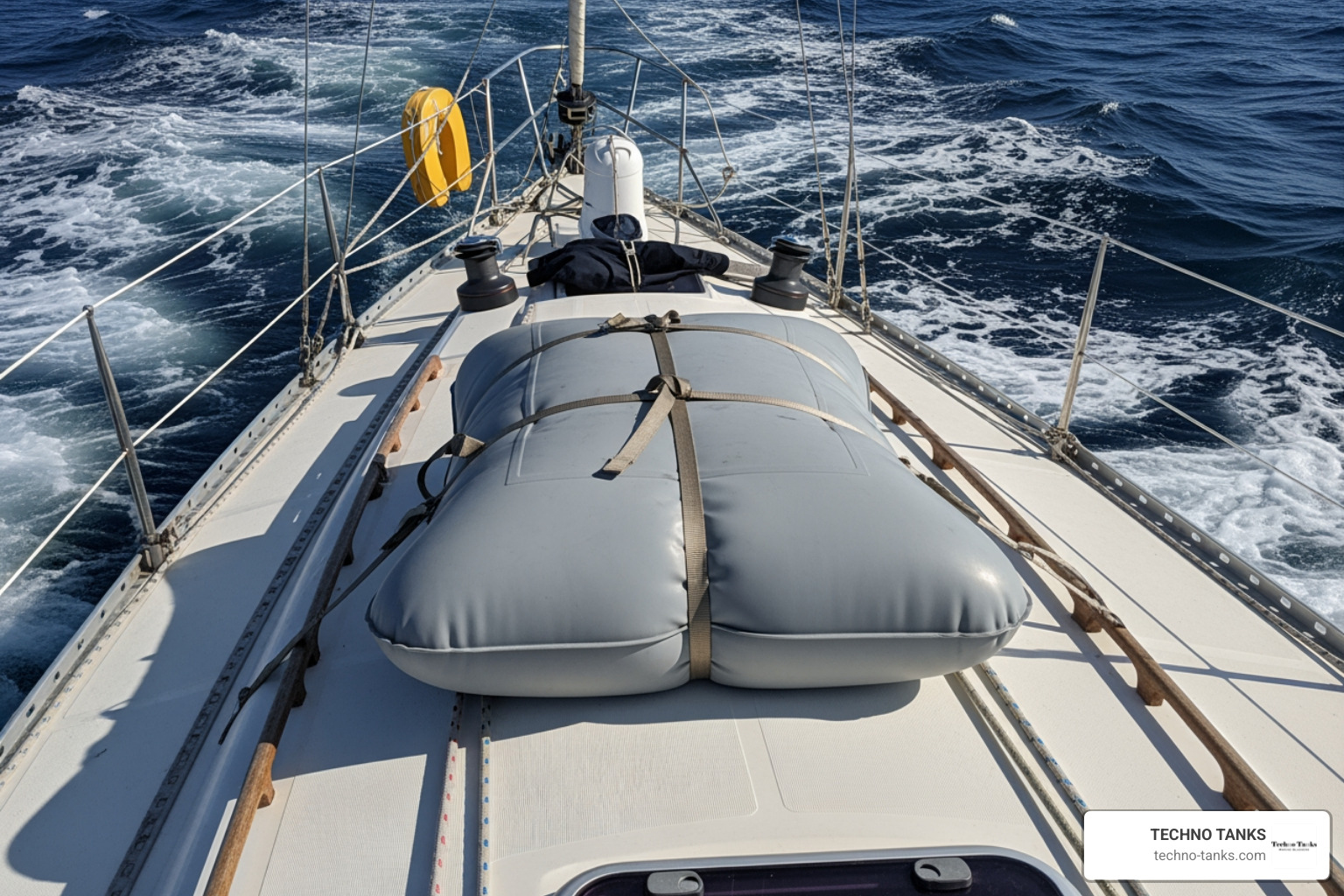
Flexible fuel bladders for extended cruising range without major refits
For many boat owners, flexible fuel bladders are the fastest and cleanest way to add real-world range.
At Techno Tanks, we build patented recyclable TPU marine fuel bladders from 30 to 3000 gallons. That matters because a temporary solution should still be rugged, marine-ready, and sized to the trip instead of forcing a permanent redesign of the boat.
Flexible bladders are ideal when we want:
- More fuel for a specific season or expedition
- A temporary offshore range upgrade
- Extra capacity without cutting into hull structure
- A removable solution for fishing or cruising missions
They also help us avoid a full refit when all we really need is more fuel for selected passages. For a deeper look, see Get a Grip on Your Range with Custom Boat Fuel Bladders and Go Further with Flexible Diesel Tanks and Long Range Upgrades.
Custom marine fuel tanks for permanent long-range upgrades
If extended range is part of the boat’s permanent mission, a custom marine fuel tank may make more sense.
Permanent tanks are best when we want:
- Integrated plumbing and venting
- Predictable weight placement
- Protected installation below deck
- Long-term resale and mission fit
The trade-off is complexity. Permanent upgrades involve design, access, installation planning, inspections, and often more downtime. We also need to think carefully about vent routing, fuel transfer arrangements, and future service access. If we bury a tank where nobody can inspect it, we have created tomorrow’s headache today.
For more on permanent options, read The Best Custom Marine Fuel Tanks to Keep You Cruising.
Compact backup fuel options for fishing trips and short-range extension
Not every trip needs hundreds of extra gallons. Sometimes we just need enough reserve to stop that little voice in our head from asking, “Was that fuel gauge always this dramatic?”
Compact backup fuel bladders are useful for:
- Offshore fishing trips
- Weekends with uncertain fuel dock access
- Safety margin on shorter passages
- Support vessels and tenders
A small-capacity bladder can create a meaningful reserve without major deck impact. If we only need a short-range extension, this is often the best value option. Helpful starting points include Never Run Dry with These 30 Gallon Boat Bladders and More info about marine fuel bladders.
Practical Ways to Extend Range With Better Efficiency and Onboard Management
Adding fuel is powerful, but stretching every gallon is just as important.

Water, power, and hotel-load upgrades that support longer passages
True long-range cruising is not just about fuel for propulsion. It is also about self-sufficiency.
A boat tied to shore power and dock water is comfortable, but that is not the same thing as being independent. To stay out longer, we need to reduce how often we must return for basics.
Useful upgrades include:
- Watermakers to reduce dependence on tank storage
- Solar to cut generator runtime
- Lithium battery banks for more usable energy
- Efficient refrigeration and DC appliances
- Propane cooking to reduce electrical load
- Battery monitoring to track consumption accurately
A Krogen 42, for example, carries 360 gallons of water, enough for roughly a month if the crew is disciplined and not treating the shower like a spa day. Add a watermaker, and our route flexibility improves dramatically because water stops become less urgent.
Maintenance, weight management, and onboard efficiency gains
Some of the best range gains come from maintenance, not hardware.
Focus on:
- Clean hull bottoms
- Smooth propellers
- Proper engine tune
- Correct trim
- Reduced unnecessary payload
- Clean fuel and sound filtration
Research suggests proper maintenance can improve range by up to 20%. That is huge. It is also cheaper than many upgrades.
Weight is another quiet range killer. More passengers, provisions, spare gear, and water can push fuel consumption up noticeably. Before a long passage, we should ask a simple question: does this item help us get there safely, or is it just coming along for the ride?
Speed, Hull, and Propulsion: The Biggest Range Multipliers
Speed changes everything. Hull shape changes almost everything else.
Why slower speeds usually deliver the best fuel economy
For many boats, the most effective no-cost range upgrade is slowing down.
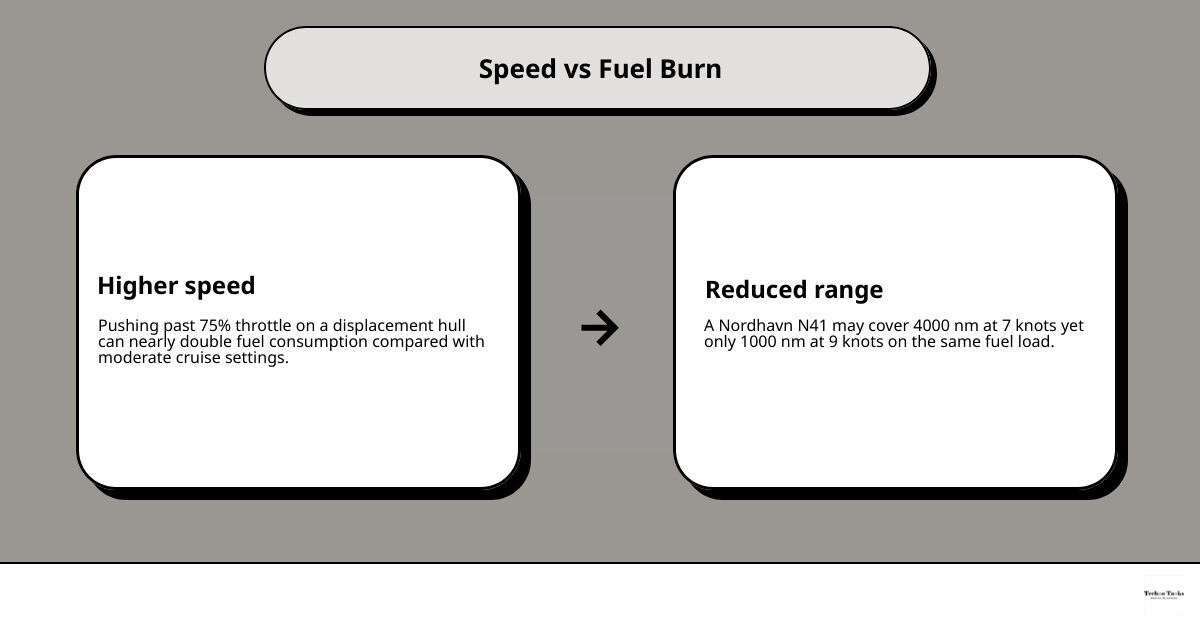
A common planning rule is that around 75% of maximum speed often lands near the efficiency sweet spot. Push much harder, and fuel burn can rise steeply. Some guidance shows that above 85% of max speed, consumption may nearly double compared with more moderate cruise settings.
For long-range displacement boats, this is especially important. Many 40- to 50-foot passagemakers cruise near the square root of waterline length in knots. A boat with roughly 39 feet of waterline might cruise just over 6 knots efficiently. That sounds slow until we remember the point: arrive, not audition for a speed record.
This is why a vessel such as the Nordhavn N41 can be projected at over 4,000 miles at 7 knots, yet only around 1,000 miles at 9 knots with the same fuel load. Same boat. Very different result.
How hull type and propulsion system change your range
Hull and propulsion decisions shape the entire range profile.
Displacement hulls:
- Best for long, efficient passages
- Lower fuel burn at modest speeds
- Common choice for bluewater power cruising
Semi-displacement hulls:
- Good middle ground
- Can run economically at lower speeds
- Offer more flexibility than full displacement designs
Planing hulls:
- Faster
- Less efficient over long distances
- Better suited to shorter runs where refueling is easy
Propulsion matters too:
- Single-screw diesel boats usually deliver the best fuel economy
- Twin-screw boats add redundancy and maneuverability, but often with more drag and burn
- Diesel typically offers better efficiency and safer fuel characteristics for long-range work than gasoline
- A get-home engine can be useful, but good maintenance on the main engine often matters more than bolting on extra complexity
How to Plan Fuel Consumption, Safety Margins, and Real-World Range
Good range planning is part math, part discipline, and part humility. The ocean is very good at punishing optimism.
A simple fuel-planning formula for long passages
We recommend starting with this basic formula:
- Determine total fuel aboard
- Subtract unusable fuel
- Subtract your reserve
- Divide remaining fuel by actual burn rate at planned cruise
- Multiply by average speed in knots
That gives estimated range in nautical miles.
Example:
- 500 gallons aboard
- 50 gallons unusable/untouchable margin
- 25% reserve policy
- 10 gallons per hour burn
- 8 knots average speed
Usable trip fuel after reserve is what matters, not the heroic total on the spec sheet.
Best practices:
- Use sea-trial numbers, not guesses
- Track burn in a logbook
- Measure miles per gallon or liters per hour at several speeds
- Include transfer timing if using auxiliary fuel
- Recalculate after loading provisions and water
For a deeper planning approach, see Going the Distance Without Running Your Yacht Dry.
Recommended minimum range for common cruising scenarios
The right minimum range depends on what we are actually doing.
For Mediterranean-style island-hopping:
- Around 200 nautical miles can cover basic short-hop exploration
- 350 to 450 nautical miles is a stronger target for more serious cruising with margin
For offshore coastal legs:
- Enough for the route plus at least 20% to 25% reserve
- More if fuel dock reliability is uncertain
For ocean passages:
- The Atlantic crossing is roughly 2,700 nautical miles on common routes
- In practice, motor vessels need substantial fuel capacity, efficient hulls, or staged fueling plans
- Sailing vessels are less fuel dependent, but still need range for calms, charging, and safety maneuvers
For remote overland or vehicle-based travel, the same logic applies. A standard 23-gallon Ram ProMaster tank at about 18 mpg yields roughly 414 miles, and even that can feel tight when fuel spacing gets unpredictable. The lesson translates directly to boats: standard capacity may be enough until it suddenly is not.
Best practices for self-sufficiency, supplies, and waste management
Longer range is only useful if we can stay out comfortably and safely.
We recommend:
- Storing dry goods in sealed reusable containers
- Removing cardboard packaging before departure to reduce pests
- Carrying spare filters, belts, impellers, and hoses
- Managing trash volume aggressively
- Using cloth towels instead of disposables where practical
- Upgrading water and holding tank strategy
- Favoring freshwater-flush toilets when appropriate to reduce odor and improve tank management
- Following legal offshore discharge and pumpout rules
Self-sufficiency is not glamorous in the brochure sense, but it is what makes extended cruising enjoyable instead of stressful.
Product Roundup: Best Extended-Range Upgrades by Use Case
If we strip away the marketing noise, the best range upgrade depends on trip profile, not fantasy profile. We should buy for the miles we actually run.
Best option for Mediterranean island-hopping and coastal cruising
Best choice: compact or mid-size flexible fuel bladders
Why:
- Moderate range boost
- Fast installation
- Great for weekend through week-long trips
- Easier to remove when not needed
This setup works well when we want a practical reserve margin without committing to a permanent tank redesign. Good related resources include Fuel Your Wanderlust with These Top Rated Auxiliary Tanks and Don’t Get Stranded with These Top Portable Boat Fuel Tanks.
Best option for offshore passages and bluewater cruising
Best choice: large-capacity flexible fuel bladders or a permanent custom tank strategy
Why:
- Major fuel increase
- Ideal for displacement and passagemaking boats
- Supports weather delays and rerouting
- Helps match serious self-sufficient cruising plans
If our mission includes long offshore windows, extra fuel should be part of a full systems plan that also includes water, power, maintenance spares, and transfer procedures.
Best option for fishing boats, expedition tenders, and remote operations
Best choice: compact removable fuel bladders
Why:
- Fits tighter deck layouts
- Quick to deploy
- Easy to remove after the trip
- Adds emergency return margin
These are especially useful when operational flexibility matters more than permanent capacity. For more examples, see Don’t Let Your Boat Run Dry with These Marine Fuel Tanks and Fueling Your Dreams with an 80 Gallon Boat Tank.
Frequently Asked Questions About Extended Cruising Range
What minimum extended cruising range should I have for Mediterranean cruising?
For basic cruising, 200 to 400 nautical miles is a practical range band. If we want comfortable safety margin for headwinds, detours, and marina issues, the higher end of that range is better. A 25% reserve policy is smart.
How much does speed reduce extended cruising range?
A lot. On many boats, the jump from efficient cruise to higher-speed operation causes fuel burn to rise disproportionately. Running around 75% of max speed is often efficient, while pushing above 85% can slash range dramatically. On long passages, slowing down is often the best free upgrade available.
Are flexible fuel bladders or custom marine fuel tanks better for extending range?
It depends on our use case.
Flexible fuel bladders are better when we want:
- Lower upfront complexity
- Temporary or seasonal range extension
- Fast installation
- Removable capacity
Custom marine fuel tanks are better when we want:
- A permanent integrated upgrade
- Dedicated plumbing and fixed placement
- A long-term mission-specific solution
If we are unsure, a flexible solution is often the better first step because it lets us test real capacity needs before committing to a full refit. We can also explore The Ultimate Guide to 30 Gallon TPU Tanks and Bladders.
Conclusion: Choose the Right Range Upgrade for Safer, Smarter Cruising
The best extended cruising range solution is the one that fits our boat, our route, and our risk tolerance.
For some crews, that means slowing down, cleaning the hull, and planning fuel better. For others, it means adding serious extra capacity with a scalable bladder system. And for long-term passagemaking, a permanent tank upgrade may be worth the effort.
At Techno Tanks, we focus on practical range extension that helps us cruise farther with better safety margins and less stress. Our flexible marine fuel bladders are available in 30-3000 gallon sizes, built from patented recyclable TPU, and designed to give boat owners a smarter way to add capacity without unnecessary complexity.
If you are ready to match your fuel system to your real cruising ambitions, start here: More info about marine fuel bladders.

