
When a Backup Fuel Bladder Makes Sense for a Boat
A fuel bladder backup is one of the most practical range-extension tools available to marine operators, expedition crews, and commercial vessels today — and it takes up almost no space when you don’t need it.
Quick Answer: What Is a Fuel Bladder Backup?
A fuel bladder backup is a collapsible, flexible fuel-storage tank intended for temporary or auxiliary capacity. Construction, fuel compatibility, fittings, placement, and handling requirements vary by product, so the bladder must be selected for the specific fuel system and vessel application.
| Factor | What to Verify |
|---|---|
| Capacity | Fuel required for the route plus the vessel-specific space and weight constraints |
| Fuel compatibility | Manufacturer documentation for the exact gasoline or diesel application |
| Fittings and transfer | Valve, hose, connector, pump, or gravity-transfer requirements for the system |
| Placement and securing | Product instructions, vessel layout, loaded weight, and operating conditions |
| Storage when empty | How the bladder is drained, folded, protected, and stored between uses |
Unlike permanent rigid tanks, a fuel bladder stores flat, deploys fast, and doesn’t require vessel modifications.
For operators managing extended offshore runs, remote site deployments, or emergency fuel reserves, the math is simple: more fuel capacity, less permanent footprint, no welding or structural changes required.
A filled fuel bladder carries substantial moving mass and should be treated as fuel-storage equipment, not as flotation or a safety device. Placement and securing should follow the bladder manufacturer’s instructions and the requirements of the vessel and operating conditions.
Whether you need 30 gallons of backup diesel for a center console or a 25,000-gallon temporary fuel farm for a remote operation, flexible bladder tanks are purpose-built for exactly this kind of demand.
For marine auxiliary and backup-fuel applications, start with Techno Tanks marine fuel bladders, then choose capacity and configuration from the actual vessel, route, fuel type, and transfer setup rather than from a generic emergency-storage rule.
Technical Specifications of a Fuel Bladder Backup
At the core of any high-performance fuel bladder backup is the science of flexible containment. Unlike standard utility jugs or rigid auxiliary tanks, a flexible fuel bladder is engineered to expand as it fills and collapse completely as it empties. This dynamic movement eliminates the need for mechanical venting systems that can release volatile organic compounds (VOCs) or admit moisture-laden air, which often leads to fuel degradation.
Modern fuel bladders are constructed using advanced Thermoplastic Polyurethane (TPU) or heavy-duty, urethane-coated military-specification fabrics. These materials are chosen for their exceptional tensile strength, puncture resistance, and chemical compatibility. According to technical resources on Fuel Tank Bladder Uses and Benefits | Vinyl Technology , these flexible systems rely on highly specialized RF (radio frequency) welding. This process fuses the fabric layers at a molecular level, creating seamless, leak-proof joints that are actually stronger than the parent material itself.
For marine operators, understanding these material differences is critical. Ocean environments subject equipment to constant UV exposure, extreme temperature swings, and corrosive saltwater. A high-quality bladder must feature hydrolysis stabilizers and UV-resistant topcoats to prevent the material from cracking or becoming brittle over its service life. To learn more about the basic engineering behind these systems, consult our comprehensive Marine Fuel Bladder Guide.
Marine Fuel Bladder Backup Applications
In offshore marine operations, range anxiety is a highly practical concern. Whether you are running a twin-outboard sportfishing boat to the canyons or commanding a commercial utility vessel during an inter-island transit, your vessel’s built-in fuel capacity dictates your operational limits. Installing a deck-mounted fuel bladder backup provides the auxiliary range needed to reach remote destinations and return safely without the massive capital expense of modifying a vessel’s internal hull.
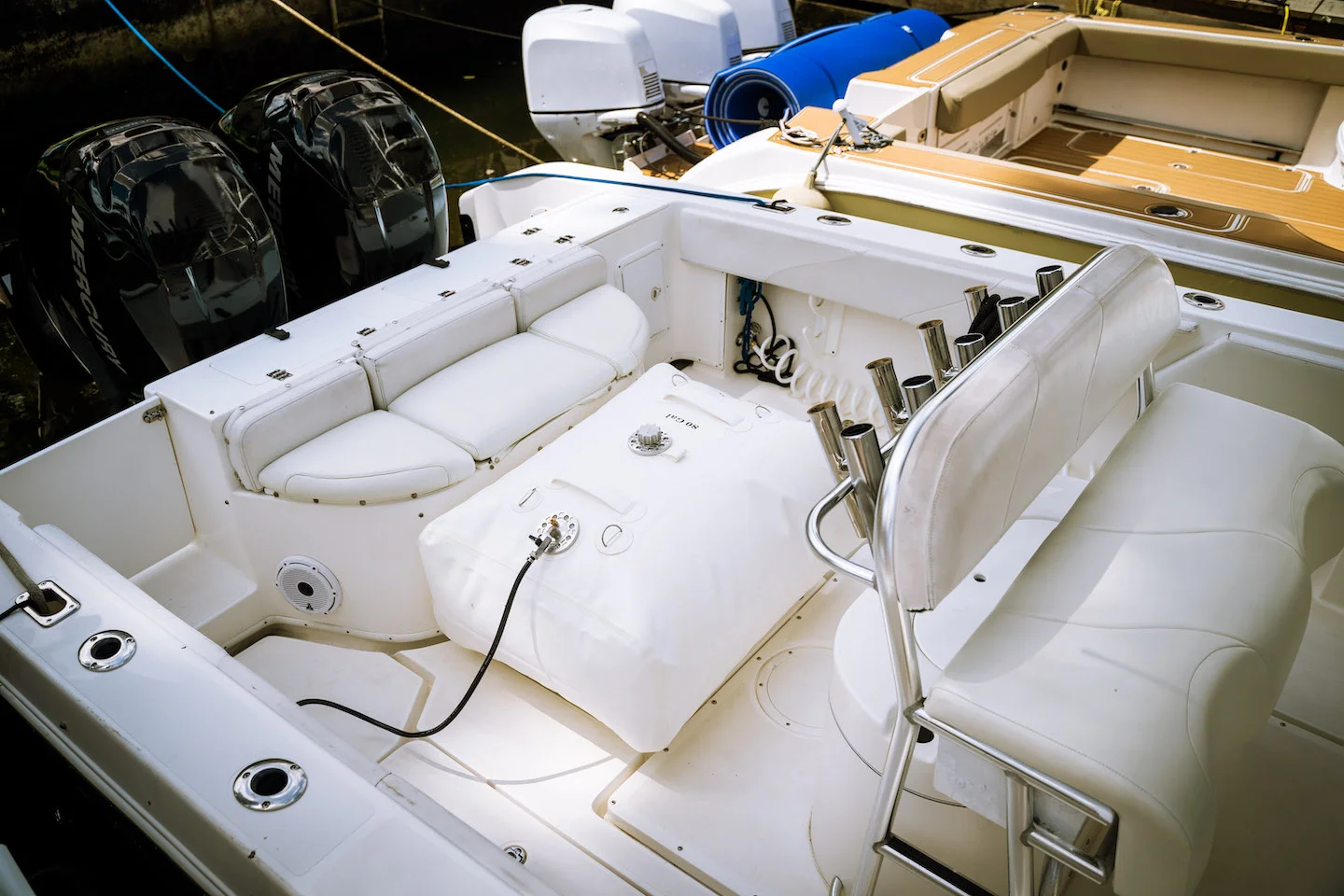
When deployed on a boat, fuel bladders must be positioned above deck. This is not just a matter of convenience; it is a critical safety standard. United States Coast Guard (USCG) regulations strictly prohibit the installation of temporary or flexible fuel bladders in below-deck compartments or internal hulls due to the risk of trapped fumes and lack of immediate visual inspection. Placing the bladder on the foredeck or cockpit deck allows for natural ventilation, easy gravity-fed fuel transfer, and rapid containment in the highly unlikely event of a spill. For a detailed breakdown of marine deployment and safety protocols, read The Complete Guide to Marine Bladder Tanks and Storage.
Industrial and Remote Site Storage
Beyond the marine industry, flexible fuel bladders are widely utilized for bulk fuel management in remote land-based operations. Industrial sites, mining facilities, and agricultural operations frequently require temporary fuel farms to power heavy machinery and generators. In these scenarios, transporting rigid steel or plastic tanks to off-grid locations is logistically complex and cost-prohibitive.
A high-capacity flexible bladder can be packed down to a fraction of its filled volume, loaded onto a standard utility vehicle, and deployed on-site within minutes. These large-scale systems, often referred to as “pillow tanks,” are capable of holding anywhere from 100 to over 210,000 gallons of diesel or jet fuel.
According to industrial product specifications on Fuel Bladder Tanks | Flexible Fuel Storage For Remote Sites | WST , these bladders are invaluable for maintaining continuous operations in harsh environments. They are also widely deployed by military forces for rapid-runway fueling and tactical operations, as highlighted in historical operational reports like Fueling the fight > U.S. Air Forces Central > News . For commercial and industrial buyers looking to establish temporary fueling infrastructure, our rugged Collapsible Fuel Tanks offer a rapidly deployable, highly durable solution.
Key Advantages of Flexible Bladders Over Rigid Tanks
When comparing a fuel bladder backup to traditional rigid tanks (such as aluminum, stainless steel, or rotomolded polyethylene), several clear operational advantages emerge:
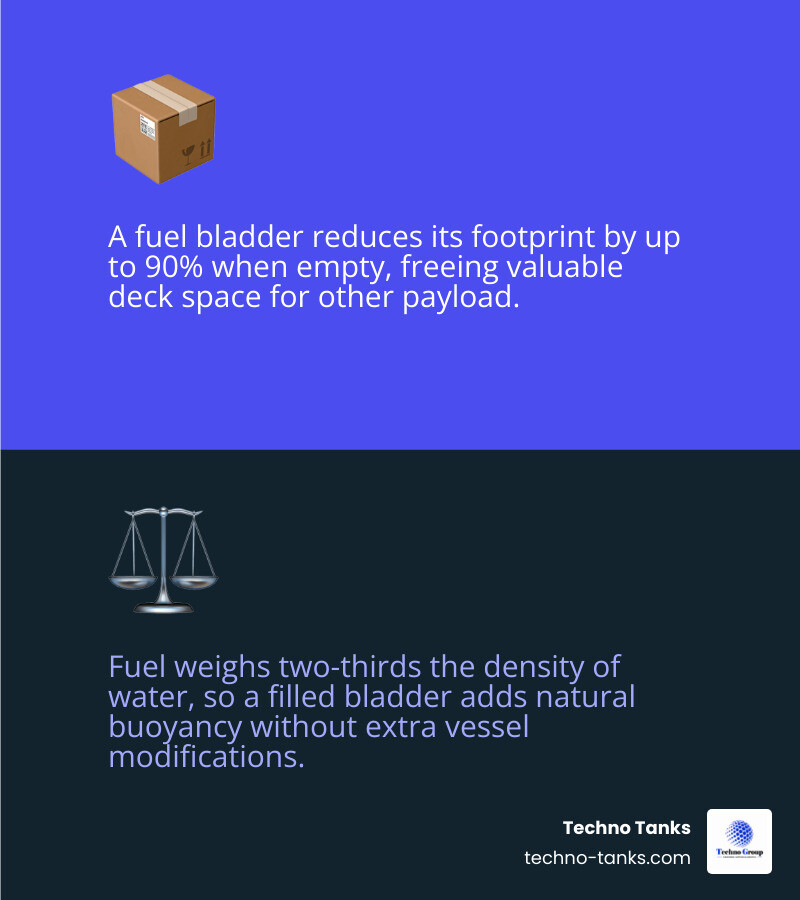
- Extreme Space Efficiency: When empty, a flexible fuel bladder can shrink its storage footprint by up to 90%. This means that once you have transferred the fuel to your main tank, you can roll up the bladder and store it in a dry, vented locker, completely reclaiming your deck or truck bed space.
- Elimination of Condensation and Algae: Rigid tanks must be vented to the atmosphere, meaning as fuel is drawn out, moist air is drawn in. This moisture condenses on the cold inner walls of the tank, settling to the bottom and encouraging the growth of fuel-clogging diesel algae. Because a flexible bladder collapses as it empties, there is zero air space inside, completely eliminating condensation and fuel contamination risks.
- Corrosion and Rust Resistance: Metal tanks eventually succumb to saltwater corrosion, weld cracking, or rust. High-grade TPU bladders are entirely immune to environmental corrosion, chemical breakdown, and galvanic reactions.
- Substantial Weight Savings: An empty 100-gallon rigid steel tank can weigh several hundred pounds. A comparable 100-gallon TPU fuel bladder weighs between 15 and 25 pounds when empty, minimizing dead weight and optimizing vessel payload.
| Feature | Flexible TPU Fuel Bladder | Rigid Aluminum/Steel Tank | Rotomolded Polyethylene Tank |
|---|---|---|---|
| Empty Footprint | Collapsible (reclaims up to 90% space) | Permanent (fixed footprint) | Permanent (fixed footprint) |
| Corrosion Risk | Zero (saltwater & chemical proof) | High (rust, weld cracks, pitting) | Low (but prone to UV cracking) |
| Condensation/Algae | Zero (no internal air space) | High (requires atmospheric venting) | High (requires atmospheric venting) |
| Weight Profile | Ultra-lightweight (15–40 lbs empty) | Heavy (100–300+ lbs empty) | Moderate weight |
| Installation | Plug-and-play (no structural mods) | Complex (requires welding/mounting) | Permanent mounting brackets |
For a deeper dive into the common misconceptions surrounding flexible fuel storage, check out our guide on Bladder Tanks for Boats: 6 Common Myths About Their Drawbacks.
Material Engineering and Fuel Compatibility
Not all flexible materials are created equal. To ensure absolute safety and prevent chemical breakdown, fuel bladder manufacturers utilize distinct formulations of Thermoplastic Polyurethane (TPU) based on the specific fuel type being stored:
- Polyester TPU: Specifically formulated for diesel, jet fuel, oils, and non-aromatic hydrocarbons. This material offers incredible resistance to the chemical structures of diesel fuels but will degrade if exposed directly to highly aromatic gasoline.
- Polyether TPU: Engineered specifically for gasoline applications. Polyether-based materials resist the aggressive solvents and ethanol additives found in modern gasoline, ensuring the bladder does not soften, swell, or delaminate over time.
Using the wrong material for your fuel type can lead to internal dissolution, causing the bladder to fail. High-quality bladders are engineered to withstand extreme environmental conditions, maintaining their flexibility and structural integrity across an impressive temperature range of -30°C to +70°C (-22°F to 158°F).
Baffled vs. Un-baffled Configurations
When transporting large volumes of liquid on a moving platform—whether it is a yacht deck in heavy seas or a pickup truck bed navigating off-road terrain—the movement of that liquid can severely impact stability. This is known as the “free surface effect” or liquid sloshing.
- Un-baffled Bladders: These are standard “pillow” style bladders. They are highly cost-effective and perfectly suited for stationary fuel storage, calm inland waters, or applications where the bladder is emptied before entering rough conditions.
- Baffled Bladders: These units feature internal chamber walls or fabric baffles that restrict the rapid movement of fuel from side to side. By dampening the dynamic surge of the liquid, baffled bladders dramatically improve vessel stability and vehicle handling in rough conditions.
Regardless of the configuration, any mobile fuel bladder backup must be secured using heavy-duty, reinforced D-ring tie-down points welded directly to the bladder’s perimeter to prevent shifting under high g-forces.
Operational Best Practices: Installation, Transfer, and Maintenance
Safe Installation and Securing Protocols
Safety is the paramount concern when handling volatile fuels on deck. When setting up your fuel bladder backup, always adhere to the following checklist:
- Site Preparation: Ensure the deck or bed area is completely clean and free of sharp objects, exposed screw heads, or abrasive grit. Laying down a heavy-duty ground cloth or rubberized mat is highly recommended.
- Fill in Place: Never attempt to fill a fuel bladder on a dock or truck bed and then carry it onto your vehicle. A filled 100-gallon bladder weighs over 700 pounds and is practically impossible to move safely. Position the empty bladder in its final secure location before connecting the fuel nozzle.
- Secure Rigidly: Use high-tensile, marine-grade ratchet straps rated for the total wet weight of the bladder. Secure these straps to structural deck cleats or heavy-duty tie-down points using the bladder’s integrated D-rings. Do not rely on bungee cords or light ropes.
Fuel Transfer and Purging Procedures
Transferring fuel from your auxiliary bladder to your vehicle’s primary tank should be a controlled, spark-free process.
For diesel applications, high-quality 12V or 24V transfer pumps rated at 8 to 15 GPM (gallons per minute) are commonly used. However, for gasoline applications, gravity-fed or manual siphon systems are highly recommended to completely eliminate the risk of electrical sparks near fuel vapors.
To transfer fuel via gravity, ensure the bladder is secured on an elevated deck or platform relative to your primary tank’s fill port. Connect a fuel-rated hose equipped with high-quality, leak-proof aluminum or stainless steel camlock fittings.
To extract every possible drop of fuel from the bladder, gently roll the empty portions of the fabric from the outer corners toward the discharge valve as the level drops. This action forces the remaining fuel to the drain point, minimizing waste. For step-by-step instructions on safe transfer methods, refer to our detailed guide on How to Transfer Fuel from a Fuel Bladder.
Maintenance and Lifespan Extension
While high-grade TPU bladders are exceptionally rugged, their operational lifespan is directly linked to how they are maintained. Salt residue, trapped moisture, and prolonged, unnecessary exposure to intense UV radiation are the primary catalysts for material wear.
After each use, the bladder should be thoroughly drained, rinsed with fresh water to remove salt and grime, and allowed to air dry completely. When storing the bladder, roll it gently rather than folding it sharply, as hard creases over long periods can stress the welded seams. Store the rolled bladder in a dry, well-ventilated locker away from direct sunlight and sharp tools. For more technical tips on maximizing your equipment investment, read How to Extend Fuel Bladder Lifespan with 5 Easy Changes.
Frequently Asked Questions
Can a single bladder hold both gasoline and diesel?
No. Because of the material segregation required to prevent chemical degradation, you must never use a single bladder interchangeably for both gasoline and diesel. Polyester-based TPU is chemically optimized for diesel and hydrocarbon oils, while Polyether-based TPU is formulated specifically to handle gasoline and ethanol. Filling a diesel bladder with gasoline will eventually soften and dissolve the internal lining, leading to structural failure and hazardous leaks. Always specify your exact fuel type when ordering.
How long does a fuel bladder backup typically last?
Under normal operating conditions and with proper care, a high-quality TPU fuel bladder backup has an expected service life of 10+ years. Most premium manufacturers back their products with a 5-year warranty covering materials and workmanship. Factors that can reduce this lifespan include leaving the bladder permanently exposed to harsh tropical sun when not in use, storing it wet, or allowing it to rub against sharp or abrasive surfaces on deck.
Are fuel bladders permitted below deck by the USCG?
No. United States Coast Guard regulations do not permit the installation or use of temporary, flexible fuel bladders in below-deck compartments or internal hulls. Fuel bladders must always be secured above deck in well-ventilated areas. This ensures that any fuel vapors can safely dissipate into the atmosphere rather than pooling in the bilge, where they could pose a severe explosion hazard. Above-deck placement also allows operators to easily monitor the bladder and gravity-feed fuel directly into the primary tank fill ports.
Conclusion
When you are operating offshore or managing remote industrial sites, self-reliance is your most valuable asset. A premium fuel bladder backup from Techno Tanks provides the ultimate combination of auxiliary range, space-saving convenience, and heavy-duty reliability.
Because every vessel and remote site has unique spatial constraints, Techno Tanks specializes in custom-engineered solutions. Whether you need a low-profile deck bladder designed to fit a specific cockpit layout or a high-capacity bulk storage system for an industrial site, we can manufacture a bladder tailored to your precise dimensions, fuel type, and fitting requirements.
Do not let limited fuel capacity dictate your operational boundaries. Reclaim your deck space, secure your range, and invest in a flexible fuel storage solution built to last.
Ready to extend your range? Contact Techno Tanks today to request a custom quote based on your specific fuel storage, transfer, and sizing requirements. For more information on our complete range of flexible storage systems, explore our heavy-duty collapsible fuel tanks.

