
30 Gallon Marine Tanks Compared: Water Storage vs Fuel Bladders
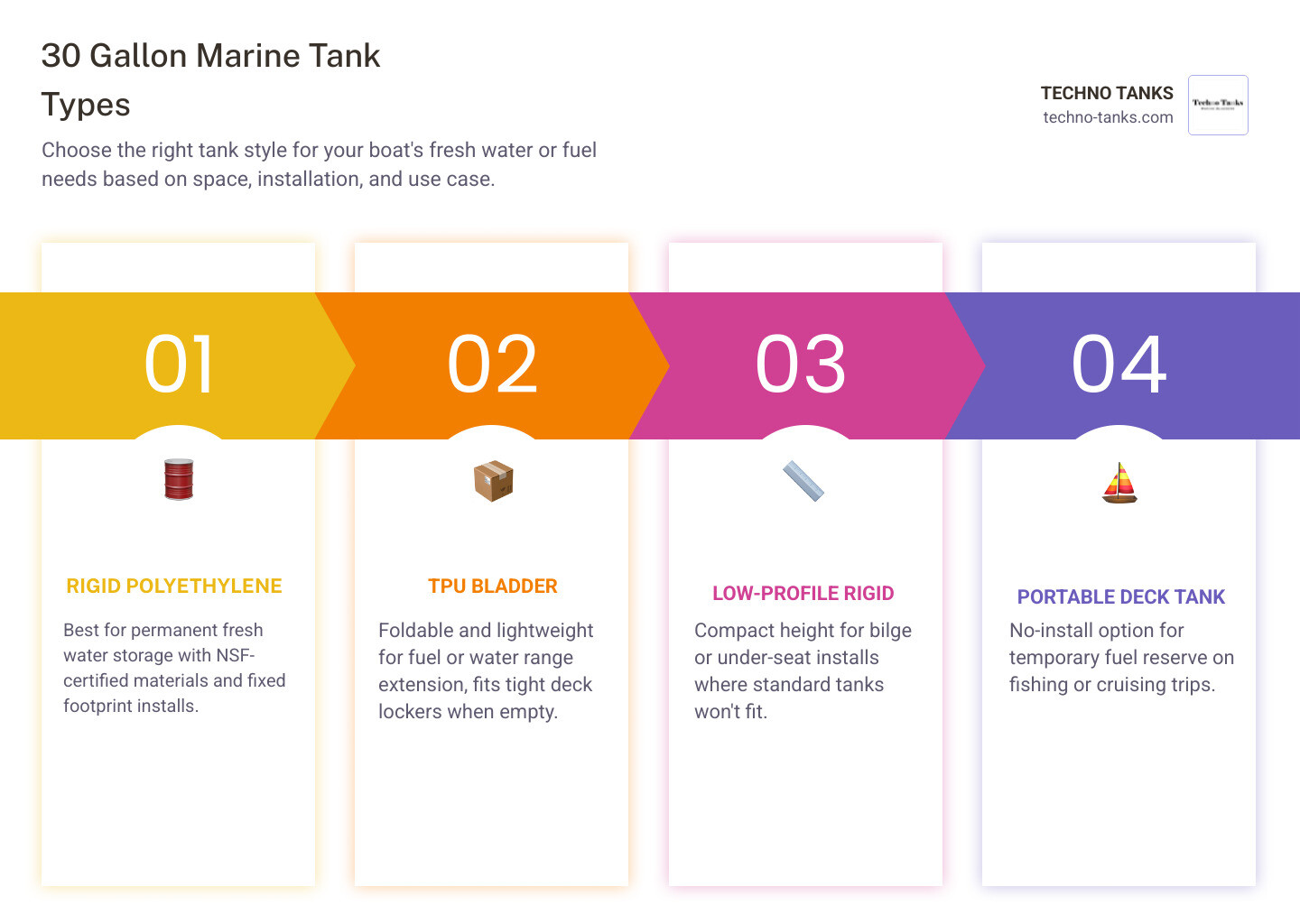
If you’re shopping for a 30 gallon marine tank, here’s a quick breakdown of the main options available:
| Tank Type | Best Use | Key Feature |
|---|---|---|
| Flexible TPU marine bladder | Temporary fuel or water range extension | Foldable, lightweight, reusable |
| Low-profile flexible bladder | Tight locker or bilge installs | Custom footprint, compact height |
| Portable deck bladder | Temporary fuel reserve on fishing trips | No permanent installation required |
A 30 gallon marine tank is one of the most useful capacity options for boat owners who need extra fresh water or fuel without a full vessel refit. Thirty gallons is enough to meaningfully extend your range or water supply – and small enough to fit into deck lockers, under-seat spaces, or tight bilge compartments where larger systems simply will not go.
The challenge is that “marine tank” means different things depending on who’s asking. A freshwater storage solution for drinking and cooking needs potable-grade materials and clean fittings. A fuel storage bladder needs entirely different construction to handle gasoline or diesel safely.
Getting the wrong type doesn’t just waste money. It can create real safety problems on the water.
This guide is built specifically for boat owners who want a clear, honest look at what’s available, what the differences are, and how to pick the right tank for how you actually use your vessel.
If your goal is auxiliary fuel rather than fresh-water storage, the dedicated commercial option is the 30 Gallon Marine Fuel Bladder. Use the comparison below to decide whether a flexible fuel bladder or a rigid marine tank fits the job, then verify the product specifications for your vessel and fuel system.
I’m Ivan Jimenez, founder of Digital Ivan, and I’ve spent years building content systems that help buyers cut through product noise and make smarter decisions – including in the marine storage space where 30 gallon marine tank options vary widely in materials, safety ratings, and real-world fit. For general boating safety context, it also helps to review guidance from the U.S. Coast Guard boating safety resources. Let’s get into what actually matters before you buy.
Similar topics to 30 gallon marine tank:
How to Choose the Best 30 Gallon Marine Tank
The best 30 gallon marine tank is not the one with the flashiest product title. It is the one that matches your liquid type, available space, plumbing plan, and how permanent the installation needs to be.
Here is what we recommend checking first:
- Material compatibility
- Actual installed footprint
- Height clearance
- Fill, vent, and outlet fitting locations
- Whether the tank is for potable water or fuel only
- Whether the system is non-pressurized
- UV, abrasion, and corrosion resistance
- How easy it is to secure and service
For fresh water, potable-safe flexible storage solutions can work well when they are dedicated to water use and configured correctly. For temporary or supplemental fuel capacity, a TPU bladder often makes more sense because it is lighter, folds flat when empty, and does not demand a permanent compartment redesign.
A quick reality check: “30 gallons” tells you capacity, not shape. One 30-gallon tank may be long and shallow, while another may be short and tall. That difference decides whether it fits under a seat or becomes a very expensive garage decoration.
Best 30 gallon marine tank features for fresh water use
For onboard fresh water, we look for:
- Potable water compatibility
- Non-pressurized design unless specifically engineered otherwise
- Smooth interior that is easier to rinse and sanitize
- Compact, low-profile footprint for lockers or under-berth spaces
- Reliable fill and vent provisions
- Access for inspection or cleaning where possible
A good benchmark from the research is a 30-gallon marine water storage format listed at 38 inches long by 26 inches wide by 13 inches high. That tells us something important: many useful marine water tanks are low and wide rather than tall. That is great for stability and tight boat spaces.
For buyers comparing materials, flexible TPU solutions can be practical for water range extension because they are corrosion resistant, lightweight, and easy to stow when not in use. Just remember that fresh water tanks should stay dedicated to fresh water. Never convert an old fuel container into a drinking water tank. That is a hard no, not a maybe.
Best 30 gallon marine tank features for fuel use
For fuel, we recommend thinking in terms of dedicated fuel storage and transfer, not improvisation.
The best features usually include:
- Fuel-compatible TPU or other approved marine-grade material
- Flexible construction for temporary or supplemental use
- Secure fittings and hose connections
- Easy tie-down options
- Fold-flat storage when empty
- Good slosh management through low-profile placement and proper securing
For many boat owners, a fuel bladder is the smartest answer because it solves a very specific problem: you need more range for a fishing trip or cruising leg, but you do not want a permanent tank taking up room all season. Our Marine Fuel Bladders are designed around that exact use case.
One caution worth repeating: fuel type matters. Diesel and gasoline have different risk profiles, and gasoline requires especially careful attention to ignition safety, ventilation, and proper system design. If you are unsure, treat that uncertainty as your sign to slow down and confirm compatibility before buying.
30 gallon marine tank dimensions, weight, and real-world fit
Thirty gallons of liquid is substantial. Water weighs roughly 8.34 pounds per gallon, so 30 gallons of water is about 250 pounds before you count the tank, hoses, and mounting hardware. Fuel weight varies by type, but it is still heavy enough to affect trim and storage planning.
Real-world examples from the research show how much dimensions can vary:
- One marine water storage format was listed around 29.75 inches by 25.75 inches by 9.5 inches
- Another was 38 inches by 26 inches by 13 inches
- Another 30-gallon marine tank format was 30 inches by 20 inches by 12 inches
That spread is exactly why we tell buyers to measure the space first, then shop. Not the other way around.
If your space is oddly shaped, a flexible bladder may outperform a fixed container simply because it works with the compartment instead of fighting it.
Best 30 Gallon Marine Tank Styles for Boats and Marine Setups
For TECHNO TANKS buyers, the most relevant 30 gallon marine tank styles are flexible, portable, and temporary-use solutions that add capacity without a permanent boat refit.
| Installation Goal | Best Tank Style | Why |
|---|---|---|
| Extra range for a trip | TPU bladder | Temporary capacity without full retrofit |
| Tight locker fit | Low-profile flexible bladder | Better use of awkward space |
| Seasonal reserve capacity | Foldable bladder | Stores flat when not in use |
| Temporary deck or locker storage | Portable marine bladder | Easy deployment and removal |
30 gallon marine bladder options
A 30 Gallons Marine Bladder is ideal when you want portable, temporary, or supplemental capacity without dedicating permanent boat volume year-round.
Why we like bladder options:
- They are lightweight when empty
- They fold for storage
- They are practical for seasonal use
- They can extend range for cruising or offshore fishing
- They can be deployed only when needed
Techno Tanks manufactures patented, recyclable TPU tanks from 30 to 3000 gallons, which gives owners a practical path when off-the-shelf rigid sizes do not match the boat or mission.
Portable and temporary 30 gallon marine tank use cases
A 30-gallon marine tank shines in temporary-use scenarios:
- Long fishing trips where you want reserve fuel
- Tender support and auxiliary transfer
- Weekend cruising where extra water adds comfort
- Emergency reserve storage
- Seasonal boating when permanent tank space is too valuable to give up
This is where flexible solutions really earn their keep. Empty-flat storage is not glamorous, but it is extremely useful. Nothing says “good design” like gear that disappears when you do not need it.
When a 30 gallon marine tank should be custom-fit instead of off-the-shelf
We recommend custom-fit solutions when:
- The compartment has odd curves or obstructions
- Hose routing is unusually tight
- Vent lines need special placement
- You are retrofitting an older boat
- Standard footprints waste too much space
If you are in that situation, start with dimensions, fitting locations, and hose path planning. Our Fuel Bladder Sizing Guide is a good place to narrow down what will actually fit.
30 Gallon Marine Tank Roundup: What to Look for in Top Models
Because this article is focused on marine bladder-style options for boats, our roundup is based on buying criteria rather than random brand hype.
When comparing top models, look for:
- Clear capacity labeling
- Exact dimensions
- Material specification
- Fill port size
- Vent port size
- Outlet size and thread type
- Tie-down or securing options
- Stated use: potable water, diesel, gasoline, or general marine water
- Lead times and shipping expectations
Research also shows how broad pricing can be in marine tank categories. A 30-gallon marine water or fuel storage solution may sit in the low hundreds, while custom or purpose-built marine systems can cost significantly more depending on material, fittings, and configuration.

Best for potable water storage
For potable water storage within the scope of flexible marine solutions, the best option is a dedicated, potable-compatible marine bladder designed for non-pressurized use.
We like this style when you need:
- A dedicated onboard water supply
- Under-seat or under-berth installation
- Corrosion resistance
- Easy cleaning and sanitation
- A removable or semi-portable setup
If you need a more portable or removable solution, our 30 Gallons Marine Bladder can be a smart fit for water range extension, provided it is configured and dedicated appropriately for that use.
Best for compact locker spaces
For compact locker spaces, low profile wins.
The best features here are:
- Short overall height
- Broad base for stability
- Lightweight construction before filling
- Flexible fit or custom sizing
- Simple plumbing runs
This is where many buyers get tripped up. They shop by gallons, not by geometry. A 30-gallon tank can be shallow and wide or narrow and tall, and only one of those may actually fit your locker.
Best for temporary fuel and range extension needs
For temporary fuel reserve and range extension, we strongly prefer a purpose-built bladder over trying to force in a permanent setup you do not need all year.
Best use cases include:
- Offshore fishing days
- Longer cruising legs
- Backup supply for limited fueling areas
- Seasonal or occasional high-demand trips
For a broader look at where this size fits into boating plans, see Popular Marine Fuel Bladder Sizes and Their Uses.
Installation, Plumbing, and Maintenance for a 30 Gallon Marine Tank
Even the best 30 gallon marine tank can fail early if it is installed poorly. Most problems come from support, venting, chafe, or using the wrong hose and fittings.
A good installation plan includes:
- Flat, fully supported base
- Proper mounting straps or restraints
- Vented cap or dedicated vent line
- Fuel- or potable-rated hose as required
- Anti-chafe protection where hoses pass edges
- Secure clamps and accessible fittings
- Space for inspection and service
Fresh water tank setup and sanitation basics
For fresh water systems, keep it simple and clean:
- Use potable-rated hose
- Rinse the tank before first use
- Sanitize on a schedule
- Keep the system above ground and non-pressurized unless specifically designed otherwise
- Check vents and fittings for contamination points
Sanitation matters more than many owners expect. A clean tank starts tasting bad long before it actually looks bad. If that sentence made you inspect your coffee mug, same principle.
Fuel tank safety and legal considerations
Fuel storage deserves extra caution.
Best practices include:
- Confirm exact fuel compatibility
- Prioritize ventilation
- Prevent fumes from entering enclosed living areas
- Avoid ignition sources
- Use marine-safe plumbing components
- Consider professional installation for anything beyond simple temporary setups
We also recommend staying aware of marine safety standards and installation practices for your vessel type. If you need technical details, our Fuel Bladder Specs can help you start the conversation with your installer.
Common mistakes that shorten tank life
We see the same avoidable mistakes over and over:
- Overfilling
- Poor venting
- Unsupported bases
- Sharp edges under or around the tank
- Using the wrong material for the liquid
- Excessive sun exposure
- Letting hoses rub through on corners
A tank should fit the boat, not be forced into it. If it only installs with “a little bending, a little pressure, and some optimism,” it is probably the wrong tank.
30 Gallon Marine Tank vs Larger Built-In Tanks and Portable Bladders
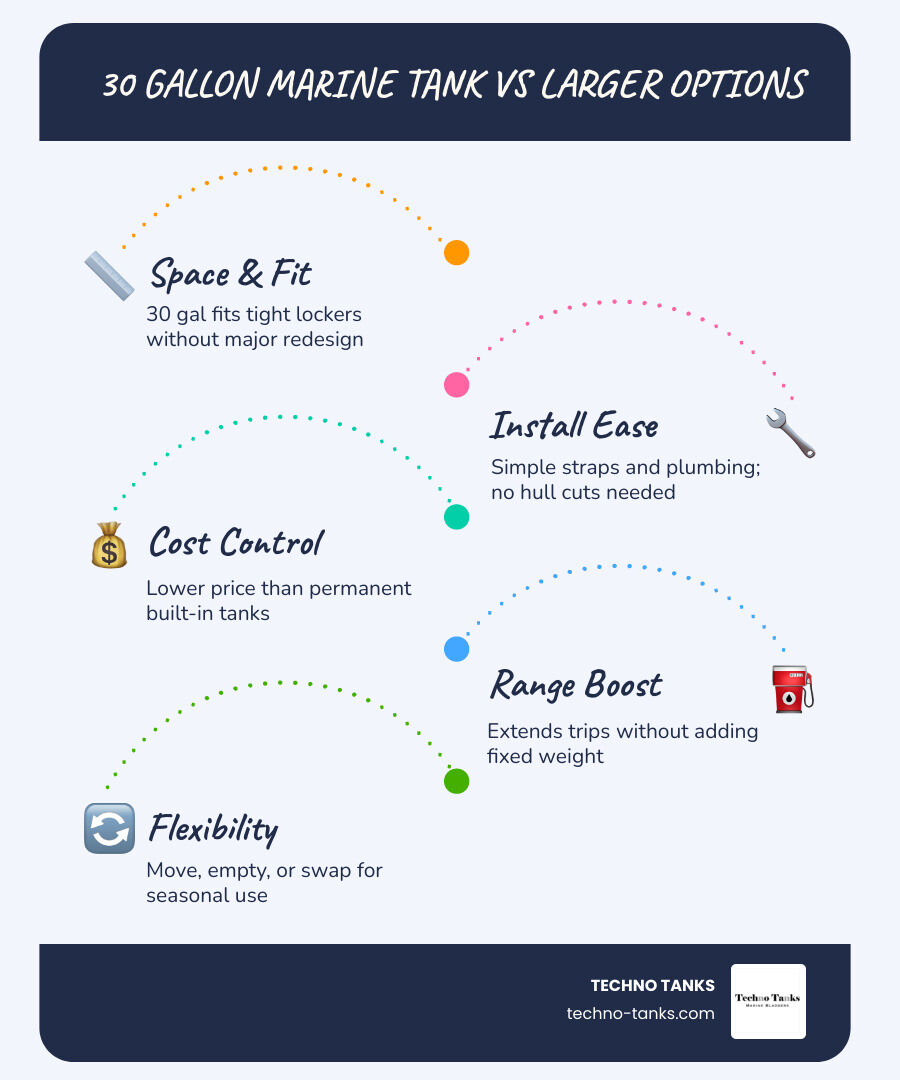
Thirty gallons sits in a very useful middle ground. It is enough to matter, but not so large that installation becomes a full redesign.
Pros and cons of a 30 gallon marine tank
Pros:
- Useful capacity for day trips and weekend trips
- Easier to place than larger built-ins
- Lower upfront cost
- Less complicated plumbing
- Good bridge size between small portable cans and large permanent systems
Cons:
- Limited capacity for heavy water or fuel demand
- Still heavy when full
- May require careful trim planning
- One size does not fit every compartment
Pros and cons of a 30 gallon bladder solution
Pros:
- Space-saving when empty
- Fast deployment
- Lightweight storage
- Excellent for temporary or seasonal needs
- Replacement is simpler than a full hard-tank retrofit
Cons:
- Not a structural tank
- Requires careful securing
- Best for dedicated use cases, not every permanent installation
- Needs protection from abrasion and sharp surfaces
If you want a deeper comparison, our Fuel Bladder vs Fuel Tank guide breaks down where each approach makes sense.
When to step up beyond 30 gallons
We recommend going beyond 30 gallons when:
- You do long-range cruising
- You support generator loads
- Your crew size drives higher water demand
- You routinely fish or travel multi-day routes
- Refueling or refilling opportunities are limited
At that point, a larger portable solution may be more efficient than juggling multiple small containers. Our article on Everything You Need to Know About Portable Marine Tanks is a helpful next read.
Frequently Asked Questions About 30 Gallon Marine Tank Options
Can a 30 gallon marine tank be used for both fresh water and fuel?
No, we do not recommend dual use. Even if a material is technically compatible, contamination risk is too high. A tank or bladder should be dedicated to one liquid type only.
What is the most common 30 gallon marine tank size?
There is no single standard size. Research examples ranged from about 29.75 x 25.75 x 9.5 inches to 38 x 26 x 13 inches, with other 30 x 20 x 12 inch formats also appearing. In practice, dimensions are driven by available space more than by any universal standard.
Is a rigid or flexible 30 gallon marine tank better for boats?
It depends on the mission.
- Choose flexible for temporary fuel or water range extension, odd spaces, and seasonal use
- Choose dedicated fixed storage only when your installation plan, space, and liquid type call for a more permanent setup
If your goal is portability and efficient storage, flexible usually wins. If your goal is a fixed onboard supply, a permanent installation may make more sense.
Conclusion
The best 30 gallon marine tank is the one that fits your boat, matches your liquid, and works safely with your installation plan. Within the flexible marine storage category, TPU bladder solutions are often the smarter buy for temporary capacity, tight spaces, and range extension.
At Techno Tanks, we focus on patented, recyclable TPU solutions built for real marine use, with capacities from 30 to 3000 gallons. If you want a compact, practical option that stores flat when not in use and helps you stretch your time on the water, start with our 30 Gallons Marine Bladder.
You can also explore:
If you measure carefully, choose the right material, and plan the plumbing before you buy, a 30-gallon setup can be one of the most useful upgrades on your boat. Small enough to fit. Big enough to matter. That is a pretty nice combination.

