
Why the Right Marine Fuel Tank Can Make or Break Your Time on the Water
Marine fuel tanks are one of the most critical — and most overlooked — systems on any boat.
If you just need a quick answer, here’s what you need to know:
What type of marine fuel tank do you need?
| Tank Type | Best For | Material Options | Typical Capacity |
|---|---|---|---|
| OEM Replacement | Exact-fit swap for a specific boat model | Aluminum, polyethylene | 17 – 380+ gal |
| Custom Fabricated | Odd shapes, legacy boats, capacity upgrades | Aluminum, stainless steel | 30 – 3,000+ gal |
| Belly / Saddle | Below-deck installs following hull contour | Aluminum, polyethylene | 19 – 250+ gal |
| Rectangular | Simple builds, above-deck, or flat bilge spaces | Aluminum, stainless steel | 16 – 300+ gal |
| Portable / Topside | Small outboards, jon boats, backup fuel | Polyethylene (HDPE) | Under 20 gal |
Running low on fuel miles from the dock is more than an inconvenience — it’s a safety risk. Whether you’re a weekend angler pushing further offshore or a cruiser planning extended passages, having the right fuel storage setup means the difference between a great day on the water and a costly rescue call.
The good news is that the marine fuel tank market has options for nearly every boat and budget. From direct-fit OEM replacements for popular models like Grady-White, Regulator, and Intrepid, to fully custom-fabricated aluminum tanks built from scratch to your exact dimensions — there’s a solution that fits your vessel, your fuel type (gasoline or diesel), and your range goals.
This guide covers everything you need to make a confident decision: tank types, materials, shapes, compliance rules, installation requirements, and long-term maintenance.
If the requirement is removable auxiliary capacity rather than a fabricated replacement tank, compare suppliers against the Techno Tanks marine fuel bladder option as a separate category. A flexible bladder solves a different problem from an OEM or permanent rigid tank, so supplier selection should start with the storage format the vessel actually needs.
I’m Ivan Jimenez, founder of DIGITAL IVAN and DORAL SEO, and I’ve worked extensively with Techno Tanks to build authoritative content around marine fuel tanks — helping boat owners cut through the noise and find reliable, code-compliant fuel storage solutions. Let’s get into what actually matters when choosing the right tank for your boat.
Marine Fuel Tanks: Types, Materials, and Best Use Cases
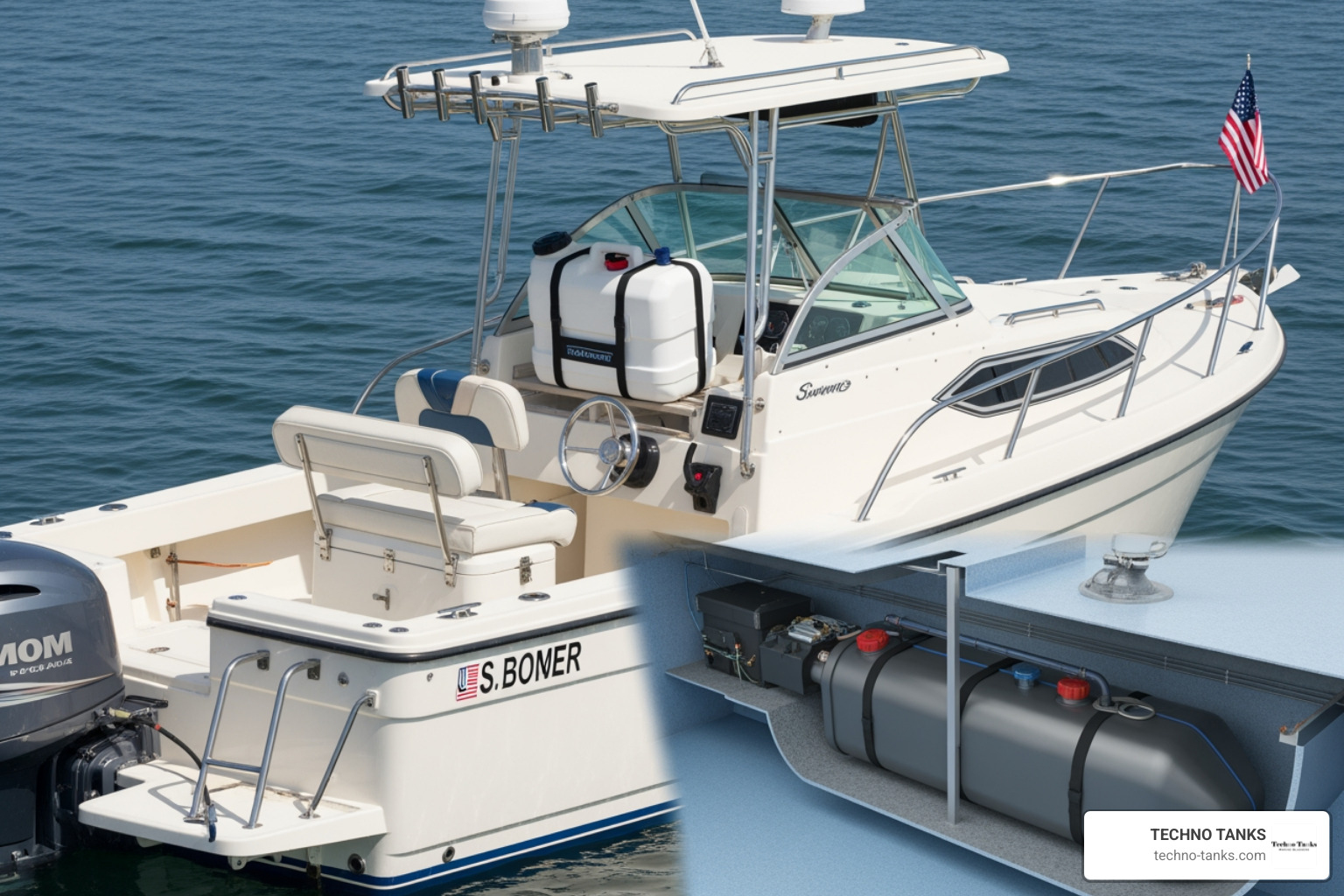
When we talk about marine fuel tanks, we are really talking about several different categories of storage solutions:
- OEM replacement tanks
- Custom-fabricated rigid tanks
- Portable topside tanks
- Permanent below-deck tanks
- Flexible fuel bladders for temporary or range-extension use
For many boat owners, the first fork in the road is simple: do we need an exact replacement, or do we need something built around the boat we actually have now?
OEM vs custom marine fuel tanks
OEM replacement tanks are designed to match a specific boat model and year range as closely as possible. They are ideal when:
- the original tank shape worked well
- the boat still has the original tank cavity
- we want the fastest path to replacement
- fittings and sender locations are already known
Good OEM-style replacements are often based on factory drawings, prior production records, or reverse engineering from old tanks and customer measurements. Buyers should still verify dimensions, because two boats with the same badge can have small production differences. A tape measure beats a headache every time.
Custom tanks are the better choice when:
- the original tank is no longer available
- the boat has been modified
- the existing cavity is odd-shaped
- we want more capacity
- we need different fittings, senders, or fill locations
Custom fabrication also matters for older boats and repowers. If deck structures, hatches, rigging, or fuel fills have changed, a direct replacement may not actually be direct anymore.
A smart buying process usually includes:
- exact measurements of the space
- drawings for approval before fabrication
- sender depth confirmation
- fitting location review
- hatch and installation clearance checks
- realistic lead time expectations
If your goal is extra range rather than permanent replacement, flexible options can be even more practical. Our Marine Fuel and Liquid Bladders Category and Marine Fuel Bladders are built for range extension in 30 to 3000 gallon sizes, which can be useful for fishing, cruising, and temporary onboard fuel storage.
Material choices for marine fuel tanks
The three most common rigid tank materials are aluminum, stainless steel, and polyethylene.
| Material | Main Advantages | Main Drawbacks | Best Use Cases |
|---|---|---|---|
| Aluminum | Strong, widely available, easy to custom fabricate, common for below-deck tanks | Can corrode if installed poorly or left in trapped moisture | OEM replacements, custom below-deck builds |
| Stainless steel | Excellent corrosion resistance, long service life, strong lifecycle value | Higher upfront cost, heavier, less common for many small recreational builds | Premium diesel storage, harsh salt exposure, long-life installations |
| Polyethylene | Non-corrosive, lightweight, dent resistant, good for molded production tanks | Shape options are more limited, harder to custom modify, not ideal for every installation | Portable tanks, molded permanent tanks |
Aluminum remains the most common custom material in recreational boats because it balances strength, weight, and fabricability well. Many builders use 5052 aluminum alloy, and thicknesses around 1/8 inch, 0.188 inch, and 0.190 inch are common depending on tank size and design. Research also showed examples of .190-inch 5052 H32 aluminum tanks with epoxy coating for additional exterior protection.
Stainless steel has a strong case in aggressive marine environments, especially with diesel. The long-term corrosion story is compelling: some stainless diesel tank designs cite a 50+ year design life, versus roughly 15 to 20 years for standard carbon steel. Upfront cost can be about 2.5x to 3x higher, but lower maintenance can deliver a positive ROI over time. For a broader look at stainless storage principles, see SS Diesel Tanks | Premium 304/316L SS Fuel Storage .
Polyethylene, especially HDPE or cross-linked polyethylene, is common in portable and rotationally molded permanent tanks. It is corrosion-resistant and lightweight, and many recreational above-deck tanks use UV-stabilized polyethylene. Some barrier tank constructions also add an inner layer designed for ethanol compatibility and permeation resistance.
Shapes, Capacities, and Features That Affect Performance
Shape is not just a packaging decision. It affects installation, capacity, center of gravity, and even how the boat behaves underway.
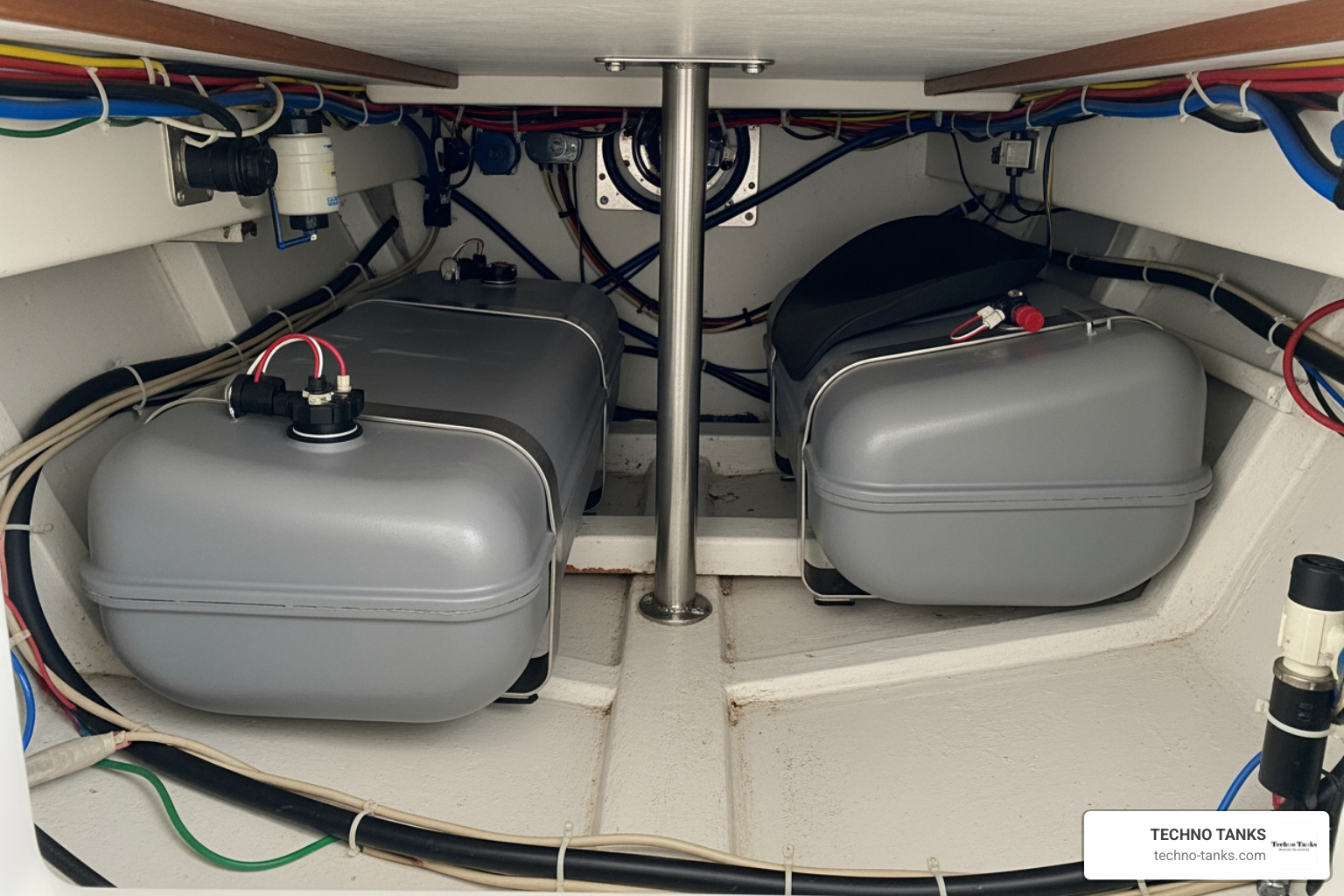
How tank shape changes installation and boat handling
Here are the most common shapes and what they do best:
- Belly tanks sit low and follow hull contour, which helps maximize volume in shallow underdeck spaces.
- Saddle tanks are often installed in pairs port and starboard, helping twin-engine layouts and side-to-side balance.
- Bow tanks can use otherwise awkward forward volume, but weight distribution must be considered carefully.
- Rectangular tanks are simple and efficient in flat spaces or above-deck applications.
- V-bottom tanks conform to deeper bilge geometry.
- Saddle-bottom designs can bridge structure or fit complex hull shapes.
Shape affects more than fit:
- Lower tanks generally help center of gravity.
- Tanks that match hull contours can increase capacity without raising deck height.
- Poorly placed weight can worsen trim.
- In twin-engine boats, paired tanks can help balance fuel burn.
- Long, wide tanks may need careful baffling to reduce slosh loads.
That last point matters. Tanks exceeding 30 inches in any horizontal dimension should have vertical baffle plates at intervals of no more than 30 inches. That is not just a nice engineering touch; it is a major safety and structural requirement.
Common capacities, wall thicknesses, and built-in features
Marine fuel tanks come in an enormous range. Small permanent tanks may be under 20 gallons, while offshore and custom applications can run far larger. Rigid replacements commonly fall in the 17 to 380+ gallon range, while our flexible fuel bladders cover 30 to 3000 gallons for serious range extension.
Common specs buyers will see include:
- capacities from 16 to 150 gallons in many molded recreational tanks
- OEM-style replacements from roughly 17 to 380+ gallons
- larger custom systems over 400 gallons requiring additional structural design considerations
- minimum custom fabrication thicknesses often starting at 1/8 inch
- aluminum options around 0.188 inch or 0.190 inch for heavier-duty builds
Common built-in features include:
- fuel level sender or sending unit
- vent fitting
- fill fitting
- pickup tube
- return fitting for diesel systems where needed
- bonding tab
- mounting tabs
- lifting eyes
- internal baffles
- exterior coatings or barrier finishes
These details matter because the tank itself is only one part of the fuel system. The sender must match the gauge. The vent must route safely. The pickup has to be placed and sized correctly. The bonding tab helps reduce static and electrical risk. A nice-looking tank with the wrong fittings is basically a shiny paperweight.
If you’re comparing rigid tanks to temporary capacity solutions, our Fuel Bladder vs Fuel Tank, Fuel Bladder for Boats, Marine Fuel Bladder Sizing Guide, and Popular Marine Fuel Bladder Sizes and Their Uses can help you match capacity to trip profile.
Above-deck vs below-deck tanks
Above-deck tanks are easier to inspect and often easier to refuel. They make sense for:
- smaller boats
- portable setups
- temporary fuel capacity
- auxiliary fuel supply
- boats with limited below-deck access
Below-deck tanks are the standard choice for permanent installations because they:
- protect deck space
- lower weight in the hull
- improve aesthetics
- support larger capacities
The tradeoff is access. Below-deck tanks need proper ventilation, support, moisture control, and inspection planning. Once they disappear under a deck, they should not disappear from your maintenance routine too.
For smaller topside options, see our Marine fuel tank selection guide.
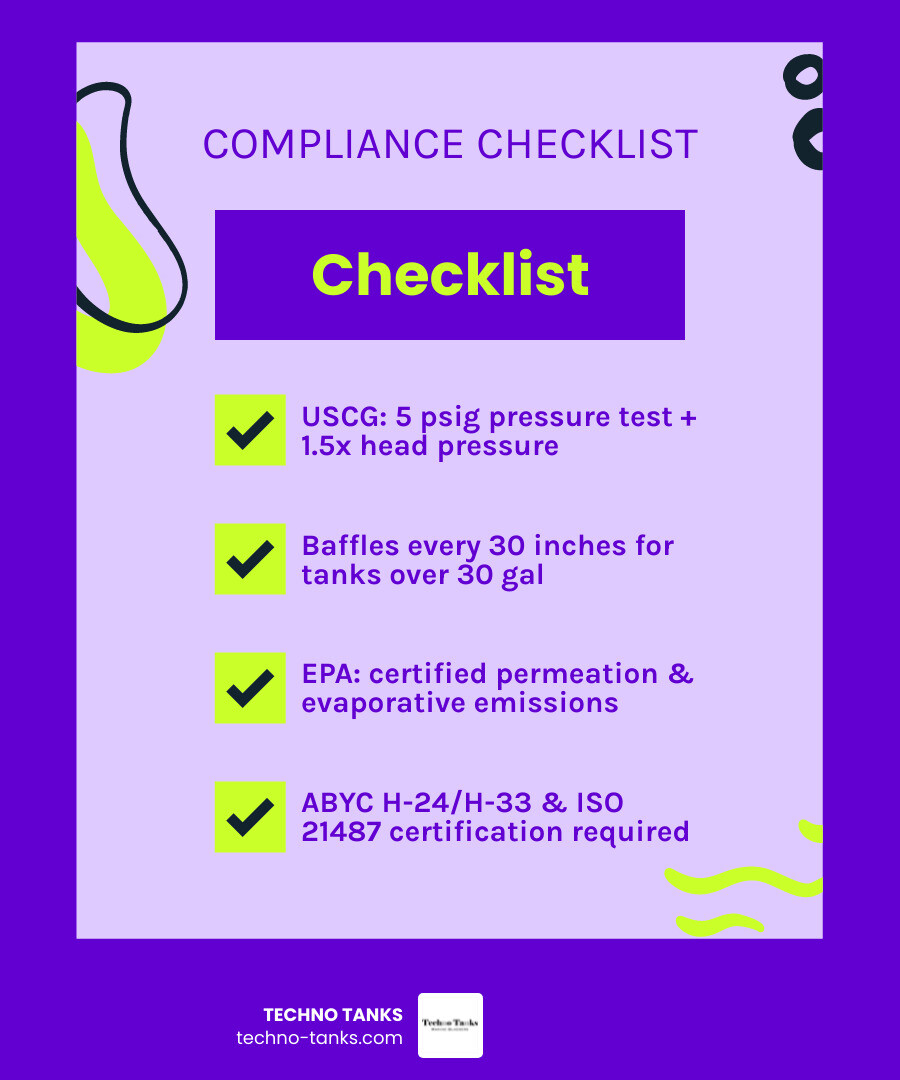
Marine Fuel Tanks Compliance: USCG, ABYC, EPA, NMMA, and ISO Rules
Compliance is where a lot of buyers glaze over. We get it. Standards are not exactly cocktail-hour conversation. But they matter, because marine fuel is one of those systems where “close enough” is a terrible strategy.
USCG construction and testing requirements
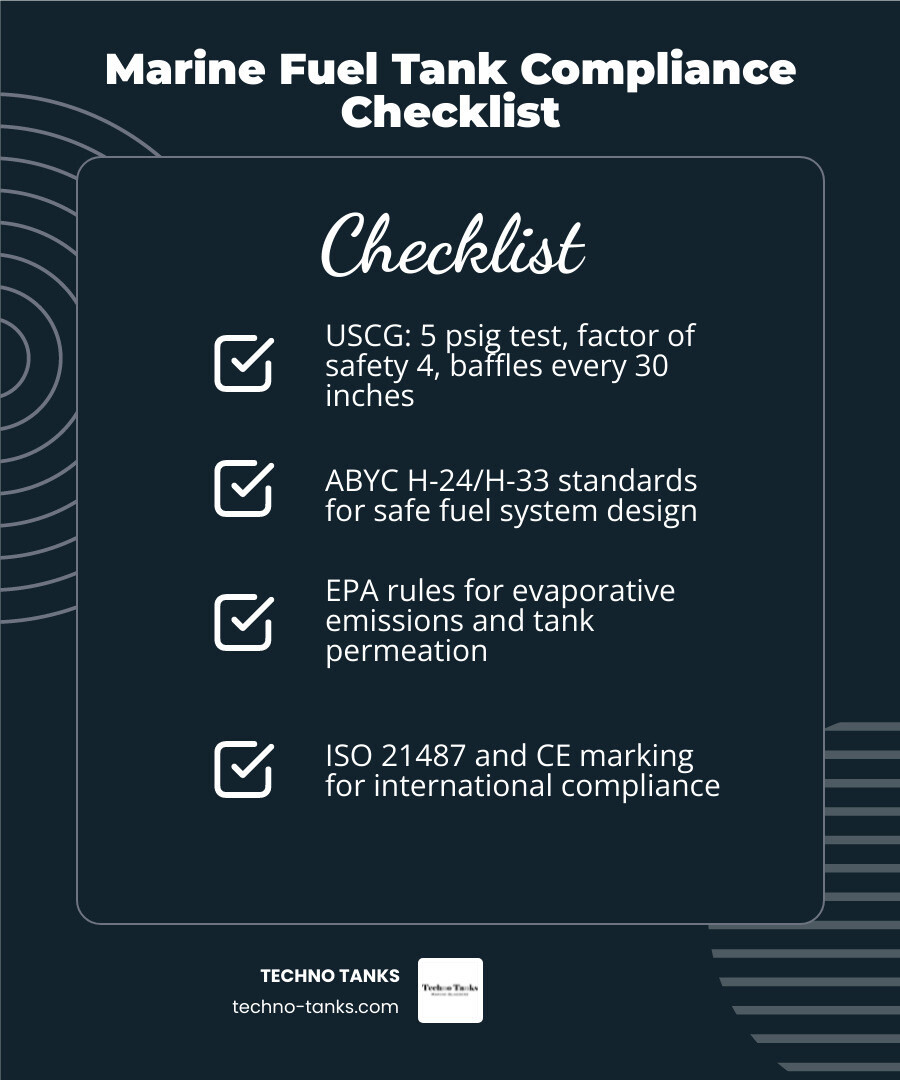
For gasoline tanks, one of the most important federal references is Gasoline tank rules in 46 CFR. Key requirements from the research include:
- Tanks over 400 gallons must be designed with a factor of safety of four on ultimate material strength, using a design head of at least 4 feet of liquid above the top of the tank.
- Tanks exceeding 30 inches in any horizontal dimension need vertical baffles at intervals not over 30 inches.
- Before installation, tanks vented to atmosphere must withstand 5 psig or 1.5 times the maximum service head, whichever is greater.
- Metallic joints are generally expected to be welded or brazed.
- Tanks need proper support, bracing, and bonding.
- Designs that trap moisture, such as flanged-up top edges, are not acceptable.
Research also noted capacity-based material thickness rules in the CFR for certain metallic tank types. In practical recreational boat work, many manufacturers exceed minimums by using thicker aluminum stock and pressure testing each tank before it leaves the shop.
ABYC, NMMA, EPA, and ISO standards buyers should verify
Beyond federal rules, buyers should also verify relevant industry standards and certification pathways:
- ABYC standards such as H-24 and H-33 for fuel systems
- NMMA certification, which generally means a builder is following applicable ABYC requirements
- EPA evaporative emissions requirements for gasoline fuel systems
- ISO 21487 for small craft fuel tanks in many international applications
- CE or related documentation where applicable for non-US markets
EPA rules matter especially for newer gasoline boats. In simple terms, emissions compliance is not just about the engine anymore. It also involves tank permeation, venting behavior, and fuel system components. If you’re replacing a tank in a newer boat, ask whether the tank was built for the emissions standard your boat must meet and whether paperwork such as vent studies or compliance documentation is available.
Not every older tank can be “upgraded” in place to meet current evaporative standards. In many cases, a proper replacement is the safer route.
Why installation quality is part of compliance
A compliant tank can still fail early if it is installed badly. Installation quality affects both safety and service life.
Best practices include:
- allowing free air circulation around the tank
- avoiding moisture-trapping surfaces
- using support strips or pads correctly
- isolating dissimilar materials where needed
- routing fill and vent hoses without kinks or low traps
- bonding metallic tanks to the boat’s grounding system
- testing after installation, not just before it
For a practical installation perspective, see Fuel tank installation best practices.
Fitment, Installation, and Long-Term Maintenance
How manufacturers achieve precise fitment for specific boats
Precise fitment usually comes from a mix of:
- original drawings
- reverse engineering
- physical measurement of the old tank
- customer-supplied dimensions
- trial-fit knowledge from previous builds
Good manufacturers often allow limited fitting relocation or minor dimensional adjustments after a drawing review. That matters because sender depth, hose clearance, hatch opening size, and mounting geometry can all ruin an otherwise good plan.
Before buying, we recommend verifying:
- length, width, and height of the cavity
- sender depth and swing clearance if float-based
- fill, vent, and pickup orientation
- installation path through deck or hatch openings
- mounting tab placement
- whether insulation or pads change final fit
Installation details that protect safety and service life
A long-lasting installation usually comes down to basics done well:
- Put the tank where it can be supported evenly.
- Keep it from sitting in trapped water.
- Prevent chafe between tank and structure.
- Route vent lines so they actually vent.
- Route fill hoses for smooth fuel delivery.
- Maintain access for inspection and sender service.
- Bond and ground metallic components properly.
- Protect coatings during installation.
One of the most common reasons aluminum tanks fail early is not bad aluminum. It is bad installation: wet foam, trapped water, blocked airflow, or abrasive contact points. In other words, the tank did not lose the fight with fuel. It lost the fight with the environment around it.
Inspection, maintenance, and warranty questions to ask before buying
Before purchase, ask these questions:
- Is the tank pressure-tested, and can we get records?
- What warranty applies, and what voids it?
- Are coatings included or optional?
- Are sender, fittings, and pickup included?
- What inspection access will be required after install?
- What is the return policy for custom work?
- What documentation comes with the tank?
Then, once installed, inspect at least annually for:
- fuel odors
- wet spots or staining
- corrosion or pitting
- chafe points
- loose fittings
- vent blockage
- sender issues
- sludge or water contamination
If you are evaluating a replacement project now, More info about marine fuel tank replacement is a useful next read.
Frequently Asked Questions about Marine Fuel Tanks
Should I choose an OEM replacement or a custom tank?
Choose OEM-style replacement if you want the most predictable fit for a known boat model and you have confirmed your dimensions match.
Choose custom if:
- your boat is older or modified
- the tank cavity is unusual
- you want more capacity
- the original tank is discontinued
- you need fitting changes
For temporary range extension, a flexible solution may be smarter than altering the permanent tank system. Our The Best Custom Marine Fuel Tanks to Keep You Cruising and Why You Should Use Techno Tanks and Marine Fuel Bladder for Marine Bulk Liquids explain where each approach makes sense.
What material lasts longest in saltwater conditions?
For pure corrosion resistance, 316 stainless is a standout choice in harsh salt environments, especially for diesel applications. Stainless also offers impressive long-term service life when properly fabricated and installed. For more on that material logic, see Scientific research on stainless diesel storage.
That said, aluminum can also serve very well in marine use if installed correctly and kept away from trapped moisture and corrosive contact points. Polyethylene does not corrode, but it is not the answer for every custom shape or structural installation.
So the honest answer is:
- 316 stainless often wins on ultimate saltwater corrosion resistance
- aluminum wins on customability and weight for many boat builds
- polyethylene wins on corrosion immunity in molded or portable applications
Can an older non-EPA tank be upgraded to current standards?
Sometimes parts of a system can be updated, but a full “upgrade” is not always practical. EPA compliance can involve the tank material, permeation behavior, venting, and the rest of the fuel system. On older boats, replacing the tank and related components is often more realistic than trying to retrofit everything piece by piece.
If you are dealing with this exact issue, Discussion on converting non-EPA tanks gives useful context.
Conclusion
Choosing the right marine fuel tanks setup comes down to five things:
- fitment
- material
- shape
- compliance
- installation quality
If you need a direct-fit rigid replacement, verify the dimensions and documentation carefully. If you need a custom rigid tank, pay close attention to shape, fittings, support, and inspection access. And if your real goal is more fishing range or longer cruising legs without redesigning the boat, flexible fuel storage can be the smartest tool in the box.
At Techno Tanks, we focus on patented, recyclable thermoplastic polyurethane fuel bladders in 30 to 3000 gallon sizes to help extend range safely and efficiently. If that sounds like the right fit for your trip profile, explore our Marine Fuel Bladders and Everything You Need to Know About Portable Marine Tanks.
Because out on the water, the best fuel tank is the one you do not have to worry about.

