
When Your Boat’s Built-In Tank Just Isn’t Enough
Quick Answer: What Is an 80 Gallons Marine Bladder?
| Feature | Details |
|---|---|
| Capacity | 80 gallons (303 liters) |
| Filled Dimensions | 42.5″ x 34″ x 18″ |
| Empty Weight | 24.5 lbs (11 kg) |
| Price (2026) | $1,150.00 |
| Compatible Fuels | Gasoline, diesel, biodiesel, ethanol, methanol, 100LL, lubricants, fuel oils, potable water |
| Mounting Location | Above deck only (Coast Guard requirement) |
| Material | Military-spec TPU-coated polyester, 50 mil thick |
| Tie-Down Method | D-rings on top of tank |
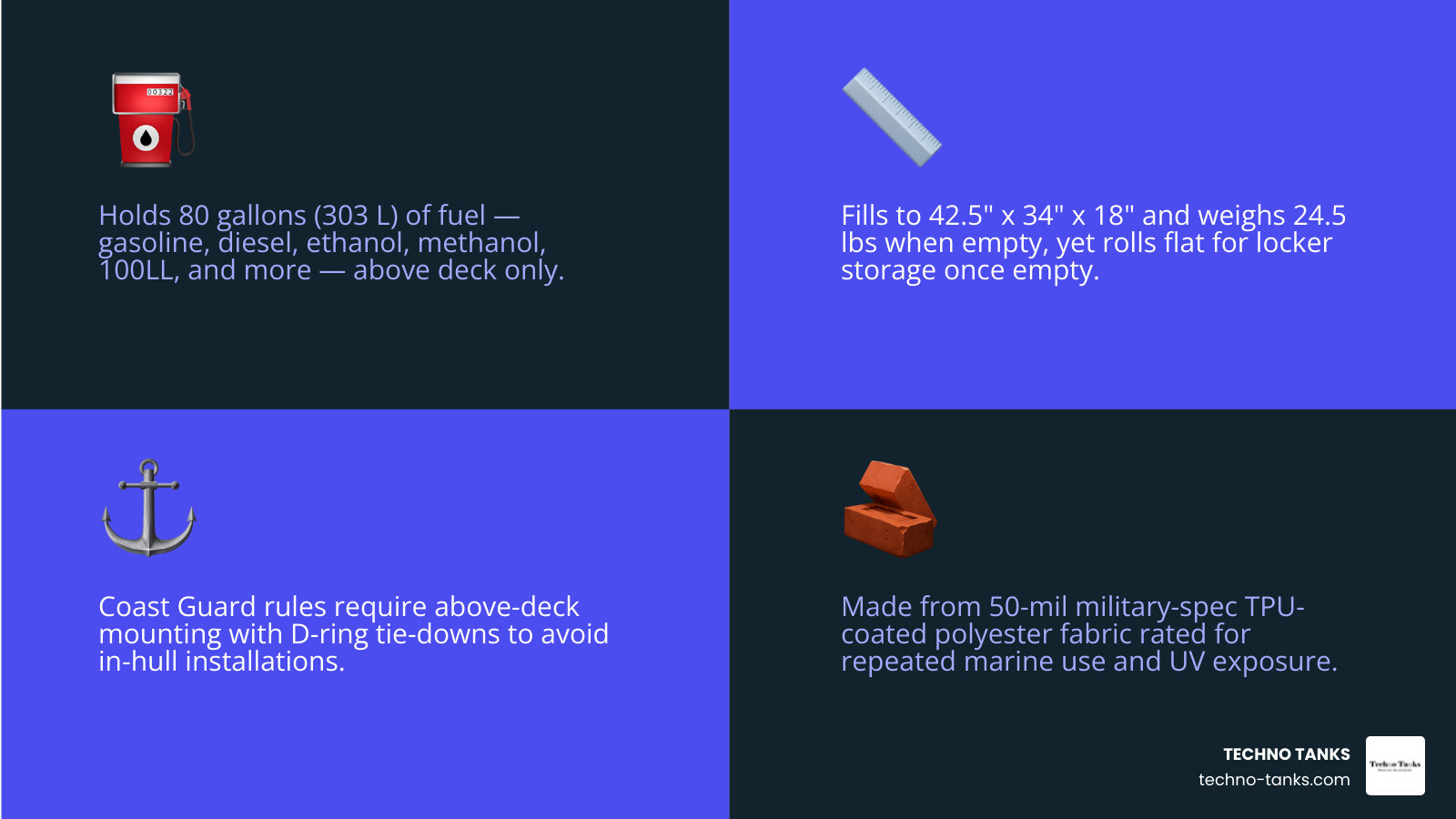
An 80 gallons marine bladder is a flexible, collapsible fuel storage tank designed to sit on your boat’s deck and give you extra range without cutting into your hull or adding permanent fixtures.
You fill it where it sits. You tie it down with D-rings. When it’s empty, it folds flat and stores in a locker. That’s the whole concept – and it solves a real problem for anyone who’s ever watched their fuel gauge drop faster than expected, miles from the nearest marina.
Flexible fuel bladders like this one are built from military-spec coated fabric, rated for gasoline, diesel, and several other liquids. They’re not jerry cans. They’re purpose-built marine fuel systems that happen to fold up when you don’t need them.
If you run long fishing trips, offshore cruises, or any route where fuel stops are scarce, an 80-gallon bladder can add meaningful range without a major vessel modification.
I’m Ivan Jimenez, founder of Digital Ivan and Doral SEO, where I build authority content systems for industrial and marine brands – including Techno Tanks, whose 80 gallons marine bladder lineup this guide covers in full detail. Let’s break down everything you need to know before you buy.
80 gallons marine bladder helpful reading:
What Is an 80 Gallons Marine Bladder and When Does It Make Sense?
When we talk about an 80 gallons marine bladder, we are referring to a sophisticated piece of auxiliary fuel equipment. Unlike the plastic jugs you might see rolling around the back of a truck, these are engineered specifically for the marine environment. They are designed to carry significant amounts of fuel safely on the deck of a boat or yacht.
In offshore boating, range is everything. Whether you are chasing billfish 100 miles out or cruising through remote island chains, your factory fuel tank is often the limiting factor. An 80-gallon bladder acts as your “reserve tank,” providing that extra cushion of 303 liters that can mean the difference between making it home or calling for a tow.
How an 80 gallons marine bladder differs from a rigid marine fuel tank
The primary difference is flexibility—both literally and figuratively. A rigid tank, whether made of aluminum or polyethylene, requires a permanent footprint. Once you install it, that deck space is gone forever. If you want to retrofit a boat with more fuel capacity using rigid tanks, you are looking at expensive fiberglass work or losing a massive amount of cockpit space.
Our flexible bladders, however, are collapsible. When they are empty, they take up virtually no space. You can roll them up and tuck them into a vented locker. Furthermore, because they are flexible, they conform slightly to the deck surface, which helps lower the center of gravity compared to a tall, rigid tank. For a deeper look at these differences, check out our guide on fuel bladder vs fuel tank.
Best use cases for an 80 gallons marine bladder
When does it make sense to go with the 80-gallon model?
- Extended Fishing Trips: If your favorite fishing grounds are just beyond your safe “one-third” fuel rule, this bladder bridges the gap.
- Generator Feed: Many yacht owners use these bladders to supply diesel generators during long stays at anchor, keeping the main tanks reserved for travel.
- Emergency Refueling: Having 80 gallons of stable fuel ready to go can be a lifesaver in remote areas where fuel quality is questionable.
- Center Consoles: The 80-gallon size is a “sweet spot” for mid-sized center consoles that need extra range but can’t handle the weight of a 200-gallon monster.
Learn more about how these fit into your vessel’s setup in our article on fuel bladder for boats.
Why 80 gallons is a practical mid-size option
Techno Tanks offers a wide range of sizes from 30 to 3,000 gallons. The 80-gallon model is positioned as a medium-capacity option. It’s large enough to provide a substantial range boost—roughly equivalent to adding two to four hours of cruising time for many outboard engines—yet it remains manageable. At 42.5 inches long, it fits comfortably on the bow or in the cockpit of most boats over 24 feet without blocking all walking paths. You can see how this compares to other volumes in our popular marine fuel bladder sizes and their uses guide.
80 Gallons Marine Bladder Specs, Capacity, and What You Actually Carry
Understanding the physical footprint and weight of your fuel storage is critical for boat balance and safety. You don’t want to just “guess” when it comes to adding nearly 600 pounds of liquid to your deck.
Exact dimensions and weight of the 80 gallons marine bladder
When you receive your 80 gallons marine bladder, it arrives in a surprisingly compact box measuring just 25.5″ x 20.5″ x 10″. It weighs only 24.5 lbs (11 kg) when empty, making it easy for one person to move around.
However, once filled, the dimensions shift to 42.5″ x 34″ x 18″. It takes on a “pillow” shape that is low-profile and stable. These exact measurements are vital for planning where the tank will sit and where your tie-down points need to be. For a full breakdown of all our sizes, visit the fuel bladder specs page.
Empty vs filled weight: how heavy is it in real use?
This is where the math gets serious. While the bladder itself is light, the fuel inside is not.
- Gasoline: Weighs approximately 6 lbs per gallon. An 80-gallon bladder will add about 480 lbs to your deck.
- Diesel: Weighs approximately 7 lbs per gallon. This brings the total weight to roughly 560 lbs.
Because of this weight, we have a golden rule: Never attempt to carry a full bladder. You must place the empty bladder exactly where you intend to use it, secure it, and then fill it. Attempting to move 500+ lbs of shifting liquid by hand is a recipe for injury or boat damage.
Price, value, and cost-per-gallon in 2026
As of May 2026, the Techno Tanks 80 gallons marine bladder is priced at $1,150.00. While this might seem higher than a few plastic jugs, the value lies in its durability, safety, and reusability. When you consider that this tank is built to last for years of offshore abuse and can be stored away to save space, the “cost per trip” becomes very economical. Check our latest fuel bladder pricing for any seasonal updates.
Sizing up before you buy
Before clicking “buy,” measure your deck. You need a flat area that can accommodate the 42.5″ x 34″ footprint. You also need to ensure that the deck in that area is rated to hold the weight of the fuel. Most cockpit soles are plenty strong, but some forward casting platforms might require a second look. If the 80-gallon isn’t quite right, our fuel bladder sizing guide can help you find the perfect fit.
Materials, Construction, and Fuel Compatibility
We don’t play around when it comes to the materials used in our bladders. When you are carrying flammable liquids on a moving boat, “good enough” isn’t an option.
Why the fabric and seam design matter offshore
Our bladders are constructed from 50 mil thick military-spec coated fabric weighing 40 oz per square yard. This isn’t just a single layer of plastic; it is a high-tenacity polyester base fabric coated with patented Thermoplastic Polyurethane (TPU).
The seams are not just glued; they utilize a taped seam construction that is actually stronger than the fabric itself. This ensures the bladder can handle the “sloshing” forces of a boat hitting waves at high speed. The white matte finish isn’t just for looks—it reflects UV rays and reduces heat absorption, which minimizes gas expansion inside the tank.

Compatible fuels and liquids for one bladder
One of the best features of our TPU technology is its chemical resistance. Our bladders are compatible with 10 different liquid types, including:
- Gasoline
- Diesel
- Bio-diesel
- Ethanol
- Methanol
- 100LL Aviation Fuel
- Lubricants
- #2 Fuel Oil
- #4 Fuel Oil
- Potable Water (TPU is food-grade safe!)
This versatility means you can use your bladder for a diesel delivery one week and for hauling fresh water to a remote camp the next (provided you clean it thoroughly between uses).
Durability, weather exposure, and reusability
Even though our materials include UV additives and hydrolysis stabilizers, the marine environment is brutal. Sun, salt, and extreme temperatures will eventually take a toll on any fabric. To maximize the life of your bladder, we recommend storing it in a dry, vented locker when not in use. This prevents unnecessary UV degradation and keeps the material supple. Because they are collapsible fuel tanks, they are easy to protect.
Fuel bladder material selection: don’t mix applications
While our tanks are compatible with many liquids, we always advise customers to designate a tank for a specific use. If you have used a bladder for gasoline, it should stay a gasoline bladder. Even with cleaning, microscopic residues can remain. If you need a dedicated water solution, we recommend a separate unit to ensure the highest safety and purity standards.
Safe Installation, Tie-Down, and Coast Guard Best Practices
Safety is the most important part of this guide. Fuel bladders are incredibly safe when used correctly, but they require respect.
Where to mount an 80 gallons marine bladder safely
Above deck only. This is not just our recommendation; it is a Coast Guard regulation. You should never, under any circumstances, mount a fuel bladder below deck or in an enclosed hull space.
Mounting above deck ensures that if there is a spill during filling, the fuel drains out the scuppers rather than pooling in your bilge. It also allows for proper venting and easy inspection. For more on these requirements, see our section on marine fuel bladders.
How to secure it so it won’t shift in rough water
A full 80-gallon bladder is heavy, but it can still slide. In high seas, a shifting 500-lb weight can damage your boat’s gunwales or unbalance the vessel.
- Use the integrated D-rings on the top of the bladder.
- Secure it to deck cleats or dedicated tie-down points using high-quality ratcheting straps or lines.
- Ensure the bladder is “snug” but not so tight that you are pinching the fabric against sharp edges.

Filling, transferring, and emptying fuel the right way
- Fill in Place: Lay the empty bladder on the deck, secure it, and then bring the fuel nozzle to the boat.
- Gravity/Siphon Transfer: We recommend using gravity or a simple siphon to transfer fuel into your main tanks. It’s the safest method.
- Direct Connection: You can connect the bladder directly to your engine’s fuel line using the correct fittings and adapters. This is a great way to “run off the bladder” first, then switch to your main tanks once the bladder is empty and ready to be stowed.
- Purging: To get every last drop, roll the bladder from the end opposite the outlet fitting toward the valve.
Transport and handling rules every boater should know
Aside from the “don’t carry it full” rule, fuel is 2/3 the density of water. This means your bladder will actually float if it falls overboard! In an emergency, an empty bladder can even be lightly filled with air to serve as a flotation device for personnel. However, the goal is to keep it on the boat. Always check your straps after the first 30 minutes of a trip, as fuel settling can sometimes loosen the lines.
Included Fittings, Custom Options, and How It Compares on Buying Criteria
When you buy a Techno Tanks product, you are getting a complete kit designed to get you on the water immediately.
What fittings and accessories buyers should expect
The 80 gallons marine bladder typically includes:
- High-quality fill and outlet fittings.
- A secure cap set to prevent leaks and odors.
- Reinforced D-ring tie-down points.
- Compatibility with standard marine fuel hoses.
Can you connect it directly to your engine?
Yes. Many of our customers prefer this method. By using a “Y” valve or a simple quick-connect fitting, you can draw fuel directly from the bladder. This is often more convenient than stopping to transfer fuel in the middle of a choppy sea. For more information on setting this up, check out our custom fuel bladders page.
When custom configurations are worth it
If you have a very specific deck layout – perhaps a narrow walkway or a strangely shaped bow area – we can help. While our 80-gallon model is a standard size, we do offer custom fuel bladders tailored to your specific boat dimensions.
Compare an 80-gallon bladder by price, quality, and features
How does the flexible bladder stack up for buyers focused on portability and range extension?
| Criteria | Flexible Bladder (80 Gal) |
|---|---|
| Upfront Cost | ~$1,150 |
| Installation | Zero permanent installation |
| Storage | Folds away when empty |
| Weight (Empty) | 24.5 lbs |
| Portability | High |
| Versatility | Can move between boats |
For the modern boater who values flexibility and doesn’t want to permanently alter their vessel, the bladder offers a practical way to add capacity only when needed.
Frequently Asked Questions About 80 Gallons Marine Bladder
Can you mount an 80 gallons marine bladder below deck?
No. As mentioned, Coast Guard regulations strictly prohibit in-hull locations for these types of flexible fuel bladders. They must be mounted above deck for safety, venting, and spill containment. If you need more info on why, read everything you need to know about portable marine tanks.
Can you really get almost every drop of fuel out?
Yes. Unlike rigid tanks that often have “unusable” fuel at the bottom, the bladder collapses as it empties. By rolling the tank from the back toward the outlet fitting, you can purge nearly 100% of the contents.
Will it float if it goes overboard?
Definitely. Because fuel is lighter than water, a full bladder will float. Even more interesting is that an empty bladder, if filled with just a bit of air, provides massive buoyancy. It’s a nice “hidden” safety feature to have offshore.
Conclusion
The 80 gallons marine bladder is the ultimate “middle ground” for boaters. It offers enough capacity to significantly extend your range—whether you are fishing, cruising, or just exploring—without the massive footprint or weight of larger units.
At Techno Tanks, we pride ourselves on using patented, 100% recyclable TPU materials that are built to military specifications. We want you to go further, stay longer, and get home safely. Whether you need a small 30-gallon reserve or a massive 3,000-gallon system, we have the solution to keep you from running dry.
Ready to extend your range?
- Shop the 80 Gallon Marine Bladder
- Browse all Marine Fuel and Liquid Bladders
- Explore Large Capacity Options
Don’t let your fuel gauge dictate your adventure. With an 80-gallon bladder on deck, the horizon just got a lot closer. Reach out to us at Techno Tanks today to find the perfect fit for your boat!

