
Why Serious Offshore Operators Are Choosing Boat Gas Bladder Systems
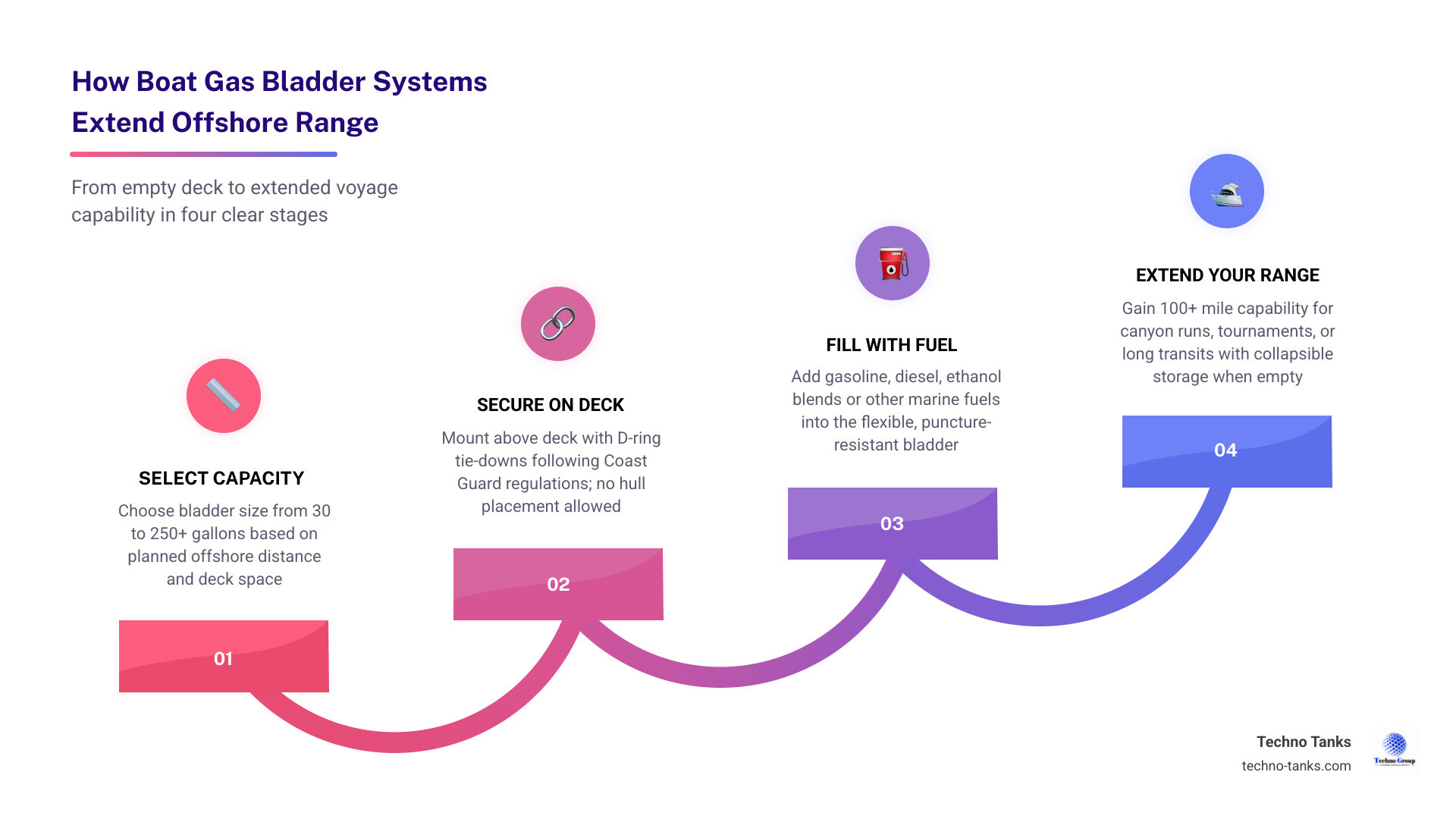
Boat gas bladder systems are the practical solution for yacht operators, offshore fishing crews, and commercial marine operators who need more range — without the cost, complexity, or permanence of installing additional rigid tanks.
Here is what you need to know upfront:
- What they are: Flexible, collapsible containers made from fuel-resistant materials that store gasoline or diesel aboard a vessel
- Where they mount: Secured above deck using D-ring tie-down points (U.S. Coast Guard regulations prohibit in-hull placement)
- What they hold: Gasoline, diesel, biodiesel, ethanol blends, methanol, and other marine fuels
- Sizes available: From 30 gallons up to 250+ gallons, with custom options beyond that
- Key advantage: Folds flat when empty — no permanent footprint, no wasted space
- Who uses them: Yacht operators, canyon fishing crews, expedition teams, and commercial marine operators extending operational range
For offshore runs exceeding 100 miles one-way, tournament fishing circuits, or long-distance transits, carrying auxiliary fuel is not optional — it is operational planning. A flexible bladder system gives you that capacity without permanently altering your vessel.
Pricing depends on capacity, configuration, fuel type, and custom requirements. Request a quote based on your specific vessel and use case.
Understanding Boat Gas Bladder Systems vs. Rigid Tanks
When planning long-range offshore voyages, vessel operators must evaluate how to carry auxiliary fuel safely and efficiently. The choice typically comes down to installing permanent, rigid tanks or deploying flexible boat gas bladder systems.
While rigid tanks have been the traditional choice for decades, they introduce significant engineering, financial, and spatial challenges. In contrast, flexible containment offers an adaptable, mission-specific alternative. Understanding how these systems compare is essential for making an informed commercial decision.
For a comprehensive breakdown of the core structural differences between these two storage methods, operators can read the detailed comparison in our article on Fuel Bladder vs Fuel Tank.
| Feature | Flexible Fuel Bladder | Rigid Aluminum / Steel Tank |
|---|---|---|
| Footprint | Dynamic; collapses to zero when empty | Permanent; occupies deck or hull space constantly |
| Weight (Empty) | Extremely lightweight (typically under 45 lbs for 300 gal) | Heavy; adds permanent deadweight to the vessel |
| Installation | Temporary; secured with straps on deck | Complex; requires structural modifications and plumbing |
| Venting | Self-collapsing; requires minimal to no venting | Static; requires dedicated hull venting systems |
| Customization | Highly adaptable to specific deck footprints | Expensive to fabricate in custom geometric shapes |
| Maintenance | Wash, dry, roll, and store in a dry locker | Prone to condensation, corrosion, and pinhole leaks |
Rigid fuel tanks are permanently mounted inside the hull or bolted to the deck. While they provide highly protected containment, they consume valuable space even when empty. Furthermore, metal tanks are susceptible to structural fatigue, welds cracking from hull flexing, and internal condensation as fuel levels fluctuate.
Flexible Collapsible Fuel Tanks address these vulnerabilities. Because they collapse as fuel is drawn out, there is no air pocket inside the bladder. This lack of headspace completely eliminates the risk of fuel vapor accumulation and condensation, which is a major contributor to fuel contamination and microbial growth in diesel systems.
How Flexible Bladders Differ from Traditional Tanks
The primary engineering distinction of flexible marine fuel bladders lies in their volume reduction capabilities. A standard rigid tank has a fixed footprint. Whether it holds 100 gallons of fuel or is completely empty, it occupies the exact same cubic volume on your boat.
A flexible bladder system, however, dynamically scales its volume. When fully discharged, the empty bladder can be rolled up and stowed away in a compact locker. For example, a heavy-duty 10-cubic-meter industrial-grade flexible tank can fold down to less than 0.25 cubic meters of physical space when empty. On a yacht or sportfish deck, this means that once the auxiliary fuel is transferred to the main tanks during the first leg of a trip, the deck space is completely recovered for fishing, diving, or passenger comfort.
For operators new to this technology, reading a Beginners Guide to Fuel Bladders for Boats provides a foundational look at how these systems integrate into standard marine operations.
Selecting the Right Boat Gas Bladder Systems for Your Vessel
Choosing the correct bladder system requires careful analysis of your vessel’s deck layout, weight distribution limits, and planned range requirements. Carrying hundreds of gallons of extra fuel on deck adds thousands of pounds of shifting mass. Therefore, capacity planning must be balanced with vessel stability.
To calculate the proper capacity:
- Determine your vessel’s fuel burn rate at cruising speed.
- Calculate the “fuel gap”—the difference between your main tank capacity (minus a 10% safety margin) and the total fuel required for your longest planned voyage.
- Check deck dimensions to ensure the bladder’s filled footprint fits securely within a flat, unobstructed deck area.
For detailed sizing charts and step-by-step calculations, consult the Fuel Bladder Sizing Guide to find the exact dimensions that match your vessel’s layout. You can also explore commercial sizing options through Marine Fuel Bladders for Boat and Vessel Fuel Storage tanks .
Key Benefits of Marine Fuel Bladders for Long-Distance Voyages
Operating a vessel offshore demands a strict margin of safety. Marine fuel bladders provide a reliable method to extend that margin, offering several operational advantages over standard configurations.
To explore the full scope of auxiliary storage advantages, read The Complete Guide to Marine Bladder Tanks and Storage or view our specialized Marine Fuel Bladders product options.
Maximizing Range and Operational Flexibility
The most immediate benefit of deploying a boat gas bladder system is the dramatic extension of your vessel’s cruising range. Whether you are running 120 miles offshore to fish deep canyons, participating in multi-day tournament circuits, or transiting a yacht along remote coastlines with limited fuel infrastructure, having auxiliary capacity is crucial.
Rather than being forced to cut trips short or buy expensive fuel at remote docks, operators can purchase fuel at their home port and run directly to their destination. This operational flexibility allows captains to run their engines at optimal cruising speeds without constantly monitoring the fuel gauge in a state of anxiety. Learn more about deck-mounted solutions in our guide on Fuel Bladder for Boats.
Space-Saving and Collapsible Storage Advantages
Unlike rigid auxiliary tanks, which remain a permanent obstacle on your cockpit sole, a flexible bladder is designed for rapid deployment and quick removal. Once the fuel inside the bladder is transferred to your vessel’s main tank, the bladder collapses flat.
Captains can then disconnect the fittings, roll the empty bladder from the outer edges toward the center to purge any remaining vapors, and slide it into a dedicated storage bag. This restores 100% of your deck space for the return trip, eliminating the trip hazards and physical obstructions associated with rigid deck tanks.
Technical Specifications: Materials, Durability, and Fuel Compatibility
Marine environments are incredibly demanding. Equipment is subjected to constant UV exposure, saltwater spray, extreme temperature fluctuations, and intense mechanical abrasion. To withstand these forces, marine fuel bladders are engineered using advanced polymer chemistry and military-spec manufacturing techniques.
For specialized applications, operators can review our technical specifications for Gasoline Fuel Bladders or read Fuel Bladders for Boats: The Complete Guide to Fuel Storage .
Advanced TPU and Elastomer Materials
Modern marine fuel bladders are constructed from high-tensile, reinforced Thermoplastic Polyurethane (TPU) or advanced elastomer-coated fabrics. The material thickness typically ranges from 0.7 mm to 2.0 mm, depending on the bladder’s capacity and application.
Polyester-based TPU is highly favored for fuel storage due to its exceptional resistance to hydrocarbons, microbial attack, and mechanical wear. This material provides:
- High tensile strength to withstand the hydrostatic pressure of sloshing fuel.
- Excellent puncture and abrasion resistance to protect against deck hardware.
- UV stabilizers and hydrolysis inhibitors to prevent the polymer from breaking down under intense sunlight and damp marine conditions.
Fuel Compatibility: Gasoline, Diesel, and Alternative Fuels
Fuel chemistry has become increasingly complex with the introduction of ethanol, methanol, and various bio-diesel blends. Standard rubbers and low-grade plastics can degrade rapidly when exposed to these solvents, leading to fuel contamination or catastrophic tank failure.
Techno Tanks’ advanced TPU bladders are engineered for broad chemical compatibility, making them suitable for:
- Gasoline (including high-ethanol blends like E10 and E15)
- Diesel and Bio-Diesel (such as B20)
- Aviation Gas (100LL)
- Methanol and Ethanol
- Lubricants and Fuel Oils
For operators utilizing diesel propulsion systems, choosing dedicated Diesel Fuel Bladders ensures optimal long-term material compatibility. If you operate in extreme offshore conditions, exploring Offshore Fuel Solutions will help you find the right system configuration for heavy seas.
Installation, Securing, and Fuel Transfer Best Practices
A marine fuel bladder is only as safe as its installation and transfer setup. Because fuel is dense—weighing approximately 6.1 lbs per gallon for gasoline and 7.1 lbs per gallon for diesel—a 150-gallon bladder weighs over 1,000 lbs when full. If this mass shifts in rough seas, it can damage deck structures, compromise vessel stability, or sever fuel lines.
To ensure safe operation, operators must understand the mechanics of How to Transfer Fuel from a Fuel Bladder and familiarize themselves with Everything You Need to Know About Boat Fuel Tank Fittings.
Proper Deck Placement and Securing Methods
When deploying a bladder, always follow these critical placement guidelines:
- Fill in Place: Never attempt to fill a bladder on the dock and carry it onto the boat. The weight makes it impossible to handle safely. Position the empty bladder in its designated deck location before inserting the fuel nozzle.
- Use Heavy-Duty Tie-Downs: Secure the bladder using high-strength web straps rated for the full weight of the loaded tank. Connect these straps to the bladder’s integrated D-rings and anchor them to heavy-duty deck cleats or structural tie-down points.
- Avoid Slack: As fuel is drawn from the bladder, the tank will shrink. Straps must be monitored and adjusted periodically during the voyage to maintain tension and prevent the bladder from sliding.
Safety Regulations and Compliance for Boat Gas Bladder Systems
Safety must be the primary consideration when handling flammable fuels on open water.
- Above-Deck Mounting Only: U.S. Coast Guard regulations do not permit the installation of flexible fuel bladders below deck or inside enclosed hull compartments. They must be mounted on an open deck where any fuel vapors can dissipate naturally into the atmosphere.
- Venting and Pressure Relief: Ensure the bladder is equipped with an appropriate air vent or pressure relief valve. White matte finishes are highly recommended because they reduce heat absorption, minimizing thermal expansion and fuel vaporization.
- Static Mitigation: When transferring gasoline, ensure all equipment is properly grounded to prevent static electricity discharge, which can ignite fuel vapors. For safer transfers, gravity feed or manual siphon systems are preferred over non-explosion-proof electric pumps.
For broader marine safety context, operators can look at specialized inflation and buoyancy technologies such as the Gas Inflation System (GIST Type) – Leafield Marine or the Antisink All-in-One – Antisink system, which illustrate how advanced flexible membranes are utilized for vessel safety and buoyancy.
Frequently Asked Questions about Marine Fuel Bladders
Can fuel bladders be mounted below deck?
No. U.S. Coast Guard regulations strictly prohibit mounting flexible fuel bladders in below-deck compartments or enclosed hull spaces. Enclosed spaces trap hazardous fuel vapors, creating a severe fire and explosion risk. Bladders must always be secured on an open deck where natural airflow can safely disperse any vapors.
How do you extract all remaining fuel from a flexible bladder?
Because flexible bladders collapse as fuel is withdrawn, they naturally purge almost all of their contents. To extract the final fraction of a gallon, operators can gently roll the empty portions of the bladder from the outer edges toward the discharge fitting. This channels the remaining fuel directly into the suction line, leaving virtually zero residual fuel inside. For transfer operations, deploying dedicated Fuel Transfer Bladders can streamline this process.
Do marine fuel bladders degrade under UV exposure?
While high-quality bladders are manufactured with UV-inhibiting additives and protective matte finishes to resist sun damage, prolonged exposure to harsh UV rays, extreme heat, and saltwater will eventually cause wear. To maximize the lifespan of your system, always rinse the drained bladder with fresh water, allow it to dry completely, and store it in a dry, vented locker when not in use.
Conclusion
For serious offshore operators, expanding a vessel’s range is a matter of safety, efficiency, and operational capability. Boat gas bladder systems provide a high-performance, temporary fuel storage solution that avoids the structural modifications, weight penalties, and permanent space loss associated with rigid tanks.
By utilizing military-grade TPU materials, robust tie-down systems, and smart collapsible designs, Techno Tanks delivers reliable auxiliary fuel solutions tailored to your specific voyage requirements. If you are preparing for an upcoming transit, tournament, or long-distance run, explore our Custom Fuel Bladders to design a system that fits your deck layout.
Ready to plan your vessel’s range extension? Contact our engineering team today to review your deck dimensions, fuel requirements, and application details, or request a custom quote for Fuel Bladder Pricing.

