
When Every Gallon Counts: Fuel Bladder Emergency Response Explained
Fuel bladder emergency response is the use of flexible, collapsible fuel storage tanks to rapidly deliver, store, and transfer fuel in crisis situations — where speed, portability, and reliability are non-negotiable.
If you need a quick answer, here’s what matters most:
| Factor | What to Know |
|---|---|
| What they are | Collapsible, flexible tanks made from fuel-resistant fabric |
| Key advantage | Deploy in hours, fold flat when empty, require no permanent infrastructure |
| Typical capacities | From 25 gallons up to 210,000 gallons |
| Fuel types | Diesel, gasoline, jet fuel (JP-5, JP-8, Jet A) |
| Core use cases | Disaster relief, remote operations, military logistics, emergency services |
| Safety essentials | Secondary containment, pressure relief valves, anti-static grounding |
| Pricing | Varies by size, fuel type, and configuration — request a quote for your application |
When infrastructure fails — after a hurricane, flood, or large-scale power outage — fuel supply chains break down fast. Emergency teams, generators, vehicles, and helicopters all need fuel now, not in three weeks when a permanent tank can be installed.
That’s exactly where flexible fuel bladders earn their place in a serious emergency response plan.
They’re lightweight. They ship flat. They can be operational within hours of arriving on site. And when the crisis is over, they fold away for storage until they’re needed again.
The global industrial fuel bladder market reflects this growing demand — valued at over $2 billion in 2025 and projected to reach $3.5 billion by 2035, with emergency services accounting for a significant share of that growth.
This guide covers the best options available, what to look for, and how to choose the right fuel bladder for your specific emergency response requirements.
Quick fuel bladder emergency response definitions:
The Critical Role of Fuel Bladder Emergency Response Systems
In any critical crisis management scenario, fuel is the lifeblood of the response. Power grids are often the first infrastructure components to fail during natural disasters, leaving emergency services, hospitals, and water treatment facilities dependent on diesel generators. Without an immediate, secure method for storing and distributing fuel on-site, relief efforts quickly stall.
Deploying traditional, rigid steel or plastic tanks to a disaster area presents massive logistical bottlenecks. They require heavy machinery, flatbed trucks, crane cranes for offloading, and extensive site preparation. In contrast, flexible fuel bladders can be folded down to a fraction of their filled size, packed into standard shipping crates or the back of a utility vehicle, and flown or driven directly into the affected zone.
For emergency services, having a rapidly deployable fuel source means generators remain online, communication towers stay powered, and rescue vehicles have a dedicated refueling point. These systems are also vital for establishing Forward Arming and Refueling Points (FARP) for search-and-rescue helicopters.
In marine crises, dedicated containment is equally crucial. Offshore operations, oil spill recovery vessels, and emergency response fleets rely on flexible storage to maintain operational readiness. When vessels must operate for extended periods without access to port refueling, integrating a flexible bladder ensures auxiliary machinery continues to run. For deep-dive insights on marine applications, refer to The Ultimate Guide to Marine Emergency Fuel Supply Systems.
By utilizing advanced Techno Tanks Collapsible Fuel Tanks, emergency response teams can establish modular fuel farms in remote locations within hours. This rapid deployment capability bridges the critical gap between the onset of an emergency and the restoration of permanent fuel infrastructure.
Key Advantages of Flexible Bladders Over Rigid Tanks
When evaluating temporary fuel storage solutions for emergency preparedness, decision-makers must weigh the performance of flexible bladders against traditional rigid tanks. In high-pressure situations, the differences in transport, setup, and storage efficiency become distinct operational advantages.
| Operational Metric | Flexible Collapsible Bladders | Traditional Rigid Tanks |
|---|---|---|
| Transport Logistics | Can be folded flat; a 10,000-gallon bladder can ship in a compact wooden crate. | Requires heavy-duty flatbed transport and cranes for loading/offloading. |
| Setup Time | Minutes to hours; requires minimal site preparation and basic hand tools. | Days to weeks; requires level concrete pads, heavy machinery, and anchoring. |
| Storage Footprint | Folds down to less than 10% of its filled volume when empty. | Occupies the same physical space empty or full, consuming valuable yard space. |
| Explosion/Vapor Risk | Collapses as fuel is withdrawn, eliminating the internal air pocket and reducing explosive gas buildup. | Fixed internal volume creates an air-vapor headspace that can pose ignition risks. |
| Cost-Effectiveness | Significantly lower initial acquisition cost and drastically reduced transport fees. | High upfront costs, heavy logistics expenses, and continuous maintenance needs. |
The collapsible design of a fuel bladder directly translates to unmatched transport efficiency. For example, a standard 10,000-liter bladder folds into a compact carton of approximately 0.3 cubic meters when empty. This allows response teams to load dozens of bladders onto a single transport vehicle, establishing millions of gallons of storage capacity in a single logistical run.
Furthermore, because flexible bladders do not have a fixed internal headspace, they eliminate the contact between fuel and air during storage. This air-exclusion design prevents the formation of condensation and explosive gas mixtures inside the tank, preserving fuel quality and enhancing site safety.
When selecting the appropriate capacity for a deployment site, consult the Techno Tanks Fuel Bladder Sizing Guide to match the bladder’s dimensions with the available flat ground footprint. For operations requiring variable durations of deployment, these systems serve as the premier choice for Temporary Fuel Storage.
Note on Pricing: Because emergency response requirements vary widely based on volume, site conditions, and custom fitting configurations, buyers should request a direct quote from the manufacturer to receive accurate pricing tailored to their specific project scope.
Essential Materials and Safety Features for Crisis Deployment
Emergency response environments are inherently harsh. Fuel bladders deployed in these scenarios must withstand extreme climatic conditions, UV exposure, physical abrasion, and chemical degradation from the hydrocarbons they contain. Utilizing sub-par materials can lead to catastrophic leaks, environmental contamination, and compromised operations.
Selecting the Right Material for Fuel Bladder Emergency Response
The choice of fabric is the single most critical factor in a bladder’s durability and chemical compatibility. Historically, PVC-coated fabrics were used for temporary water storage, but they degrade rapidly when exposed to hydrocarbons and have a limited field lifespan of 3 to 5 years.
For reliable fuel bladder emergency response, Thermoplastic Polyurethane (TPU) is the industry standard. High-grade TPU offers:
- Exceptional Chemical Resistance: TPU resists degradation from diesel, gasoline, jet fuels (JP-8, Jet A), and oils, preventing the outer fabric from delaminating or softening.
- Extended Temperature Range: TPU remains highly flexible and crack-resistant in extreme temperatures ranging from -40°C to +90°C, making it suitable for both arctic and desert deployments.
- Superior Tensile Strength: The mechanical properties of TPU provide high resistance to punctures, tears, and abrasions caused by ground debris.
- Longer Service Life: TPU bladders typically offer a service life of 8 to 12 years under active field conditions.
To ensure leak-proof performance, high-quality bladders utilize 100% Radio Frequency (RF) welded seams. RF welding fuses the polyurethane-coated layers at a molecular level, creating a bond that is stronger than the parent fabric itself. Secure, heavy-duty aluminum or stainless steel flange connections are then integrated to prevent mechanical stress at the input and output ports.
For technical guidelines on handling these high-capacity systems safely, refer to The Big Guide to Large Fuel Bladder Safety and Handling. When storing diesel specifically, choosing dedicated Techno Tanks Diesel Fuel Bladders ensures optimal material-to-fuel compatibility.
Safety Protocols and Secondary Containment in Fuel Bladder Emergency Response
Storing bulk fuel always carries environmental responsibilities. Under EPA regulations, any facility or temporary site storing more than 1,320 gallons of petroleum products must implement a Spill Prevention, Control, and Countermeasure (SPCC) plan.
To meet these strict environmental guidelines, emergency fuel bladders must be integrated with secondary containment systems. These typically consist of:
- Spill Berms: Flexible, drive-through, or foam-wall containment berms that form a secure basin around the bladder.
- Ground Liners: Protective under-mats that shield the bladder fabric from sharp rocks, sticks, or debris on the ground.
- Grounding Kits: Static electricity is a major hazard during high-speed fuel transfers. Grounding cables and static-discharge clamps are essential to prevent sparks.
- Venting and Pressure Relief Valves: As temperatures change, fuel expands and contracts. Automatic pressure relief valves prevent the bladder from over-pressurizing.
Best Practices for Deploying and Managing Emergency Fuel Bladders
To ensure operational readiness and maximize the lifespan of your flexible fuel assets, response teams must follow strict deployment and maintenance protocols.
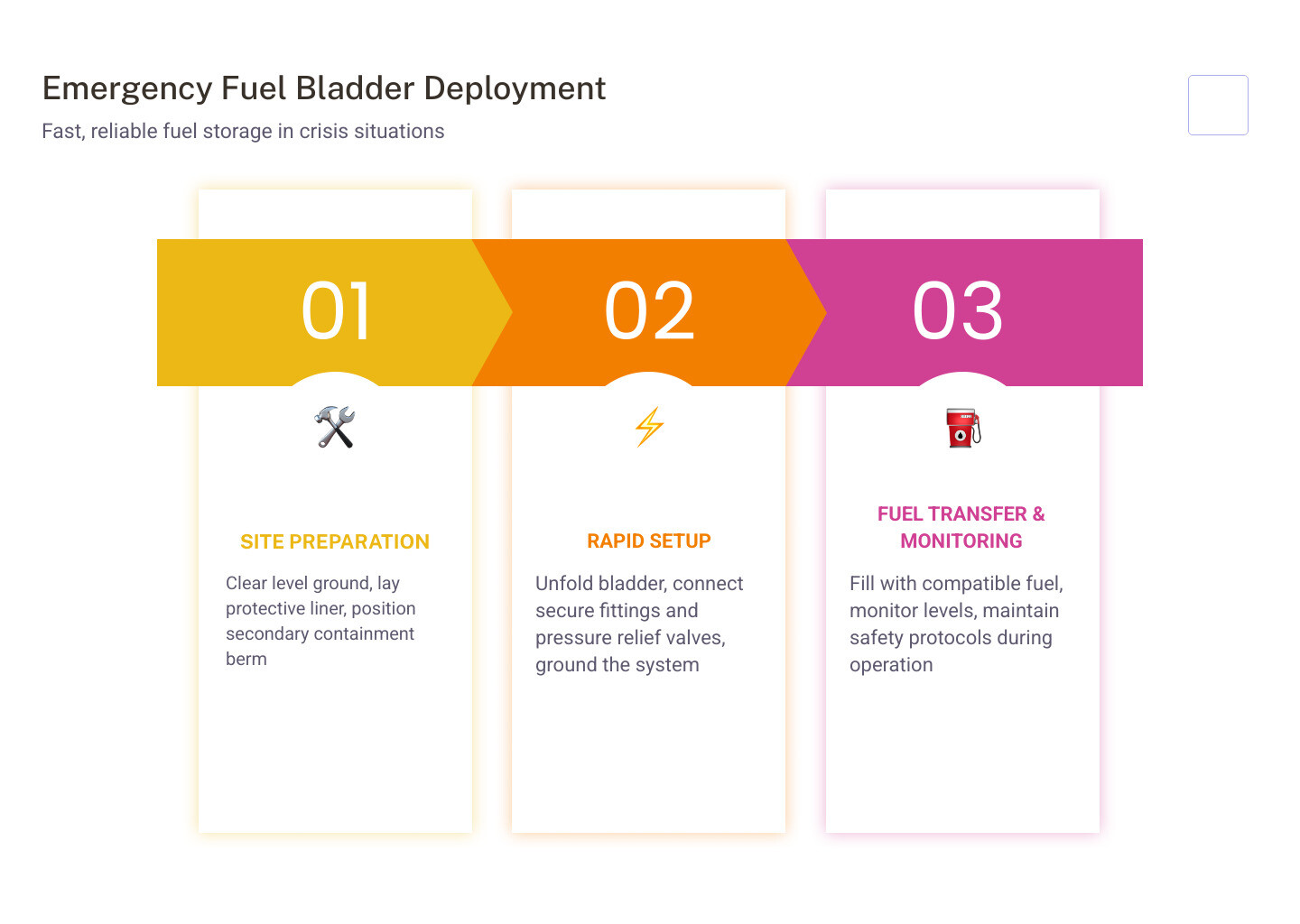
Step 1: Site Preparation
The deployment area must be as level as possible. Clear the ground of all sharp objects, including rocks, branches, glass, and metal debris. If deploying on rough or uneven terrain, lay down a heavy-duty ground cloth or protective felt liner first.
Step 2: Unfolding and Positioning
Carefully unroll and unfold the bladder within the designated secondary containment berm. Ensure there are no sharp twists or folds in the fabric. Position the bladder so that the inlet and outlet ports align logically with your fuel transfer pumps and vehicle access paths.
Step 3: Connection and Grounding
Secure all hose connections using high-quality camlock fittings. Attach grounding clamps to the bladder’s dedicated grounding points and drive a grounding rod into the earth to dissipate static electricity. Ensure all air release vents are clear and functional.
Step 4: Filling Operations
Begin filling slowly while monitoring the bladder’s expansion. Ensure the fabric settles evenly without stretching or pulling on the connection flanges. Do not exceed the manufacturer’s rated volume capacity.
Step 5: Transferring and Monitoring
When retrieving fuel, use a compatible pump system designed for volatile hydrocarbons. Monitor the bladder as it collapses to prevent suction locks. For a step-by-step breakdown of safe fuel extraction, see How to Transfer Fuel from a Fuel Bladder.
Step 6: Post-Incident Recovery and Storage
Once the emergency operation is complete, empty the bladder completely. Flush the internal chamber if switching fuel types or preparing for long-term storage. Allow the bladder to dry thoroughly to prevent mold, fold it carefully according to the manufacturer’s guidelines, and store it in a cool, dry, rodent-proof container.
Frequently Asked Questions About Emergency Fuel Bladders
What is the lifespan of a high-quality fuel bladder in the field?
A premium fuel bladder constructed from military-grade TPU typically has a field service life of 8 to 12 years when properly maintained. Lifespan is influenced by UV exposure, physical abrasion during deployment, and adherence to proper storage protocols between uses. PVC-based alternatives generally last only 3 to 5 years.
Are flexible fuel bladders compatible with both gasoline and diesel?
Yes, but compatibility depends on the specific material formulation. High-grade TPU bladders are fully compatible with diesel, biodiesel, jet fuels, and non-aromatic gasoline. However, because gasoline has a higher volatility and aromatic content, operators should verify with the manufacturer that the bladder is specifically rated for gasoline storage. For specialized gasoline storage options, explore Techno Tanks Gasoline Fuel Bladders.
How do secondary containment systems integrate with collapsible tanks?
Secondary containment berms are designed to act as a physical barrier surrounding the collapsible bladder. In the event of a puncture or valve leak, the berm catches the escaping fuel, preventing it from reaching the soil or local waterways. This integration is essential for meeting EPA SPCC regulations when storing fuel volumes exceeding 1,320 gallons.
Conclusion
In emergency response, preparation and rapid action save lives. Flexible fuel bladders provide the ultimate combination of portability, durability, and rapid deployment, making them indispensable tools for disaster relief, remote operations, and critical backup power.
Techno Tanks manufactures high-performance, flexible fuel bladders and collapsible storage systems engineered to meet the demanding requirements of mission-driven operators and emergency services. With capacities ranging from 30 to 3,000 gallons, flexible TPU construction, and custom sizing options, these systems deliver reliable auxiliary fuel capacity exactly when and where it is needed most.
To ensure your organization is prepared for the next crisis, evaluate your operational footprint and select a system designed for rapid deployment.
Ready to secure your backup fuel capabilities? Contact Techno Tanks Today for a Custom Quote or explore our complete lineup of Techno Tanks Collapsible Fuel Tanks to find the perfect fit for your operational readiness plan.

