
Why Choosing the Right Flexible Marine Pump System Matters for Fuel Transfer
Flexible marine pump systems are the critical link between auxiliary fuel storage and your vessel’s engine — and choosing the wrong one can compromise your range, your safety, and your operation.
Quick answer: A flexible marine pump system is a self-priming pump designed to transfer, circulate, or manage fluids onboard a vessel. For auxiliary fuel transfer, the most relevant types are:
| Pump Type | Best For | Self-Priming | Handles Solids |
|---|---|---|---|
| Flexible impeller | Fuel transfer, bilge, cooling | Yes (up to 10 ft dry) | Yes |
| Diaphragm | Bilge, washdown, dirty water | Yes | Yes |
| Centrifugal | High-volume circulation | No | Limited |
| Gear | Oil, high-viscosity fluids | Yes | No |
For most auxiliary fuel transfer applications — especially when paired with a marine fuel bladder — flexible impeller pumps are the go-to choice. They self-prime, handle varying viscosities, and work reliably in the demanding conditions offshore operators face.
But the pump is only half the equation.
Operators extending vessel range or managing backup fuel capacity need a system that works: the right pump matched to the right flexible fuel storage, correctly sized for their engine load and duty cycle. A poorly designed pump system — not the pump itself — is cited as the primary cause of most marine pump failures.
This guide is written for marine operators, commercial crews, and serious buyers evaluating flexible marine pump systems for fuel transfer and auxiliary capacity. It covers pump types, technical selection criteria, installation best practices, and how to pair the right pump with a collapsible fuel bladder for reliable offshore operations.
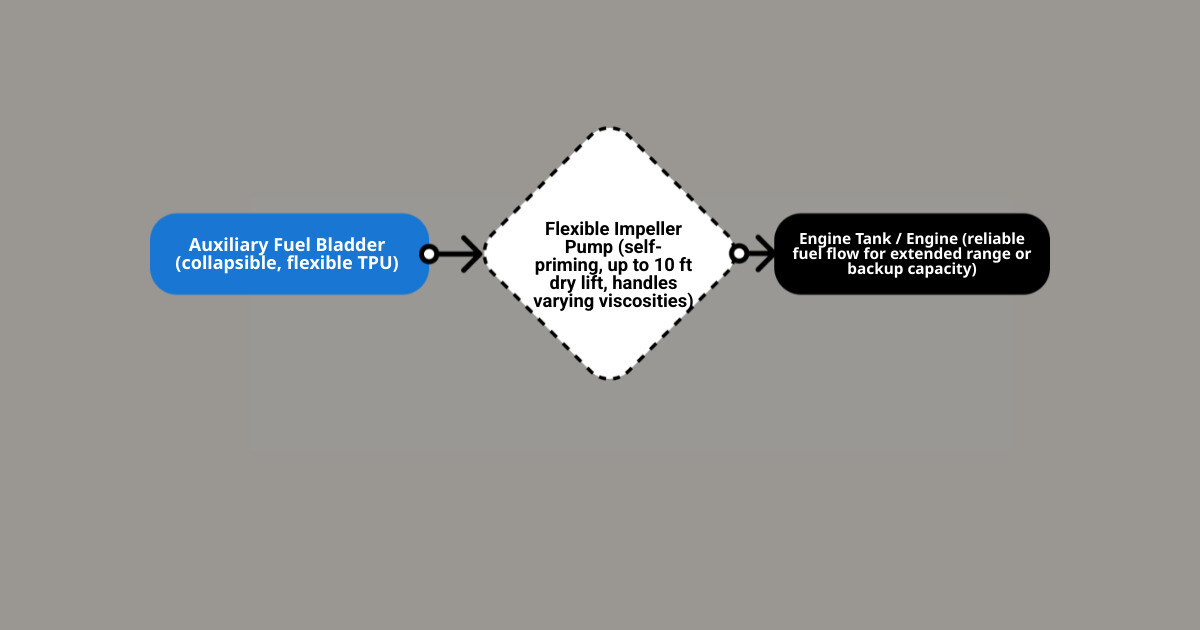
Handy flexible marine pump systems terms:
Understanding Flexible Marine Pump Systems for Auxiliary Fuel Transfer
To design an efficient auxiliary fuel system, an operator must first understand the fluid dynamics and physical mechanics of flexible marine pump systems. These systems are distinct because they do not rely on rigid metal-on-metal tolerances to build pressure. Instead, they utilize elastomeric materials that adapt dynamically to the pump housing.
In auxiliary fuel transfer, the pump must pull fuel from a temporary deck-mounted bladder or a deep internal tank and deliver it to the vessel’s primary day tanks. This process requires a pump that can handle air pockets, self-prime without manual intervention, and maintain a consistent flow rate regardless of vessel motion or changes in fuel head pressure.
Key Types of Flexible Marine Pump Systems and Their Mechanics
The term “flexible marine pump” most commonly refers to flexible impeller pumps (FIPs). The mechanics of a flexible impeller pump are elegantly simple but highly effective. The pump consists of a circular housing containing an offset cam and a flexible elastomeric impeller with multiple flat blades.
As the impeller rotates within the eccentric housing, the blades compress and bend against the offset cam. This compression squeezes the air or fluid out of the chambers, creating a partial vacuum at the inlet port. This vacuum allows the pump to self-prime with dry suction and lift fluids up to 10 feet (3 meters), or up to 25 feet (8 meters) once the impeller is wetted.
As the blades rotate past the cam, they unfold, expanding the pocket volume and drawing liquid into the pump. The liquid is then carried between the blades to the discharge port, where the blades compress again, forcing the liquid out of the pump in a smooth, continuous, and virtually pulsation-free flow. For those evaluating high-capacity or AC-powered variants, Flexible Impeller Pumps – AC | SPX FLOW provides a deeper look into industrial-grade AC units designed for heavy marine duty.
Beyond flexible impellers, other flexible or adaptable pump systems exist in marine engineering, such as the patented cartridge-based three-spindle screw pumps. For example, the Flexcore – Fluid pumps – Leistritz – Pump technology utilizes an adaptable casing that can be rotated 4 x 90 degrees to allow up to 20 different flow directions. This physical flexibility is highly valued in tight engine rooms where piping geometry is fixed.
The Role of Flexible Impeller Pumps in Marine Fuel and Water Management
In a marine environment, flexible impeller pumps are highly versatile utility players. Their ability to handle both thin and highly viscous liquids, combined with their tolerance for small suspended solids, makes them ideal for several critical onboard applications:
- Engine Cooling: Raw water pumps draw seawater through hull inlets to cool heat exchangers. Because these pumps are self-priming, they can quickly re-establish water flow even if the vessel pitches and the intake briefly gulps air.
- Bilge Pumping: Bilge water is rarely clean; it often contains hair, scale, and oil. The flexible blades of an FIP bend to pass small solids that would instantly jam a gear pump or ruin a centrifugal pump.
- Deck Washdown: High-pressure washdown systems benefit from the steady, continuous pressure generated by FIPs.
- Fuel Transfer: When equipped with the correct elastomeric compound, FIPs are exceptionally reliable for transferring diesel, light fuel oils, and gasoline between collapsible fuel tanks and primary fuel systems.
Choosing the correct impeller material is the single most important factor when dedicating an FIP to fuel transfer. Standard Neoprene impellers will quickly swell, degrade, and tear when exposed to hydrocarbons. For fuel transfer, operators must specify Nitrile impellers, which provide excellent chemical resistance to petroleum products.
Comparing Flexible Impeller Pumps to Other Marine Pump Technologies
No single pump design is perfect for every marine application. To make an informed decision, operators must compare the mechanical behaviors of flexible impeller pumps against other common marine pump types.

Flexible Impeller Pumps vs. Centrifugal, Diaphragm, and Gear Pumps
- Centrifugal Pumps: These are the industry standard for high-flow, low-pressure water movement, such as continuous seawater circulation or automated bilge pumping. However, centrifugal pumps are not self-priming. They must be installed below the waterline or utilize a manual priming mechanism. If they gulp air, they lose prime and stop pumping. Furthermore, if the discharge line is restricted, a centrifugal pump will simply decrease its flow until it stops, whereas a positive displacement pump will continue trying to force fluid through, potentially causing system damage if not fitted with a pressure relief valve.
- Diaphragm Pumps: Operating via a reciprocating membrane, diaphragm pumps are highly valued for bilge and greywater management because they can run dry indefinitely without damage and draw very little electrical current. They are also highly self-priming (typically up to 10 feet of head). However, their flow is highly pulsating, and they deliver lower overall flow rates compared to a similarly sized flexible impeller pump.
- Gear Pumps: These pumps use interlocking rigid gears to move fluids. Because of their tight metal-on-metal operating tolerances, they are excellent for generating high pressures and transferring highly viscous fluids like engine lubrication oil. However, they require highly clean fluids; any hard debris or abrasive particles in the fluid will quickly score the gears and ruin the pump. They also lack the ability to handle air pockets or run dry for more than a few seconds.
- Flexible Impeller Pumps: FIPs bridge the gap. They combine the self-priming power of a positive displacement pump with the steady, continuous flow of a centrifugal pump. They can handle small solids, work across a temperature range of 45°F to 180°F (7°C to 80°C), and are highly compact. For a comprehensive look at how these systems compare and whether an alternative might suit a specific hull design, see Is there an alternative to flexible impeller pumps? .
Heavy-Duty vs. Extra Heavy-Duty Flexible Marine Pump Systems
For demanding commercial operations, standard utility pumps are rarely sufficient. Manufacturers of premium marine equipment segment their lines into heavy-duty and extra heavy-duty configurations:
- Heavy-Duty Pumps: These typically feature robust bronze pump bodies, stainless steel shafts, and high-grade internal seals. They are designed for continuous duty in raw water cooling, high-volume bilge pumping, and routine fuel transfer.
- Extra Heavy-Duty Pumps: These systems are engineered for extreme environments or critical safety systems, such as emergency onboard firefighting or continuous septic handling on commercial vessels. They often feature separate, grease-lubricated bearing housings rather than relying on the pumped fluid or simple bushings for shaft support. This design isolates the pump bearings from the fluid chamber, preventing bearing failure if the shaft seal eventually leaks. Extra heavy-duty models also frequently incorporate mechanical seals instead of lip seals and can be configured with electro-magnetic clutches or vacuum switches for automated control. More details on choosing between these commercial-grade tiers can be found at Flexible Impeller Pumps | Reliable Marine Solutions by … .
Technical Selection and Installation Best Practices for Marine Fuel Systems
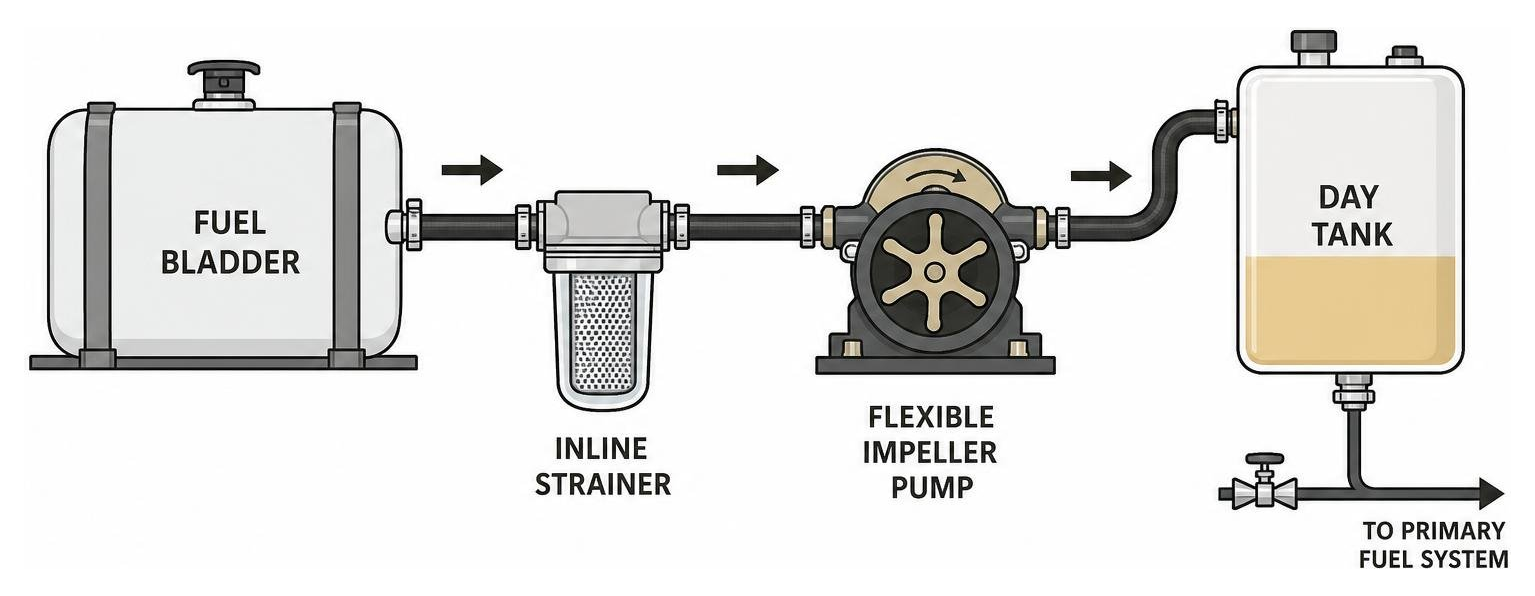
Integrating a flexible marine pump system with a fuel transfer bladder requires careful engineering to ensure safety, prevent leaks, and maintain the integrity of both the pump and the storage bladder.
Flow Capacity and Sizing Calculations for Marine Engines
When sizing an auxiliary pump or a raw water cooling pump, operators must match the pump’s flow capacity to the specific engine load and cooling requirements. Sizing too small leads to starvation and overheating; sizing too large can cause pipe erosion in heat exchangers and excessive system pressure.
According to industry engineering standards outlined in Flexible Impeller Pumps Used in Marine Engine Cooling … , the required flow capacities for diesel propulsion engines vary by cooling configuration:
- Heat Exchanger Cooling (Raw Water): The pump capacity should be approximately 15 to 18 gallons per minute (57 to 68 liters per minute) for every 100 horsepower at maximum engine load and RPM.
- Keel Cooling (Freshwater Circulation): Flow capacity should be approximately 30 to 36 GPM (113 to 136 LPM) for every 100 HP at maximum load and RPM.
- Direct Cooling (Raw Water): Flow capacity should be approximately 10 GPM (38 LPM) per 100 HP at full load and speed.
- Gasoline Engines: Gasoline engines run hotter and require a flow capacity increase of approximately 10% at maximum RPM compared to diesel engines.
- Water-Cooled Exhausts: If the exhaust manifolds are water-cooled, the pump capacity must be increased by an additional 10% to 15%.
For auxiliary fuel transfer, the flow rate does not need to match engine consumption directly, as the pump is typically used to bulk-transfer fuel to a day tank. A flow rate of 8 to 13.5 GPM is standard for portable or deck-mounted 12V DC systems, allowing a 200-gallon auxiliary bladder to be transferred in 15 to 25 minutes.
Preventing Dry Running and Ensuring System Safety
The Achilles’ heel of any flexible impeller pump is dry running. Because the elastomeric impeller blades rub against the pump housing, they rely on the pumped fluid to act as a lubricant and coolant. If run dry, friction will rapidly heat the impeller, causing the blades to melt, tear, or delaminate within minutes.
To prevent dry-running damage, operators should implement the following safety features:
- Vacuum Switches: A vacuum switch installed on the inlet side of the pump can detect when the fuel bladder is empty. When the fluid runs out, the vacuum drops, and the switch automatically cuts power to the pump motor or disengages an electro-magnetic clutch.
- Thermal Protection: DC-powered fuel pumps should feature internal thermal overload protection. If the pump heats up due to a blockage or extended run time, the thermal switch automatically shuts down the motor before the fuel reaches its flashpoint or the motor coils burn out.
- Static Ground Wires: When transferring highly flammable fuels like gasoline, E15, or even diesel, static electricity is a major hazard. The transfer system must utilize fuel-rated hoses with integrated static ground wires, and the pump housing must be securely bonded to the vessel’s common grounding system.
- Fuel Compatibility: Ensure the pump seals, housing, and impeller are fully compatible with modern fuels, including biodiesel blends up to B20 and ethanol-blended gasolines.
Installation Best Practices for Marine Fuel Bladders and Auxiliary Pumps
To ensure reliable fuel transfer and maximize the lifespan of your collapsible fuel tanks, adhere to the following installation best practices:
- Suction Pipe Sizing: The bore of the suction hose must never be smaller than the pump’s inlet port. If the total suction run exceeds 10 feet (3 meters), increase the hose diameter by one standard size to minimize flow restriction.
- Avoid Tight Elbows: Use long sweep bends instead of standard 90-degree elbows in the suction piping. Tight elbows introduce turbulence and increase the risk of pump cavitation.
- Install Inline Strainers: Always place a high-quality, coarse strainer on the suction line before the pump. This prevents debris, tank scale, or sediment from entering the pump and tearing the flexible impeller.
- Secure the Pump: Mount the pump securely to a rigid structure. If the pump is belt-driven and the engine is on flexible mounts, mount the pump directly to the engine to prevent belt tension fluctuations. A correctly tensioned belt should deflect 1/2 to 3/4 of an inch (13 to 19 mm) under finger pressure.
- Pair with High-Quality Bladders: For offshore range extension, pair your pump with a commercial-grade, flexible TPU fuel bladder. Techno Tanks manufactures custom, space-saving fuel bladders featuring multi-layered TPU construction, internal baffles to prevent fuel sloshing, and high-strength taped seams.
For step-by-step operational instructions, consult our guide on How to Transfer Fuel from a Fuel Bladder.
Frequently Asked Questions About Marine Auxiliary Pumps
How do flexible impeller pumps prevent dry running?
On their own, standard flexible impeller pumps cannot prevent dry running; they require external protection. The most effective method is integrating a vacuum switch on the suction line. When the pump draws in the last of the fuel from a collapsible fuel tank, the vacuum pressure drops. The switch senses this change and immediately cuts power to the pump or disengages the electro-magnetic clutch. Additionally, high-quality DC-powered auxiliary pumps feature built-in thermal overload switches that automatically shut down the motor if friction heat rises to dangerous levels.
What maintenance is required for marine flexible impeller pumps?
Routine maintenance is straightforward but critical:
- Impeller Inspection: Inspect the impeller every 50 to 100 operating hours or at least once a season. Look for cracking at the base of the blades, curved set (where blades do not spring back straight), or pitting on the blade tips.
- Replacement Intervals: Replace the impeller annually or immediately if any wear is detected. Always use genuine OEM replacement kits to maintain the exact tolerances required for self-priming.
- Use the Right Tools: Use a specialized impeller removal tool to pull the impeller straight out of the housing. Prying it out with screwdrivers can scratch the bronze housing or bend the shaft, leading to premature seal failure.
- Lubrication: When installing a new impeller, coat the blades and the inside of the pump housing with a manufacturer-approved lubricant (such as glycerin) to protect the blades during the initial dry-prime phase. Never use petroleum-based grease on Neoprene impellers, as it will degrade the rubber.
Can flexible impeller pumps be used for both diesel and gasoline transfer?
Yes, but only if the pump is specifically rated for fuel transfer and equipped with a Nitrile (NBR) rubber impeller. Nitrile provides the necessary chemical resistance to withstand hydrocarbons without swelling or dissolving.
Furthermore, transferring gasoline requires strict safety protocols. The pump motor must be ignition-protected and explosion-proof (such as ATEX or UL listed for fuel transfer), and the entire system must be grounded with static wire hoses to eliminate the risk of static sparks. For diesel transfer, the safety requirements are less stringent due to diesel’s higher flashpoint, but using fuel-rated components remains mandatory.
Conclusion: Optimizing Your Vessel’s Range and Fuel Transfer Infrastructure
A high-performance flexible marine pump system is only as good as the storage tank it draws from. For commercial operators, offshore cruisers, and military vessels, relying on rigid metal or plastic tanks often means sacrificing valuable deck space or carrying unnecessary permanent weight.
Techno Tanks solves this challenge by manufacturing heavy-duty, collapsible marine fuel bladders designed to integrate seamlessly with your auxiliary transfer pumps. Constructed from advanced, multi-layer thermoplastic polyurethane (TPU), our bladders offer:
- Space-Saving Efficiency: Lay the bladder flat on deck, fill it to extend your range, and roll it up compactly once empty.
- Custom Sizing: Available in capacities from 30 to 3,000 gallons, custom-tailored to fit your vessel’s exact deck layout or compartment dimensions.
- Extreme Durability: Built with mil-spec coated fabrics (up to 50 mils thickness and 40 oz/sq yd weight) and reinforced taped seams to withstand rough offshore conditions.
- Fuel Compatibility: Fully compatible with both diesel and gasoline, ensuring safe, leak-free storage over a long operational lifespan.
Because every vessel’s fuel storage, transfer, and dimensional requirements are unique, Techno Tanks pricing depends on size, fuel type, configuration, and custom project scope.
Ready to optimize your vessel’s range and build a reliable, high-capacity auxiliary fuel system? Explore our range of Fuel Transfer Bladders and contact Techno Tanks today to request a custom quote tailored to your specific marine operations.

