
What Are Collapsible Marine Fuel Systems — and Do You Need One?
Collapsible marine fuel systems are flexible, bladder-based tanks designed to store and carry additional gasoline or diesel aboard a vessel — without the permanent footprint of a rigid built-in tank.
Here’s the quick answer for operators evaluating their options:
What they are: Flexible fuel bladders made from fuel-resistant materials (typically TPU-coated polyester or polyether fabric) that collapse flat when empty and expand to full capacity when filled.
Key advantages at a glance:
| Feature | Collapsible Fuel Bladder |
|---|---|
| Space when empty | Folds nearly flat — reclaims deck or storage space |
| Weight (empty) | Fraction of rigid metal or polyethylene tanks |
| Installation | No permanent modifications required |
| Capacity range | 30 to 5,000+ gallons |
| Fuel types | Gasoline or diesel (material-specific) |
| Custom sizing | Available for specialized vessel layouts |
| Deployment | Above-deck, rapid setup |
Who uses them:
- Offshore yacht and expedition operators extending cruising range
- Commercial marine crews needing backup or auxiliary fuel capacity
- Emergency response and tactical logistics teams requiring rapid fuel deployment
- Vessel operators who need flexible, removable fuel storage without structural modification
For boat owners and operators, the question isn’t usually whether a permanent tank works — it’s whether it’s enough. Extended offshore passages, remote destinations, and multi-day operations all demand more fuel capacity than most vessels are built with. A collapsible fuel bladder solves this without retrofitting your hull or sacrificing permanent storage.
Techno Tanks marine fuel bladders are available in sizes from 30 to 250 gallons as standard units, with custom configurations available for larger or specialized requirements. Pricing depends on capacity, fuel type, and configuration — request a quote based on your specific vessel and use case.
This guide covers everything operators need to know: materials, sizing, installation, securing, fuel transfer, maintenance, and regulatory compliance.
Understanding Collapsible Marine Fuel Systems: Bladders vs. Rigid Tanks
When expanding a vessel’s operational range, marine architects and operators traditionally faced a difficult choice: install larger, permanent rigid tanks or carry rigid portable drums. Rigid tanks—constructed from aluminum, polyethylene, or stainless steel—provide durable, long-term storage but introduce permanent weight and consume valuable hull space regardless of whether they are full or empty.
This is where collapsible marine fuel systems offer a distinct operational advantage.
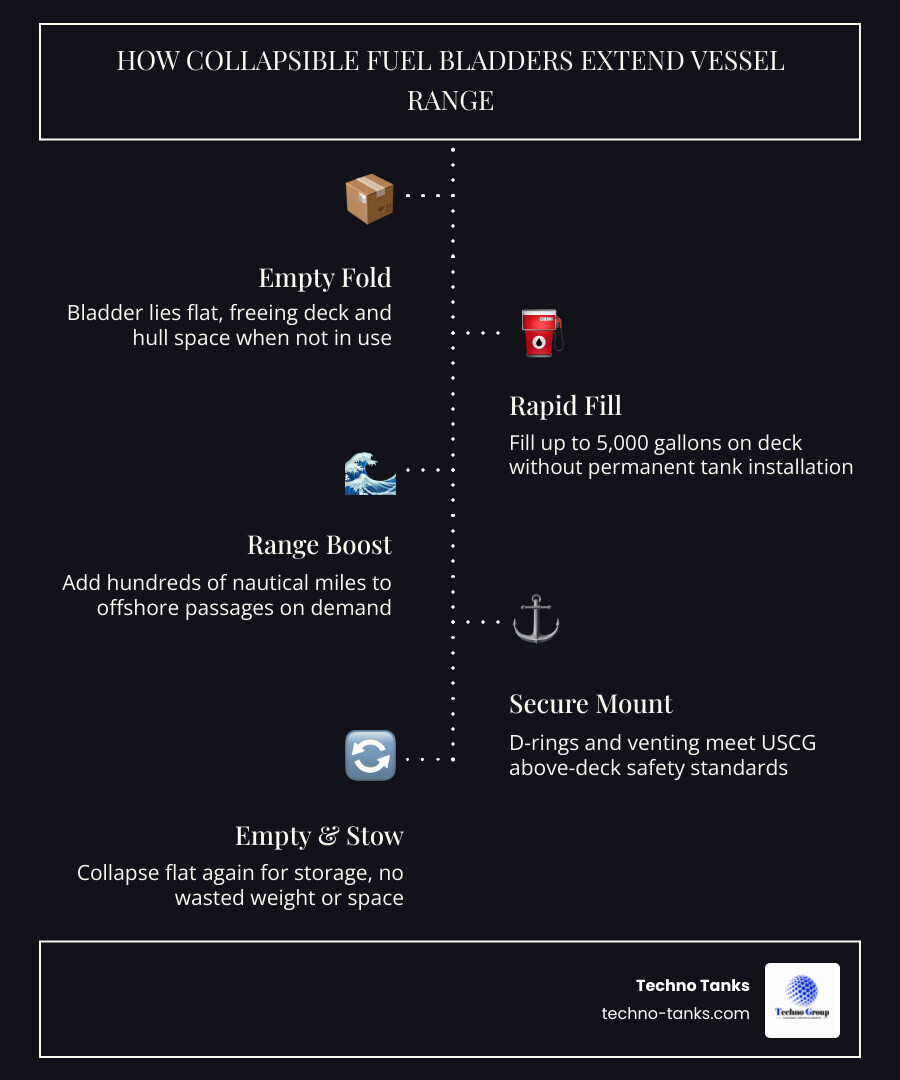
Unlike rigid tanks, flexible fuel bladders adapt to their contents. As fuel is consumed, the bladder collapses, eliminating empty internal volume. This dynamic collapse prevents the formation of highly flammable fuel vapor pockets inside the tank, enhancing onboard safety. Furthermore, once empty, a collapsible bladder can be rolled or folded flat, reclaiming up to 90% of the deck or storage space it occupied when full.
Weight reduction is another critical factor. Rigid metal tanks are heavy, adding to the vessel’s dry weight and impacting fuel efficiency even when running light. In contrast, flexible TPU bladders are highly efficient. For example, a standard 30-gallon Techno Tanks bladder weighs only 17.5 lbs empty, and a larger 150-gallon bladder weighs just 34 lbs empty. This lightweight design allows crews to carry significant auxiliary fuel without carrying unnecessary deadweight on the return leg of a voyage.
| Feature | Permanent Rigid Tanks | Portable Rigid Drums/Caddies | Collapsible Fuel Bladders |
|---|---|---|---|
| Space Efficiency | Permanent footprint; consumes hull space. | Bulky; remains the same size when empty. | Collapses flat; reclaims deck space when empty. |
| Weight Impact | Heavy metal or thick plastic construction. | Moderate weight; difficult to handle when full. | Extremely lightweight (approx. 10% of metal tanks). |
| Vapor Elimination | Air enters as fuel is used, creating vapors. | Air enters; requires constant venting. | Collapses as fuel is drawn; minimizes vapor space. |
| Installation | Requires structural changes and professional installation. | No installation, but difficult to secure safely. | Fast deck-mounting with integrated tie-down points. |
| Corrosion Risk | High risk of rust (metal) or condensation buildup. | Low corrosion, but susceptible to UV cracking. | Highly resistant to saltwater, UV, and corrosion. |
For a deeper dive into the common misconceptions surrounding flexible tanks, read Bladder Tanks for Boats: 6 Common Myths About Their Drawbacks, or consult An Operator’s Guide to Fuel Bladders for Boats to understand how they integrate into standard vessel configurations.
Engineering and Material Science of Marine Fuel Bladders
To survive the punishing environments of offshore commercial use and recreational sportfishing, collapsible marine fuel bladders must be engineered to military-grade standards. The primary material used in modern high-performance bladders is Thermoplastic Polyurethane (TPU) coated onto high-tenacity woven fabrics.
However, not all TPU is created equal. Material selection must be strictly matched to the chemical composition of the fuel to prevent degradation, structural failure, or fuel contamination:
- Polyester TPU: This formulation is highly resistant to hydrocarbons and is the industry standard for diesel fuel bladders. It resists the chemical action of diesel, bio-diesel, and associated lubricants, ensuring the bladder fabric remains supple and leak-proof over years of service.
- Polyether TPU: Engineered specifically for gasoline fuel bladders, polyether TPU is formulated to resist the highly aggressive chemical solvents found in modern gasoline blends, including ethanol and methanol.
Using the wrong material—such as storing gasoline in a polyester TPU bladder—will cause the inner chemical barrier to dissolve, leading to catastrophic structural failure.
To withstand the dynamic forces of sloshing fuel in heavy seas, manufacturers utilize high-frequency (RF) welding rather than traditional adhesives. This process bonds the TPU-coated fabrics at the molecular level, creating seamless joins that are actually stronger than the base fabric itself. Advanced manufacturers implement double-layer welding protection, applying a secondary reinforcement strip over the primary weld seam. This double-layer seam absorbs the intense kinetic energy generated by fuel movement, providing near-perfect leak prevention under dynamic surge conditions.
Additionally, the exterior of the bladder must resist environmental degradation. High-quality bladders feature heavy-duty UV inhibitors and hydrolysis stabilizers to prevent the fabric from cracking or weakening under intense solar exposure and salt-fog conditions. Many bladders are finished in a white matte coating, which actively reduces heat absorption, limits gas expansion, and keeps fuel temperatures stable.
For more technical details on how these materials hold up over time, read The Ultimate Guide to Marine Bladder Tanks and Storage.
Types, Sizes, and Configurations of Flexible Fuel Storage
Selecting the right collapsible marine fuel system requires matching the vessel’s physical deck layout with the correct bladder configuration.

Pillow-Style vs. Space-Saver Collapsible Marine Fuel Systems
Standard flexible fuel bladders generally fall into two design categories:
- Pillow-Style Bladders: These low-profile tanks expand outward and upward, resembling a large pillow when full. Because of their wide, flat footprint, pillow-style bladders distribute fuel weight evenly across a large surface area. This low center of gravity makes them exceptionally stable on the open deck of sportfishers and commercial workboats. However, they require a larger flat deck area.
- Space-Saver Bladders: Designed for vessels with limited deck space, space-saver bladders utilize a more vertical, box-like profile. They provide a compact footprint, allowing them to fit into narrow walkways, swim platforms, or bow areas where a wide pillow bladder would block crew access.
For operators with smaller vessels or tight deck layouts, managing space is everything. Learn more about maximizing your deck layout by reading Optimizing Deck Space with 30-Gallon Auxiliary Bladders.
Custom Engineering for Specialized Vessels
Standard off-the-shelf capacities typically range from 30 gallons (measuring approximately 33.5″ x 22″ x 12.5″ when filled) up to 250 gallons. However, many commercial, military, and long-range cruising vessels require custom configurations to maximize spatial efficiency and maintain strict vessel stability.
Custom marine fuel bladders can be designed to fit specific hull compartments, under-seat storage areas, or irregular deck spaces. For high-speed applications or rough-sea operations, custom bladders can be built with internal baffled designs. Baffles are flexible inner chambers that restrict the rapid movement of fuel, minimizing the dynamic surge (sloshing) that can otherwise destabilize a vessel during tight turns or heavy swells.
Whether you need a lightweight bladder for a small utility boat or a high-capacity system for an offshore commercial vessel, custom engineering ensures the bladder fits your exact requirements. Discover your options in Get a Grip on Your Range with Custom Boat Fuel Bladders and explore Flexible Fuel Bladders for Lightweight Marine Applications.
Operational Integration: Securing, Venting, and Fuel Transfer
A collapsible fuel bladder is only as safe as its installation. Because fuel is heavy—weighing roughly 6 to 7 lbs per gallon—a full 150-gallon bladder weighs over 1,000 lbs. If unsecured, this mass can shift violently in rough water, damaging the vessel and endangering the crew.
Securing and Venting Collapsible Marine Fuel Systems
To ensure safety and compliance with maritime standards, operators must adhere to strict installation protocols:
- Above-Deck Mounting: According to Coast Guard regulations, flexible fuel bladders must never be mounted below deck or inside the hull of a recreational vessel. They must be secured on an open, draining deck area. This ensures that any accidental spills during refueling vent safely into the atmosphere rather than accumulating dangerous fumes in the bilge. For detailed regulatory discussions on portable fuel storage, refer to the Regulations For Stowing Gasoline on Cruisers Forum.
- Tie-Down Points: High-quality bladders feature integrated stainless steel or heavy-duty polymer D-rings welded directly to the bladder’s perimeter. Operators must use high-strength, marine-grade ratcheting straps rated for the full weight of the wet load, securing the bladder to structural deck cleats or dedicated pad eyes.
- Safety Venting: Proper venting is critical to prevent pressure buildup caused by fuel expansion in warm weather. Marine fuel bladders should feature dedicated pressure-relief valves or manual vent caps to safely bleed off vapors. For more context on venting and fuel safety standards, see the EPA Certified Fuel Tank Guide by West Marine and A Boater’s Guide to Marine Portable Fuel Tanks on Clix Fueling.
Fuel Transfer Methods and Integration
Once the bladder is secured, operators must integrate it into the vessel’s primary fuel system. There are three main methods for transferring fuel from a bladder to the main tanks:
- Gravity Feed: If the bladder is secured on an elevated deck or bow section, gravity can do the work. By connecting the bladder’s discharge valve directly to the vessel’s main fuel deck fill, fuel flows naturally downward without the need for electrical power.
- Siphon Flow: Using a simple manual siphon pump, operators can easily prime a siphon line to transfer fuel dockside or while underway in calm conditions.
- Transfer Pumps: For faster, more controlled transfers, operators utilize dedicated fuel transfer pumps. While diesel can be moved using standard 12V or 24V marine pumps, transferring gasoline requires explosion-proof, ignition-protected pumps to prevent spark ignition.
For high-speed dockside or onboard transfers, many crews complement their bladders with portable fuel caddies and rotary hand pumps. For example, a FLO-FAST rotary hand pump can move up to 8 gallons per minute (GPM), allowing a full 15-gallon auxiliary container to be emptied in under two minutes. Battery-powered options, such as the Scepter Powered Fueling Station, achieve up to 4.5 GPM on battery power and 6 GPM via an AC adapter, while gravity-fed systems like the Scepter Flo ‘N Go DuraMax average around 2 GPM.
To learn the step-by-step procedures for safe, spill-free fuel routing, read How to Transfer Fuel from a Fuel Bladder.
Maintenance, Storage, and Lifespan Optimization
A high-quality marine fuel bladder is a significant investment. With proper care and maintenance, a premium TPU bladder can provide reliable service for many years. Neglect, however, can lead to premature wear, fuel contamination, or material degradation.
To maximize the lifespan of your collapsible fuel system, implement the following best practices:
- Never Transport Full Bladders by Hand: Fuel bladders are designed to be filled in situ (in the exact location where they will be used). A full bladder is extremely difficult to grasp, and even a small 30-gallon bladder weighs over 200 lbs. Attempting to carry a filled bladder can cause severe physical injury and puts unnecessary stress on the bladder’s seams.
- Complete Fuel Purging: When emptying the bladder, you can purge almost every drop of fuel by gently rolling the bladder fabric from the outer edges toward the discharge flange. This forces the remaining fuel into the pickup line.
- Cleaning and Rinsing: If the bladder is to be stored for an extended period, drain it completely. For diesel bladders, rinse the interior with clean fuel to remove sediment. For bladders used with ethanol-blend gasoline, ensure no fuel remains inside, as phase separation can cause water buildup over time. Wipe down the exterior with mild soap and fresh water to remove salt crust and grime.
- Dry Storage: Always allow the bladder to dry completely before folding. Store the empty, collapsed bladder in a cool, dry, and well-ventilated locker away from direct sunlight, sharp objects, or heavy equipment that could puncture the fabric.
By establishing a routine inspection and cleaning schedule, you can prevent structural issues and ensure your backup fuel remains free of contaminants. Read How to Extend Fuel Bladder Lifespan with 5 Easy Changes for practical maintenance tips.
Frequently Asked Questions about Collapsible Marine Fuel Systems
Can a single bladder hold both gasoline and diesel interchangeably?
No. Because of the strict chemical compatibility requirements of TPU materials, a single bladder cannot be used interchangeably for gasoline and diesel. Polyester TPU is specifically formulated for diesel, while polyether TPU is engineered for gasoline. Storing gasoline in a diesel-rated bladder will dissolve the inner liner, leading to leaks and fuel contamination. Always specify your intended fuel type when ordering.
Are fuel bladders permitted below deck by maritime regulations?
No. United States Coast Guard (USCG) and international maritime safety regulations strictly prohibit the mounting of flexible fuel bladders below deck or inside enclosed hull compartments on recreational vessels. Bladders must be secured above deck in a well-ventilated area. This ensures that any fuel vapors or minor spills during refueling can dissipate safely into the open air rather than collecting in the bilge, where they could pose a severe fire hazard.
How do you extract the remaining fuel from a collapsed bladder?
Because collapsible bladders do not have rigid walls, they naturally compress as fuel is drawn out. To extract the final few gallons, gently roll or fold the empty sections of the bladder from the outer edges toward the discharge valve. This concentrates the remaining liquid around the pickup fitting, allowing your transfer pump or gravity line to drain the tank completely.
Conclusion
Whether you are planning an ambitious offshore passage, managing commercial marine operations, or coordinating emergency response efforts, a collapsible marine fuel system provides a safe, flexible, and highly efficient way to extend your vessel’s range. By eliminating the permanent weight and space constraints of traditional rigid tanks, flexible bladders allow you to carry extra fuel only when you need it—and reclaim your deck space the moment the job is done.
At Techno Tanks, we manufacture high-performance, military-grade flexible fuel bladders designed to withstand the harshest marine environments. With standard sizes ranging from 30 to 250 gallons, and custom capacities up to 3,000 gallons, we can engineer a fuel storage solution tailored to your vessel’s exact specifications.
Ready to extend your cruising range? Explore Techno Tanks Marine Fuel Bladders and request a custom quote for your vessel today.

