
The Practical Buyer’s Guide to Collapsible Fuel Tanks for Marine Use
Collapsible fuel tanks for marine applications are the most practical solution for operators who need more range, backup capacity, or flexible fuel storage — without cutting into the hull or committing to a permanent rigid installation.
Here is a quick overview of what you need to know:
| Factor | Key Detail |
|---|---|
| What they are | Flexible TPU bladders that fold flat when empty, fill to capacity on deck |
| Common capacities | 30 to 3,000 gallons (custom sizing available) |
| Approved placement | Above deck only — Coast Guard regulations prohibit below-deck installation |
| Fuel compatibility | Diesel and gasoline (confirm rating before use) |
| Key safety rule | Always secure with D-rings and tie-down straps — full bladders can weigh up to 3,000 lbs |
| Pricing | Quote-based — depends on capacity, fuel type, and configuration |
Boat owners, commercial operators, and expedition crews use them for one core reason: they deliver serious auxiliary fuel capacity without the weight, cost, or permanence of a rigid tank system.
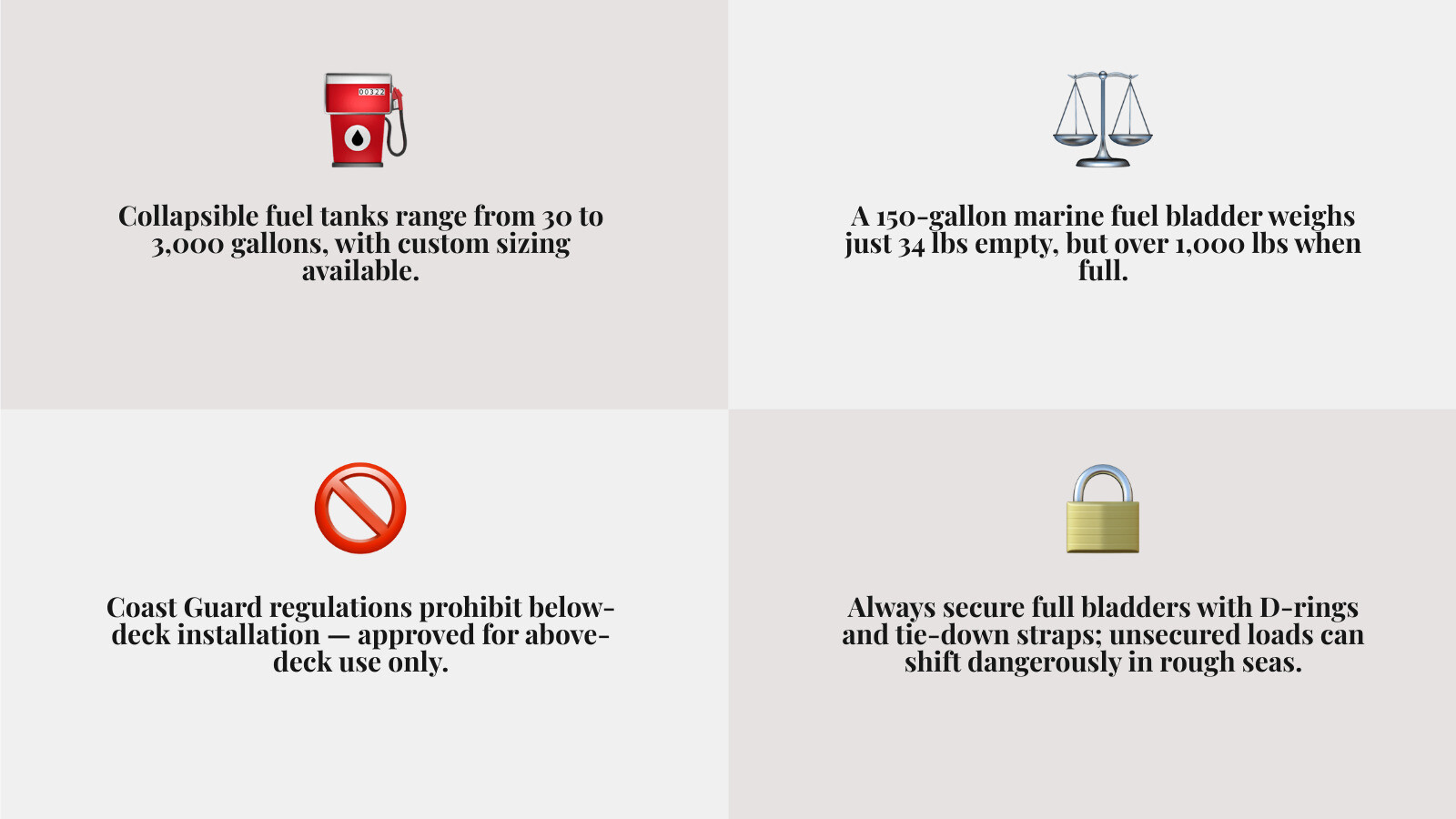
A 150-gallon marine fuel bladder weighs just 34 lbs empty and folds into a box roughly 25″ x 20″ x 10″. A 300-gallon version weighs 41.5 lbs empty. Once deployed and filled on deck, they become heavy, fixed fuel reserves — ready to extend your range far beyond what your built-in tanks allow.
The tradeoff is real, though. A full bladder is not something you move around casually. At 150 to 3,000 lbs depending on capacity, an unsecured bladder in rough seas is a serious hazard. Safe use depends on proper placement, correct securing, and understanding the regulatory limits.
This guide covers everything a serious buyer needs: sizing, materials, fuel compatibility, installation protocols, safety rules, and maintenance.
Storage capacity solves only one side of the problem; the transfer connection matters too. If the bladder will feed or transfer through a removable fuel line, compare the setup with the Techno Tanks Fuel Line Quick Connector and confirm the connection requirements for the specific valve, hose, and engine system.
Basic collapsible fuel tanks marine glossary:
Why Choose Collapsible Fuel Tanks Marine Over Rigid Systems?
For offshore vessels, auxiliary fuel capacity has traditionally meant adding heavy, permanent aluminum or plastic tanks. While rigid tanks offer long-term durability, they come with permanent weight penalties, structural modifications, and significant loss of usable onboard space.
Collapsible fuel tanks marine systems solve these issues by offering an “on-demand” fuel storage solution. When the extra range is needed, the bladder is rolled out and filled. Once the fuel is transferred into the main engines or primary tanks, the bladder is drained, rolled up, and stored in a small compartment, returning the deck space to the crew.
To understand the core differences between these two options, explore the detailed breakdown in the Fuel Bladder vs Fuel Tank comparison.
Key Benefits of Collapsible Fuel Tanks Marine
The primary advantages of using flexible fuel bladders for marine vessels include:
- Temporary Fuel Storage: You only carry the extra weight and occupy deck space when your voyage requires it. Once the fuel is consumed, the tank is packed away.
- Extreme Weight Savings: A 300-gallon rigid steel or aluminum tank can weigh hundreds of pounds empty. A 300-gallon TPU bladder weighs a mere 41.5 lbs empty.
- Deck Space Optimization: Permanent auxiliary tanks permanently crowd your deck or cockpit. A collapsible bladder shrinks to a fraction of its filled size once empty.
- Cost Efficiency: Avoid paying premium dockside fuel prices at remote marinas by carrying your own reserve supply.
To see why so many commercial and recreational operators are switching, read Shrink Your Storage: Why Collapsible Marine Tanks are a Game Changer.
Material Engineering and TPU Technology
Modern marine fuel bladders are not simple rubber bags. They are highly engineered systems manufactured using advanced Thermoplastic Polyurethane (TPU) featuring directional molecule technology. This material science delivers a unique balance of extreme flexibility, elasticity, and puncture resistance.
Furthermore, high-quality marine bladders are manufactured with an all-white matte finish. This is a critical design feature: the white surface reflects solar radiation, drastically reducing heat absorption. Minimizing fuel temperature on an open deck is essential to control gas expansion, prevent excessive vapor pressure, and preserve fuel quality.
Technical Specifications and Sizing Options
Selecting the right bladder requires matching your vessel’s deck layout with the physical footprint of the filled tank. Below is a comparison of two highly popular mid-range marine capacities:
| Specification | 150-Gallon Marine Bladder | 300-Gallon Marine Bladder |
|---|---|---|
| Capacity | 150 Gallons (568 Liters) | 300 Gallons (1,135 Liters) |
| Empty Weight | 34 lbs (15 kg) | 41.5 lbs (18.5 kg) |
| Filled Dimensions | 63″ x 44.5″ x 17.5″ | 68″ x 63″ x 19.5″ |
| Boxed / Folded Dimensions | 25.5″ x 20.5″ x 10″ | 25.5″ x 20.5″ x 10″ |
| Standard Fittings | Dual-Action Aluminum Flanges | Dual-Action Aluminum Flanges |
For a comprehensive breakdown of all available sizes, check out the official Techno Tanks dimensions resource.
Selecting the Right Capacity for Collapsible Fuel Tanks Marine
Vessel operators can choose standard capacities ranging from 30 to 3,000 gallons. When choosing a size, it is critical to plan your footprint carefully. A filled bladder expands outward and upward; you must ensure that its fully inflated footprint does not block essential walkways, access hatches, or emergency gear.
Before ordering, consult the fuel bladder sizing guide to match your boat’s deck dimensions with safe weight-bearing zones.
Heavy-Duty Commercial vs. Standard Marine Bladders
While recreational vessels typically utilize bladders in the 30 to 300-gallon range, commercial operators, offshore support vessels, and military operations require massive capacities.
For instance, military-grade tactical bladders can scale up to 20,000 gallons. To understand the scale of these systems, consider the specifications of a 20,000-gallon military collapsible fuel tank:
- Dry Shipping Weight: 805 lbs
- Operating Weight (Full): 135,325 lbs
- Shipping Dimensions: 164.0 x 31.0 x 27.0 inches
- Operating Dimensions: 360.0 x 360.0 x 71.0 inches (30 ft x 30 ft footprint)
- Connections: Dual 4-inch hose connections and a single vapor vent
These ultra-large systems require heavy machinery (such as forklifts and dedicated transport rigs) for deployment and are utilized in amphibious assault fuel systems (AAFS) and tactical airfield fuel dispensing systems (TAFDS). For commercial marine operators, Techno Tanks offers custom commercial-grade bladders up to 3,000 gallons constructed from high-tensile TPU to withstand the punishing motion of rough seas.
Safe Installation, Securing, and Fuel Transfer Protocols
Deploying a collapsible fuel tank marine system requires strict adherence to safety protocols. Because a filled bladder can weigh anywhere from 150 lbs to 3,000 lbs (or more), an unsecured tank can easily slide across a deck, crushing gear, damaging the vessel, or destabilizing the boat.
Step-by-Step Installation Protocol:
- Prepare the Deck: Thoroughly clean the deck area where the bladder will sit. Ensure there are no sharp edges, screws, or debris. Always place a protective heavy-duty liner or rubber mat underneath the bladder to prevent abrasion.
- Position the Empty Bladder: Lay the empty bladder flat in its final destination. Never attempt to fill a bladder elsewhere and carry it onto the boat. Once filled, it is impossible to move safely.
- Secure the Bladder: Prior to filling, lash the bladder securely using heavy-duty tie-down straps attached to the integrated top-mounted D-rings. Secure these straps to high-strength vessel cleat or deck eyes.
- Fill the Bladder: Fill the bladder slowly, monitoring the expansion. Ensure the straps remain taut as the bladder fills to its final shape.
For more detailed deployment tips, read Smooth Sailing: The Ultimate Guide to Collapsible Marine Fuel Systems.
Direct Engine Connection and Fittings
Can you connect a flexible fuel bladder directly to your boat’s engine? Yes.
Techno Tanks utilizes high-performance dual-action aluminum flanges that allow for secure, leak-free plumbing. By using appropriate marine-grade fuel hoses, valves, and quick-connect adapters, you can plumb the bladder directly into your fuel water separator or primary fuel lines.
To learn more about the exact hardware, fittings, and hose configurations needed for direct engine integration, refer to Fuel Bladder for Boats.
Fuel Compatibility and Liquid Types
Material compatibility is non-negotiable when dealing with volatile fuels. TPU bladders must be specifically rated for the liquid they will contain:
- Diesel Fuel Bladders: Diesel is highly stable, making it the most common fuel stored in marine bladders. You can safely transfer diesel using gravity, a manual siphon, or specialized 12V/24V explosion-proof electric transfer pumps.
- Gasoline Fuel Bladders: Gasoline is highly volatile and has strict static-dissipation and vapor requirements. Ensure your bladder is explicitly rated for gasoline before filling. Never use non-explosion-proof electric pumps to transfer gasoline.
For specialized diesel applications, visit the dedicated diesel-fuel-bladders resource.
Critical Safety and Regulatory Considerations
Safety is the single most important factor when carrying auxiliary fuel on the open ocean.
The U.S. Coast Guard (USCG) strictly prohibits the installation of flexible fuel bladders below deck (in-hull locations).
Bladders must be installed above deck in an open, well-ventilated area. This ensures that any fuel vapors can safely dissipate into the atmosphere rather than accumulating in an enclosed bilge, which presents a catastrophic explosion hazard. Additionally, above-deck placement allows for instant visual inspection and easy spill clean-up in the rare event of a leak.
For a deeper look into the legal and logistical safety standards, read Collapsible Marine Fuel Tanks for Extended Offshore Trips.
Vessel Stability and Weight Distribution
Adding 1,000 to 3,000 lbs of liquid weight to your deck will drastically alter your vessel’s center of gravity and handling characteristics.
- Positioning: Place the bladder as close to the vessel’s centerline and as low on the main deck as possible. Avoid placing large bladders on flybridges or high platforms, which can induce severe rolling.
- Liquid Sloshing: Unlike rigid tanks with internal baffles, flexible bladders collapse as they empty, minimizing the “free surface effect” (the sloshing of liquid that destabilizes a boat). However, keeping the bladder tightly strapped down is still required to prevent the entire mass from shifting in rough seas.
Maintenance, Purging, and Long-Term Storage
To maximize the lifespan of your TPU marine bladder, proper post-use care is essential.
How to Purge Every Drop of Fuel:
- Once gravity or pump transfer slows down, begin rolling the empty outer edges of the bladder inward.
- Roll the fabric tightly toward the dual-action discharge flange (similar to squeezing a tube of toothpaste).
- This forces the remaining fuel into the sump area, allowing you to evacuate almost 100% of the contents.
Cleaning, Degassing, and Storage Guidelines:
- Clean and Dry: Once completely drained, rinse the exterior with mild soap and fresh water to remove salt residue. Ensure the bladder is completely dry before folding.
- UV Protection: Although Techno Tanks integrates premium UV stabilizers into the TPU fabric, constant exposure to extreme sun, salt, and dampness will eventually degrade any material.
- Storage: Fold the dry bladder and store it inside a dedicated storage chest or a dry, well-ventilated locker away from direct sunlight and extreme temperature fluctuations.
For more details on keeping your temporary storage systems in top condition, see the temporary fuel storage guide.
Frequently Asked Questions about Marine Fuel Bladders
Can I mount a flexible fuel bladder below deck?
No. Coast Guard regulations and basic marine safety standards strictly prohibit below-deck or in-hull placement of flexible fuel bladders. They must be mounted above deck in open air to prevent the dangerous buildup of explosive fuel vapors in enclosed bilges.
Can I use the same bladder for both diesel and gasoline?
It is highly discouraged. While high-quality TPU is chemically compatible with both fuels, cross-contamination is a major risk. Even tiny amounts of diesel left in a bladder can damage a gasoline engine, and vice versa. Always use dedicated, clearly labeled bladders for each fuel type.
How do I secure a heavy fuel bladder in rough seas?
Use heavy-duty ratchet straps rated for the maximum filled weight of the bladder. Attach these straps to the integrated D-rings on top of the bladder and secure them to high-strength deck cleats or structural tie-down points on your vessel. Never rely on the bladder’s weight alone to keep it in place.
Conclusion
When planning extended offshore trips or managing commercial marine logistics, having reliable auxiliary fuel capacity is a game-changer. Collapsible fuel tanks marine systems from Techno Tanks provide the range extension and flexible storage you need, without the permanent weight, high cost, or deck-space sacrifice of rigid tanks.
Because every vessel, fuel type, and voyage is unique, Techno Tanks offers custom-tailored solutions ranging from 30 to 3,000 gallons. Fuel bladder pricing depends on your specific size, configuration, and application requirements.
To get an accurate quote for your next voyage, explore The Definitive Guide to Top Collapsible Marine Fuel Tank Suppliers or visit the official marine-fuel-bladders-2 page to request a custom quote today.

