
What Are Collapsible Fuel Tanks — and Are They Right for Your Operation?
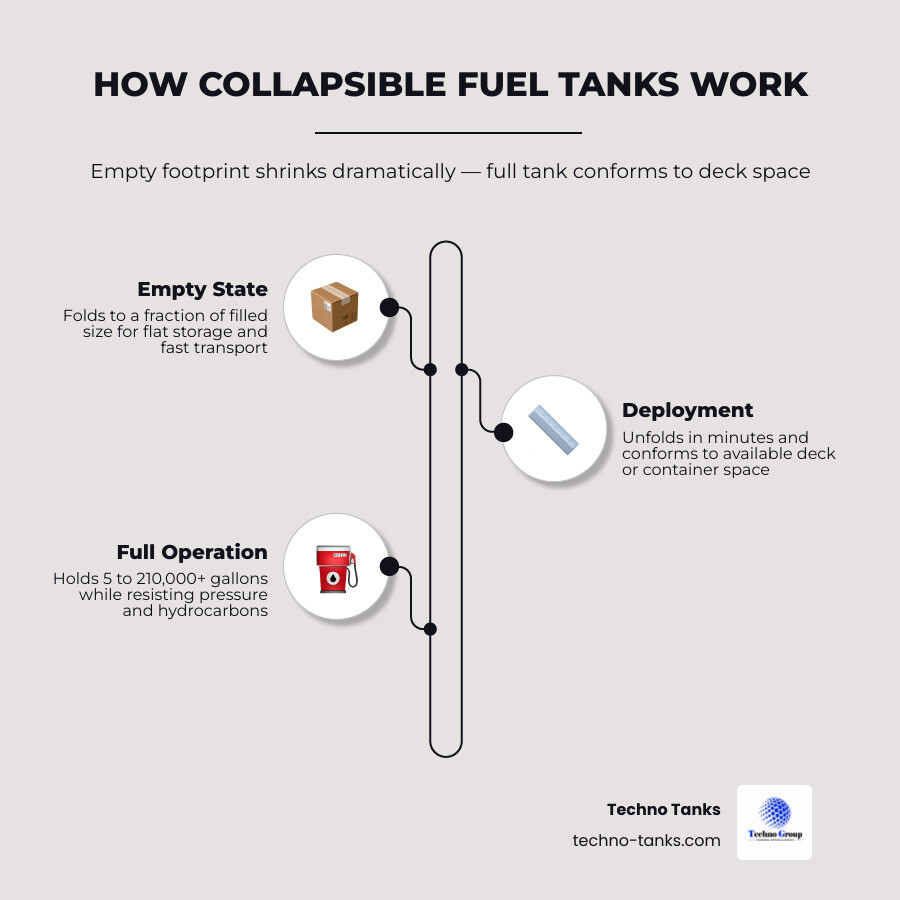
Collapsible fuel tanks are flexible, fabric-based containers engineered to safely store and transfer liquid fuels — including diesel, gasoline, and aviation fuels — without the fixed footprint of a permanent rigid tank. When empty, they fold down to a fraction of their filled size. When full, they conform to the available space and hold their shape under pressure.
Here’s a quick summary for buyers evaluating collapsible fuel tanks:
| Factor | What to Know |
|---|---|
| What they are | Flexible fabric bladders for fuel storage and transfer |
| Common materials | TPU (thermoplastic polyurethane), PVC, urethane-coated fabric |
| Capacity range | From ~5 gallons up to 210,000+ gallons |
| Key advantage | Store flat when empty; deploy fast when needed |
| Typical users | Marine operators, offshore crews, emergency response, military logistics |
| Primary fuels | Diesel, gasoline, jet fuel, blended hydrocarbons |
| Pricing | Request a quote — depends on size, fuel type, and configuration |
For marine operators, offshore crews, and expedition teams, the question isn’t usually whether to carry more fuel — it’s how. Permanent rigid tanks are expensive to install, fixed in size, and consume valuable space even when empty. A collapsible fuel tank solves all three problems.
The technology isn’t new. Flexible fuel bladders have been used across military, aviation, and industrial logistics for decades. What has changed is the material engineering and deployment flexibility — modern TPU-fabric bladders are lighter, more chemically resistant, and more pressure-tolerant than earlier generations.
This guide covers everything serious buyers need to know: how collapsible fuel tanks are built, what they’re made of, which applications they suit, how to size them correctly, and what safety and compliance requirements apply.
Understanding Collapsible Fuel Tanks: Design and Mechanics
Modern collapsible fuel tanks rely on advanced polymer chemistry and high-strength textile manufacturing. Unlike a rigid metal or molded plastic container, a flexible fuel bladder is engineered to expand as it fills and collapse as fuel is drawn out. This dynamic movement eliminates the need for traditional air venting systems that introduce moisture, condensation, and atmospheric contaminants into the fuel supply.
At the core of a high-performance tank is the fabric. Manufacturers use heavy-duty, high-tensile base fabrics woven from nylon or aramid fibers. These fabrics are then coated or impregnated on both sides with specialized synthetic elastomers or thermoplastic polyurethane (TPU). The internal coating must resist continuous hydrocarbon exposure without swelling, cracking, or leaching chemicals into the fuel, while the external coating must withstand abrasion, UV radiation, ozone, and extreme temperatures ranging from -50°C to +90°C.
To join these fabric panels, manufacturers use Radio Frequency (RF) welding rather than traditional stitching or adhesives. RF welding uses electromagnetic energy to fuse the polymer molecules of adjacent fabric sheets together under pressure. This creates a monolithic, seamless bond that is actually stronger than the base fabric itself, ensuring absolute leak-proof integrity at the seams. Heavy-duty metal or composite flanges and valves are then mechanically reinforced and welded into the structure to handle the physical stresses of fuel transfer.
For operators seeking reliable, field-tested configurations, they can Explore Techno Tanks Collapsible Fuel Tanks to see how these engineering principles are applied to real-world marine and industrial systems.
How Collapsible Fuel Tanks Differ from Rigid Tanks
The most obvious difference between flexible bladders and rigid tanks is space efficiency. A rigid tank occupies the exact same physical volume whether it contains 1,000 gallons of diesel or is completely empty. For vessels or vehicles returning from long missions, this “dead space” cannot be repurposed for other cargo or equipment.
Additionally, rigid tanks require internal baffling to prevent dangerous fuel sloshing, which can destabilize a boat or truck during rapid maneuvers. Because a flexible fuel bladder collapses as it empties, there is zero air space inside the tank. This lack of an air pocket naturally eliminates fuel sloshing, vapor buildup, and condensation, significantly reducing the risk of fuel contamination and vacuum-lock.
For a detailed look at how these mechanical differences translate to real-world operations, buyers can read Dont Let Fuel Cramp Your Style The Guide To Space Saving Bladders.
Material Engineering: TPU vs. PVC
When selecting a collapsible fuel tank, material composition is the single most critical factor determining durability, fuel compatibility, and lifespan.
- Polyvinyl Chloride (PVC): PVC-based bladders are generally less expensive and are often selected for temporary, short-term water storage or light industrial applications. However, PVC has poor resistance to aromatic hydrocarbons. Over time, fuels like gasoline or jet fuel leach the plasticizers out of PVC, causing the material to become brittle, crack, and fail prematurely. PVC also loses its flexibility in cold environments.
- Thermoplastic Polyurethane (TPU): TPU is the industry standard for high-performance hydrocarbon storage. It offers exceptional tensile strength, puncture resistance, and outstanding chemical compatibility with diesel, gasoline, jet fuels, and crude oils. TPU remains highly flexible across a wide temperature spectrum (-50°C to +90°C) and has extremely low vapor permeability, meaning fuel vapors do not easily diffuse through the tank walls. This makes TPU the superior choice for long-term storage and rugged offshore deployments.
Key Benefits of Flexible Fuel Storage Systems
Choosing a flexible fuel system over a traditional steel or aluminum tank provides immediate operational advantages, particularly in environments where payload, space, and deployment speed are critical.
- Corrosion Resistance: Unlike metal tanks, which are highly susceptible to rust, galvanic corrosion, and microbial growth (especially in marine environments where saltwater is present), synthetic elastomer bladders are entirely immune to corrosion.
- Reduced Evaporation and Contamination: Because the bladder wall collapses directly onto the liquid fuel surface, there is no head space where volatile fuel vapors can accumulate. This minimizes fuel evaporation losses and prevents the formation of condensation, which is the primary cause of water contamination and diesel bug (microbial growth) in storage systems.
- Conformability: Flexible tanks can conform to irregular or awkward spaces on a deck, inside a hold, or in a truck bed, optimizing the use of available physical space.
To debunk common misconceptions about the durability and safety of these systems, operators can consult Bladder Tanks For Boats 6 Common Myths About Their Drawbacks.
Portability and Rapid Deployment
The logistical footprint of an empty collapsible fuel tank is remarkably small. For example, a 50-gallon collapsible fuel tank weighs only 30 lbs when empty and measures 40″ x 50″ x 9″ when full. On a much larger scale, a massive 20,000-gallon military-grade collapsible fuel tank weighs just 805 lbs when empty, yet holds 135,325 lbs of fuel when fully deployed.
This extreme weight reduction allows operators to transport large-capacity fuel storage systems to remote locations via standard utility vehicles, helicopters, or light aircraft without requiring heavy cranes or specialized transport permits. Setup typically takes only a few minutes, requiring minimal site preparation and no specialized tools. For temporary projects, disaster relief, or mobile fueling depots, these systems offer unparalleled agility. Learn more about these setups in Temporary Fuel Storage Solutions.
Impact Resistance and Safety in Extreme Environments
Unlike rigid steel or aluminum tanks, which can rupture, crack, or spark upon impact, flexible fuel bladders are designed to deform and absorb energy during a crash or heavy impact.
High-quality Standard Grade fabric tanks are tested to 5 psi during quality control tests, which exceeds the pressure resistance of standard aluminum ferry tanks by 300%. For high-risk or military applications, Extra Grade fabrics are used. These fabrics are approximately 30% heavier and take up 30% more space when folded compared to standard grades, but they provide extreme puncture, tear, and abrasion resistance.
In fact, high-grade elastomeric fuel bladders have been used in demanding aviation and marine operations since 1991 with an exceptional safety record, showing no reported structural failures even during forced landings or heavy impacts.
Primary Applications and Industry Use Cases
The unique characteristics of collapsible fuel tanks make them indispensable across several demanding commercial and industrial sectors. For a broader look at how different portable tank options compare across these industries, refer to Portable Fuel Tank Solutions: Comparing Options.
Marine and Offshore Operations
In the marine sector, fuel range is the ultimate limiting factor for offshore sportfishers, long-range yachts, commercial workboats, and tugs. Installing permanent fuel tanks to extend range is often structurally impossible or financially impractical.
Flexible deck bladders allow captains to carry auxiliary fuel on the cockpit sole or bow deck for the outbound leg of a journey. Once that fuel is transferred to the main engine tanks, the empty bladder is rolled up and stowed away, freeing up deck space for fishing, cargo, or passenger activities.
For specific details on choosing and operating these systems at sea, captains can consult:
- Top Collapsible And Flexible Diesel Fuel Bladders For Yachts And Trucks
- Inflatable Fuel Tanks For Lightweight Marine Adventures
- Beginners Guide To Fuel Bladders For Boats
Tactical, Industrial, and Emergency Response
Beyond the marine industry, flexible fuel storage is widely used in tactical logistics, remote mining camps, agricultural facilities, and disaster relief zones:
- Tactical Fuel Farms: Military logistics rely heavily on containerized and modular fuel bladders. For example, the TCB-TEU system provides 15,000 gallons of fuel storage using four 3,750-gallon bladders housed in a standard 20-foot ISO container, allowing rapid ship-to-shore or tactical airfield deployment.
- Disaster Relief and Remote Power: When hurricanes or earthquakes disrupt local infrastructure, emergency response teams deploy flexible bladders to supply diesel for generators at hospitals and relief centers.
- Environmental Protection: Specialized open-top modular frame tanks are deployed during oil spills or HAZMAT operations to temporarily hold recovered hydrocarbons and contaminated water.
Sizing, Capacity, and Selection Criteria
Selecting the correct collapsible fuel tank requires matching the physical dimensions of the deployment area with the payload capacity of the host vessel or vehicle.
| Nominal Capacity (USG) | Empty Dimensions (ft) | Filled Dimensions (L x W x H in) | Dry Weight (lbs) | Full Weight (lbs) |
|---|---|---|---|---|
| 50 | 4.0 x 4.0 | 40 x 50 x 9 | 30 | ~380 |
| 100 | 6.0 x 4.0 | 60 x 36 x 12 | 23 | ~723 |
| 250 | 7.0 x 5.0 | 66 x 42 x 12 | 26 | ~1,776 |
| 500 | 9.0 x 7.0 | 90 x 72 x 24 | 40 | ~3,540 |
| 1,000 | 11.0 x 10.0 | 108 x 96 x 24 | 65 | ~7,065 |
| 5,000 | 16.0 x 16.0 | 156 x 156 x 48 | 165 | ~35,165 |
| 20,000 | 28.0 x 24.0 | 294 x 258 x 60 | 805 | 135,325 |
Note: Full weight calculations are based on standard diesel fuel weighing approximately 7 lbs per gallon. Dimensions and weights may vary slightly based on fabric grade and fitting options.
Selecting the Right Size for Your Operation
When sizing a fuel bladder, operators must perform a strict weight and balance calculation. Fuel is heavy, weighing roughly 7 lbs per gallon for diesel and 6.1 lbs per gallon for gasoline. Placing a 500-gallon bladder (weighing over 3,500 lbs) on the deck of a vessel or the bed of a utility truck drastically alters the center of gravity and handling characteristics.
Operators must ensure that the deck structure can support the concentrated load and that there are sufficient, load-rated tie-down points to secure the bladder during transit. For a comprehensive overview of choosing the correct capacity, refer to The Final Guide to Collapsible Fuel Tanks: Benefits, Uses & Safety.
Fuel Compatibility: Diesel vs. Gasoline
Fuel chemistry dictates the choice of bladder material:
- Diesel and Jet Fuels: These are middle distillate hydrocarbons. They are relatively stable and compatible with a wide range of TPU and high-grade nitrile-coated fabrics.
- Gasoline: Gasoline is highly volatile and contains aggressive aromatic compounds and solvents (such as ethanol). Storing gasoline requires specialized TPU bladders with advanced vapor-barrier coatings to prevent fuel diffusion and vapor loss. Standard industrial bladders rated for diesel should never be used for gasoline unless explicitly certified by the manufacturer.
Safety, Compliance, and Operational Best Practices
Operating a collapsible fuel tank requires strict adherence to safety protocols to prevent leaks, environmental contamination, and fire hazards.
Safe Deployment and Grounding Procedures for Collapsible Fuel Tanks
- Site Preparation: The deployment surface must be completely free of sharp rocks, debris, metal protrusions, or tools that could puncture the bladder. Always use a heavy-duty protective underlayment ground cloth or friction pad.
- Static Grounding: Pumping fuel generates static electricity. Before opening any valves or beginning the transfer process, the fuel nozzle, pump, and bladder frame (if applicable) must be electrically bonded and grounded to a dedicated grounding point to prevent static sparks.
- Secure Tie-Downs: Liquid fuel is dynamic. When a vessel pitches or a truck turns, the fuel inside the bladder shifts. The tank must be secured using heavy-duty webbing straps and load-rated ratchet systems attached to structural tie-down points.
- Expansion Allowance: Never overfill a collapsible tank. Leave at least 5% to 10% of the rated capacity empty to allow for thermal expansion of the fuel as temperatures rise during the day.
Maintenance, Inspection, and Storage Guidelines
Regular maintenance ensures the long-term reliability of your investment:
- Pre-Deployment Inspection: Before filling, inspect all RF-welded seams for signs of stress, checking the reinforced areas around the valves and flanges for cracking or wear.
- Secondary Containment: For stationary land-based storage, always deploy the bladder inside a certified secondary containment berm to comply with EPA and SPCC (Spill Prevention, Control, and Countermeasure) regulations.
- Industry Standards: Ensure your equipment complies with recognized regulatory frameworks, such as the CAN/CSA B-837 standard (released in 2014, the world’s first standard specifically for collapsible fabric storage bladders), or military specifications like MIL-PRF-32233B.
- Cleaning and Storage: After use, drain the bladder completely. Flush the interior if switching fuel types (following local environmental disposal guidelines), allow the tank to dry completely to prevent mold, and fold or roll the bladder loosely into its protective storage valise. Store it in a cool, dry, rodent-free environment away from direct sunlight.
Frequently Asked Questions About Flexible Fuel Bladders
What is the lifespan of a high-quality flexible fuel bladder?
With proper care, regular inspections, and UV protection, a high-quality TPU fuel bladder can last 10 to 15+ years. Lifespan is highly dependent on handling practices, exposure to extreme sunlight, and the type of fuel stored.
Are flexible fuel bladders safe for transporting gasoline?
Yes, but only if the bladder is specifically manufactured and certified for gasoline storage. Gasoline-rated bladders utilize specialized inner liners and barrier coatings to contain highly volatile vapors and withstand aggressive additives. Always ground the system during transfer.
How do you secure a flexible fuel bladder on a vessel deck?
Use a dedicated system of heavy-duty, UV-resistant webbing straps laid in a grid pattern over the bladder. These straps must connect to high-load D-rings or structural cleats on the vessel’s deck. Placing a non-slip rubber friction pad beneath the bladder prevents it from sliding.
Conclusion
Collapsible fuel tanks represent a highly engineered, reliable, and space-saving solution for modern operators who require auxiliary fuel capacity without the permanent weight and footprint of rigid tanks. Whether extending the range of a commercial vessel, setting up a remote refueling depot, or securing emergency backup fuel, selecting the right material, size, and containment system is paramount.
Because every application has unique requirements regarding fuel type, space constraints, and regulatory compliance, fixed pricing is rarely applicable. Techno Tanks fuel bladder pricing depends on size, fuel type, configuration, application, custom requirements, and project scope.
For an accurate, tailored quote based on your specific operational needs, contact the technical team today and Explore Techno Tanks Collapsible Fuel Tanks.

