
Gasoline Bladder Tanks: Flexible Fuel Storage for Extended Range
Gasoline bladder tanks are collapsible, flexible fuel containers designed to extend the operational range of boats and vessels without permanent tank installation. Here is a quick overview for buyers:
- What they are: Flexible, collapsible tanks made from fuel-safe materials, mounted above deck
- Who uses them: Offshore anglers, yacht operators, expedition crews, commercial marine operators
- Typical sizes: 30 to 250+ gallons (custom sizes available)
- Key benefit: Adds auxiliary fuel capacity without structural modification to the vessel
- USCG rule: Must be mounted above deck — in-hull installation is not permitted
- Pricing: Varies by size, configuration, and application — request a quote for accurate pricing
For operators running long offshore legs — canyon fishing trips of 100 miles or more, multi-day tournament runs, or extended ocean passages — hard tank capacity alone often falls short. A deck-mounted gasoline bladder tank solves that problem cleanly, without cutting into the hull or installing permanent plumbing.
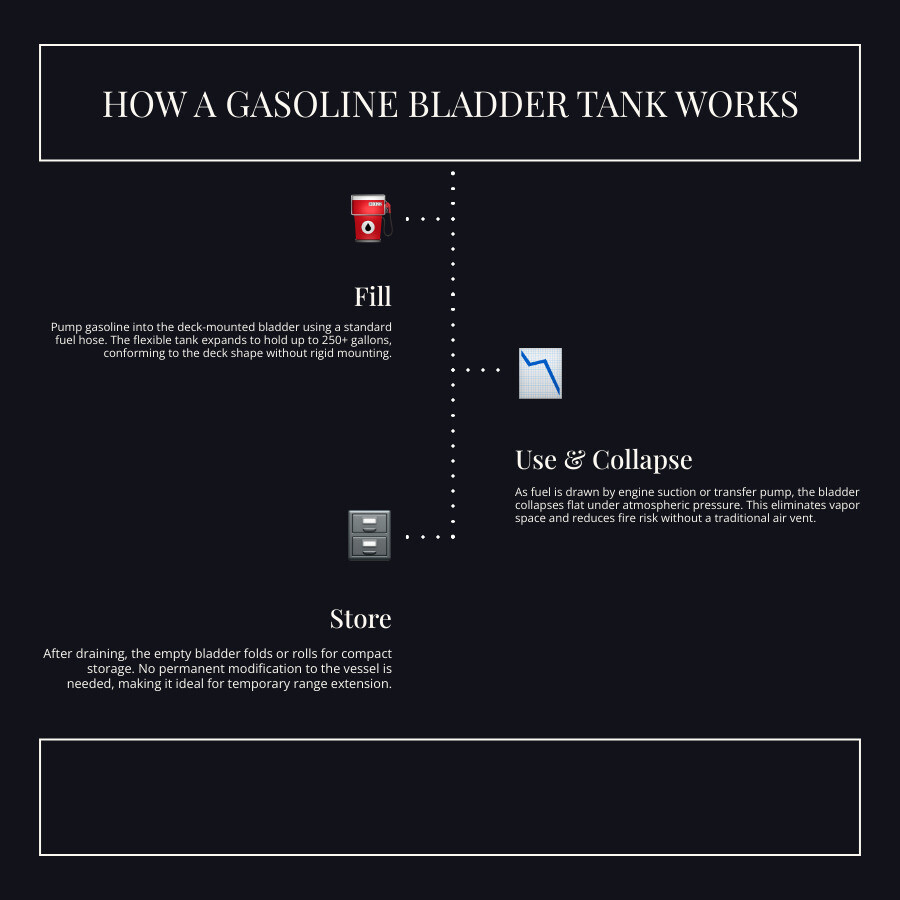
Unlike rigid auxiliary tanks, gasoline bladder tanks collapse flat as fuel is consumed, which eliminates vapor space, simplifies venting, and makes storage straightforward when the trip is done.
This guide covers everything serious buyers need to evaluate before purchasing: safety requirements, placement, system integration, material engineering, operational care, and what to look for in a high-performance bladder.
If you are already evaluating a flexible gasoline system rather than a rigid auxiliary tank, use Gasoline Fuel Bladders for Boats & Auxiliary Fuel Storage as the commercial reference point. This article is the supporting guide for placement, integration, material compatibility, and operating considerations.
Easy gasoline bladder tanks word list:
Safety, Regulations, and Placement for Gasoline Bladder Tanks
Safety considerations for carrying volatile fuel on an open deck demand strict adherence to proper installation protocols. Gasoline possesses a significantly higher volatility and lower flashpoint than diesel fuel, requiring precise vapor management and open-air ventilation. Understanding why gas-safe flexible bladders are changing fuel storage forever begins with recognizing how these engineered textiles control fuel stability under harsh marine conditions.
Offshore Safety and USCG Compliance for Gasoline Bladder Tanks
United States Coast Guard (USCG) regulations prohibit the installation of flexible fuel bladders inside the hull or below deck on marine vessels. Below-deck spaces allow volatile gasoline fumes to settle in bilges where electrical sparks or hot engine components create immediate fire hazards.
To maintain compliance and maximize safety:
- Mount bladders exclusively above deck on open areas such as cockpit soles or bow decks where natural air movement continuously dissipates vapors.
- Provide dedicated spill containment or position the bladder where fuel overflows can drain directly overboard through scuppers rather than pooling on deck.
- Ensure zero ignition sources exist in the immediate vicinity of fittings, valves, or connection manifolds.
Adhering to these structural safety guidelines ensures compliance with federal marine standards while eliminating vapor buildup. Operators who follow proper deck placement protocols experience reliable auxiliary capacity without compromising vessel safety, as highlighted in guides on no leaks allowed with these gas-compatible marine tanks.
Deck Securing, Stability, and Weight Impact
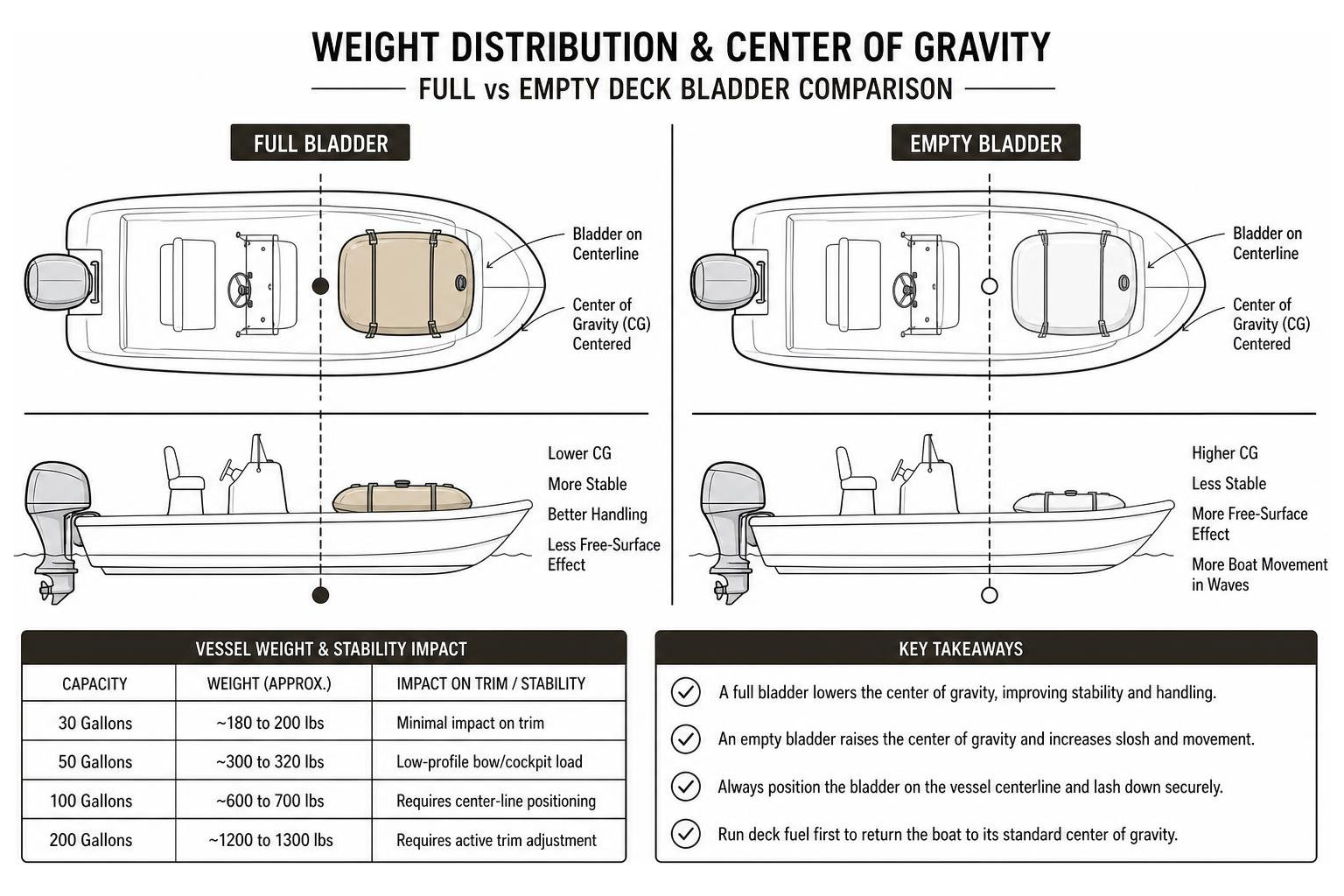
Securing a full fuel bladder is critical for vessel handling and stability. Gasoline weighs approximately 6.1 to 6.3 pounds per gallon. Consequently, a 100-gallon bladder weighs 600 to 700 pounds, while a 200-gallon bladder can weigh over 1,200 pounds when filled to capacity.
Unrestrained liquid exhibits a free-surface effect, where fluid movement sloshes in response to wave motion, shifting the vessel’s center of gravity and degrading planing performance. In rough seas, an unsecured bladder acts like an uncontrolled weight that can tear fittings or compromise deck balance.
To maintain optimal vessel performance and safety:
- Lash down securely: Use heavy-duty tie-down straps anchored to structural deck eyelets and integrated top-mounted D-rings on the bladder.
- Position on the centerline: Place the bladder forward of the console or centrally on the cockpit sole to maintain lateral equilibrium.
- Run deck fuel first: Draw fuel from the temporary bladder during the outbound leg of a voyage. Consuming auxiliary fuel early clears deck space and returns the boat to its standard center of gravity before entering rough fishing grounds or navigating treacherous inlets.
For deeper mechanical insights into fluid containment dynamics and internal baffle structures under stress, review bladder for fuel tank mechanical design insights.
Plumbing and System Integration Options
Integrating gasoline bladder tanks into a boat’s propulsion system requires safe, leak-free connections tailored to the vessel’s engine layout. Proper plumbing prevents engine fuel starvation and prevents vapor leakage into deck spaces. Choosing high-grade fittings and valves ensures long-term system integrity, preventing structural fatigue as covered in don’t burst your bubble with these flexible gas bladders.
Direct Engine Suction vs. Fuel Transfer Systems
There are two primary methods for delivering fuel from a deck bladder to marine engines: direct suction and powered fuel transfer systems.
Direct Engine Suction: Engine fuel pumps draw fuel directly from the bladder using fuel lines connected to a three-way fuel selector valve. Quick-disconnect fittings with automatic shutoffs allow operators to detach lines without fuel leakage. Because flexible bladders collapse under suction, no air vent is required, eliminating vapor discharge. As the bladder approaches empty, cracking open the valve to the main tank allows a smooth transition without starving the engines.
Fuel Transfer Systems: Transfer pumps move fuel from the deck bladder directly into the boat’s primary rigid fuel tank. Gravity or manual siphon transfers offer safe, simple operations. If using an electric pump, it must feature an ignition-protected, explosion-proof motor specifically rated for gasoline service to eliminate spark hazards.
Filling, Venting, and Draining Best Practices
When deploying temporary fuel storage, strict adherence to filling and draining procedures protects equipment and crew:
- Fill in place: Always position and strap down the empty bladder on deck prior to filling. Attempting to move or lift a filled bladder weighing hundreds of pounds risks severe physical injury and structural damage.
- Heat management: Standard bladders utilize a white matte finish to reflect solar heat, minimizing liquid thermal expansion and internal gas vapor buildup while resting on exposed decks. Built-in bronze pressure valves relieve excess expansion pressure safely if left sitting in direct sunlight.
- Complete purging: Direct plumbing allows engines to draw out fuel cleanly. To drain the final fraction of a gallon, operators can roll the flexible material from the outer edges toward the discharge valve, ensuring minimal residual fuel remains before stowing.
Understanding proper compatibility and operational procedures is thoroughly explained in the ultimate compatibility guide: choosing the right fuel bladder for gasoline.
Gasoline vs. Diesel Bladder Requirements and Material Engineering
Gasoline and diesel fuels interact with polymers in fundamentally different ways. Gasoline contains volatile aromatic hydrocarbons and oxygenated additives like ethanol, which aggressively degrade standard rubbers, unrated plastics, and low-grade coatings. Using a diesel-only bladder for gasoline storage causes material degradation, liner softening, and eventual catastrophic leakage.
Selecting purpose-built materials engineered specifically for gasoline volatility is essential, as detailed in gas-compatible gasoline tanks that actually last.
Key Features of High-Performance Gasoline Bladder Tanks
High-performance marine fuel bladders rely on advanced chemical engineering and commercial-grade hardware to ensure zero permeability and maximum physical durability:
- Thermoplastic Polyurethane (TPU): Constructed with specialized TPU formulations utilizing directional molecule technology. This material resists aromatic fuel blends, ethanol, and UV exposure while maintaining extreme flexibility across wide temperature ranges.
- Puncture and Abrasion Resistance: Multi-ply reinforced fabrics protect against physical deck friction, heavy sea impacts, and accidental punctures from dropped gear.
- Corrosion-Resistant Hardware: Integrated heavy-duty aluminum flanges and 304/316 stainless steel ball valves prevent fuel degradation and resist harsh marine saltwater environments.
Commercial buyers evaluating total costs across marine range extension systems can review how to choose gas-compatible boat bladders without sinking your budget.
Operational Care, Emergency Protocols, and Storage
Proper care and proactive emergency preparedness prolong bladder life and keep vessel crews safe during long-distance offshore transits.
- Leak Response Protocols: Regularly inspect quick-disconnect fittings, hose clamps, and valve seals during transit. Run a raw water washdown stream across the deck near the bladder assembly; any minor fuel seep immediately produces a visible rainbow sheen on the wet deck, alerting the crew before vapors accumulate.
- Safety Equipment Onboard: Always keep organic vapor respirators, non-sparking absorbent pads, and fuel-rated spill response supplies onboard when carrying auxiliary gasoline. If fuel leaks, isolate line valves immediately, extinguish all electronic ignition risks, and flush deck surfaces with raw water.
- Cleaning and Storage: After emptying the bladder, wash the exterior with neutral soap and fresh water to remove salt spray and fuel residue. Roll or fold the dry, collapsed bladder flat, and store it inside a cool, dry, well-ventilated locker away from direct sunlight.
For custom sizing recommendations tailored to specific hull dimensions and storage spaces, consult sizing up your options: custom gasoline bladder sizes for boats and yachts.
Frequently Asked Questions
Can gasoline fuel bladders be installed below deck inside the hull?
No. United States Coast Guard regulations strictly prohibit mounting portable flexible fuel bladders in-hull or below deck on marine vessels. Gasoline vapors are denser than air and collect in enclosed bilges, creating extreme explosion and fire hazards. Gasoline bladders must always be secured on open decks where natural airflow dissipates vapors safely overboard. Additional compliance details are available under fuel bladder for boats.
How do flexible gasoline bladders function without an air vent?
Flexible fuel bladders do not require traditional air vents because they are completely sealed and pliable. As the engine draws fuel via direct suction, atmospheric pressure presses down on the exterior fabric, causing the bladder to collapse flat at the exact rate liquid is removed. This elimination of internal vapor space prevents fuel sloshing, reduces vapor expansion, and eliminates the need for open atmospheric venting.
What immediate steps should be taken if a fuel bladder leaks offshore?
If a leak occurs while underway:
- Immediately close all fuel shutoff valves at the bladder outlet manifold to isolate the supply.
- Maintain an open-air environment on deck and eliminate any potential ignition sources (turn off non-essential electronics or open flames).
- Put on organic vapor respirators if fuel fumes are concentrated on deck.
- Deploy raw water deck hoses to wash spilled fuel off the stern scuppers while deploying oil-absorbent pads to contain localized pooling.
Conclusion
Gasoline bladder tanks provide a safe, scalable, and non-permanent solution for extending vessel range across demanding commercial and offshore applications. By collapsing as fuel is consumed, these flexible containers optimize deck space, prevent vapor formation, and simplify auxiliary fuel management.
When selected in the correct material configurations, secured properly on deck, and integrated with high-grade plumbing, bladders allow operators to complete extended voyages with full confidence.
Techno Tanks manufactures military-grade flexible TPU fuel bladders ranging from 30 to over 2,500 gallons, engineered specifically for marine durability and fuel compatibility. Pricing depends on overall dimensions, capacity requirements, fittings, and application scope. To review custom configurations or request an exact price quote for your vessel, visit Gasoline Fuel Bladders today.

