
What Are Flexible Gas Bladders — and Are They Right for Your Operation?
Flexible gas bladders are collapsible, fuel-impermeable containers designed to safely store and transport gasoline, diesel, jet fuel, and other hydrocarbons — without the weight, permanence, or structural demands of a rigid tank.
Here’s a quick answer for operators evaluating their options:
| Question | Quick Answer |
|---|---|
| What are they? | Collapsible fuel containers made from fuel-resistant coated fabrics |
| Capacity range | From under 100 litres to 300,000+ litres |
| Fuels supported | Diesel, gasoline, jet fuel, kerosene, hydraulic oil, and more |
| How compact when empty? | Can fold down to as little as 1–5% of their filled volume |
| Typical service life | 8–15 years with quality TPU construction |
| Deployment time | Minutes to hours depending on size |
| Primary advantage over rigid tanks | Portable, space-efficient, no permanent installation required |
For vessel operators, expedition crews, and remote-site managers, this matters. When you need more range, backup capacity, or temporary bulk storage without cutting into structure or committing to permanent infrastructure, a flexible bladder changes the equation entirely.
Standard sizes run from 100 US gallons up to 200,000+ US gallons. A 1,000-gallon bladder, for example, folds down to a fraction of its filled footprint — practical for vessels, staging areas, or remote deployments where space is always at a premium.
This guide covers everything serious buyers need to know: materials, applications, safety standards, installation best practices, lifecycle costs, and how to size and specify the right bladder for your operation.
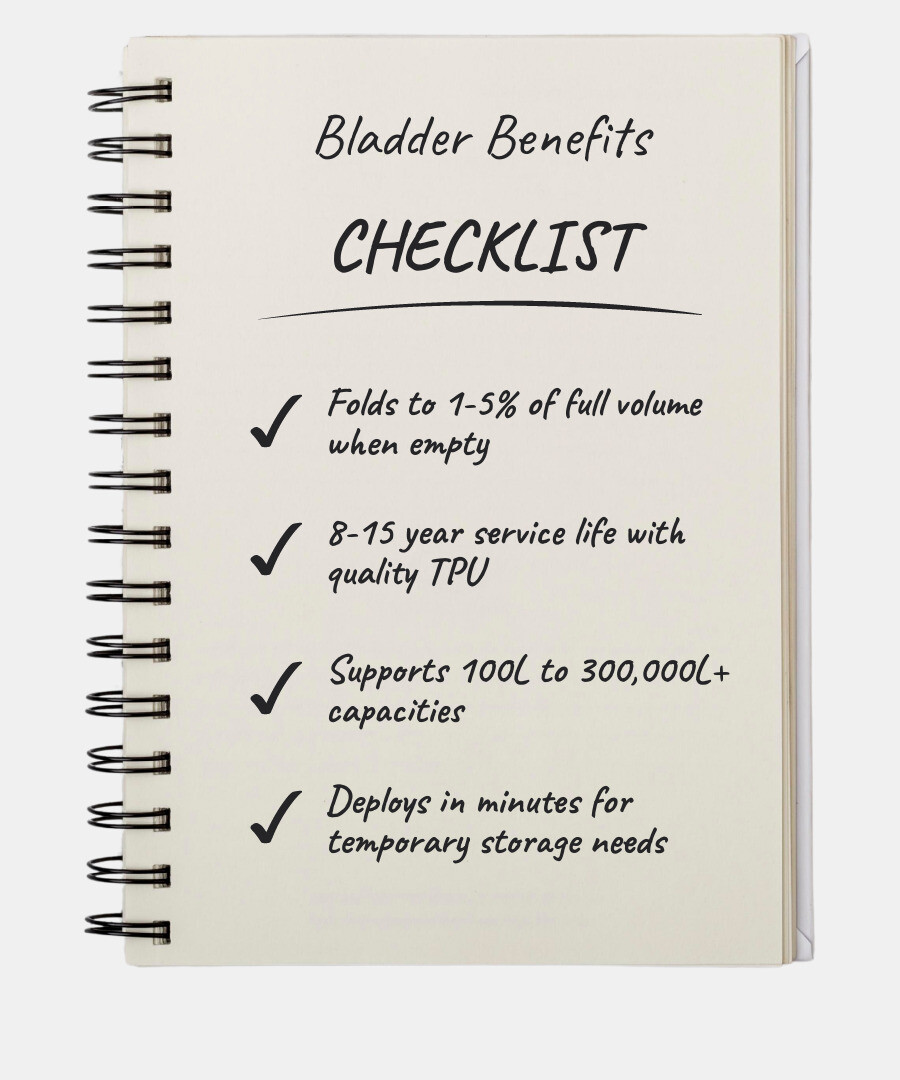
Flexible gas bladders terms at a glance:
Flexible Gas Bladders vs. Rigid Fuel Tanks: A Technical Comparison
When engineering a fuel system or planning a long-range operation, the choice between rigid tanks and flexible fuel bladders often dictates your project’s physical and logistical limits. Traditional rigid tanks—constructed from marine-grade aluminium, stainless steel, Monel, or high-density polyethylene (HDPE)—are structural fixtures. They require dedicated, unyielding spaces and complex installations. In contrast, flexible gas bladders offer a dynamic alternative that adapts to the physical constraints of your platform.
Understanding how these options compare mechanically and logistically is essential for making an informed decision.
| Engineering Metric | Flexible Gas Bladders | Rigid Fuel Tanks (Aluminium/Steel) |
|---|---|---|
| Volumetric Efficiency | Extremely High; conforms to irregular spaces and collapses as fuel is discharged. | Fixed; requires a designated rectangular or faceted compartment. |
| Weight-to-Volume Ratio | Minimal tare weight; a 100-gallon bladder weighs roughly 30 lbs empty. | Heavy; rigid metal walls require structural framing and mounting brackets. |
| Footprint Reduction | Shrinks to 1% to 5% of its total nominal capacity when empty. | Remains at 100% volume, occupying valuable payload space when dry. |
| Installation Complexity | Low; can be rolled, passed through small hatches, and deployed in hours. | High; often requires cutting bulkheads, deck plates, or structural framing. |
| Maintenance & Corrosion | Zero risk of rust or weld cracking; requires simple washing and dry storage. | Susceptible to galvanic corrosion, weld fatigue, and condensation buildup. |
| Explosion & Vapor Hazard | Minimal; collapses as fluid drains, preventing the formation of explosive vapor pockets. | High; empty space fills with volatile fuel vapors requiring complex venting. |
Volumetric Efficiency and Footprint Reduction
Rigid tanks are bound by the laws of fixed geometry. If you install a 500-gallon steel tank, it occupies exactly 500 gallons of volume on your vessel or site, whether it is completely full of diesel or bone dry. This creates a permanent payload penalty.
Flexible bladders solve this issue through physical collapse. As fuel is pumped out, atmospheric pressure collapses the bladder’s walls inward. This eliminates the “empty space” entirely, freeing up deck or compartment area for other equipment. When fully drained, high-quality polyurethane bladders can be rolled or folded down to less than 10% of their filled volume—and in some specialized configurations, as little as 1% of their nominal storage capacity.
To explore how these structural differences play out in real-world scenarios, review Flexible Tanks vs Rigid Tanks: Why Custom Bladders Win Every Time.
Structural Integration and Weight Savings
For weight-sensitive operations—such as high-speed commercial workboats, offshore transport vessels, and remote exploration teams—every kilogram counts. Rigid metal tanks require heavy structural mounting, internal baffles, and thick walls to withstand sloshing forces.
Flexible systems reduce this dead weight. Because the bladder fabric lies flat against its containment compartment or deck support, the hydrostatic load is transferred directly and evenly to the supporting structure beneath it. This eliminates the concentrated point-loads associated with rigid tank mounting feet. Additionally, because the bladder collapses as it empties, it prevents the massive shifting of liquid weight (sloshing) that can destabilize a vessel or transport vehicle.
For more details on how custom engineering maximizes these weight savings, see Why Custom Fuel Bladders Are the Ultimate Flexible Storage Solution.
Engineering and Material Science of Flexible Gas Bladders
The performance of a flexible bladder depends heavily on its material science. Because hydrocarbons are aggressive solvents, storing them in a flexible container requires advanced polymer engineering to prevent chemical breakdown, environmental contamination, and fuel degradation.
Thermoplastic Polyurethane (TPU) vs. Polyvinyl Chloride (PVC)
In the flexible containment industry, two primary materials dominate: Thermoplastic Polyurethane (TPU) and Polyvinyl Chloride (PVC). For hydrocarbon storage, the choice of material is critical.
- Thermoplastic Polyurethane (TPU) (Premium Option): TPU is the industry standard for high-durability fuel bladders. It offers exceptional resistance to microbial attack, puncture, and abrasion. Unlike PVC, TPU contains no plasticizers (compounds added to make plastics flexible). Over time, hydrocarbons leach plasticizers out of PVC, leaving the material brittle, prone to cracking, and highly susceptible to fuel permeation. TPU remains stable and flexible over a service life of 8 to 15 years.
- Polyvinyl Chloride (PVC) (Cost-Effective Option): While PVC is a viable, low-cost option for temporary water storage, its chemical resistance to aromatic hydrocarbons is limited. A PVC bladder used for fuel typically has a lifespan of only 3 to 5 years and is generally restricted to non-aromatic fuels or light oils under mild environmental conditions.
For a deeper dive into the polymer chemistry behind these systems, consult The Ultimate Guide to Fuel Bladder Materials: Kevlar, Polymers, and Beyond.
Seam Construction: High-Frequency RF Welding vs. Hot Vulcanization
A flexible bladder is only as strong as its seams. Manufacturers use two primary methods to join technical fabrics:
- High-Frequency Radio Frequency (RF) Welding: This process uses electromagnetic energy to agitate the polymer molecules at a molecular level, fusing the layers together without external heat. RF welding creates a monolithic joint that is physically stronger than the surrounding material, ensuring leak-tightness under mechanical stress.
- Hot Vulcanization: Used primarily with rubberized elastomer fabrics, this process involves assembling the bladder components and curing them in an autoclave under high heat and pressure. This vulcanization process chemically cross-links the polymers, eliminating weak points and seams altogether.
Permeation and Chemical Compatibility
Fuel permeation is the process by which volatile organic compounds (VOCs) pass through a container’s walls at a molecular level. High-end flexible gas bladders utilize an internal neutral barrier film to prevent fuel molecules from escaping. This is especially critical when storing gasoline, which contains highly volatile aromatics. Without a proper barrier, gasoline will permeate the bladder wall, resulting in fuel loss, environmental hazards, and explosive vapor accumulation.
For specific compatibility ratings and chemical resistance charts, refer to The Ultimate Compatibility Guide: Choosing the Right Fuel Bladder for Gasoline.
Material Performance in Extreme Environments
Industrial operations rarely take place in temperature-controlled environments. Flexible gas bladders must perform reliably across a wide range of climates, from sub-zero arctic environments to scorching desert oilfields.
- Extreme Temperatures: High-quality TPU formulations retain their flexibility and cold-crack resistance down to –50°C (–58°F) and can withstand continuous operating temperatures up to +70°C (+158°F), with some specialized materials rated up to +90°C. This prevents the bladder from becoming brittle in cold climates or softening under intense heat.
- UV Degradation: Solar radiation can degrade polymers, causing micro-cracking and loss of tensile strength. Industrial-grade bladders feature UV-stabilized exterior coatings that block ultraviolet radiation, preserving the underlying fabric’s structural integrity over years of direct sun exposure.
- Mechanical Stress: Bladders deployed on vessel decks or in remote fields are subjected to constant movement, friction, and environmental wear. High-tensile base fabrics—woven from heavy-duty polyester, nylon, or Kevlar—provide the puncture resistance and tensile strength needed to withstand these dynamic forces.
To understand how these materials hold up against aggressive fuels over long periods, read Gas Compatible Gasoline Tanks That Actually Last.
Industrial and Commercial Applications
The versatility of flexible gas bladders makes them valuable across a wide range of industrial, commercial, and emergency response sectors.
- Tactical Bulk Fuel Storage: Military logistics and expeditionary forces rely on collapsible bladders to establish rapid-deployment fuel depots. These systems integrate with existing fuel-handling equipment to distribute diesel, gasoline, and jet fuel (JP-8) in remote or contested environments.
- Disaster Relief & Emergency Response: When natural disasters compromise permanent infrastructure, restoring power is a priority. Flexible bladders can be deployed in under four hours to supply diesel for emergency generators, pumps, and water purification systems.
- Remote Power Generation: Mining operations, forestry camps, and remote construction sites use high-capacity bladders (ranging from 1,000 to 200,000 gallons) to store fuel on-site without the need for permanent concrete foundations or heavy steel tanks.
- Emergency Fluid Transport: Towable bladder systems are used for marine emergency response, oil spill recovery, and transporting bulk water or fuel across lakes, rivers, and oceans. High-capacity towable bladders are designed specifically for rugged marine towing, while specialized containment bladders are utilized for wastewater and agricultural runoff containment.
Key Applications for Flexible Gas Bladders in Marine and Offshore Operations
In marine environments, space is a premium, and weight distribution directly impacts vessel performance and safety. Flexible gas bladders provide an efficient way to temporarily extend a vessel’s range or manage liquid ballast.
- Auxiliary Fuel Capacity for Range Extension: For long-distance offshore transits, sportfishing expeditions, and commercial deliveries, standard fuel tanks are often insufficient. Placing a temporary, deck-mounted marine fuel bladder allows operators to carry auxiliary fuel for the outward journey, transfer it to the main tanks as space permits, and roll up the empty bladder for the return trip.
- Ballast and Trim Management: Large vessels use flexible bladders to adjust trim and list, compensating for changing payload weights without permanently sacrificing cargo space.
- Subsea and ROV Operations: Pressure-compensated flexible bladders are used in deep-water subsea equipment and Remote Operated Vehicles (ROVs) to store hydraulic fluids and dielectric oils at ambient ocean pressures.
To see how marine operators use these systems to optimize deck space, read Shrink Your Storage: Why Collapsible Marine Tanks Are a Game Changer. For cost-effective selection advice, check out How to Choose Gas Compatible Boat Bladders Without Sinking Your Budget.
Additionally, for unique compact water systems, operators refer to Flexible Marine Tanks for the Modern Aquarist.
Safety Standards, Certifications, and Regulatory Compliance
Because hydrocarbons are classified as hazardous materials, storing and transferring them requires careful attention to environmental controls, fire risk, and site-specific regulations. Requirements vary by jurisdiction, fuel type, storage volume, and whether the bladder is used for temporary storage, transfer, vessel range extension, or a semi-permanent installation.
Secondary Containment and Environmental Protection
For bulk fuel storage, operators should evaluate whether secondary containment is required under applicable environmental rules and project specifications. In the United States, the EPA’s Spill Prevention, Control, and Countermeasure (SPCC) rule applies to certain facilities that store oil or fuel above regulatory thresholds and could reasonably discharge into navigable waters or adjoining shorelines.
When large-scale flexible bladders are used, operators commonly pair them with collapsible secondary containment berms. These berms are designed to capture released fuel in the event of an unexpected leak, fitting failure, hose issue, or overfill event. Capacity requirements should be confirmed against the applicable regulation, authority having jurisdiction, and site plan; many project specifications call for containment sized to hold at least the largest container plus additional freeboard.
Static Dissipation and Transfer Safety
As fuel moves through hoses, valves, and fittings, it can generate static electricity. If static charge is not controlled, it can create an ignition hazard during fuel transfer operations. Fuel bladder systems used for gasoline, diesel, or other hydrocarbons should be evaluated for appropriate grounding, bonding, anti-static provisions, and compatible transfer hardware.
High-quality fuel bladders may incorporate grounding points, conductive components, or static-dissipative transfer accessories depending on the application. Operators should follow the bladder manufacturer’s instructions, fuel supplier procedures, and relevant fire safety practices, including guidance associated with standards such as NFPA 30 where applicable.
Venting and Pressure Relief
Hydrocarbon fuels expand and contract with temperature changes and may release vapors during filling, storage, and transfer. Flexible gas bladders should be specified with suitable venting or pressure-relief provisions for the intended fuel and operating environment. Proper venting helps prevent over-pressurization while reducing the likelihood of moisture, debris, or uncontrolled air entry into the fuel system.
Before deployment, buyers should confirm fitting configuration, vent placement, grounding requirements, secondary containment needs, and fuel compatibility with the manufacturer or project engineer.
Operational Guidelines and Lifecycle Management
To maximize the performance, safety, and service life of a flexible gas bladder, operators must follow established deployment, handling, and storage procedures.
Site Preparation and Ground Protection
Before deploying a flexible bladder, proper site preparation is critical to prevent punctures and structural damage.
- Clear the Area: Remove all sharp stones, roots, metal debris, and glass from the footprint area. The ground slope should be flat, ideally under 0.5%.
- Lay Down a Ground Mat: Always use a heavy-duty geotextile ground cloth or protective rubber mat. This layer acts as a barrier between the bladder fabric and the ground, protecting against wear and tear.
- Position the Bladder: Unroll the empty bladder over the ground mat. Ensure there are no folds, twists, or wrinkles in the fabric before filling.
- Connect Fittings: Secure all inlet and outlet valves, ensuring that connections are tight and gaskets are properly seated.
Deployment Speed and Logistics
One of the primary advantages of flexible bladders is their rapid deployment. While constructing a permanent 300-cubic-meter (approx. 79,000 gallon) steel tank can take weeks and require heavy machinery, a collapsible bladder of the same capacity can be unpacked, unrolled, and ready to fill in under four hours by a small crew. This rapid setup makes them highly effective for emergency response and remote industrial projects.
Sizing and Pricing
Techno Tanks fuel bladder pricing depends on size, fuel type, configuration, application, custom requirements, and project scope. Because each commercial operation has unique constraints, buyers should request a custom quote for accurate pricing tailored to their specific fuel storage, transfer, sizing, and use-case requirements.
Best Practices for Installing and Maintaining Flexible Gas Bladders
Proper installation and ongoing maintenance are essential to ensure the safety and longevity of your flexible fuel bladder.
- Chafe Prevention: When installing a bladder in a boat compartment or on a vehicle deck, prevent friction damage by lining all contact surfaces with rubber mats, carpet, foam, or neoprene sheeting. Unprotected contact with raw fiberglass, wood, or metal bulkheads will cause wear over time.
- Venting Protocols: Always open the degassing vent before filling a bladder. This allows trapped air to escape as the fuel level rises. Once filled, close the vent to prevent fuel sloshing or vapor loss, but ensure the automatic pressure-relief valve remains clear.
- Inspection Schedules: Establish a regular inspection routine. Check all seams, corners, and fitting interfaces for signs of stress, weeping, or fuel dampness. Inspect grounding straps and static lines for electrical continuity.
- Long-Term Storage and Cleaning: After draining the bladder, rinse the interior to remove residual fuel and sediment. Wash the exterior with mild, soapy water (never use harsh solvents or abrasive cleaners), rinse thoroughly, and allow it to dry completely. Once dry, fold or roll the bladder loosely and store it in a cool, dry, ventilated area away from direct sunlight and pests.
Frequently Asked Questions About Flexible Gas Bladders
Can flexible gas bladders be used for permanent fuel storage?
While flexible bladders are highly durable, they are primarily designed for temporary, auxiliary, or semi-permanent storage. Over years of continuous use, permanent installations require robust structural support, containment, and regular inspection. If installed permanently inside a vessel or vehicle compartment, the bladder must be fully supported on all four sides by bulkheads or structural walls, lined with protective padding, and equipped with foam baffling to prevent movement.
What is the lifespan of a high-quality fuel bladder?
The lifespan of a flexible fuel bladder depends on its material, usage, and environmental exposure:
- TPU Bladders: Typically last 8 to 15 years under normal operating conditions due to their high chemical resistance and UV stability.
- PVC Bladders: Generally have a shorter lifespan of 3 to 5 years and are best suited for light duty or temporary applications.
How do you prevent fuel sloshing and movement during transport?
Liquid movement (sloshing) can destabilize a vessel or transport vehicle. To prevent this, flexible bladders use three primary stabilization methods:
- Fully Supported Compartments: Placing the bladder in a dedicated, form-fitting compartment restricts its movement.
- Tie-Down Straps: Heavy-duty webbing straps and integrated D-rings secure deck-mounted bladders directly to the vessel or vehicle deck.
- Foam Baffling: Inserting open-cell polyurethane foam baffling inside the bladder dampens fuel movement, reduces sloshing, and minimizes explosive vapor risks by slowing flame propagation in the event of an impact.
Conclusion
For operators, logistics managers, and vessel captains, flexible gas bladders offer a practical, lightweight, and space-saving alternative to traditional rigid tanks. Whether you need to extend a vessel’s offshore range, establish a temporary bulk fuel station, or manage fuel logistics in remote areas, these collapsible systems provide a reliable, highly adaptable solution.
By selecting high-quality Thermoplastic Polyurethane (TPU) materials, following proper installation guidelines, and using secondary containment systems, you can ensure safe, long-term performance in demanding environments.
Ready to optimize your fuel storage and transfer capabilities? Contact the engineering experts at Techno Tanks to discuss your project requirements, specify your dimensions, and Request a Custom Fuel Bladder Quote today.

