
What Are Custom Fuel Bladders — and Why Do Operators Choose Them?
Custom fuel bladders are flexible, collapsible storage tanks built to your exact capacity, dimensions, fuel type, and deployment environment — offering a practical alternative to permanent rigid tanks when space, weight, or operational flexibility matter.
Quick answer for buyers:
| What you need to know | The short answer |
|---|---|
| What they are | Collapsible flexible tanks for fuel storage and transfer |
| Common fuels stored | Diesel, gasoline, jet fuel, lubricants |
| Typical capacity range | 25 gallons up to 300,000 gallons |
| Key advantage over rigid tanks | Fold flat when empty, fit irregular spaces, absorb vibration |
| Who uses them | Marine operators, offshore crews, industrial sites, emergency response |
| How to get the right one | Request a quote based on capacity, fuel type, and use case |
Whether you need to extend the range of a long-haul vessel, store fuel at a remote job site, or carry backup diesel without bolting in a permanent tank, a collapsible fuel bladder gives you options that rigid steel or aluminum tanks simply can’t match.
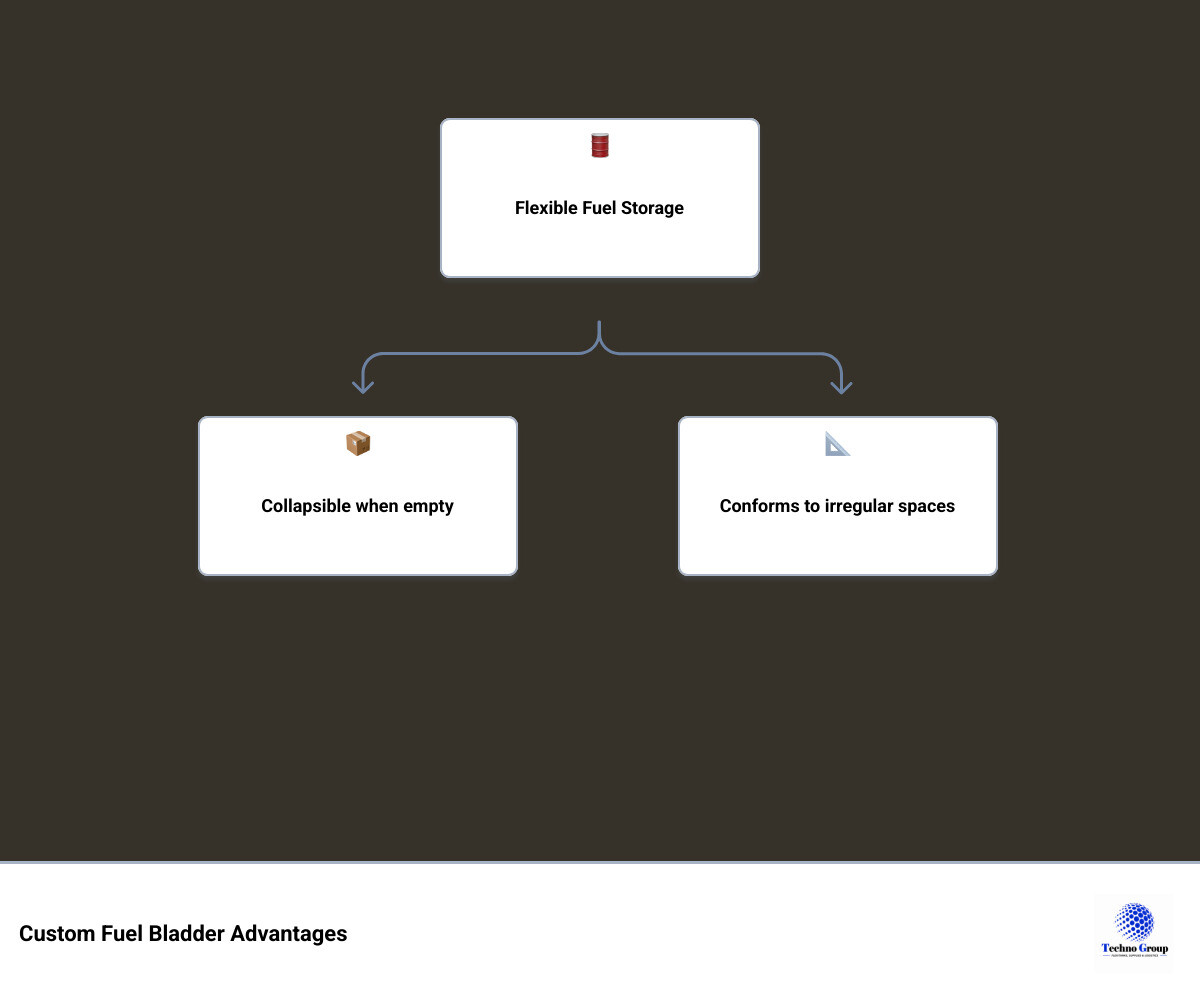
The core appeal is straightforward: when empty, a bladder folds down to a fraction of its filled size. When full, it conforms to available space rather than demanding it. That combination of spatial efficiency and operational flexibility is why custom fuel bladders are used across commercial marine, offshore, industrial, and emergency-response operations worldwide.
But not all fuel bladders are built the same. Material selection, welding method, fitting configuration, and fuel compatibility all determine whether a bladder performs reliably under real operating conditions — or fails when it matters most.
This guide covers everything you need to evaluate, specify, and deploy the right custom fuel bladder for your application.
Custom Fuel Bladders vs. Rigid Fuel Tanks: A Technical Comparison
When choosing a fuel containment system, operators must weigh the differences between flexible materials and rigid metals. Traditional rigid steel or aluminum tanks are heavy, fixed in shape, and prone to structural fatigue from continuous vibration. Conversely, flexible fuel bladders offer dynamic containment that adapts to physical and environmental forces.
The table below highlights the key differences between these two storage methodologies:
| Technical Parameter | Flexible Fuel Bladder | Rigid Steel / Aluminum Tank |
|---|---|---|
| Weight-to-Volume Ratio | Extremely low (empty weights range from 5 to 40+ lbs depending on size) | High (requires heavy structural framing and thick metal walls) |
| Footprint Recovery | Up to 90% space recovery when empty; rolls or folds flat | Permanent; occupies the same volume regardless of fuel level |
| Vibration & Shock Absorption | Excellent; flexible seams absorb kinetic energy and hull flex | Poor; rigid welds are susceptible to stress cracking and fatigue |
| Installation Effort | Rapid, plug-and-play deployment without structural modification | Complex; requires permanent mounting, welding, and structural support |
| Corrosion Resistance | 100% immune to rust, scale, and galvanic corrosion | High susceptibility to rust (steel) or galvanic pitting (aluminum) |
| Customizability | Easily molded to fit irregular spaces, tight compartments, or decks | High cost and manufacturing complexity for non-standard shapes |
For an in-depth analysis of these engineering trade-offs, read our comprehensive breakdown on Fuel Bladder vs Fuel Tank.
Structural Flexibility and Space Recovery
Rigid tanks demand permanent, dedicated space. For commercial vessels, offshore transport trucks, and temporary staging areas, dedicating valuable square footage to an empty metal tank is highly inefficient.
A collapsible fuel bladder solves this constraint through high spatial efficiency. When the auxiliary fuel is spent, the bladder can be completely drained, rolled up, and stored in a small locker or compartment. This allows operators to reclaim up to 90% of their deck or truck bed space for other payloads.
For marine vessels, this capability is a game-changer. Instead of letting permanent auxiliary tanks compromise your deck layout, you can deploy a flexible tank only when your voyage requires range extension. To learn more about maximizing your onboard layout, check out Dont Let Fuel Cramp Your Style The Guide to Space Saving Bladders.
Durability and Fatigue Resistance
Rigid tanks operating in high-vibration environments—such as marine hulls, off-road transport, or industrial machinery decks—suffer from structural fatigue. Over time, constant vibration and structural twisting cause microscopic stress fractures along rigid weld seams, eventually leading to catastrophic leaks.
Flexible Collapsible Fuel Tanks are naturally immune to vibration fatigue. Because the bladder wall is flexible, it moves in harmony with the vessel’s motion or the vehicle’s chassis.
Rather than resisting kinetic energy, the flexible polyurethane or elastomer material absorbs and dissipates it. This dynamic stress-resistance prevents seam failure, making flexible bladders highly reliable for long-term operations in rough seas or turbulent transport conditions.
Engineering Custom Fuel Bladders for Demanding Environments
Designing a reliable flexible fuel storage system requires precise material engineering and robust manufacturing standards. In extreme climates—ranging from arctic cold to intense tropical heat—the bladder must maintain its physical integrity while remaining completely chemically inert to the volatile hydrocarbons stored inside.

At Techno Tanks, we design Custom Fuel Bladders to withstand these exact stressors, matching advanced material science with rugged construction techniques.
Material Selection for Custom Fuel Bladders
The chemical composition of the bladder material must be carefully matched to the specific fuel type to prevent material degradation, delamination, or fuel contamination. The industry relies primarily on advanced thermoplastic polyurethanes (TPU) and specialized coated fabrics:
- Polyester TPU: This formulation is highly resistant to diesel, jet fuel (including JP-8, JP-5, Jet A-1), crude oil, and lubricants. It offers exceptional mechanical strength, puncture resistance, and long-term contact stability with heavier hydrocarbons.
- Polyether TPU: Specifically engineered for gasoline and highly aromatic fuels. Polyether TPU prevents the chemical breakdown and swelling that occurs when standard elastomers are exposed to volatile gasoline additives, ethanol, or methanol.
- Coated Fabrics: Heavy-duty, high-tensile woven fabrics (such as high-grade polyester or nylon) are coated with polyurethane or nitrile rubber on both sides. This fabric core provides the structural “backbone” that prevents stretching under hydrostatic pressure, while the chemical coatings ensure liquid-tight containment.
Using the wrong material can cause the inner layer of the bladder to dissolve, leading to fuel contamination and structural failure. For a deeper look at matching material chemistry to your vehicle, read our guide on Top Collapsible and Flexible Diesel Fuel Bladders for Yachts and Trucks. For specialized industrial and racing applications, operators can also reference Harmon Custom Fuel Cells-Fuel Bladders-High Performance Racing to understand extreme fuel-cell containment engineering.
Manufacturing Standards and Quality Control
To ensure absolute fuel-tightness and structural integrity, high-quality custom bladders are manufactured using advanced Radio Frequency (RF) welding.
Unlike hot-air welding or adhesive bonding—which can degrade over time when exposed to fuel—RF welding uses electromagnetic energy to agitate the polymer molecules at the seam. This fuses the material layers at the molecular level, creating a single, continuous weld seam that is actually stronger than the surrounding fabric.
To provide an extra layer of security, premium manufacturers utilize Double-Layer Welding Technology. This process applies a secondary reinforcement strip directly over the primary weld seam, providing 99% leak protection and absorbing high-stress kinetic surges during transport.
Additionally, manufacturing facilities must adhere to strict quality management systems:
- ISO 9001:2015 Certification: Ensures every stage of design, material sourcing, welding, and testing meets international quality standards.
- Military Specifications (e.g., GJB4219A): Bladders built to these standards undergo rigorous pressure testing, drop testing, and chemical exposure analysis to ensure survival in the field.
- Air Pressure Testing: Every single bladder must undergo a comprehensive air-holding and pressure-decay test before leaving the factory floor to guarantee it is 100% leak-free.
For a complete breakdown of material thicknesses, tensile strengths, and manufacturing tolerances, refer to our Fuel Bladder Specs resource page. For insights into defense-contract and aerospace-grade flexible manufacturing, you can also view Custom Fuel Bladder Manufacturer in the USA – VTL .
Key Applications Across Marine, Offshore, and Industrial Sectors
Because custom fuel bladders are highly adaptable, they serve as critical infrastructure across several demanding industries. Wherever permanent rigid storage is cost-prohibitive, physically impossible, or operationally restrictive, flexible bladders bridge the gap.
Marine and Offshore Range Extension
For commercial mariners, yacht captains, and offshore operators, fuel capacity is the ultimate limiting factor for voyage range. Installing a permanent, rigid metal tank to extend this range requires extensive shipyard time, structural modifications, and significant capital expenditure.
Custom marine fuel bladders offer a non-destructive, cost-effective alternative. These bladders are typically deployed above-deck in secure, flat areas where they can feed directly into the vessel’s primary fuel system via gravity feed or auxiliary transfer pumps.
Once the fuel is transferred and the bladder is empty, it is rolled up, restoring valuable deck space for the remainder of the voyage. For an exhaustive look at marine deployment, check out The Complete Guide to Marine Bladder Tanks and Storage.
When selecting a marine bladder, operators must choose between two primary configurations:
- Pillow-Style Bladders: Low-profile, wide-footprint bladders designed to lie flat on open decks. They distribute weight evenly and are exceptionally stable in moderate seas.
- Space-Saver Bladders: Designed with a more compact, vertical footprint to fit into tight compartments, lazarettes, or narrow deck passages. These often incorporate internal baffle systems to minimize fluid movement.
To learn more about optimizing your vessel’s liquid cargo capacity, read Why You Should Use Techno Tanks and Marine Fuel Bladder for Marine Bulk Liquids. For those interested in smaller-scale watercraft or recreational range extension, see our Beginners Guide to Fuel Bladders for Boats and Inflatable Fuel Tanks for Lightweight Marine Adventures.
Industrial and Temporary Fuel Storage
In remote industrial sectors—such as mining, logging, agricultural operations, and construction sites—establishing a permanent fuel depot is often impractical or legally restricted.
Custom fuel bladders provide a rapidly deployable Temporary Fuel Storage solution. They can be shipped compactly to remote locations, unrolled, and filled within minutes, creating an instant fueling station for heavy machinery, generators, or fleet vehicles.
[Compact Folded Bladder] ---> [Rapid Transport to Site] ---> [Unroll & Connect Fittings] ---> [Fill & Deploy]
In these environments, environmental protection is paramount. Operators must use secondary containment systems—such as flexible spill berms—to comply with EPA and SPCC (Spill Prevention, Control, and Countermeasure) regulations.
These berms sit beneath the bladder, creating a secure catchment basin that prevents soil or water contamination in the unlikely event of a spill during fuel transfer. For broad industrial and portable applications, you can also explore Husky Fuel Bladder Tanks – Safe & Portable Diesel & Gas Storage .
Operational Deployment, Sizing, and Maintenance
To maximize the service life of a custom fuel bladder and ensure safe operations, buyers must understand the practical steps of sizing, installing, and maintaining their flexible storage systems.
Sizing and Capacity Planning for Custom Fuel Bladders
Sizing a custom fuel bladder requires balancing your required fuel volume with the physical space constraints of your deployment area. Standard flexible bladders range from small 25-gallon auxiliary marine tanks up to massive 300,000-gallon industrial pillow tanks for bulk fuel farms.
When planning a custom build, consider the following parameters:
- Filled Dimensions: A flexible bladder expands in all directions as it fills. A 300-gallon bladder that lies flat when empty will swell to a height of 19 to 20 inches when full. Ensure your deck, truck bed, or storage compartment has sufficient vertical clearance.
- Weight Distribution: Fuel is heavy. Diesel weighs approximately 7.1 lbs per gallon, while gasoline weighs roughly 6.1 lbs per gallon. A filled 300-gallon diesel bladder weighs more than 2,100 lbs. You must ensure that the supporting deck or structure can safely handle this concentrated load.
- Footprint Optimization: If deck space is limited, a custom-dimension bladder can be engineered to be longer and narrower, or constructed as a “Space Saver” model to fit specific physical boundaries.
For step-by-step calculations and layout templates, consult our Fuel Bladder Sizing Guide and explore Popular Marine Fuel Bladder Sizes and Their Uses.
Installation and Tie-Down Best Practices
Deploying a flexible fuel bladder requires careful preparation to prevent physical damage and ensure operational safety. Follow these industry best practices:
- Site Preparation: Ensure the deployment surface is completely level and free of sharp objects, stones, debris, or metal burrs. When deploying on the ground, always lay down a heavy-duty ground cloth or protective underlayment.
- Secure Tie-Downs: A full fuel bladder is incredibly stable due to its low center of gravity. However, in high seas or during transport, liquid kinetic energy can cause the bladder to shift. Always secure the bladder using high-tensile ratchet straps attached to the integrated D-ring tie-down points on the bladder’s perimeter.
- No In-Hull Placement for Gasoline: Per Coast Guard regulations, flexible fuel bladders containing gasoline must never be mounted below deck or in-hull. They must be secured above-deck in well-ventilated areas to allow safe venting and rapid cleanup in case of accidental spills during filling.
- Gravity and Siphon Transfer: For marine range extension, above-deck mounting allows for simple gravity-fed fuel transfer into the vessel’s main deck fills. If using pumps, ensure they are explosion-proof and rated specifically for the fuel type being transferred. Learn more about transfer systems at Fuel Transfer Bladders.
For detailed, step-by-step deployment procedures, read our Marine Bladder Operating Instruction Tips.
Maintenance, Cleaning, and Storage
With proper care, a high-quality TPU custom fuel bladder has an expected service life of 10+ years. To maintain material integrity, follow these routine maintenance procedures:
- Draining Completely: To extract the final drops of fuel from the bladder, roll the empty tank flat from the outer edges toward the discharge fitting.
- Rinsing and Cleaning: If storing the bladder long-term, flush the interior with clean water (or an appropriate neutralizing agent if switching fuel types, though material segregation is highly recommended) and allow it to dry completely.
- Folding and Stowing: Fold the dry bladder flat, avoiding sharp or tight creases that could stress the material over time. Store the folded bladder in a cool, dry, and well-ventilated locker away from direct sunlight and pests.
Frequently Asked Questions About Flexible Fuel Storage
Can a single custom fuel bladder hold both diesel and gasoline interchangeably?
No. This is a critical safety and engineering constraint. Polyester TPU is chemically formulated for diesel, jet fuel, and heavier hydrocarbons, whereas Polyether TPU is engineered specifically to resist the volatile aromatic compounds in gasoline.
Using a diesel-rated bladder for gasoline will cause the inner polymer layer to swell, weaken, and eventually dissolve, leading to structural failure and fuel contamination. Always specify your exact fuel type when ordering, and never mix fuels within a single bladder.
What are the regulatory requirements for deploying fuel bladders?
Regulatory compliance depends on your industry and deployment location:
- Marine Use: The U.S. Coast Guard (USCG) permits above-deck flexible fuel bladders for range extension but strictly prohibits below-deck or in-hull installations for temporary gasoline storage due to venting and explosion risks.
- Industrial Use: Under EPA regulations, any temporary or permanent bulk fuel storage system must incorporate secondary containment (such as a spill berm) capable of holding 110% of the bladder’s total capacity to comply with SPCC guidelines.
- Local Permitting: Always check with state and local environmental authorities regarding temporary fuel storage permits before deploying large-scale pillow tanks.
How do custom fuel bladders perform in extreme weather conditions?
High-quality TPU bladders are engineered for extreme environmental resilience, operating reliably in temperatures ranging from -30°C to +70°C (-22°F to 158°F).
Additionally, the outer polymer layers are infused with UV inhibitors and hydrolysis stabilizers. This prevents the material from becoming brittle under intense solar exposure or degrading when continuously exposed to saltwater, humidity, and damp environments.
Conclusion
Custom fuel bladders represent the pinnacle of modern flexible liquid containment. By replacing heavy, rigid, space-consuming metal tanks with high-tensile, collapsible thermoplastic polyurethane (TPU) systems, operators gain unmatched spatial efficiency, vibration resistance, and rapid deployment capabilities.
Whether you are extending the cruising range of a commercial vessel, establishing a temporary fuel depot at a remote construction site, or managing critical offshore logistics, a custom-engineered flexible tank ensures your fuel is stored safely and efficiently.
Ready to design your flexible fuel solution?
Techno Tanks fuel bladder pricing depends on size, fuel type, configuration, application, custom requirements, and project scope. To get accurate pricing tailored to your specific fuel storage, transfer, sizing, and use-case requirements, contact our engineering team today.
Request a Custom Fuel Bladder Quote or explore our Fuel Bladder Pricing page to get started.

