
Why Durable Fuel Bladder Materials Define Operational Reliability
Choosing the right durable fuel bladder materials is one of the most consequential decisions a marine operator, commercial fleet manager, or expedition crew can make. The material your bladder is built from determines how long it lasts, which fuels it can safely contain, how it holds up under temperature extremes, and whether it stays serviceable when conditions get harsh.
Here is a quick breakdown of the most common fuel bladder materials and how they compare:
| Material | Typical Lifespan | Temp Range | Best For |
|---|---|---|---|
| TPU (Thermoplastic Polyurethane) | 8-12 years | -40°C to +90°C | Diesel, jet fuel, biodiesel, gasoline |
| PVC Coated Fabric | 3-5 years | -20°C to +60°C | Diesel, engineering oils, lower-demand applications |
| Nitrile Rubber | 7-9 years | Limited at high temps | Commercial fuel systems, standard aircraft |
| Polyurethane (cast/coated) | ~10 years | Degrades above 160°F | General aviation, ground storage |
| HNBR (Hydrogenated Nitrile) | Extended service | To -65°F low end | High-temperature military aviation |
The stakes are real. Research from the Air Force Research Laboratory found that conventional nitrile rubber and polyurethane bladder materials passed fluid aging tests at 160°F — but failed after just 28 days at 200°F. Many bladder systems that are rated for longer service lives are failing in under three years when exposed to modern operating conditions.
For marine operators and commercial buyers, the failure mode is different but just as costly: a bladder that degrades prematurely, loses seam integrity, or becomes chemically incompatible with your fuel type means downtime, safety risk, and early replacement costs.
This guide covers every major material category — from TPU and PVC to advanced aramid reinforcements — so you can make an informed decision before you buy.
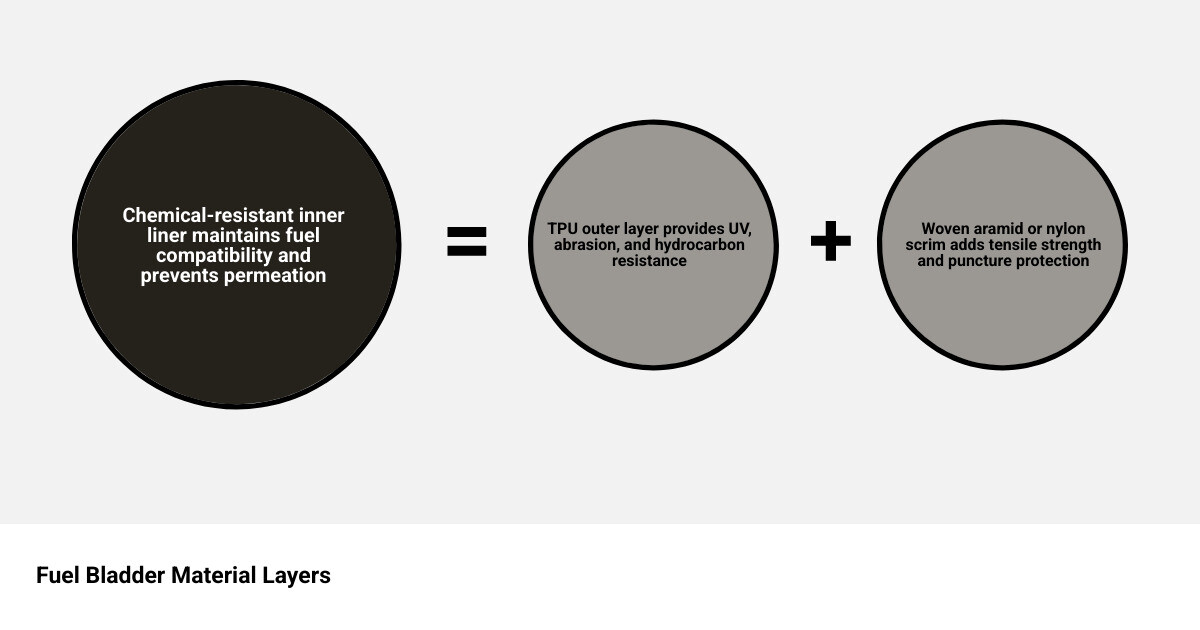
Basic durable fuel bladder materials terms:
Primary Elastomers and Polymers in Fuel Bladder Construction
Selecting the correct polymer is the foundation of engineering a dependable flexible containment system. The chemical interactions between the stored fuel and the containment wall dictate the rate of permeation, physical swelling, and structural degradation over time.
In commercial, industrial, and marine operations, the choice typically comes down to a balance of chemical resistance, mechanical strength, and cost. While budget-conscious applications might lean toward standard PVC coatings, high-performance environments demand specialized elastomers capable of handling aggressive aromatic hydrocarbons without breaking down.
| Performance Metric | TPU (Thermoplastic Polyurethane) | PVC (Polyvinyl Chloride) | Nitrile Rubber (NBR) | Cast Polyurethane |
|---|---|---|---|---|
| Hydrocarbon Resistance | Excellent | Moderate | Good | Excellent |
| Puncture Resistance | Outstanding | Moderate | Good | High |
| Low-Temp Flexibility | Exceptional (-50°F) | Poor (stiffens) | Moderate | Good |
| Environmental UV Resistance | High | Moderate | Low | Moderate |
| Average Service Life | 8–12 Years | 3–5 Years | 7–9 Years | ~10 Years |
To prevent premature failure, operators must match the material’s specific resistance profile with the stored fuel’s chemical makeup. For example, storing high-aromatic fuels or modern biofuels in an incompatible bladder will rapidly leach out plasticizers, causing the material to become brittle, crack, and ultimately leak. For a deeper look at matching storage systems with volatile fuels, consult The Ultimate Compatibility Guide: Choosing the Right Fuel Bladder for Gasoline.
Thermoplastic Polyurethane (TPU) as a Durable Fuel Bladder Material
Thermoplastic Polyurethane (TPU) has emerged as the premier choice for high-performance and durable fuel bladder materials. From a molecular standpoint, TPU consists of linear segmented block copolymers composed of hard and soft segments. This unique structure yields a material that behaves like an elastomer yet can be processed with the efficiency of a thermoplastic.
TPU’s mechanical properties are highly suited for demanding fuel containment:
- Broad Operating Temperature Range: It maintains structural integrity and flexibility from -40°C up to +90°C (with some premium formulations reaching lower limits of -50°F / -46°C).
- Extended Operational Lifespan: While standard PVC bladders require replacement after 3 to 5 years, TPU-based systems regularly achieve a service life of 8 to 12 years (and up to 15 years under optimal maintenance conditions).
- Hydrocarbon Inertness: TPU offers exceptional resistance to microbial attack, weathering, and long-term exposure to diesel, jet fuel, and biofuels.
- Static Safety and Compliance: High-quality TPU formulations can be engineered to meet NFPA 30 static electricity safety standards, integrating anti-static properties that are vital during rapid fuel transfer operations.
Furthermore, TPU’s flexibility allows a massive storage system to collapse into a fraction of its filled volume. For instance, a 10,000-liter TPU fuel bladder can be folded down to a compact 0.3 cubic meters when empty, saving up to 90% of transport and storage space.
Nitrile Rubber and Polyurethane Systems
Nitrile Butadiene Rubber (NBR) and cast polyurethane have served as the workhorses of industrial and aviation fuel storage for decades. NBR, a copolymer of butadiene and acrylonitrile, offers excellent resistance to petroleum-based oils and fuels, with higher acrylonitrile content yielding better fuel resistance but reduced low-temperature flexibility.
Under standard operating conditions, nitrile rubber bladders typically deliver a reliable service life of 7 to 9 years, while cast urethane systems average around 10 years. However, real-world operational environments are exposing these traditional materials to unprecedented stresses.
Modern high-performance machinery and recycled engine-cooling fuel loops subject fuel systems to sustained heat. Recent industry testing with JP-8 fuel demonstrated that while both nitrile and polyurethane systems passed aging qualifications at 160°F, they experienced severe chemical degradation and mechanical failure after 28 days of exposure at 200°F.
This thermal vulnerability leads to premature failure modes—such as micro-cracking, delamination of the inner liner, and accelerated fuel vapor permeation—often reducing the actual service life of these systems to under three years in demanding applications.
Advanced Reinforcements: High-Performance Aramids and Woven Fabrics
An elastomer alone cannot withstand the hydrostatic pressures and physical impacts associated with mobile fuel storage. To prevent stretching, ballooning, and tearing, the elastomer must be molecularly bonded to a high-strength woven fabric matrix.
This internal reinforcement layer typically consists of high-tenacity polyester or nylon woven scrims, ranging from 840D to 1680D (denier). For mission-critical, high-stress, or extreme impact environments, advanced para-aramid fibers like Kevlar® are utilized.
The integration of advanced aramid reinforcements, such as the next-generation Kevlar® EXO™, has revolutionized crash-resistant and puncture-resistant fuel bladder design. Kevlar® EXO™ utilizes a modified molecular structure incorporating a third monomer, yielding significantly higher molecular alignment and strength.
Key advantages of these advanced aramid reinforcements include:
- Extreme Thermal Stability: A decomposition temperature exceeding 500°C (932°F) with inherent flame resistance; the material will not melt or support combustion.
- Unmatched Puncture and Tear Resistance: Exceptional protection against sharp debris, shrapnel, and structural impact without adding bulk.
- Substantial Weight Reduction: Delivers ballistic-grade and crash-resistant protection at a fraction of the weight of traditional multi-ply rubber bladders, matching the lightweight profile of high-end polyethylene while retaining the flexibility of a soft aramid.
- Sustained Integrity: Maintains its protective and structural properties over extended service lifetimes, ensuring that the bladder is as resilient after five years of field deployment as it was on day one.
Puncture and Impact Resistance in Extreme Environments
In rugged industrial deployments, marine environments, and commercial transport, fuel bladders are subjected to constant dynamic forces. On a vessel’s deck, auxiliary fuel bladders experience continuous shifting, salt spray, and physical abrasion. In land transport or remote mining sites, ground debris and vehicle vibrations pose constant puncture risks.
Integrating high-tensile woven matrices ensures that the bladder can withstand these localized stresses. High-tenacity nylon and polyester scrims provide excellent tensile strength (often exceeding 700 lbs warp/fill) and high tear resistance. This structural reinforcement prevents a minor scratch from propagating into a catastrophic tear under the hydrostatic pressure of several hundred gallons of fuel.
Key Performance Requirements, Industry Standards, and Testing
Commercial and industrial fuel bladders must comply with rigorous engineering standards to ensure safety and environmental protection. Manufacturers design and test these systems to withstand extreme hydrostatic pressures, mechanical forces, and environmental exposure.
Key commercial testing protocols include:
- Hydrostatic Pressure Testing: Verifies that the bladder can withstand internal pressures far exceeding normal operating limits (often up to 600 psi for specific reinforced fabrics) without leaking or bursting.
- Tensile and Tear Testing: Measures the force required to rupture the fabric or propagate a tear, ensuring the bladder can handle rough handling and physical stress.
- Permeation Testing: Quantifies the rate at which fuel vapor escapes through the bladder wall, which is critical for environmental compliance and minimizing fuel loss.
Understanding these material limits is vital when comparing flexible systems to rigid alternatives. For a comprehensive analysis of how rigid structures fail under extreme conditions where flexible bladders survive, see Understanding Rigid Tank Structural Limits in Extreme Environments.
Thermal Limits and High-Temperature Durable Fuel Bladder Materials
As modern engines and industrial systems run hotter, the thermal limits of fuel bladders have become a critical engineering focus. While standard fuel bladders are historically qualified for continuous service only up to 135°F, real-world applications often experience temperature spikes of 300°F to 400°F at the bladder inlet, with sustained operating temperatures hovering between 200°F and 250°F.
At these elevated temperatures, conventional elastomers undergo thermal-oxidative degradation, leading to a loss of tensile strength, increased swelling, and premature cracking. To solve this, advanced high-temperature elastomers are utilized:
- Hydrogenated Nitrile Butadiene Rubber (HNBR): HNBR compounds retain their mechanical properties and fuel resistance after prolonged exposure to fuels at 225°F, while maintaining excellent low-temperature flexibility down to -65°F.
- Epichlorohydrin (ECO): ECO compounds exhibit superb resistance to high-temperature fuel aging and ultra-low fuel permeation. However, they offer only marginal low-temperature flexibility below -40°F, making them less suitable for extreme cold-weather operations compared to HNBR.
Manufacturing Innovations and Quality Control Standards
The durability of a fuel bladder is only as good as its seams and fittings. Traditional manufacturing methods relied heavily on manual, artisan-dependent lay-up processes that could take up to 60 days per bladder, introducing a high risk of human error, inconsistent seam strength, and frequent rework.
Modern manufacturing innovations have transformed this landscape:
- High-Frequency (HF) / Radio Frequency (RF) Welding: This process uses electromagnetic energy to agitate the molecules of the polymer coatings, fusing them together at the molecular level. This creates a seam that is actually stronger than the surrounding parent material, eliminating the risk of adhesive failure.
- Calendared Inner Liners: Precision-calendared elastomer liners ensure uniform thickness and eliminate microscopic pinholes, drastically reducing fuel permeation.
- Rigorous Testing Protocols: Every high-quality bladder undergoes ASTM D471 fluid aging tests, weld peel strength evaluations, and comprehensive pressure testing before leaving the factory.
Proper handling and deployment are equally critical to preserving these manufactured properties. To learn more about the operational best practices that protect these advanced materials in the field, read The Big Guide to Large Fuel Bladder Safety and Handling.
Selecting Durable Fuel Bladder Materials for Commercial and Marine Applications
In commercial marine and offshore operations, space is always at a premium, and the environment is unforgiving. Saltwater exposure, continuous vessel motion, and UV radiation will rapidly degrade substandard materials.
For these demanding applications, flexible TPU fuel bladders provide a highly durable, space-saving alternative to heavy, corrosion-prone metal or fiberglass tanks.
When selecting a bladder for marine or offshore use, operators should prioritize:
- Dynamic Stability (Baffling): Marine bladders should feature internal baffling to reduce fuel sloshing, which can destabilize a vessel in rough seas.
- Space-Saving Footprints: “Space Saver” or low-profile “Pillow” designs allow operators to maximize deck space or fit auxiliary fuel into tight, otherwise unusable compartments.
- Heavy-Duty Fitting Reinforcements: The connection points between metal flanges and the flexible bladder wall must be heavily reinforced to withstand the constant stress of vessel motion.
To explore how flexible marine containment systems are designed, deployed, and secured, read The Ultimate Guide to Marine Bladder Tanks and Storage. For a direct comparison of how these systems stack up against traditional rigid tanks, see Flexible Tanks vs Rigid Tanks: Why Custom Bladders Win Every Time.
A one-size-fits-all approach does not work for specialized commercial operations. Custom-engineered bladders are often required to match specific dimensions, fuel types, and mechanical connections. Discover why custom solutions are the preferred choice for commercial operators in Why Custom Fuel Bladders Are the Ultimate Flexible Storage Solution.
Frequently Asked Questions about Durable Fuel Bladder Materials
What is the typical lifespan of a TPU-based fuel bladder?
Under normal operating conditions and with proper maintenance, a high-quality TPU-based fuel bladder has an expected service life of 8 to 12 years (and up to 15 years in some light-duty applications). In comparison, standard PVC bladders generally last only 3 to 5 years before UV exposure and fuel contact render them brittle.
Lifespan is highly dependent on environmental factors, handling practices, and storage conditions. For a detailed breakdown of how flexible bladders compare to permanent rigid tanks over their life cycles, consult Fuel Bladder vs Fuel Tank. To maximize the return on your investment, implement the practical maintenance tips outlined in How to Extend Fuel Bladder Lifespan with 5 Easy Changes.
Can these materials safely store both gasoline and diesel?
Yes, but material selection is critical. While diesel is relatively non-aggressive, gasoline contains highly volatile aromatic hydrocarbons that will rapidly degrade standard PVC and low-grade rubbers.
For gasoline storage, premium fuel-grade TPU is highly recommended due to its superior chemical resistance and low permeation rates. Always confirm with the manufacturer that both the elastomer and the adhesive/welding systems used in the bladder are rated for gasoline and high-aromatic fuel contact before deployment.
How do temperature spikes affect fuel bladder durability?
Extreme heat accelerates the chemical degradation of standard elastomers. While conventional nitrile rubber and polyurethane bladders perform reliably at temperatures up to 135°F, exposure to sustained heat above 160°F—or temperature spikes up to 200°F and beyond—causes rapid loss of tensile strength, micro-cracking, and seam delamination.
For high-temperature environments, specialized elastomers like HNBR (Hydrogenated Nitrile) or ECO (Epichlorohydrin) must be selected to prevent premature structural failure.
Conclusion
The reliability of your flexible fuel containment system begins and ends with material science. From high-performance Thermoplastic Polyurethane (TPU) that delivers up to 12 years of service, to advanced aramid reinforcements like Kevlar® that provide puncture resistance without added weight, selecting the correct durable fuel bladder materials is essential for operational success.
For operators looking to safely extend their range, secure backup fuel capacity, or deploy temporary fuel storage, Techno Tanks designs and manufactures premium, flexible fuel bladders. Built with high-grade, fuel-compatible TPU and reinforced with high-tenacity fabrics, Techno Tanks’ systems are engineered to withstand the harshest marine and commercial environments.
Techno Tanks fuel bladder pricing depends on size, fuel type, configuration, application, custom requirements, and project scope. To get accurate pricing tailored to your specific fuel storage, transfer, and sizing requirements, contact our engineering team today.
Request a Custom Quote for Marine Fuel Bladders or visit Techno Tanks to explore our complete range of flexible fuel storage solutions.

