
Why a Flexible Marine Tank Could Change the Way You Cruise
A flexible marine tank is one of the smartest upgrades a boat owner can make — especially if you’ve ever had to cut a trip short because you ran out of fuel.
Quick answer: What is a flexible marine tank?
| Feature | Details |
|---|---|
| What it is | A collapsible bladder made from flexible material that stores fuel, water, or other liquids on a vessel |
| How it works | Unfolds flat when empty, expands to full shape when filled — no rigid shell required |
| Common sizes | 100L (25 gal) up to 1,000,000L (260,000 gal) |
| Main materials | Thermoplastic polyurethane (TPU) or urethane-coated fabric |
| Key benefit | Fits in spaces a rigid tank cannot — under decks, in bilges, or on open deck |
| Common uses | Fuel range extension, potable water storage, disaster relief, military logistics |
Most boat owners don’t realize how much usable space they’re leaving on the table with a rigid tank setup. Traditional tanks are fixed in size, fixed in location, and fixed in shape. A flexible bladder works around your boat — not the other way around.
Flexible bladder tanks can be fitted into irregular spaces, removed when not in use, and scaled to exactly the volume you need. A 10m³ tank, for example, folds down to just 0.25m³ when empty — small enough to store in a locker until your next long run.
This guide walks you through everything you need to know: materials, sizing, installation, plumbing, and safety.
I’m Ivan Jimenez, founder of Digital Ivan and Doral SEO, where I build authority content systems for industrial and technical brands — including hands-on research into practical solutions like the flexible marine tank for real-world vessel operators. As you read through this guide, you’ll find everything organized to help you make a confident, informed decision about your own setup.
Important flexible marine tank terms:
What is a Flexible Marine Tank and How Does It Work?
At its core, a flexible marine tank—often referred to as a pillow tank or bladder tank—is a collapsible, heavy-duty liquid storage container. Unlike traditional metal or plastic tanks that maintain their rigid shape regardless of whether they are full or empty, a flexible bladder dynamically expands and contracts based on the volume of liquid inside.
This bladder design allows it to function as a highly efficient collapsible storage unit. When you fill the tank, it rises to its specified height; as you draw liquid out, the tank collapses down, eliminating empty air space inside. This simple physical mechanism is incredibly beneficial for liquid transport at sea, as it prevents the dangerous sloshing and shifting of weight that can compromise a vessel’s stability.
To understand the fundamental differences in how these two systems handle fuel and water, check out our in-depth breakdown of Fuel Bladder vs Fuel Tank.
Materials and Durability of a Flexible Marine Tank
When you are out on the open ocean, the last thing you want to worry about is a tank rupture. That is why modern flexible marine bladders are engineered using cutting-edge materials.
The premier material of choice in May 2026 is Thermoplastic Polyurethane (TPU). At Techno Tanks, we use a patented, fully recyclable TPU that provides outstanding resistance to microbial attack, UV rays, and chemical degradation. TPU is incredibly tough; a standard 1.5mm TPU bladder offers immense tensile strength, allowing it to withstand extreme drops, drags, and abrasions.
To ensure the tank acts as a single, seamless unit, the seams are joined using high-frequency Radio Frequency (RF) welding. RF welding uses electromagnetic energy to fuse the polymer chains of the material together, creating a bond that is actually stronger than the surrounding fabric itself.
For an objective look at how these materials hold up under extreme stress, you can read Practical Sailor’s analysis of flexible potable water tanks, which details real-world drop and drag tests on various flexible bladders.
Comparing Rigid Tanks and Flexible Bladders
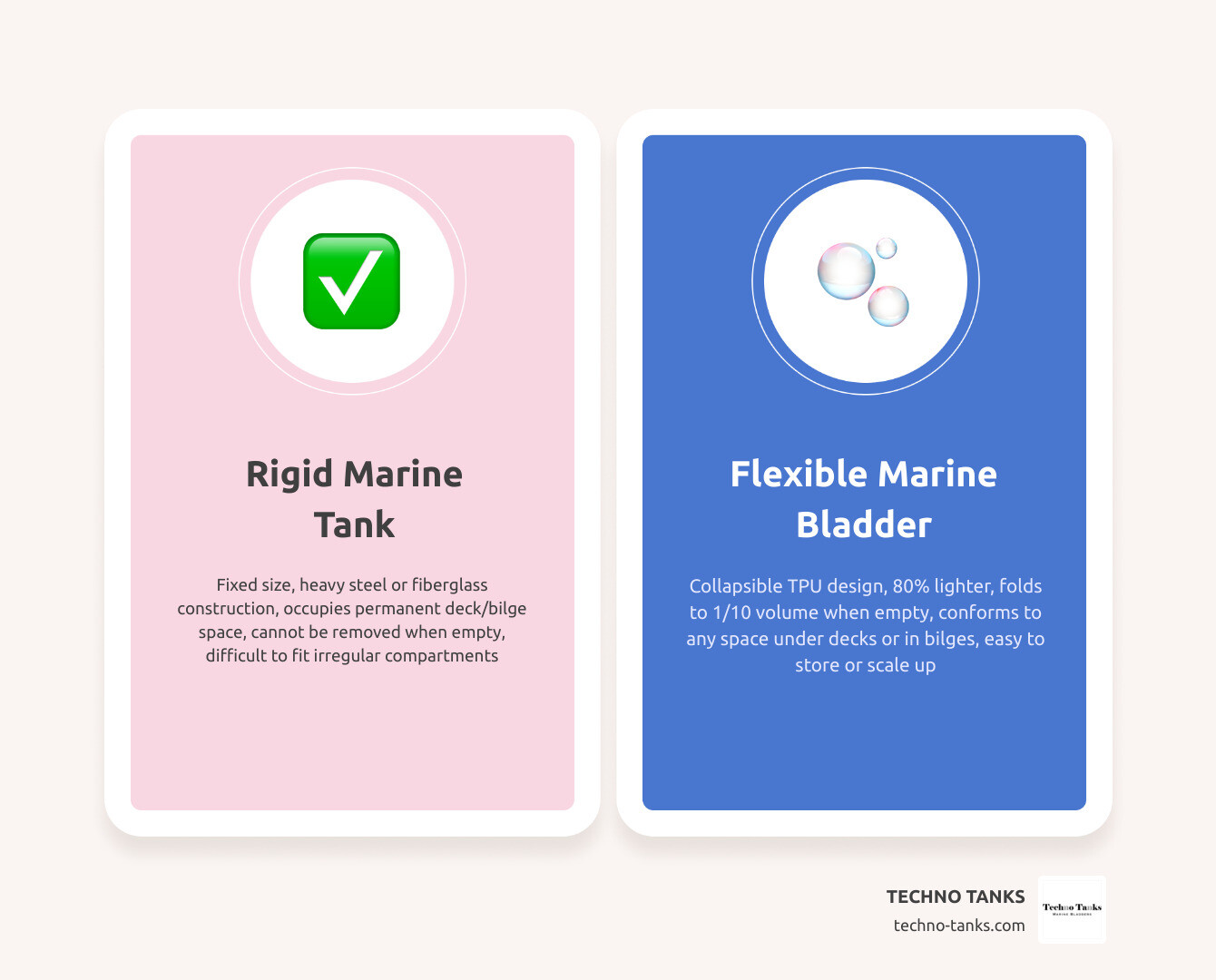
When deciding between a traditional rigid tank and a flexible bladder, the choice often comes down to weight savings and the physical footprint of the storage system. Rigid tanks require dedicated, permanent space and add constant dead weight to your vessel, even when completely dry. Flexible bladders, on the other hand, can be rolled up and stowed away in a small locker when they are not in use.
| Feature | Rigid Marine Tank | Flexible Marine Bladder |
|---|---|---|
| Empty Weight | Heavy (metal or thick molded plastic) | Lightweight (collapsible fabric/TPU) |
| Space Utilization | Fixed footprint; requires a dedicated compartment | Adapts to irregular spaces; rolls up when empty |
| Air Headspace | Yes (allows condensation and fuel degradation) | No (collapses to eliminate air pockets) |
| Installation | Complex; often requires cutting hatches or decks | Simple; rolls out and connects in minutes |
| Customization | Expensive tooling for custom shapes | Easily tailored to unique dimensions |
For a deeper dive into the mechanical and logistical benefits of these space-saving systems, explore our guide on Collapsible Fuel Tanks.
Key Applications: From Yachting to Marine Conservation
The versatility of the flexible marine tank makes it indispensable across a wide range of maritime sectors. From recreational boaters aiming to cross oceans to emergency crews delivering life-saving resources, these bladders solve the age-old logistical challenge of carrying extra liquid without permanently sacrificing deck space.

For adventurous boaters, long-range cruising requires careful calculation of fuel reserves. A flexible bladder allows you to temporarily carry hundreds of extra gallons of fuel for the outward journey and simply roll the bladder up once empty, leaving your decks clear for fishing or relaxing on the return leg. You can learn more about configuring your vessel for these extended journeys in our guide on Flexible Diesel Tanks and Long Range Upgrades.
Beyond recreational yachting, these systems play a massive role in global logistics, oil spill recovery, and disaster relief. Heavy-duty towable bladders, such as the Canflex Sea Slug series, are utilized worldwide to transport up to 250 m³ of fresh drinking water or recovered oil through open ocean currents. To see how these systems are deployed during humanitarian crises, read about Towable Water Storage Bladders for Disaster Relief.
Fuel and Water Storage for Boats and Yachts
For the average boat owner, a bladder represents the ultimate tool for range extension. Whether you are planning a transit to the Bahamas or heading offshore to the canyons for a multi-day fishing tournament, carrying auxiliary fuel safely is paramount.
Using a temporary deck bladder eliminates the need to carry dangerous, unstable plastic jerry cans. Instead, a single, secure bladder can hold anywhere from 30 to 3,000 gallons of fuel, feeding directly into your main fuel system via a transfer pump.
- To get started with the basics of auxiliary marine fuel systems, check out our Beginners Guide to Fuel Bladders for Boats.
- If you have a unique deck layout or specific range goals, discover how custom designs can optimize your space in our article on how to Get a Grip on Your Range with Custom Boat Fuel Bladders.
Aquarist and Marine Life Support Systems
While we often think of marine bladders in the context of propulsion and human consumption, they are also incredibly useful for advanced aquarists and marine conservationists. Setting up a large saltwater reef aquarium or managing a commercial marine life support system requires handling vast quantities of highly conditioned saltwater.
When setting up a new system, performing massive water changes, or temporarily holding delicate corals and fish during a tank move, a flexible bladder serves as an excellent temporary holding tank. It allows you to mix and store synthetic seawater without needing to store giant, rigid plastic drums in your home or facility.
Once your saltwater reef is stable, the bladder can be dried, folded, and tucked away in a closet. To understand the water quality and environmental demands of these delicate systems, consult The Supreme Guide To Setting Up A Saltwater Reef Aquarium.
Step-by-Step Guide to Setting Up Your Flexible Marine Tank
Setting up a flexible marine tank is a straightforward process, but it requires attention to detail to ensure safety and longevity. Here is our step-by-step guide to deploying your bladder tank correctly:
- Inspect the Footprint: Before unrolling your bladder, thoroughly inspect the deck or compartment area. Ensure the surface is completely free of sharp objects, screws, fiberglass splinters, or tools.
- Position the Empty Bladder: Unroll the bladder flat in its designated location. Ensure that the filling and discharge ports are oriented in the correct direction for your plumbing run.
- Secure the Tie-Downs: Thread your heavy-duty tie-down straps through the bladder’s integrated harness loops. Secure them to robust deck cleats or structural pad eyes.
- Connect the Vent Line: Always ensure your vent line is connected and clear. As a bladder fills, air must escape freely to prevent over-pressurization.
- Begin Filling Slowly: Start filling the tank at a low flow rate. Monitor the bladder as it begins to expand to ensure it is inflating evenly and that no folds or kinks are trapped underneath.
- Secure the Cap: Once filled to its rated capacity, close the fill valve and secure the cap tightly. Double-check your tie-down straps to ensure the filled bladder cannot slide.
For a comprehensive overview of portable bladder maintenance and operations, read Everything You Need to Know About Portable Marine Tanks.
How to Install and Secure Your Flexible Marine Tank
Proper securement is the most critical safety aspect of using a flexible bladder on a moving vessel. Liquid is heavy—one gallon of water weighs approximately 8.34 pounds, and diesel weighs about 7 pounds per gallon. If a 100-gallon bladder is allowed to slide freely across a deck in rough seas, the kinetic energy can easily damage your boat’s gunwales or alter your center of gravity.
Always use dedicated, marine-grade tie-down straps rated for several times the wet weight of your filled bladder. Secure these straps to structural points on your boat, never to flimsy plastic fittings or handrails. If you are operating a smaller vessel, weight distribution is even more critical. Read our guide on The Best Portable Boat Fuel Tank for Small Vessels to learn how to position and secure temporary tanks on light boats.
Plumbing, Pumps, and Integration Options
Integrating your flexible bladder into your vessel’s existing plumbing system requires high-quality valves, hoses, and transfer pumps. For fuel setups, we recommend using a dedicated, ignition-protected 12V or 24V fuel transfer pump to move fuel from the bladder into your main rigid tank as space becomes available.
For water and waste systems, choosing the correct hose material is vital to prevent odors and permeation. This is especially true for sanitation systems. To understand the environmental and structural standards for pleasurecraft waste systems, refer to the US EPA document on the Flexible Holding Tank for Pleasurecraft Sanitary Systems – epa nepis.
If you are looking for a seamless, built-in look that perfectly matches the contours of your bilge or bow locker, explore our custom plumbing and design options in The Best Custom Marine Fuel Tanks to Keep You Cruising.
Frequently Asked Questions about Marine Bladders
Are flexible marine tanks safe for drinking water?
Yes, absolutely—provided you choose a bladder specifically certified for potable water storage. Potable water bladders must be constructed from food-grade materials that comply with FDA and NSF/ANSI standards. These specialized TPU materials do not leach chemicals or impart plastic tastes into your drinking water, ensuring your crew stays hydrated and healthy throughout your voyage.
How do you prevent fuel sloshing in a flexible tank?
Unlike rigid tanks, which require internal baffles to prevent liquid from crashing back and forth, a flexible bladder naturally minimizes sloshing by collapsing as it empties. Because there is no empty air space (headspace) inside a properly vented bladder, the liquid has no room to build up momentum.
For massive commercial transport applications, advanced modular systems like the 30000L V1 FlexConnex baffled modular tank | Rapid Spray use specialized compartmentalized sections and internal baffling technology to eliminate chassis stress and liquid surge during transport.
Can these tanks be towed behind a boat?
Yes, certain heavy-duty flexible bladders are specifically designed for towing. These are not your standard deck bladders; ocean-towable bladders feature a hydrodynamic, torpedo-shaped design optimized for stability. They are built with ultra-strong, polyurethane-coated fabrics and heavy-duty towing harnesses, allowing them to be towed through rivers, lakes, and open ocean conditions without rolling or diving.
Conclusion
Whether you are looking to extend your fishing range, carry extra fresh water for an extended cruise, or temporarily hold saltwater for an advanced reef setup, a flexible marine tank provides an elegant, space-saving solution.
At Techno Tanks, we specialize in manufacturing high-performance, eco-friendly marine fuel bladders and water tanks. Our patented, fully recyclable thermoplastic polyurethane (TPU) tanks are available in sizes ranging from 30 to 3,000 gallons, allowing us to build the perfect custom solution for your vessel.
Ready to unlock your boat’s true cruising potential? Take a look at our popular, highly versatile 80-gallon marine bladder and start planning your next long-range adventure today!

