
What Rules Apply When Carrying Extra Gasoline on a Boat?
Rules can vary by vessel type, container, fuel quantity, jurisdiction, and how the fuel is stored or connected. Use a container intended for gasoline, follow the container and vessel manufacturers’ instructions, and check the requirements that apply to your boat and location.
The U.S. Environmental Protection Agency regulates evaporative emissions from portable fuel containers and from marine spark-ignition fuel systems. State, local, marina, passenger-vessel, and manufacturer requirements may add additional restrictions.
Understanding the Dangers of Fuel Vapors
The invisible threat of gasoline vapors is arguably more dangerous than the liquid fuel itself. Gasoline vapor is heavier than air, meaning it will sink and accumulate in the lowest parts of your boat, such as the bilge or enclosed compartments. This accumulation creates a highly combustible environment.
For gasoline vapor to ignite, it needs to be present in a specific concentration with air—known as the explosive range. The lower explosive limit (LEL) for gasoline vapor in air is around 1.2 percent. This means that even a small amount of vapor, if mixed with air in the right proportion, can lead to a catastrophic explosion if an ignition source is present. Given that a boat’s engine compartment and bilge areas can easily trap these heavy vapors, proper ventilation is absolutely critical to prevent such dangerous accumulations.
What Type of Fuel Container Should You Use?
Do not rely on color or appearance alone. Use a portable fuel container or marine fuel tank that is intended for gasoline, is compatible with the intended use, and has secure closures, fittings, and venting or pressure-management features appropriate to its design.
For products sold as portable fuel containers in the United States, review the manufacturer’s labeling and documentation and confirm applicable EPA requirements. For portable marine fuel tanks connected to an outboard, also verify the tank, fuel line, connector, and engine requirements as a complete system.
Choose capacity based on the boat and trip rather than a universal “best” can size. Account for available space, the weight of the fuel when full, how the container will be secured, and how it will be filled and transferred.
Useful features to compare:
- Secure cap, closure, and seals
- Fuel-compatible materials and fittings
- Venting or pressure-management design appropriate to the container
- Clear manufacturer labeling and capacity information
- Attachment or tie-down features that allow the container to be secured
If a portable gas can is too small or awkward for the amount of auxiliary fuel your trip requires, compare that approach with Techno Tanks marine fuel bladders. A fuel bladder is a different storage format, not a substitute for checking the rules that apply to your vessel, fuel, route, and jurisdiction.
For larger removable auxiliary capacity, compare fuel bladders for boats, gasoline fuel bladders, and the fuel bladder vs. rigid tank guide.
Plastic vs. Metal Marine Gas Cans
Both plastic (HDPE) and metal marine gas cans have their pros and cons. Understanding these differences can help you make an informed choice based on your specific needs and boating conditions.
| Feature | Plastic (HDPE) Marine Gas Cans | Metal Marine Gas Cans |
|---|---|---|
| Durability | Good impact resistance, flexible, but can degrade with UV over time. | Very robust, resistant to punctures and impacts. |
| Weight | Lighter, easier to carry when full. | Heavier, especially when full, can be cumbersome. |
| Corrosion | Immune to rust and saltwater corrosion. | Susceptible to rust, especially in marine environments. |
| UV Resistance | Requires UV-stabilized plastic; can become brittle if not. | Not directly affected by UV, but paint can fade. |
| Cost | Generally more affordable. | Typically more expensive. |
| Common Capacities | Available in various sizes, often 1-6 gallons. | Often found in 5-gallon capacities, sometimes larger. |
| Maintenance | Inspect for cracks, brittleness, swelling, damaged seals, or other deterioration; replace when condition or manufacturer guidance requires. | Inspect for rust/dents; can last longer if well-maintained. |
| Venting | Integrated specialized venting systems. | Older models may have simpler vents; modern ones are improved. |
For most recreational boaters, modern HDPE plastic marine cans are a popular choice due to their lighter weight and resistance to corrosion, provided the material and container design are appropriate for the intended use and the container remains in good condition.
How Can You Safely Store and Secure Gas Cans on Your Boat?
Proper storage and securing of gas cans are paramount to preventing accidents. Gasoline vapors are heavier than air and can accumulate in enclosed spaces, creating an explosive hazard. Therefore, where and how you store your cans makes a significant difference.

Optimal storage locations are always in well-ventilated areas, ideally above deck. This allows any released vapors to dissipate safely into the atmosphere rather than collecting in dangerous concentrations. Popular spots include a dedicated area on the swim platform, a stern deck, or an open bow area, provided they are not exposed to direct engine heat or exhaust.
Avoid storing gasoline where vapors can collect near ignition sources. Do not place portable gasoline containers in bilges, engine compartments, or other enclosed areas unless the vessel and container guidance specifically allow that installation and the required ventilation and fuel-system provisions are in place. Follow the boat manufacturer’s ventilation and blower instructions rather than relying on a generic time interval.
Securing methods must be robust. In rough waters, an unsecured gas can can become a dangerous projectile or spill its contents, creating a fire hazard. We recommend using:
- Ratchet straps: These provide a strong, non-slip hold, preventing movement.
- Dedicated racks: Some boats have built-in or aftermarket racks specifically designed to hold fuel cans securely.
- Bungee cords: While useful for lighter items, ensure they are heavy-duty and used in conjunction with other securing methods for gas cans.
- Rubber bin tops: If storing on a swim platform, placing cans in rubber bins can help contain any minor spills and protect the boat’s surface.
Always prevent movement in rough waters by ensuring cans are tightly fastened. Also, protecting cans from direct sunlight and heat is vital. Heat causes gasoline to expand and vaporize, increasing internal pressure within the can. This can lead to leaks, vent cap failures, or even structural damage to the can. Store cans in shaded areas or cover them with a light-colored tarp to reflect heat.
Account for the weight of the fuel when loaded and its effect on vessel balance, stability, and capacity. Secure the container so it cannot shift, and follow the vessel manufacturer’s loading and capacity guidance.
For off-season storage, always ensure cans are empty or treated with a marine fuel stabilizer. Store them in a well-ventilated, detached shed or garage, away from ignition sources and direct sunlight. Never store fuel cans inside a shrink-wrapped boat or any enclosed space during the off-season.
Real-world experiences from boaters highlight both successful and risky storage solutions. While some have safely carried multiple cans on swim platforms for extended trips by using strong straps, others have reported losing cans overboard or experiencing fuel smells from internal storage. The consensus is clear: prioritize external, well-ventilated, and securely fastened storage.
What Are the Best Practices for Refueling from Portable Cans?
Refueling from portable gas cans requires extreme caution to prevent spills, static sparks, and the accumulation of dangerous vapors. Follow these best practices to ensure a safe and clean refueling process:
Pre-fueling checklist:
- Shut off engine and all power: Before you even open a fuel cap, turn off your boat’s engine, all electrical systems, and any open flames (e.g., galley stoves).
- Remove passengers: If possible, have all non-essential personnel disembark or move to a safe distance away from the fueling area.
- Extinguish open flames: Ensure no smoking, open flames, or spark-producing devices are nearby.
- Know your fuel type: Double-check that you are using the correct fuel for your boat’s engine.
Spill prevention techniques:
- Use funnels and siphons: Always use a marine-specific funnel with a wide mouth and a filter to prevent debris from entering your tank. Self-priming siphon hoses can also be excellent for transferring fuel without lifting heavy cans, minimizing the risk of spills.
- Keep absorbent towels handy: Have oil-absorbent towels or pads readily available to immediately wipe up any drips or spills.
- Never fill cans inside the boat: Always remove the portable can from the boat and fill it on the dock or land.
Static spark prevention: Gasoline flowing from a plastic can can generate static electricity, which can create a spark. To prevent this:
- Maintain metal-to-metal contact: When pouring fuel, keep the metal nozzle of the gas can (or funnel) pressed firmly against the metal fill pipe of your boat’s fuel tank. This grounds any static charge and prevents sparks.
Filling level:
- Leave space for expansion: Do not fill your boat’s fuel tank or the portable can completely to the brim. Gasoline expands with heat. Leave about 10% of the tank volume empty to allow for this expansion, preventing spills and pressure buildup.
- Avoid overfilling: Modern EPA-compliant spouts are designed with automatic shut-off features to prevent overfilling. While these can sometimes be challenging to use, they are a vital safety mechanism. Practice using them with an empty can first.
Post-fueling checks:
- Inspect for spills: After refueling, carefully check for any fuel spills on deck, around the fill pipe, or on the portable can itself. Clean up any spills immediately and thoroughly using absorbent materials.
- Check the bilge: Open your boat’s bilge access and sniff for any gasoline fumes. Gasoline vapors are heavier than air and will sink to the lowest point.
- Run the blower: If your boat is equipped with a bilge blower, run it for at least 4-5 minutes before starting the engine. This helps to ventilate any accumulated fumes. Never start your engine if you detect gasoline fumes.
For more detailed information on your boat’s fuel system, refer to Everything You Need to Know About Boat Fuel Tank Fittings.
Here’s a step-by-step guide for safe refueling from a portable can:
- Step 1: Prepare the Area: Turn off the engine, all electronics, and extinguish any open flames. Ensure good ventilation.
- Step 2: Position the Can: Place the portable can on a stable, level surface on the dock or land, away from the boat.
- Step 3: Open Fill Port: Open your boat’s fuel fill port cap.
- Step 4: Insert Funnel/Nozzle: Insert a marine-grade funnel into the fill port, or if using a can with an integrated nozzle, ensure it makes metal-to-metal contact with the fill pipe.
- Step 5: Pour Slowly: Carefully and slowly pour the fuel from the portable can into the boat’s tank. Do not rush.
- Step 6: Stop Before Full: Leave approximately 10% of the tank empty to allow for fuel expansion. Do not rely solely on automatic shut-off features; maintain control.
- Step 7: Clean Up: Immediately wipe up any spills with absorbent pads.
- Step 8: Secure Caps: Tightly close both the boat’s fuel cap and the portable can’s cap.
- Step 9: Ventilate: Run the bilge blower for 4-5 minutes (if applicable) and check for fumes before starting the engine.
How Does Carrying Extra Fuel Affect Your Boat’s Performance and Planning?
While carrying extra fuel can extend your range and provide peace of mind, understand its impact on your boat’s performance and how to incorporate it into your trip planning.
The most immediate effect is the impact of added weight on boat balance, handling, and stability. Gasoline weighs approximately 6.3 pounds per gallon. If you carry, say, 12 gallons of extra fuel, that’s nearly 76 pounds added to your vessel. This additional weight can:
- Alter trim: Your boat might sit lower in the water, especially if the weight is concentrated in one area.
- Affect handling: Steering and maneuverability can change, particularly in rough seas.
- Reduce stability: A heavier boat can sometimes feel more sluggish or less responsive.
- Increase fuel consumption: More weight means your engine has to work harder to achieve the same speed, leading to higher fuel burn. This is a crucial planning consideration, as the extra fuel you carry can paradoxically make your boat less fuel-efficient.
Calculating fuel burn for a boat differs significantly from automotive fuel economy. Boats typically measure fuel consumption in Gallons Per Hour (GPH) rather than Miles Per Gallon (MPG). To plan effectively, you need to know your boat’s GPH at various RPMs and speeds. Always factor in the additional weight of extra fuel when estimating your GPH for a trip.
The “Rule of Thirds” for fuel planning is a golden standard in boating:
- One-third of your fuel for the journey out.
- One-third of your fuel for the journey back.
- One-third of your fuel as a reserve for emergencies, unexpected detours, or adverse weather conditions.
This rule provides a crucial safety margin, ensuring you’re never caught short. When carrying extra portable fuel, you can factor it into this calculation, but always prioritize transferring it to your main tank as soon as safely possible.
For planning for remote areas or multi-day trips, extra fuel is often a necessity. However, meticulous planning is required. Map out potential refueling stops, understand their operating hours, and consider the quality of fuel available.
Finally, if you plan to store gasoline in portable cans for any length of time, the importance of fuel stabilizer cannot be overstated. Untreated gasoline can start to degrade in as little as 30 days, leading to gum and varnish deposits that can clog fuel systems and damage engines. A good marine fuel stabilizer can keep gasoline fresh for a year or longer, preserving its quality for when you need it. For more insights into long-range fuel planning, check out Fuel for Thought: The Essentials of Long Range Cruising.
Fuel Consumption and Weight
Understanding how each gallon of fuel, approximately 6.3 lbs, adds to your boat’s displacement is key. This added weight directly translates to increased resistance in the water, forcing your engine to burn more fuel to maintain speed. For example, if your boat typically burns 5 GPH at a cruising speed of 25 knots, adding 50 pounds of extra fuel might increase that to 5.2 GPH. While this might seem minor, over a long trip, it can significantly impact your total fuel needs. We often recommend adjusting your trim and speed to compensate for the extra load, finding the most efficient RPM for your current conditions.
What Are the Alternatives to Carrying Portable Gas Cans, and What if a Spill Occurs?
While portable gas cans serve a purpose, they are not the only solution for extending your range, and they come with inherent risks. Exploring alternatives for extending range can offer safer and more convenient options:
- Larger Built-in Fuel Tanks: If your boating habits frequently require more fuel, investing in a larger, permanently installed fuel tank might be the most practical long-term solution. This eliminates the need for portable cans altogether.
- Marina Refueling: Planning your trips around available marinas and fuel docks is often the safest and most convenient option. Although marine fuel can be more expensive, the peace of mind and reduced risk of handling fuel on board are often worth the cost.
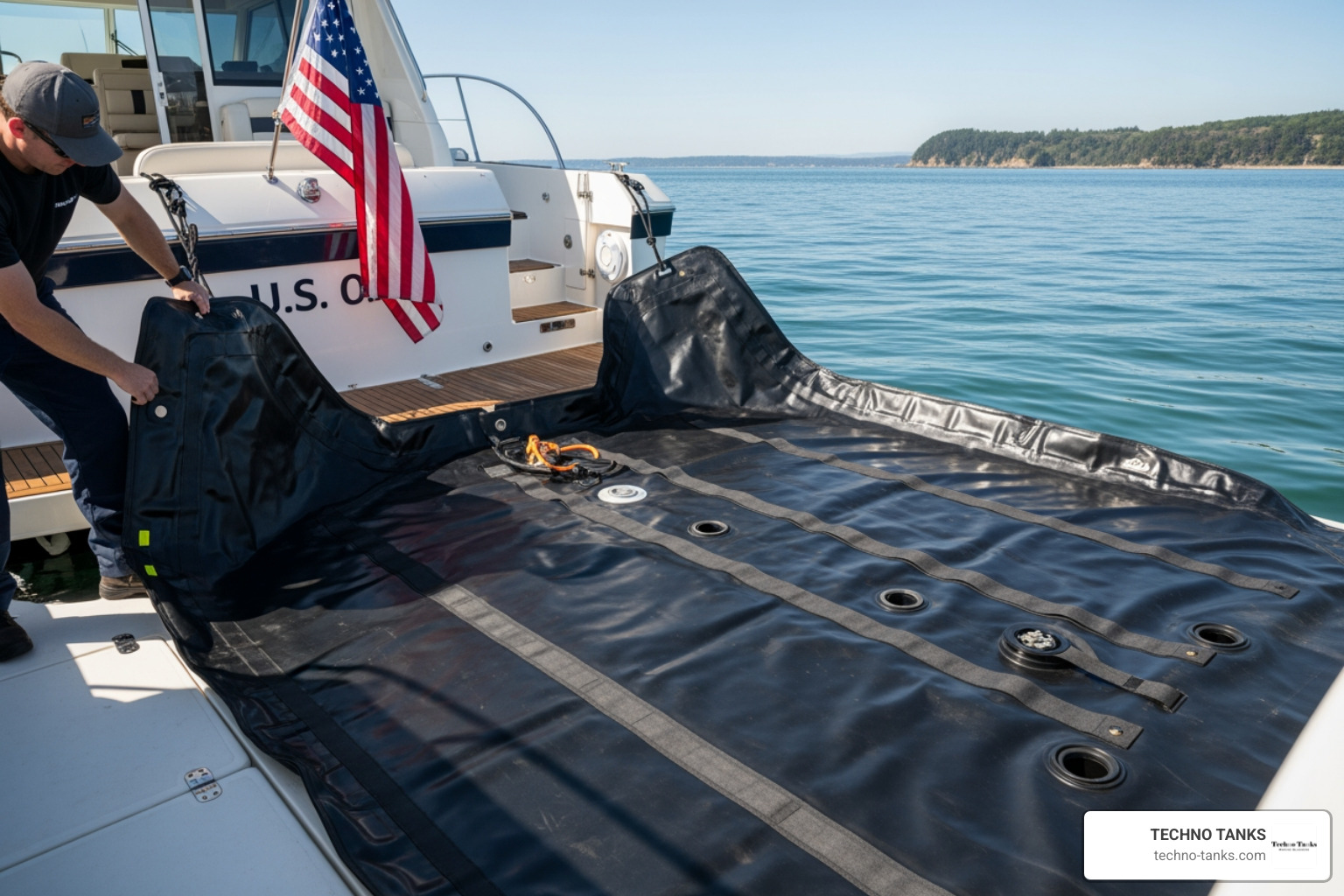
- Marine Fuel Bladders: For those needing significant temporary or auxiliary fuel capacity, Techno Tanks offers an innovative solution. Our patented, recyclable thermoplastic polyurethane fuel bladders are designed to provide flexible and efficient fuel storage. Available in sizes ranging from 30 to 3000 gallons, these bladders offer a substantial increase in range without the rigid constraints and handling difficulties of multiple small cans. They are ideal for extended fishing trips, long-distance cruising, or reaching remote destinations, providing a safer, more integrated temporary fuel storage solution. For more details, explore Fuel Bladder vs Fuel Tank, How to Transfer Fuel from a Fuel Bladder, and Temporary Fuel Storage.
However, despite all precautions, spills can happen. It’s crucial to know what to do if a spill occurs or you suspect a leak in the bilge.
Emergency Spill Response
Immediate Actions to Take:
- Stop the Source: If a spill occurs from a portable can, immediately upright it and secure the cap. If it’s a leak from your boat’s system, try to identify and stop the source if it’s safe to do so.
- Containment: Use oil-absorbent pads, socks, or rags to contain the spill on deck or in the bilge. Prevent fuel from entering the water.
- Ventilate: If fumes are present, especially in enclosed spaces, immediately open all hatches, doors, and run the bilge blower (if safe and no ignition source is present).
- No Ignition Sources: Absolutely no smoking, open flames, or engine starts until the area is thoroughly ventilated and all fumes have dissipated.
- Move to Open Water: If the spill is significant and you are near shore or in a sensitive area, and it is safe to do so, move your vessel to open water to help disperse fumes and minimize environmental impact.
Notifying Relevant Authorities:
- Report Spills: For any significant spill into the water, you are legally obligated to report it. In the U.S., contact the National Response Center (NRC) at 1-800-424-8802. State and local authorities may also need to be notified.
- Environmental Impact: Marine fuel spills can have devastating effects on marine ecosystems, harming wildlife, contaminating shorelines, and impacting water quality. Prompt reporting and cleanup are essential to mitigate this damage.
What to do if you suspect a leak in the bilge:
- Do NOT Start the Engine: This is the most critical rule. A spark from your engine’s starter can ignite accumulated fumes.
- Ventilate Immediately: Open all hatches, doors, and run the bilge blower for an extended period (at least 15 minutes or more, depending on the severity of the fumes).
- Investigate Safely: Once the area is thoroughly ventilated and you no longer detect fumes, carefully investigate the source of the leak using a flashlight (never a flame).
- Address the Leak: Repair the leak if possible, or take immediate steps to contain it. Do not operate the boat until the leak is resolved and the area is completely free of fumes.
Frequently Asked Questions about Carrying Gas Cans on Boats
How often should I replace my marine gas can?
Can I use a regular red gas can for my boat?
No, standard red gas cans are not designed for the marine environment. They lack the UV resistance, proper seals, and specialized venting required to safely handle the pressure changes and conditions encountered on the water. Using them poses serious safety risks due to potential leaks, vapor buildup, and material degradation from sun and saltwater exposure. Always opt for fuel containers intended for the vessel and fuel.
What happens if my boat runs out of gas?
Running out of gas can leave you stranded, potentially in dangerous waters or adverse weather conditions. It can lead to costly towing fees, create safety hazards for you and your passengers, and even result in fines in some areas if your disabled vessel causes a navigational obstruction or an environmental incident. Proper fuel planning, including the “Rule of Thirds,” and carrying appropriately stored extra fuel are essential to avoid this scenario.
Conclusion
Carrying a gas can on your boat is a practical solution for extending your range and ensuring peace of mind on the water, but it demands meticulous attention to safety and adherence to regulations. By choosing appropriate containers, storing them securely, practicing safe refueling techniques, and planning your fuel needs diligently, you can mitigate the inherent risks associated with handling highly flammable fuel. Responsible boating means prioritizing safety for yourself, your passengers, and the delicate marine environment. For those seeking advanced solutions for extended range and greater capacity, exploring options like marine fuel bladders can offer even greater flexibility and a more integrated approach to fuel management.
Need more auxiliary capacity? Compare marine fuel bladder sizes and dimensions or review Techno Tanks marine fuel bladder options.

