
What Are Fuel Transfer Bladders — and Do You Need One?
Fuel transfer bladders are collapsible, flexible containers engineered to safely store and move diesel, gasoline, jet fuel, and other hydrocarbon-based fuels — without the weight, permanence, or installation complexity of rigid tanks.
Quick answer for buyers:
| Question | Answer |
|---|---|
| What is it? | A flexible, collapsible fuel container for temporary storage or transfer |
| Who uses them? | Commercial marine operators, offshore crews, industrial sites, emergency response teams |
| Fuel compatibility | Diesel, gasoline, biodiesel, jet fuel, lubricants |
| Capacity range | 25 gallons up to 210,000 gallons |
| Key advantage | Folds to less than 5% of its volume when empty |
| Deployment time | Hours, not weeks |
| Mounting (marine) | Above deck only — Coast Guard regulations prohibit in-hull placement |
| Pricing | Request a quote based on size, fuel type, and application |
If you operate a commercial vessel, run extended offshore missions, manage remote fuel logistics, or need auxiliary capacity without a permanent installation — a fuel transfer bladder is likely the most practical solution available.
Unlike rigid steel or polyethylene tanks, a fuel bladder conforms to available space, collapses flat when empty, and deploys wherever you need it. A 7,500-gallon bladder lays flat at roughly 19.9 × 18.8 feet when empty — and can be rolled up and transported when the job is done. A 150-gallon marine bladder packs into a box roughly 48″ × 48″ × 15″ when deployed, and folds down to almost nothing for storage.
The engineering behind them matters. Not all bladders are built the same. Material selection, seam construction, fitting hardware, and baffle configuration all determine whether a bladder performs reliably under real operating conditions — or fails when it counts.
This guide covers everything operators and buyers need to know: materials, components, sizing, deployment, safety regulations, and how to select the right bladder for your application.
Easy fuel transfer bladders glossary:
Understanding Fuel Transfer Bladders: Flexible vs. Rigid Tanks
For commercial operators, the choice between temporary, flexible storage and permanent, rigid infrastructure is driven by logistics, weight, and operational efficiency. Traditional rigid tanks—constructed from steel, aluminum, or high-density polyethylene (HDPE)—impose a permanent physical and weight footprint on a vessel deck, truck bed, or staging site.
When a rigid tank is empty, it still occupies 100% of its physical volume. It continues to draw down payload capacity, restrict deck space, and add dead weight to the transport vehicle or vessel.
Flexible fuel bladders solve this operational bottleneck through volume efficiency. When empty, a high-quality fuel transfer bladder can be folded or rolled to less than 5% of its total filled volume. For example, a heavy-duty 10,000-gallon industrial fuel bladder can be collapsed down to fit into a compact space of roughly 0.3 cubic meters when empty. This allows operators to reclaim critical deck space or transport capacity immediately after the fuel transfer is complete.
To understand the core differences between these two systems, consider the following technical comparison:
| Operational Parameter | Flexible Fuel Bladders (Techno Tanks) | Traditional Rigid Fuel Tanks (Legacy Systems) |
|---|---|---|
| Empty Footprint | Collapsible to < 5% of active volume; rollable and stackable | 100% of physical volume is retained permanently |
| Dead Weight | Extremely low (e.g., a 300-gallon bladder weighs ~41.5 lbs empty) | High (hundreds to thousands of pounds of permanent structural weight) |
| Installation Time | Rapid deployment (minutes to hours; no specialized tools) | Weeks (requires structural mounting, welding, or site concrete prep) |
| Seismic & Impact Resistance | High flexibility; absorbs shocks, vibrations, and structural shifts | Rigid; prone to stress cracking, weld fatigue, and structural failure |
| Maintenance | No rust, corrosion, or internal scaling; simple wash-and-dry protocol | Requires continuous rust prevention, internal scaling removal, and weld inspections |
| Customization | Easily tailored to complex geometries and specific deck footprints | Highly expensive and difficult to modify once fabricated |
By opting for flexible containment, operators eliminate the logistical headaches of shipping empty rigid tanks back to a base of operations. Instead, depleted bladders are rolled up, packed into standard transport cases, and shipped back via standard freight at a fraction of the cost.
For a deeper dive into how flexible systems outperform permanent tanks across various industrial and marine applications, read our analysis on Flexible Tanks vs Rigid Tanks: Why Custom Bladders Win Every Time.
Material Science and Key Components of Flexible Tanks
The reliability of a fuel transfer bladder depends on the molecular integrity of its fabric and the manufacturing processes used to seal its seams. Because these bladders hold volatile, flammable hydrocarbons, there is no margin for material degradation or seam failure.
High-performance bladders rely on advanced Radio Frequency (RF) welding (also known as dielectric welding). Unlike adhesive gluing or hot-air welding, which can degrade when exposed to fuel over time, RF welding uses electromagnetic energy to fuse the polymer molecules of the fabric layers together. This creates a single, continuous, homogeneous bond that is physically stronger than the base fabric itself.
Material Selection: Why Fuel-Grade TPU is Essential (and Why PVC Fails)
The choice of polymer coating is the single most critical factor in determining a bladder’s lifespan, chemical resistance, and safety profile.
- Thermoplastic Polyurethane (TPU): High-grade fuel transfer bladders are constructed from heavy-duty, TPU-coated high-tenacity polyester or nylon fabrics (typically 40 oz/yd² to 50 mil thickness). TPU is highly resistant to hydrocarbon-induced swelling, cracking, and degradation. It maintains its structural flexibility across an extreme temperature range of -40°C to +90°C. Furthermore, TPU compounds are engineered with specialized static-dissipative additives to meet strict static safety standards (such as NFP 30), preventing the build-up of dangerous electrostatic charges during high-velocity fuel transfers.
- Polyvinyl Chloride (PVC): While PVC-coated fabrics are common in water storage bladders due to their lower cost, they are highly unsuitable and unsafe for fuel transfer. Hydrocarbons act as aggressive plasticizer-extraction agents on PVC. When fuel comes into contact with PVC, it rapidly leaches out the plasticizers that give the material its flexibility. Within a short period, the PVC fabric becomes brittle, cracks under stress, and suffers catastrophic failure. PVC also lacks the static-dissipative qualities required to safely handle low-flashpoint fuels like gasoline.
For long-term commercial operations, TPU-coated bladders provide an operational lifespan of 8 to 12 years with proper care, whereas PVC-based alternatives typically fail within 1 to 3 years.
Valves, Vents, and Fittings for Fuel Transfer Bladders
A flexible bladder requires high-integrity, fuel-compatible hardware to connect to external transfer lines, pumps, and venting systems.
- Dual-Action Flanges: Premium bladders utilize anodized aluminum or stainless steel flanges equipped with fuel-impermeable Viton seals. These flanges distribute mechanical stress evenly across the fabric interface to prevent leaks at connection points.
- Camlock Fittings: Standard configurations feature 2-inch or 3-inch male aluminum camlocks (complying with A-A-59326 specifications) for rapid, leak-free connection and disconnection of fill and discharge hoses.
- Venting and Spark Arrestors: To prevent pressure build-up from fuel expansion and vapor generation, bladders are equipped with dedicated vent ports. High-capacity systems include a vented spark arrestor to prevent external ignition sources from entering the bladder.
- Quick Disconnects: For marine and smaller-scale industrial applications, quick-disconnect fittings allow operators to transition lines without fuel spillage or the need for hand tools. To understand how to select and integrate these components into your system, refer to our comprehensive guide on No Tools No Leaks: How to Choose and Install Quick Disconnect Fuel Line Fittings.
Operational Performance, Deployment, and Safe Transfer Procedures
Operating a fuel transfer bladder on a vessel deck or a mobile industrial platform requires careful attention to fluid dynamics and safety protocols.
Baffled vs. Un-Baffled Performance
When a vessel encounters rough seas or a transport vehicle negotiates uneven terrain, the fuel inside a partially filled bladder shifts rapidly. This shifting—known as “sloshing”—creates dynamic kinetic forces that can destabilize the vessel or vehicle, causing dangerous handling characteristics.
To mitigate this, bladders can be ordered in either baffled or un-baffled configurations:
- Baffled Bladders: These feature internal, flexible fabric partitions that restrict the rapid lateral and longitudinal movement of fuel. Baffles keep the fluid mass centered, drastically reducing the impact of sloshing on vessel stability. While baffled bladders carry a higher manufacturing cost due to their internal complexity, they are highly recommended for offshore marine operations and high-mobility transport.
- Un-Baffled Bladders: These consist of a single open chamber. They are highly efficient and cost-effective for land-based static staging or calm-water operations where dynamic movement is minimal.
Siphon, Gravity, and Pump-Assisted Transfer
Fuel can be extracted from a bladder using gravity flow, siphon systems, or active pump systems. For gasoline transfers, gravity or manual siphon flow is often preferred to eliminate electrical ignition risks. When high-velocity transfer is required, operators must use explosion-proof, self-priming 12V or 24V DC pumps rated specifically for the fuel type being moved.
Compliance and Secondary Containment
For land-based deployments, environmental regulations (such as the EPA’s Spill Prevention, Control, and Countermeasure (SPCC) rules) require secondary containment. Any bladder storing fuel must be housed within a secondary containment berm capable of holding 110% of the bladder’s total capacity to prevent environmental contamination in the event of a physical puncture.
For detailed, step-by-step instructions on managing these transfers safely, consult How to Transfer Fuel from a Fuel Bladder. For operators looking to extend their vessel’s transit capabilities, Keep Your Boat Buzzing with These Foldable Marine Fuel Transfer Tanks provides an excellent operational blueprint.
Step-by-Step Deployment and Securing Protocol
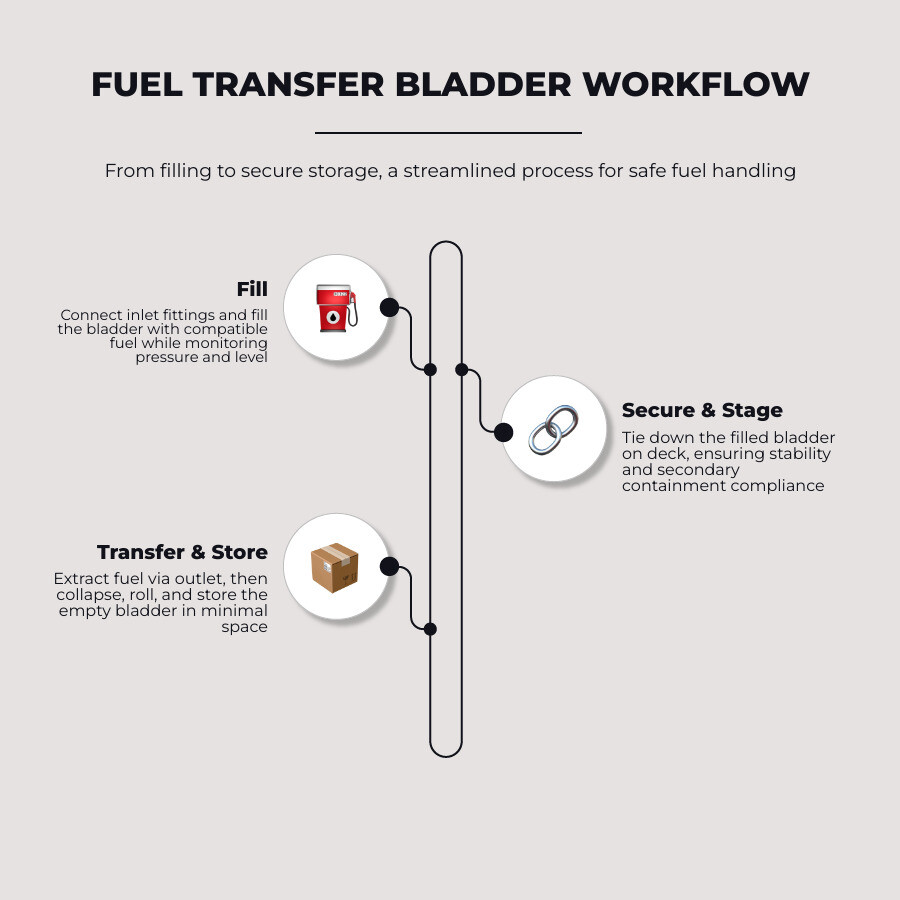
To ensure safe operation on commercial decks or flatbed transport, operators should adhere to the following strict deployment protocol:
- Site Preparation: Thoroughly sweep the deployment area to remove any sharp objects, metal shavings, gravel, or debris. Lay down a heavy-duty ground mat or protective underlayment to shield the bladder from abrasion against the deck or ground surface.
- Unfolding: Carefully lay out the empty bladder, ensuring it is centered within the designated tie-down area. Avoid dragging the bladder across rough surfaces during positioning.
- Securing Tie-Downs: Secure the bladder using heavy-duty ratchet straps rated for the filled weight of the tank (note: gasoline weighs approximately 6 lbs/gallon; diesel weighs roughly 7 lbs/gallon). Connect the straps to the integrated D-rings on the bladder and anchor them to structural tie-down points on the deck. Never fill a bladder without securing it first.
- Connecting Lines: Install the vent line, spark arrestor, and fuel transfer lines. Ensure all quick-disconnect fittings are locked and sealed with Viton gaskets.
- Filling: Begin filling the bladder slowly, monitoring the shape and checking for any initial stress concentrations on the tie-down straps. Do not exceed the rated capacity of the bladder.
- Venting Verification: Ensure the vent valve is open during filling to allow air and vapor to escape safely away from ignition sources and passenger compartments.
Frequently Asked Questions about Fuel Bladders
Can fuel bladders be mounted below deck?
No. United States Coast Guard (USCG) regulations and standard marine safety protocols strictly prohibit the installation of flexible fuel bladders below deck or in-hull.
Mounting a bladder below deck introduces critical safety hazards:
- Vapor Accumulation: Hydrocarbon vapors are heavier than air. If a bladder vents or experiences a minor leak below deck, explosive fumes will accumulate in the bilge, creating a severe risk of explosion.
- Lack of Gravity Flow: Above-deck mounting allows for safe, reliable gravity-assisted fuel transfer to the vessel’s primary tanks. Below-deck mounting would require specialized fuel-transfer pumps, increasing system complexity and ignition risks.
- Inspection Accessibility: Above-deck mounting ensures that operators can visually inspect the bladder, fittings, and tie-down straps continuously during transit.
What is the typical lifespan and maintenance routine for a flexible fuel tank?
A premium TPU fuel bladder has an operational lifespan of 8 to 12 years, depending on environmental exposure and care. To maximize the longevity of your investment, implement the following maintenance routine:
- UV Protection: While high-quality TPU contains UV inhibitors, continuous exposure to harsh sunlight will eventually degrade any polymer. When not in use, drain, clean, and store the bladder out of direct sunlight.
- Cleaning Protocol: After draining the fuel, flush the interior with a light solvent or fuel-system cleaner if switching fuel types. Wash the exterior with mild soap and water to remove salt residue, grime, and oils.
- Drying and Storage: Ensure the bladder is completely dry, both internally and externally, before folding. Moisture trapped inside a folded bladder can lead to hydrolysis and mold, which degrades the fabric over time. Store the collapsed tank in a cool, dry, and well-vented locker.
- Regular Inspections: Prior to every deployment, perform a visual inspection of all RF-welded seams, check the D-rings for structural integrity, and examine the Viton seals inside the flanges for any signs of dry rotting or compression set.
How do you extract the remaining fuel from a collapsed bladder?
Because flexible fuel bladders do not have rigid internal walls, they naturally collapse as fuel is drawn out. This collapse helps push the fuel toward the discharge port. However, a small amount of residual fuel can still become trapped in the fabric folds.
To extract every drop of fuel safely:
- Use the Rolling Technique: As the bladder nears empty, manually roll the empty fabric from the outer edges inward, toward the discharge flange. This action funnels the remaining fuel directly to the suction point.
- Avoid Excessive Suction: Do not use high-vacuum pumps on an empty bladder, as this can suck the top layer of fabric into the discharge port, blocking the flow and potentially damaging the material.
- Elevate the Opposite End: Slightly elevate the end of the bladder opposite the discharge port to let gravity assist in moving the final remaining volume to the transfer valve.
Conclusion
When permanent rigid tanks are too heavy, too restrictive, or logistically impractical, flexible fuel transfer bladders provide commercial operators, marine captains, and industrial managers with a highly reliable, space-saving alternative. By utilizing advanced TPU materials, high-strength RF welding, and application-specific fittings, these systems deliver military-grade durability that collapses to a fraction of its size when empty.
At Techno Tanks, we specialize in manufacturing custom-engineered flexible fuel bladders tailored to your exact dimensional constraints, fuel types, and operational requirements. Whether you need auxiliary marine range extension or remote industrial staging solutions, our team can deliver a system built to perform under the most demanding conditions.
To find the perfect fit for your next mission, Request a quote for custom fuel transfer bladders today.

