
Engineering and Advantages of Marine Diesel Bladder Tanks
Rigid aluminum or fiberglass fuel tanks are permanently fixed within a vessel’s hull, occupying permanent internal volume regardless of whether they are full or empty. In contrast, marine diesel bladder tanks utilize flexible TPU construction, allowing them to adapt dynamically to operational requirements. Engineered with high-tensile polyester fabrics coated with thermoplastic polyurethane (TPU), these tanks roll or fold flat once fuel is discharged, enabling complete deck space recovery when secondary storage is no longer needed.
This space-saving, collapsible design provides essential tactical flexibility for vessel operators who need auxiliary range during offshore transits but demand an unencumbered deck layout during primary work or fishing operations. Rather than permanently displacing storage lockers, deck space, or cargo holds, flexible tanks remain unobtrusive until needed.
| Capacity (Gallons / Liters) | Empty Weight | Empty Box Dimensions | Filled Dimensions (L x W x H) | Full Weight Approx. |
|---|---|---|---|---|
| 30 Gal (114 L) | 17.5 lbs (8 kg) | 20″ x 16″ x 7.5″ | 33.5″ x 22″ x 12.5″ | ~150 lbs (68 kg) |
| 50 Gal (190 L) | 23.5 lbs (10.5 kg) | 25.5″ x 20.5″ x 10″ | 48″ x 19″ x 17″ | ~350 lbs (158 kg) |
| 200 Gal (757 L) | 39.5 lbs (18 kg) | 25.5″ x 20.5″ x 10″ | 66″ x 61″ x 15″ | ~1,400 lbs (635 kg) |
| 300 Gal (1135 L) | 41.5 lbs (18.5 kg) | 25.5″ x 20.5″ x 10″ | 68″ x 63″ x 19.5″ | ~3,000 lbs (1,360 kg) |
To explore standard configurations and technical options, review the dedicated Diesel Fuel Bladders selection.
Key Benefits for Long-Range and Offshore Operations
Offshore missions often require ranges that far exceed standard built-in tank capacities. Utilizing auxiliary flexible tanks eliminates the need to retrofit fixed aluminum hull tanks or rely on dangerous, unstable stacks of rigid jerry cans.
- Extended Ocean Range: Carry hundreds of extra gallons for long passages, deep-sea sportfishing trips, or inter-island transfers.
- Offshore Logistics Support: Supply temporary fuel reserves to secondary craft, island outposts, or field equipment without permanent vessel modifications.
- Auxiliary Reserve Capacity: Maintain dedicated emergency fuel reserves when navigating isolated routes with limited bunkering stations.
- Temporary Deployment: Fill the unit at the dock, draw down the fuel into primary tanks during transit, clean and roll the unit up, and clear the deck for work.
Operators planning extended oceanic passages can discover more about long-range upgrades in Go Further with Flexible Diesel Tanks and Long Range Upgrades.
Fuel Compatibility and Material Durability
Techno Tanks constructs marine bladders using patented thermoplastic polyurethane featuring directional molecule technology. Reinforced TPU-coated polyester fabric provides high resistance to mechanical punctures, severe deck abrasion, chemical degradation, and UV exposure.
The inner chemical-resistant layer handles complex marine fuel blends, including marine gas oil (MGO), ultra-low sulfur diesel (ULSD), biodiesel, gasoline, jet fuel, and kerosene. Additionally, the outer shell features a white matte thermal finish. This white finish serves a critical technical purpose beyond deck aesthetics: it reflects intense solar heat, dramatically reducing internal gas expansion and thermal pressure buildup on exposed decks. As a sustainable engineering advantage, the materials utilized in these bladders are 100% recyclable and reusable.
Technical Specifications, Sizing, and Load Calculations
When planning fuel augmentation, marine engineers must account for filled versus empty weight ratios to maintain vessel trim and stability. Liquid diesel weighs approximately 7.0 to 7.3 lbs per gallon, meaning a high-capacity deployment drastically alters localized deck weight distribution.
Operators must also account for thermal expansion. Liquids expand when exposed to ambient solar heating, and flexible bladders accommodate internal vapor pressure changes smoothly without mechanical seam stress. For comprehensive vessel integration strategies, reference Fuel Bladders for Boats.
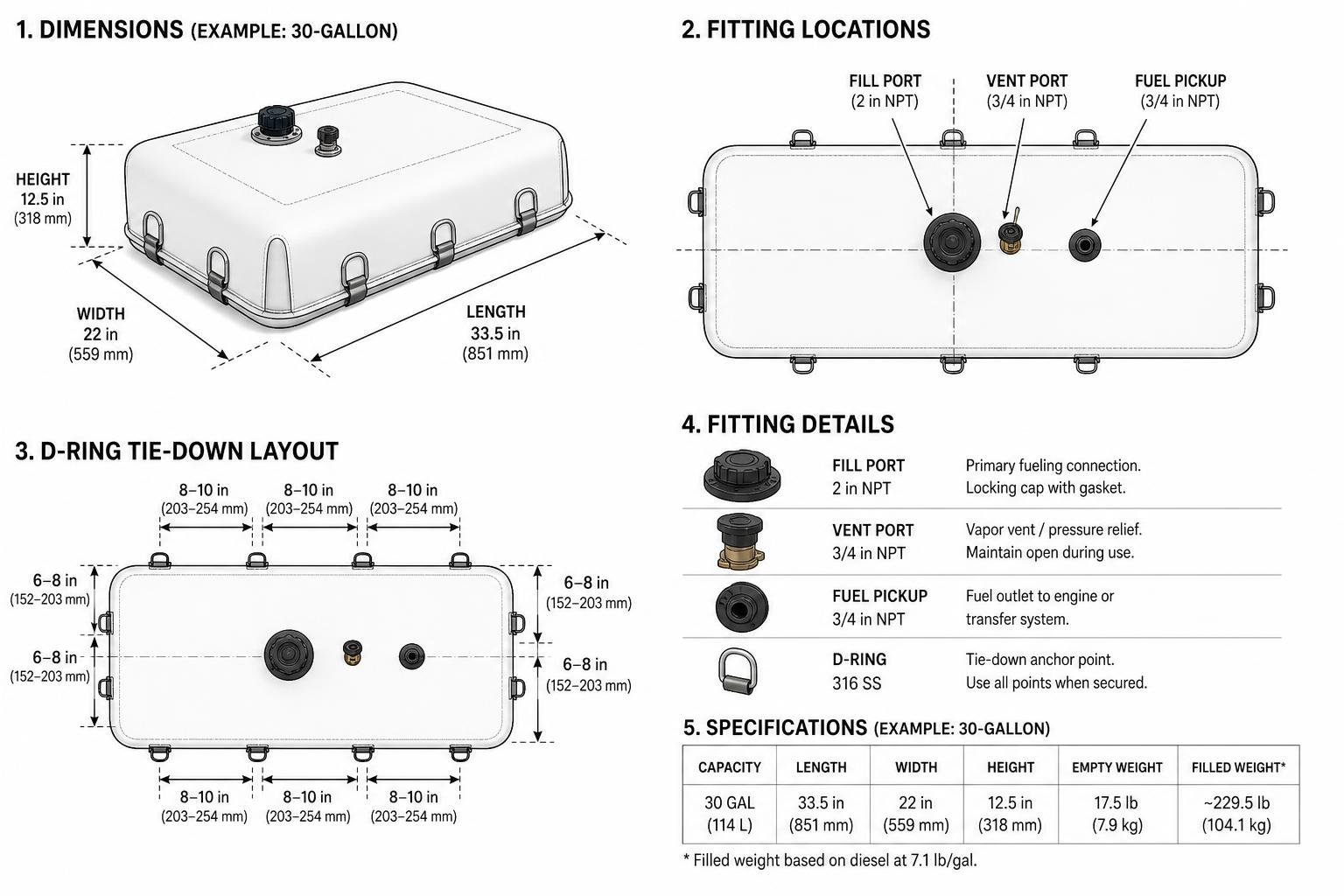
Sizing and Capacities for Marine Diesel Bladder Tanks
Choosing the correct capacity depends on available deck square footage and engine consumption rates:
- 30-Gallon Capacity: Compact footprint (33.5″ x 22″ x 12.5″) weighing 17.5 lbs empty. Ideal for small sportfishing craft, tender vessels, or light generator backups.
- 200-Gallon Capacity: Heavy-duty dimensions (66″ x 61″ x 15″) weighing 39.5 lbs empty. Standard choice for motor yachts and commercial workboats running coastal legs.
- 300-Gallon Heavy-Capacity: High-volume output (68″ x 63″ x 19.5″) weighing 41.5 lbs empty. Designed for long-range expedition vessels, supporting up to 3,000 lbs of fuel weight when full.
- Custom Sizing Options: When standard dimensions do not fit complex deck layouts or specialized commercial machinery, custom sizes can be manufactured on special order.
Installation, Safety, and Regulatory Compliance at Sea

Safety at sea requires strict adherence to marine fuel regulations. US Coast Guard safety regulations strictly prohibit installing flexible fuel bladders below deck or inside vessel hulls. Flexible fuel bladders must always be mounted above deck in open-air, well-ventilated locations. Above-deck mounting prevents liquid and heavy fuel vapor collection in enclosed bilges and facilitates direct visual inspection.
Proper deck securing protocols must be followed regardless of apparent stability:
- Place Empty: Never attempt to transport or position a filled fuel bladder. Lay the empty bladder flat on a cleared, smooth deck surface free of sharp protrusions.
- Anchor Tie-Downs: Secure heavy-duty webbing straps from the bladder’s top-mounted D-ring tie-down points directly to certified deck cleats or pad-eyes.
- Account for Load Shifts: Even if a filled bladder appears stable on calm water, unrestrained masses weighing up to 3,000 lbs will shift violently in heavy seas, compromising vessel stability and threatening crew safety.
- Inspect Hardware: Ensure all flow hardware incorporates marine-grade 304 stainless steel ball valves to maintain secure shut-off control.
For detailed guidelines on temporary installations, check out Temporary Fuel Storage.
Direct Engine Integration for Marine Diesel Bladder Tanks
Marine bladders can connect directly to a boat’s main engines or primary fuel manifold when set up with compatible fittings, shut-off valves, and fuel line adapters.
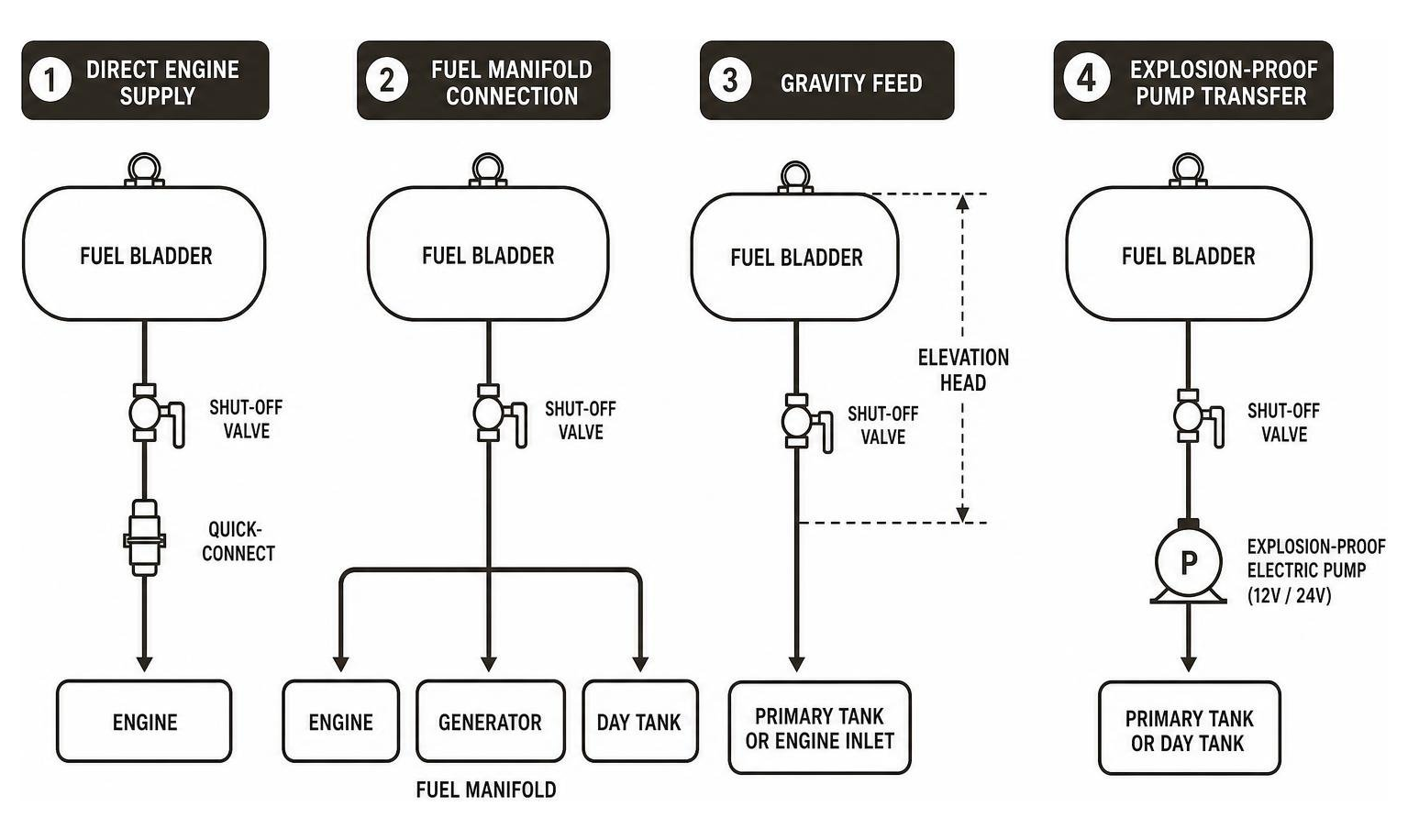
- Gravity Feed: Mounting the bladder slightly higher than the primary tank or fuel inlet allows natural elevation head to transfer fuel seamlessly without electrical power.
- Siphon Flow Systems: Simple, reliable manual siphon lines can transfer fuel into day tanks during long runs.
- Engine Quick-Connects: Standardized marine quick-disconnect fittings allow rapid switching between internal tanks and auxiliary bladders without introducing air into diesel injection lines.
- Explosion-Proof Electric Pumps: When gravity flow is unavailable, third-party 12V or 24V fuel pumps with explosion-proof motors rated specifically for fuel transfer can be integrated.
For an in-depth operational walkthrough, read The Ultimate Guide to Diesel Fuel Bladders.
Marine Safety Protocols, Buoyancy, and Overboard Protection
One of the unique physical characteristics of a marine diesel bladder tank is its natural flotation dynamics. Marine diesel fuel has a relative density of approximately 0.82 to 0.85—making fuel roughly two-thirds as dense as sea water.
Because of this density ratio, if a filled fuel bladder is accidentally dropped overboard during severe sea conditions, the full tank will float naturally on the water surface rather than sinking. In survival or distress scenarios, an empty, fully drained fuel bladder can even be lightly pressurized with air to serve as an improvised emergency buoyancy or flotation device for craft support.
Purging, Maintenance, and Off-Season Storage
Proper handling after fuel transfer extends product service life and protects material elasticity:
- Complete Fuel Extraction: To purge every remaining drop of diesel, slowly roll the flexible bladder from the outer edges inward toward the main discharge valve. This forces residual liquid out through the port.
- Surface Cleaning: Wash the exterior shell with mild soap and water to remove marine salt spray, grime, and spilled fuel droplets.
- Off-Season Storage: Store drained, dry bladders collapsed or folded flat inside a cool, dark, dry, and well-ventilated locker away from direct sunlight, severe dampness, and rodents.
- UV Mitigation: While TPU material contains UV-stabilizing compounds, storing inactive bladders out of continuous sunlight prevents unnecessary thermal weathering over multi-year periods.
For additional practical advice across marine and commercial vehicle setups, consult Top Collapsible and Flexible Diesel Fuel Bladders for Yachts and Trucks.
Frequently Asked Questions About Marine Diesel Tanks
Can marine diesel bladders be mounted below deck?
No. US Coast Guard safety standards strictly forbid the installation of flexible, collapsible fuel bladders in below-deck or in-hull locations. Flexible tanks must always be lashed securely to open decks above water level to allow ambient vapor dispersion, prevent bilge gas accumulation, and support safe fuel transfer.
Will a fully loaded diesel fuel bladder float if dropped overboard?
Yes. Diesel fuel is approximately two-thirds the density of water (density ratio ~2/3). Because liquid fuel is significantly lighter than sea water, a fully loaded marine fuel bladder remains buoyant and will float if dislodged overboard.
How do you completely drain fuel from a flexible bladder?
To extract almost every drop of fuel, disconnect the supply line and gently roll the bladder flat from its outer boundary edges inward toward the stainless steel discharge valve. This mechanical rolling action sweeps leftover liquid toward the outlet fitting.
Conclusion
When long-range offshore transits require fuel capacity beyond fixed internal tanks, marine diesel bladder tanks offer a durable, high-capacity, and Coast Guard-compliant solution. By utilizing flexible TPU construction, vessel operators gain essential auxiliary fuel reserves without giving up permanent deck space or undertaking costly hull modifications.
Whether configuring a 30-gallon reserve for coastal trips or installing a 300-gallon heavy-capacity bladder for ocean passages, selecting the right capacity, tie-down gear, and manifold connections is critical.
Because pricing and optimal configurations depend on required volume, fuel type, fitting selections, and operational environment, buyers should request a tailored quote. To evaluate dimensions or consult with fuel containment specialists on custom configurations, visit Explore Marine Fuel Bladders to request a quote.

