
Why Long Range Fuel Decides Whether You Make It Home or Not
Quick Answer: What Is Long Range Fuel for Boats?
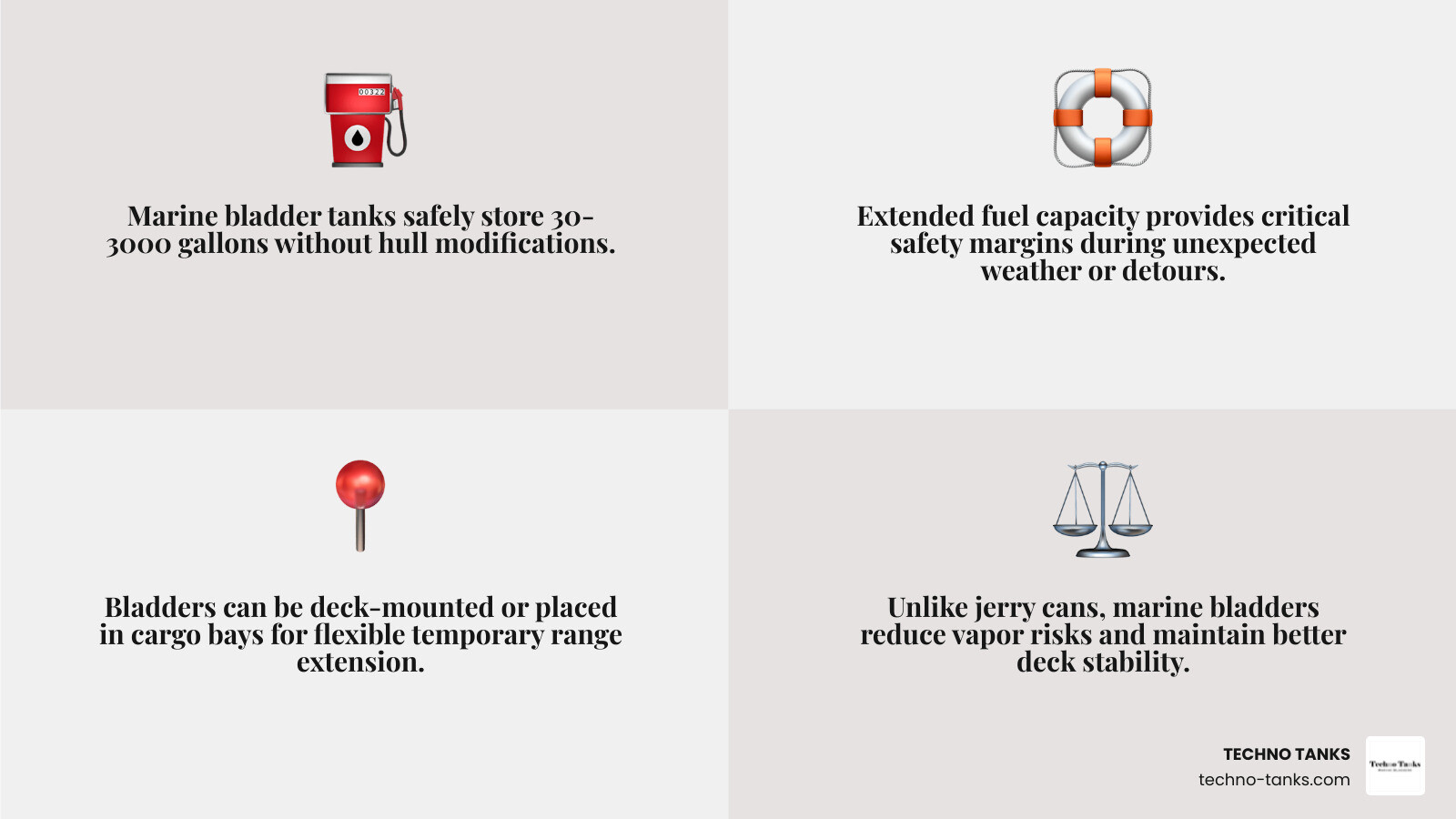
Long range fuel refers to any system that carries extra fuel beyond your vessel’s standard tank — giving you more miles, more safety margin, and more freedom on the water.
| Option | Best For | Typical Capacity |
|---|---|---|
| Marine bladder tank | Flexible, temporary, or large-volume storage | 30–3,000 gallons |
| Portable fuel cans | Short top-ups, small vessels | 5–10 gallons |
| Fixed auxiliary tank | Permanent range extension | 50–500+ gallons |
| Transfer tank | Refueling support craft or tenders | 50–300 gallons |
For most boat owners, a marine bladder tank is the safest and most flexible way to carry extra fuel without major vessel modifications.
Long range fuel is the difference between a fishing trip you planned and one that ends with a tow. If you’ve ever watched your gauge drop faster than expected — miles from the nearest marina, with weather building — you already understand the problem this guide is written to solve.
For boat owners who cruise, fish offshore, or work in remote waters, running out of fuel isn’t just inconvenient. It’s dangerous. Standard vessel tanks are sized for typical use, not extended passages or unexpected detours. When conditions change, the boats that make it back are the ones that planned ahead.
The good news is that extending your fuel range no longer means expensive permanent modifications or hauling awkward jerry cans. Modern marine bladder systems offer a practical, safe, and surprisingly simple way to carry far more fuel — on deck, in a cargo bay, or staged on a support vessel — without cutting into your hull or rewiring your entire fuel system.
I’m Ivan Jimenez, founder of Digital Ivan and Doral SEO, and I’ve spent years building authority content in the marine and industrial storage space, including deep research into long range fuel systems for vessels, vehicles, and remote operations. In the sections that follow, I’ll walk you through everything you need to choose the right setup for your boat — no fluff, just clear answers.
Learn more about long range fuel:
What Long Range Fuel Means for Marine Use and Remote Operations
In boating, long range fuel means adding safe, usable fuel capacity beyond the factory-installed tank so we can travel farther, hold a better reserve, or support operations where refueling is limited.
That sounds simple, but the use cases are broad. We see long range fuel used for:
- Offshore fishing trips
- Yacht cruising and repositioning
- Support boats and tenders
- Commercial workboats
- Emergency and disaster response
- Temporary mission planning where extra range is needed now, not after a major retrofit
On land, long range fuel often means replacement tanks, auxiliary tanks, or transfer systems. In aviation, it can mean permanent integrated tanks or removable modules. The principle is the same: more fuel capacity increases mission radius, but the best system depends on whether flexibility or permanence matters more.
What are marine bladder tanks and how are they different from standard tanks?
Marine bladder tanks are flexible fuel containers designed to store and transfer fuel safely for temporary or supplemental use. Unlike standard tanks built into a hull, a bladder can be deployed when needed and removed when not.
The biggest differences are:
Flexibility
- A fixed tank is part of the boat.
- A bladder is a temporary storage solution.
Installation
- Fixed tanks often require structural work, plumbing changes, and downtime.
- Bladders typically need placement, tie-downs, fittings, and transfer planning.
Space use
- Fixed tanks permanently occupy a compartment.
- Bladders use deck or cargo space only when needed.
Mission profile
- Fixed tanks are ideal for boats that always need extended range.
- Bladders are ideal when fuel demand changes trip to trip.
This is why marine bladders work so well for boat owners who want extra autonomy without turning a simple range upgrade into a full-blown boat surgery episode.
Why long range fuel matters for cruising, commercial work, and emergency planning
Extra range is not just about going farther. It is about staying safer.
A proper reserve helps us handle:
- Weather deviations
- Unexpected detours
- Higher-than-planned fuel burn
- Limited marina access
- Fuel availability issues after storms or during remote operations
For cruising and offshore fishing, that reserve margin can be the difference between comfort and stress. For commercial vessels and support craft, it can reduce downtime and improve route planning. For emergency response, portable extra fuel can be staged quickly where infrastructure is damaged.
If range planning is on your mind, our guide on extended cruising range is a good next read.
Materials, Construction, and Safety Features That Define a Good Marine Bladder System
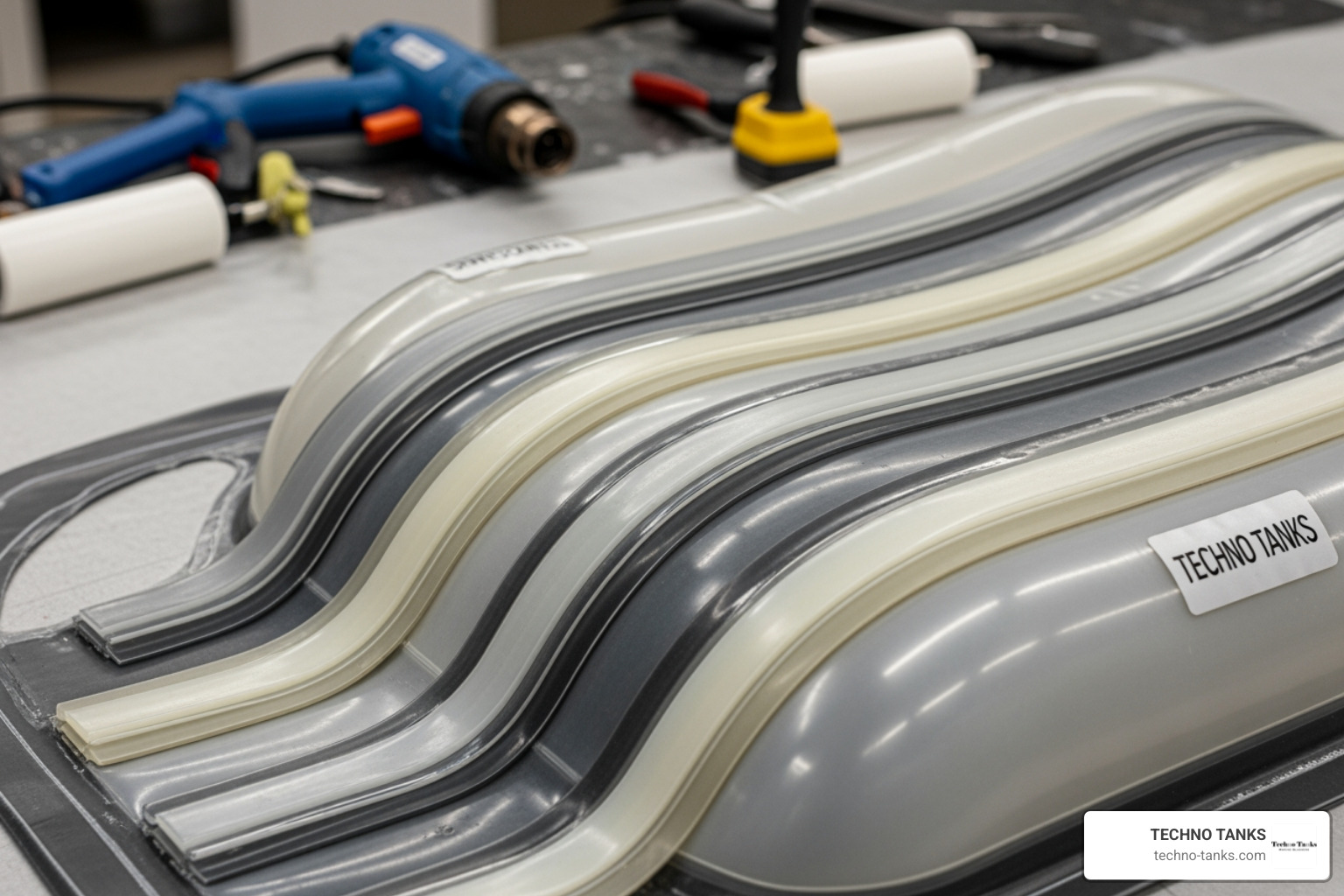
Not all long range fuel solutions are built the same. In rigid tanks, research shows durability often comes from materials like cross-linked polyethylene or aluminized steel, plus features such as baffling, anti-surge design, and pressure testing. In marine bladders, the same engineering logic applies, but through flexible materials and reinforced construction.
How marine bladder tanks are built for durability and safe fuel storage
At Techno Tanks, we focus on patented, recyclable thermoplastic polyurethane construction. TPU is a strong fit for marine bladder systems because it combines flexibility with toughness.
Key construction qualities to look for include:
- Fuel-compatible material
- Strong welded seams
- Abrasion resistance
- Flexibility without cracking
- Corrosion resistance
- Reliable fittings and ports
A good bladder should also account for expansion space and real-world handling. Fuel moves. Decks flex. Boats pound. Materials need to tolerate motion and contact without breaking down quickly.
Compared with metal tanks, flexible bladders avoid rust and can be stored compactly when empty. Compared with low-grade plastics, quality TPU systems are better suited to repeated deployment and marine exposure.
Safety features buyers should evaluate before choosing a marine fuel bladder
A marine fuel bladder is only as safe as the full system around it. Buyers should evaluate:
Venting strategy
- Fuel storage needs proper venting and transfer planning to avoid pressure problems.
Fittings quality
- Ports, valves, and connectors should be fuel-compatible and securely integrated.
Transfer pump compatibility
- The system should work with the pump and flow rate your vessel actually uses.
Leak and pressure testing
- In rigid long range systems, some manufacturers hydrostatically test every tank. The marine equivalent is documented quality control, seam testing, and fitting verification.
Chafe protection
- Any contact point with deck hardware or rough surfaces needs protection.
Deck security
- Tie-down points matter. A shifting fuel load offshore is a bad surprise nobody ordered.
Serviceability
- Replaceable hoses, fittings, and accessories simplify long-term use.
If you are comparing system styles, our article on fuel bladder vs tank choices breaks down the trade-offs in more detail.
Marine Fuel Storage System Types and the Trade-Offs of Each
Marine long range fuel is not one product category. It is a family of approaches, each with strengths and compromises.
Portable marine bladders vs fixed tanks: which long range fuel setup fits your use case?
Here is the simplest comparison:
| System | Pros | Cons | Best Use |
|---|---|---|---|
| Fixed marine tank | Always available, clean integration | Permanent install, more downtime, less flexible | Boats that always need extra range |
| Portable fuel cans | Cheap, simple, easy to find | Low capacity, clutter, more handling, vapor and spill risk | Small top-ups only |
| Marine fuel bladder | High capacity, removable, space-efficient when empty | Uses deck space while deployed, needs careful securing | Temporary or mission-based range extension |
Bladders shine when we need:
- A temporary fuel reserve
- Seasonal range extension
- Support-vessel fuel staging
- A high-capacity solution without cutting the boat apart
Permanent vs removable fuel storage solutions for boats and support equipment
The permanent-versus-removable trade-off shows up in every transport sector.
In commercial aviation, some long range systems use removable line-replaceable tanks so operators can add fuel for one mission and recover cargo space for the next. Other aircraft use permanently integrated tanks for better structural efficiency. The same idea appears in the Airbus A321 family: the A321LR used removable additional center tanks, while the A321XLR moved to a permanently integrated rear center tank to gain efficiency and range. You can read more in this A321XLR fuel system breakdown and at Long Range and Long Range auxiliary systems.
For boats, the lesson is practical:
- Choose permanent storage if your mission is always long range.
- Choose removable storage if your mission changes often and you value cargo flexibility.
Removable systems usually win for owners who want options.
Range Gains, Packaging Impacts, and Real-World Marine Performance

Adding fuel adds range, but it also adds weight, takes space, and changes how the vessel sits and behaves.
How to estimate long range fuel gains without overpromising usable range
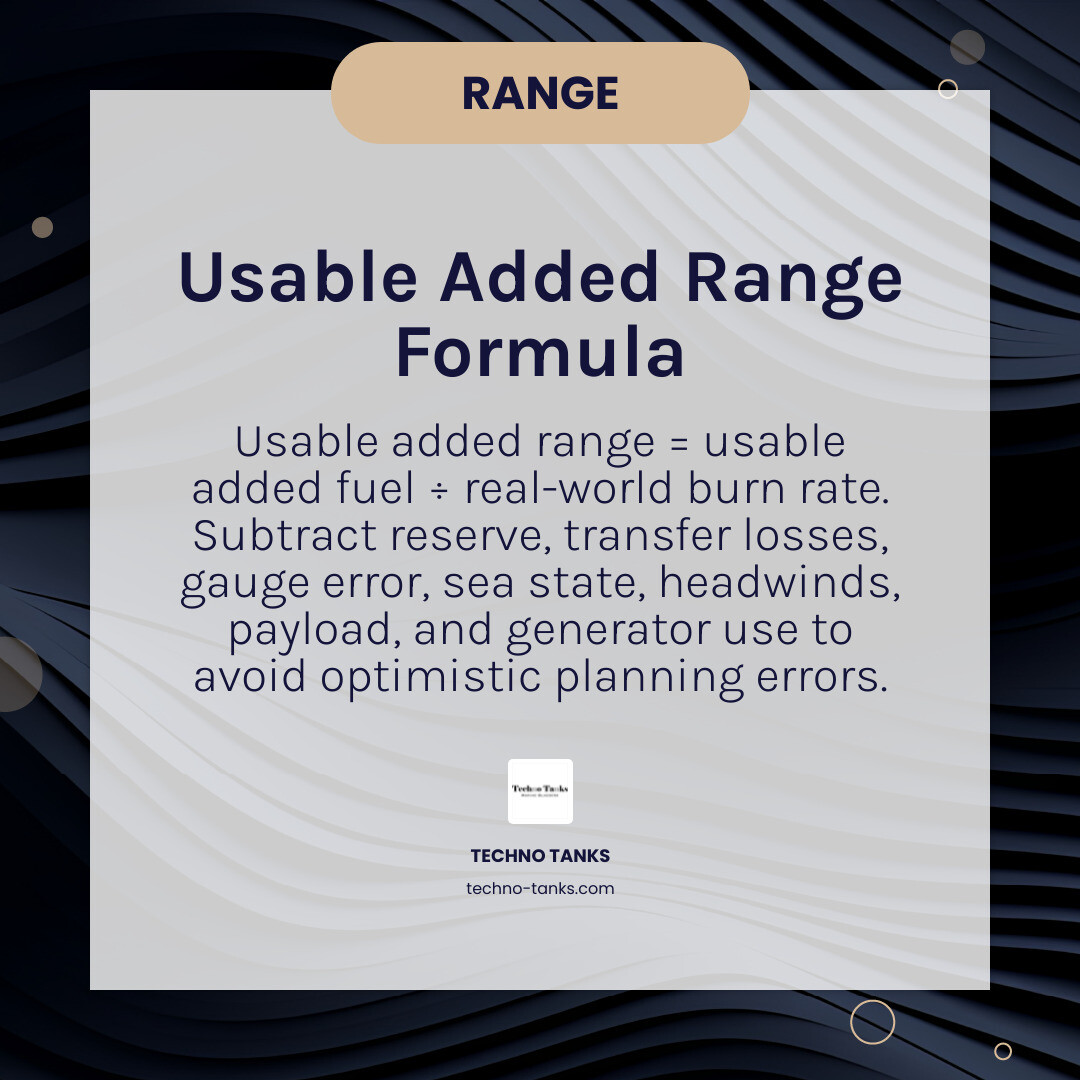
The honest formula is:
Usable added range = usable added fuel ÷ real-world burn rate
That means we should account for:
- Cruise fuel burn, not brochure fuel burn
- Sea state
- Headwinds and current
- Payload
- Generator use
- Transfer losses
- Sender and gauge inaccuracy
- Reserve fuel you refuse to touch
A simple example:
- Added bladder capacity: 100 gallons
- Usable fuel after reserve and transfer margin: 90 gallons
- Real-world burn: 10 gallons per hour
- Extra endurance: 9 hours
Then convert endurance into range at your true cruise speed, not your best day ever with a light load and flat water.
This matters because fuel gauges are not crystal balls. Even in everyday driving, people learn quickly that “miles to empty” is not a promise. On the water, the penalty for believing optimistic numbers is much higher.
For better planning, see our guide to long range cruising essentials.
How extra fuel capacity affects deck space, trim, and handling
Every gallon of fuel has weight, and that weight must go somewhere sensible.
Main effects include:
- Reduced available deck or cargo space
- Changes in trim fore and aft
- Higher deck load
- Potential effect on access paths and working space
- More motion if weight is poorly placed
Placement matters. A bladder should be positioned where the structure can support the load and where the effect on center of gravity and trim is manageable. Long, shallow placements are often easier to package than tall, concentrated loads.
Unlike rigid tanks with internal baffling, flexible bladders conform as fuel volume changes. That can help packaging, but it makes tie-down strategy and deck protection even more important.
How marine bladder systems perform in extreme heat and offshore conditions
Good long range fuel systems must perform when conditions are ugly, not just when the marina coffee is still hot.
Research on long range tanks in other sectors highlights the importance of:
- Pressure testing
- Vibration resistance
- Secure mounting
- Slosh management
- Expansion allowance
- Abrasion control
Those same ideas apply offshore. Marine bladder systems should be chosen and installed to handle:
- Heat-related expansion
- UV exposure
- Constant vibration
- Deck abrasion
- Repeated filling and emptying
- Retention of fittings under motion
We should also think in terms of system durability, not just bladder durability. Hoses, pumps, connections, and deck lashing all need to match the environment.
For deeper reading, see flexible diesel tanks and long range upgrades and marine emergency fuel supply systems.
Installation, Compliance, and Maintenance Before You Buy
A good product can still become a bad setup if installation planning is sloppy. Fuel has a way of punishing shortcuts.
Installation factors that matter most
Before buying, we recommend checking:
Deck placement
- Is the surface flat, strong, and clear of sharp edges?
Mounting and tie-downs
- Can the bladder be secured for the full weight when full?
Hose routing
- Can transfer and vent lines run without kinking, crushing, or creating trip hazards?
Chafe protection
- Are all contact points protected?
Access
- Can crew still move safely around the vessel?
- Can fittings be inspected easily?
Transfer plan
- Will fuel be gravity-fed, pumped, or transferred to another tank?
- Is the transfer hardware compatible?
Downtime
- Temporary systems usually minimize downtime compared with permanent auxiliary installs.
Certifications, legality, and warranty questions to ask
Ask any supplier:
- Is the material compatible with my fuel type?
- Is the system intended for marine fuel storage?
- What testing is performed?
- What does the warranty cover?
- Are fittings, hoses, and accessories covered too?
- What storage and usage practices are required to keep the warranty valid?
In other long range fuel sectors, warranties vary widely, from a few years to lifetime coverage, and coverage often differs for tanks versus pumps or accessories. The lesson for marine buyers is simple: read the warranty, not just the headline.
Maintenance habits that keep marine fuel bladders reliable
Reliable long range fuel depends on routine habits:
- Inspect hoses and fittings before trips
- Check tie-downs and deck protection
- Test transfer pumps periodically
- Keep fuel clean and dry
- Turn over stored fuel appropriately
- Clean and dry the bladder before seasonal storage
- Store it according to manufacturer guidance
- Watch for abrasion, seam wear, or fitting damage
Sizing matters too. Oversizing can waste space and encourage carrying more fuel than you need. Our fuel bladder sizing guide can help you choose more intelligently.
Use Cases: Who Benefits Most From Marine Bladder Fuel Solutions?
Best vessel and remote-operation applications for added range
Marine bladder fuel solutions are especially useful for:
- Offshore fishing boats that need more range and a stronger reserve
- Cruising yachts planning longer passages
- Support craft staging fuel for tenders or remote operations
- Patrol and workboats with variable missions
- Disaster-response vessels operating where fuel infrastructure is disrupted
- Expedition-style boating where route flexibility matters
Our focus at Techno Tanks is helping boat and yacht owners extend range with recyclable TPU bladder systems from 30 to 3,000 gallons, so the solution can scale from modest reserve needs to serious expedition planning.
If you want ideas tailored to boating, see custom boat fuel bladders and boat range extender tanks.
Examples that show the fixed-vs-removable trade-off clearly
A few real-world patterns make the decision easier:
Long-range yacht passage
- A removable bladder adds capacity for a repositioning trip, then comes off to restore deck space.
Support vessel refueling
- A temporary deck bladder lets a workboat or tender support operation run longer without permanent modification.
Emergency reserve deployment
- Portable, high-capacity storage can be deployed quickly when normal refueling points are offline.
Mission-flexible operations
- If one trip needs fuel and the next needs cargo space, removable storage wins.
This same flexibility principle appears even in military aviation. The MQ-25 Stingray was designed to fly 500 miles from a carrier, offload 15,000 pounds of fuel, and return, extending the reach of tactical aircraft by an estimated 300 to 400 miles. Analysis also suggests an unrefueled range of nearly 6,000 miles with endurance close to 16 hours under cruise assumptions. Different machine, same truth: fuel capacity shapes mission capability. For context, see MQ-25 Stingray’s Extreme Range Gives It Massive Potential Far Beyond A Tanker.
Frequently Asked Questions About Long Range Fuel
Is a marine fuel bladder better than carrying small portable cans?
For most larger-range needs, yes.
A properly designed bladder system usually offers:
- More capacity
- Fewer containers to manage
- Better deck organization
- Less repetitive lifting and pouring
- Better stability than a crowd of loose cans trying to become deck furniture
Portable cans still have a place for small top-ups, but they are not the best answer for substantial range extension.
Can marine fuel bladders be removed later if my mission changes?
Yes. That is one of their biggest advantages.
A removable bladder can be:
- Deployed only when needed
- Removed to recover space
- Replaced with a different size for a different trip
- Kept as emergency capacity rather than permanent equipment
That flexibility is a major reason many owners choose bladders over fixed auxiliary systems.
How much reserve fuel should I keep instead of running close to empty?
Enough that a bad day stays inconvenient instead of dangerous.
We recommend planning with:
- A defined unusable reserve
- Margin for weather and detours
- Allowance for gauge error
- Allowance for higher burn than expected
Do not plan trips around arriving nearly empty. That works right up until it does not.
Conclusion
Long range fuel is really about control: control over your route, your safety margin, and your options when conditions change. For many boat owners, the smartest way to gain that control is not a permanent retrofit but a flexible, removable marine bladder system.
At Techno Tanks, we build patented, recyclable TPU marine fuel bladders in sizes from 30 to 3,000 gallons, giving us a practical solution for everything from weekend offshore runs to serious cruising and remote support work.
If you are comparing options, keep this checklist in mind:
- Choose the right capacity based on real burn, not optimism
- Verify material and fuel compatibility
- Plan deck placement and tie-downs carefully
- Protect against chafe and heat
- Use safe transfer hardware
- Maintain a real reserve
- Buy for your mission, not just for maximum capacity
For the next step, explore our page on marine fuel bladders.

