
What Is Emergency Fuel Storage Marine Equipment — and Which Bladder Is Right for You?
Emergency fuel storage marine systems give vessels a safe, deployable way to carry additional fuel capacity beyond what fixed tanks can hold — without permanent structural modifications.
If you’re evaluating options, here’s a quick reference:
| Use Case | Recommended Bladder Size | Configuration |
|---|---|---|
| Small fishing boats / tenders | 30–100 gallons | Space Saver, un-baffled |
| Offshore fishing / cruising | 100–200 gallons | Space Saver or Pillow, baffled |
| Commercial / long-haul vessels | 200–300+ gallons | Pillow style, baffled |
| Emergency reserve / backup | 30–60 gallons | Space Saver, un-baffled |
| Custom or defense applications | Any size | Custom configuration |
Rigid tanks have a hard limit. Once your vessel’s permanent fuel capacity is committed, your range is fixed — unless you add a flexible solution.
For serious offshore operators, that ceiling creates real operational risk. Fuel availability between remote ports isn’t guaranteed. Weather delays burn reserves. Extended fishing runs push margins thin.
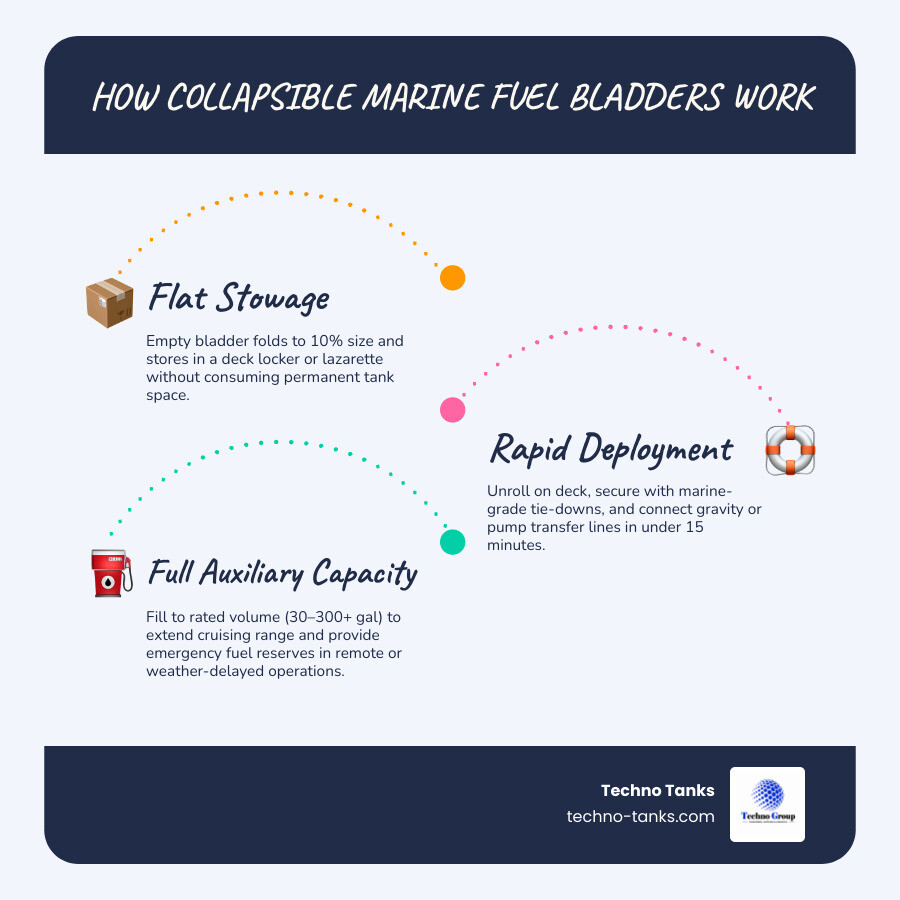
Collapsible marine fuel bladders solve this without permanent installation. They stow flat when empty, deploy on deck when needed, and are available in sizes from 30 to 300+ gallons to match the vessel and mission.
This guide covers the top foldable marine fuel transfer tanks from Techno Tanks — built with mil-spec materials, available in baffled and un-baffled configurations, and sized for everything from emergency backup reserves to full auxiliary fuel systems on commercial vessels.
The Role of Emergency Fuel Storage Marine Systems in Offshore Operations
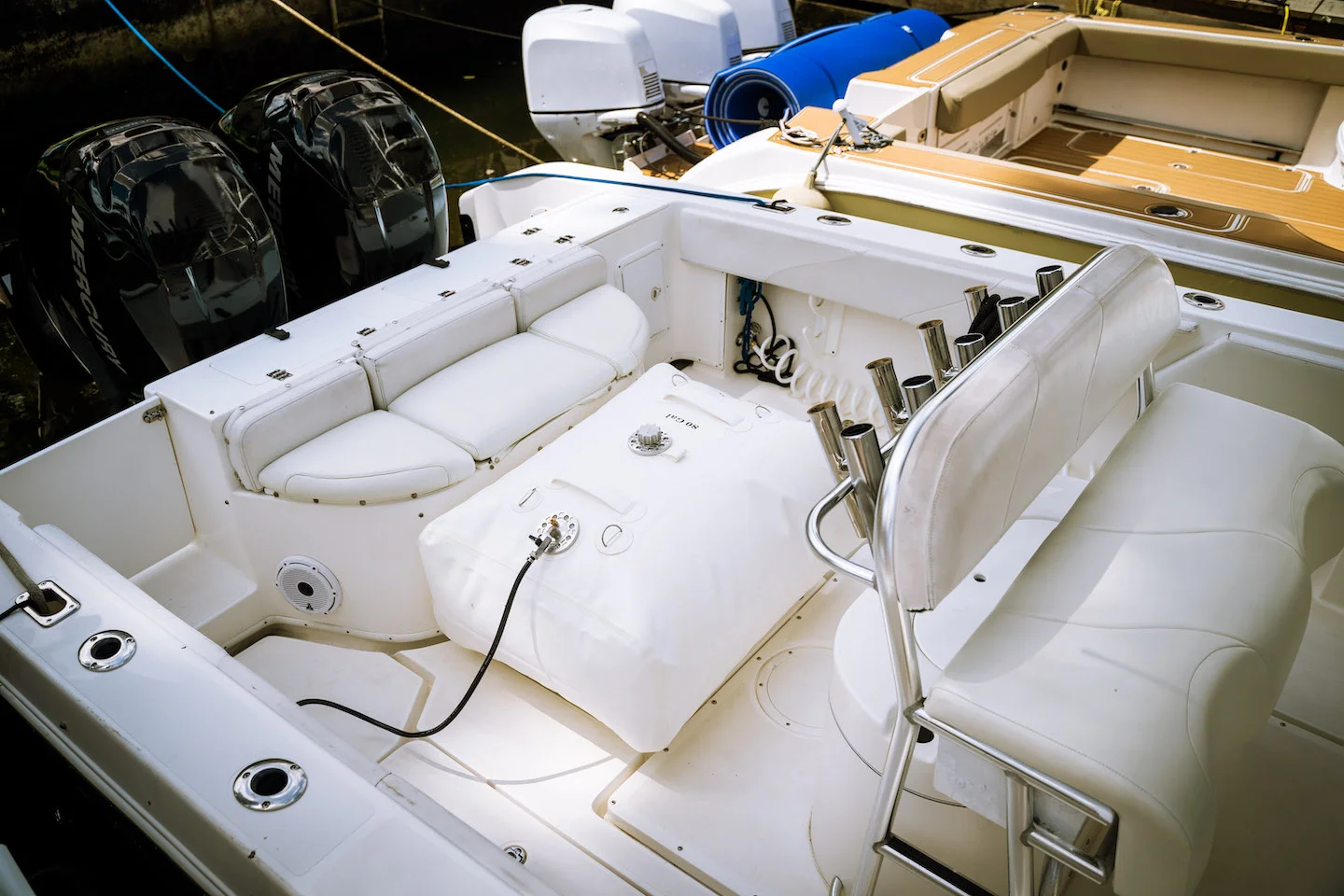
In demanding marine environments, fuel calculations dictate operational limits. Serious operators do not view auxiliary fuel as a luxury; it is a fundamental safety barrier. Implementing a dedicated emergency fuel storage marine strategy ensures that your vessel maintains a safe fuel margin under unpredictable conditions, such as sudden weather pattern shifts, mechanical inefficiencies, or rerouting.
Why Commercial and Recreational Vessels Require Emergency Fuel Storage Marine Capacity
Commercial workboats, long-haul transport vessels, and serious offshore sportfishers frequently push past the boundaries of standard fuel docks. When executing multi-day deliveries or cruising remote waters, relying solely on internal, rigid fuel tanks limits operational flexibility. Adding auxiliary capacity allows operators to achieve Solutions for an Extended Cruising Range without the massive capital expense of modifying a vessel’s hull.
Understanding The Essentials of Long Range Cruising means recognizing that weight distribution and space efficiency are paramount. When heading into deep blue waters, flexible bladders act as a reliable bridge, providing the necessary margin to reach distant fishing grounds or complete long transits. To learn more about setting up these backup configurations, consult The Ultimate Guide to Marine Emergency Fuel Supply Systems.
Key Regulatory Standards for Emergency Fuel Storage Marine Deployments
Deploying large-volume auxiliary fuel systems requires strict adherence to international and federal safety regulations. This is not just a best practice; it is a legal necessity to prevent catastrophic fires or environmental pollution.
- USCG and Federal Regulations: Under the United States Code of Federal Regulations, specifically 46 CFR 147.45 – Flammable and combustible liquids., there are strict limitations on how flammable and combustible liquids can be stored and handled on board. For instance, no more than 19 liters (5 gallons) of flammable liquids may be stowed in any machinery space, and aggregate quantities over 7.6 liters (2 gallons) must be stored in a marked paint locker or designated open location.
- MARPOL Annex I Regulations: For larger vessels, international treaties apply. According to Regulation 37 of MARPOL Annex I, oil tankers of 150 gross tonnage and above, and all other ships of 400 gross tonnage and above, must carry an approved Shipboard Oil Pollution Emergency Plan (SOPEP). This includes having certified spill response kits on board. To comply, vessels under 400 feet must carry a 7-barrel (1,100 L) marine spill kit, such as the SPILL STATION, SOPEP 7 BARREL OIL / FUEL MARINE SPILL KIT, while vessels over 400 feet must carry a 12-barrel (1,900 L) kit. You can review the complete framework directly via the IMO MARPOL Annex I Regulations.
- Location Restraints: Federal and classification society rules prohibit installing flexible fuel bladders inside the hull or below-deck compartments. They must be deployed on open weather decks where any fuel vapors can vent safely into the atmosphere, minimizing the risk of explosive vapor buildup.
Comparing Flexible Fuel Bladders to Traditional Rigid Tanks
When expanding a vessel’s fuel capacity, marine operators traditionally faced a difficult choice: install a secondary metal or plastic rigid tank, or carry awkward, rigid jerry cans. Modern flexible fuel bladders have changed this equation entirely.
| Feature | Flexible Fuel Bladder | Traditional Rigid Tank |
|---|---|---|
| Space Efficiency | Collapses flat (90% footprint reduction when empty) | Occupies permanent deck or compartment space |
| Weight (Empty) | Extremely lightweight (e.g., 50 gal weighs ~25 lbs) | Heavy metal or thick polyethylene construction |
| Corrosion Risk | Zero (TPU/polymer fabric construction) | High risk of rust (steel) or stress cracking |
| Installation | Temporary, deck-mounted, easily removable | Permanent, requires structural mounting and plumbing |
| Venting | Collapses as fuel drains, minimizing vapor space | Requires continuous atmospheric venting |
To weigh these options for your specific vessel layout, read our comprehensive analysis on Fuel Bladder vs Fuel Tank and explore Everything You Need to Know About Portable Marine Tanks.
Space Efficiency and Footprint Reduction
On a boat, deck space is prime real estate. A permanent rigid tank takes up the same amount of space whether it is full of fuel or completely empty. In contrast, a flexible fuel bladder is a temporary tool. Once the fuel is transferred into the vessel’s main tanks, the bladder can be rolled up, folded, and stored away. This represents up to a 90% reduction in storage footprint, keeping your decks completely clear for fishing, cargo, or vessel operations. For an in-depth look at space-saving layouts, check out our Guide to Space-Saving Bladders.
Durability and Lifespan in Harsh Marine Environments
A common concern among offshore operators is whether a “flexible bag” can withstand the brutal realities of saltwater, intense UV exposure, and physical abrasion.
High-quality marine fuel bladders are engineered using Thermoplastic Polyurethane (TPU) or advanced fuel-resistant polymers. TPU offers an exceptional lifespan of 8 to 12 years in harsh saltwater environments, far outlasting cheaper PVC alternatives which typically degrade within 5 to 8 years. These bladders resist puncture, extreme cold, and UV radiation, ensuring they do not crack or leak when you need them most. Discover the most rugged options for your next voyage in our guide to the Best Marine Fuel Bladder Tank Options for Offshore Trips.
Technical Specifications and Material Selection for Marine Bladders
A marine fuel bladder is only as reliable as the materials from which it is constructed. To survive constant exposure to fuel, salt, and physical movement, Techno Tanks designs its Marine Fuel Bladders using military-specification materials.
Standard specifications for a heavy-duty, space-saving bladder include:
- Material Thickness: 50-mil thick, fuel-compatible elastomer.
- Fabric Weight: ~40 oz per square yard mil-spec coated fabric.
- Seam Construction: Reinforced, multi-layered taped seams designed to withstand high pressure and dynamic loads.
- Warranty: A 5-year manufacturer warranty for repeated emergency and auxiliary use.
For detailed size charts and models, view our dedicated resource on choosing a Fuel Bladder for Boats.
Diesel vs. Gasoline Compatibility
Fuel chemistry dictates material selection. Gasoline and diesel have different chemical properties that interact uniquely with polymers.
- Diesel Fuel: Highly compatible with a wide range of urethanes and standard TPU formulations. Diesel is less volatile and does not present the same vapor-permeation challenges as gasoline.
- Gasoline: Requires specialized, highly stable, fuel-resistant TPU formulations. Cheaper materials will suffer from plasticizer extraction when exposed to gasoline, leading to hardening, cracking, and eventual structural failure.
When storing gasoline, systems must meet strict regulatory baselines. For reference on handling volatile fuels, see Annex F – Guidance on the Storage of Large Quantities of Petrol in Fixed Tanks, which highlights the necessity of gas-tight containment, spark-free environments, and robust vapor management.
Baffled vs. Un-Baffled Configurations
When a vessel moves through rough water, the liquids inside its tanks move too. This movement is called “sloshing,” and it can severely affect a vessel’s stability and handling.
- Un-Baffled Bladders: These are simpler, lighter, and more economical. They are ideal for smaller capacities (under 100 gallons), calm inland waters, or situations where the fuel will be transferred immediately before entering rough seas.
- Baffled Bladders: These feature internal chambers or fabric walls that restrict the rapid movement of fuel. For capacities over 100 gallons deployed on offshore vessels, internal baffles are highly recommended. They mitigate dynamic weight shifts, ensuring the vessel’s center of gravity remains stable even in heavy swells.
For assistance in calculating the right configuration and capacity for your boat’s deck space, refer to our Fuel Bladder Sizing Guide.
Operational Best Practices: Securing, Transferring, and Maintaining Fuel Bladders
Operating a temporary fuel storage system at sea requires discipline and a strict adherence to safety protocols. A full 200-gallon bladder weighs roughly 1,400 lbs. If unsecured, it becomes a massive, rolling safety hazard on deck.
Safe Fuel Transfer and Spill Prevention at Sea
To prevent environmental contamination and fire hazards, fuel transfers should only be conducted under favorable conditions, using reliable equipment.
- Fill in Place: Never attempt to fill a bladder on the dock and carry it onto the vessel. Always secure the empty bladder in its designated deck location first, then run the fuel hose to it.
- Secure the Bladder: Use heavy-duty, marine-grade tie-down straps rated for dynamic loads. Secure them to reinforced deck cleats or D-rings.
- Use Gravity or Siphon Flow: When transferring fuel from the bladder to your vessel’s main tank, gravity or siphon flow is often the safest method as it requires no electrical connections. If you must use a pump, ensure it is a certified, explosion-proof marine fuel pump. For step-by-step instructions, see How to Transfer Fuel from a Fuel Bladder and explore our specialized Fuel Transfer Bladders.
- Deploy Spill Containment: Always place a temporary containment berm or drip pan under the fittings during connection and transfer. Keep a marine spill kit nearby in accordance with the Spill Prevention, Control and Countermeasure Guide for Marinas.
- Vapor Management: Ensure your venting lines are clear and directed away from ignition sources, cabin intakes, or enclosed spaces, following the safety guidelines in the NYMPP: Section 4 – Fueling.
Storage, Maintenance, and Preventing Fuel Degradation
Proper post-use care ensures your bladder will perform reliably during its next deployment.
- Thorough Draining: Roll the empty bladder from the outer edges toward the drain fitting to purge every drop of fuel.
- Cleaning and Drying: Flush the exterior with fresh water to remove salt crystals. Allow the interior to dry completely to prevent microbial growth.
- Safe Storage: Fold or roll the dry, empty bladder and store it in a cool, dry, and well-vented locker away from sharp objects.
- Fuel Quality Management: If you must store fuel in a bladder for short periods, use high-quality fuel stabilizers to prevent oxidation. For detailed protocols, read our Guide to Short-Term Fuel Storage. If you suspect your fuel has degraded or been contaminated by water, consult our guide on what to do when you are Stuck with Bad Fuel and review standard procedures for Temporary Fuel Storage.
Frequently Asked Questions about Marine Fuel Bladders
Can marine fuel bladders be mounted below deck?
No. United States Coast Guard (USCG) regulations strictly prohibit the installation of flexible fuel bladders in below-deck or in-hull compartments. Because flexible bladders do not possess the rigid, fire-resistant venting systems required for permanent below-deck tanks, they must be lashed securely above deck. This ensures any fuel vapors vent safely into the open air rather than accumulating in bilge spaces where they could cause an explosion. Additionally, above-deck placement allows for straightforward gravity fuel transfer and immediate visual inspection for leaks or wear.
How do you extract all the fuel from a flexible bladder?
Because flexible bladders collapse as they empty, they do not suffer from the fuel-trapping issues common to rigid tanks. To extract the final remaining gallons, simply roll the empty end of the bladder toward the discharge or outlet fitting. This manual purging action forces the fuel toward the pickup, allowing you to empty the bladder completely.
What are the best practices for securing a bladder to prevent shifting in rough seas?
A full fuel bladder represents a significant dynamic load. To secure it safely:
- Always use heavy-duty, UV-resistant tie-down straps rated for several times the full weight of the bladder.
- Anchor the straps to reinforced deck cleats or welded D-rings, never to light-duty handrails.
- Cross the straps over the bladder in a secure matrix to prevent both lateral and longitudinal shifting.
- Periodically check strap tension during your voyage, as the bladder’s shape and volume will change as fuel is transferred.
Conclusion
When operating offshore, having a reliable reserve capacity is the ultimate peace of mind. Flexible marine fuel bladders offer a highly durable, space-saving alternative to permanent rigid tanks, allowing you to carry the extra fuel required for extended operations and stow the empty container flat when the job is done.
Techno Tanks manufactures a comprehensive line of military-grade, flexible fuel bladders and collapsible storage systems designed to perform in the world’s most demanding marine environments. From standard 30-gallon emergency reserves to massive 3,000-gallon commercial bladders, we can configure a system tailored exactly to your vessel’s layout and mission requirements.
Because every vessel, fuel type, and operational scope is unique, Techno Tanks pricing depends on your specific capacity, configuration, and customization needs. To find the ideal configuration for your next offshore run, explore our Offshore Fuel Solutions and contact our technical team to request a personalized quote.

