
What Are Gas Safe Flexible Bladders — and Why Do They Matter?
Gas safe flexible bladders are collapsible, fuel-grade storage containers engineered to safely hold, transport, and transfer gasoline, diesel, and other petroleum fuels without the weight, footprint, or installation demands of a permanent rigid tank.
Here is a quick summary for operators evaluating flexible fuel storage:
- What they are: Collapsible fuel containers made from fuel-resistant polymers such as TPU or polyurethane-coated fabric
- Who uses them: Commercial marine operators, offshore crews, military logistics teams, remote camp operators, and emergency response units
- Why they matter: They deliver high-capacity fuel storage in a fraction of the space and weight of rigid alternatives — and can be folded flat when empty
- Key certifications to look for: ISO 9001:2015, USCG guidelines, ABYC H-24, and UN/DOT standards depending on application
- Typical capacities: From under 100 litres up to 300,000 litres or more, with custom sizing available
- Typical lifespan: 5 to 20 years depending on material quality, UV exposure, and maintenance
For any operator who needs more range, backup fuel capacity, or a practical alternative to permanent tank installation, flexible bladders have become the go-to solution across marine, industrial, and tactical applications.
The core appeal is simple. A quality fuel bladder can be deployed on a vessel deck, inside a hull compartment, or at a remote site in hours — not days. When empty, many designs fold down to less than 5% of their filled volume, making storage and transport straightforward. And because they are built from fuel-grade materials with welded seams and pressure-tested fittings, they are engineered to contain fuel safely across demanding conditions.
This guide covers everything decision-makers need to know: materials, certifications, applications, safety features, and how to choose the right bladder for your specific fuel type, capacity, and operating environment.
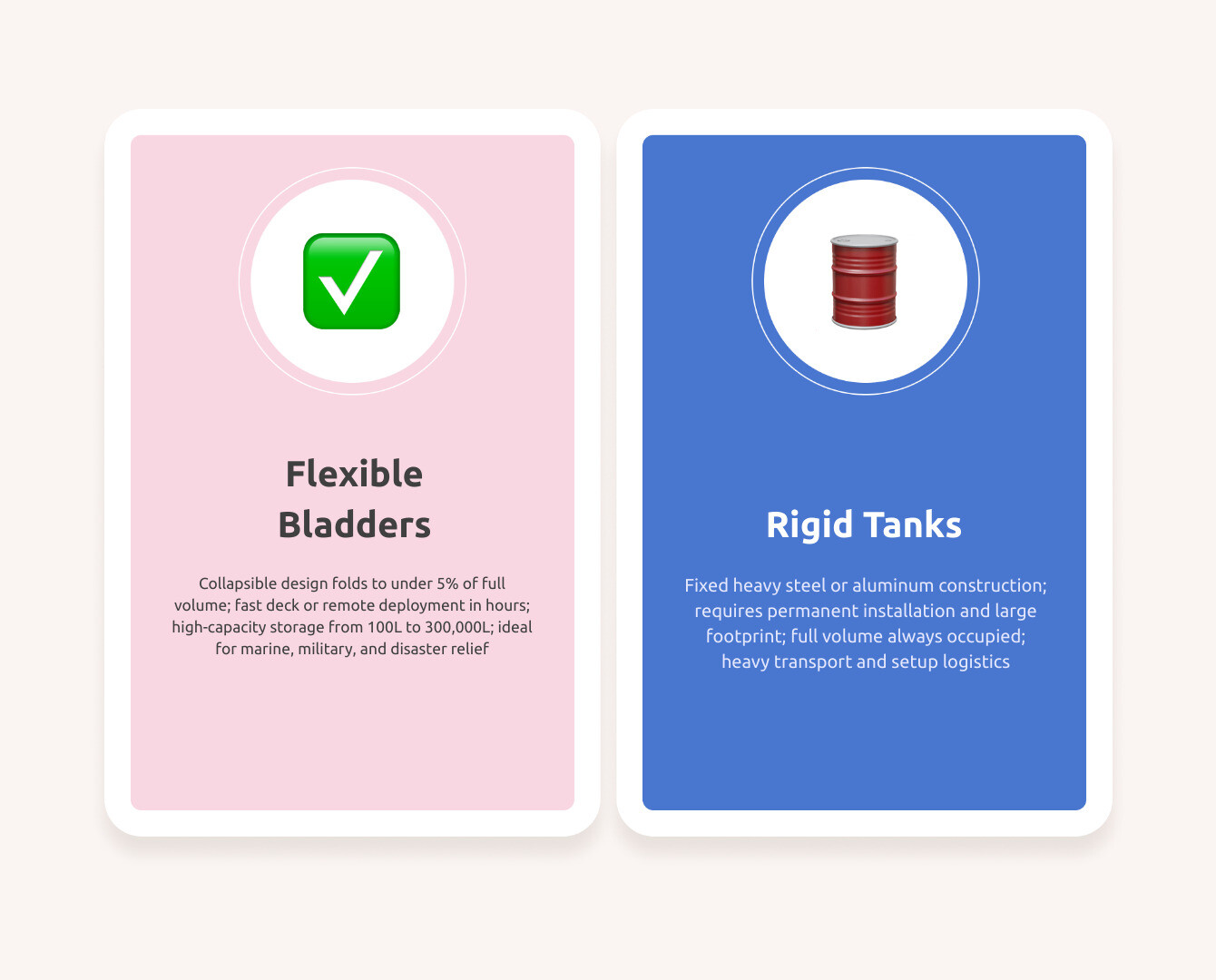
Simple guide to gas safe flexible bladders:
Defining Gas Safe Flexible Bladders and Their Core Engineering
To appreciate why gas safe flexible bladders represent such a massive leap forward in fluid logistics, one must look beneath the surface at their core engineering. Unlike standard water bladders or basic agricultural liquid bags, a true gas-safe bladder is a highly engineered system designed to handle hydrocarbons without degrading, leaking, or venting dangerous fumes.
At the heart of this technology are advanced thermoplastic polyurethane (TPU) laminated fabrics and specialized fuel-grade polymers. These materials are selected not just for their flexibility, but for their extreme resistance to chemical attack. Standard fuels contain aggressive aromatic hydrocarbons and additives that can quickly dissolve or weaken common plastics. Gas-safe bladders utilize multi-layered materials that act as a barrier to these compounds, ensuring the bladder maintains its structural integrity over years of service.
To explore the deeper science behind these materials, including the use of advanced woven reinforcements, read The Ultimate Guide to Fuel Bladder Materials: Kevlar, Polymers and Beyond.
Material Science: TPU vs. Standard PVC
When selecting a flexible fuel bladder, the choice of material is the single most critical factor determining safety and longevity. The market generally splits between Thermoplastic Polyurethane (TPU) and Polyvinyl Chloride (PVC).
- Thermoplastic Polyurethane (TPU): This is the premium standard for fuel containment. TPU-coated fabrics offer exceptional tensile strength, puncture resistance, and chemical compatibility with both diesel and volatile gasoline. Crucially, TPU remains highly flexible in extreme temperatures, maintaining its physical properties from –50°C up to +70°C. It is highly resistant to environmental cracking and UV radiation, giving it an operational lifespan of 8 to 15+ years in harsh environments.
- Polyvinyl Chloride (PVC): While PVC-coated fabrics are highly cost-effective and widely used for water storage or agricultural biogas bags, they are generally less suitable for high-grade fuel storage. PVC has a narrower operating temperature range (typically –20°C to +60°C) and can become brittle over time when exposed to the aggressive solvents found in modern gasoline. PVC-based bladders typically offer a shorter service life (5 to 8 years) and are best reserved for light-duty or temporary diesel applications.
For a comprehensive breakdown of how these materials interact with different fuel types, refer to The Ultimate Compatibility Guide: Choosing the Right Fuel Bladder for Gasoline.
Vapor Containment and Permeation Prevention
One of the greatest challenges in storing volatile fuels like gasoline is permeation—the process by which fuel molecules pass through the molecular structure of the container material at a microscopic level. Standard flexible containers can suffer from “sweating,” where fuel vapors escape through the fabric, creating both an explosion hazard and environmental contamination.
High-end gas safe flexible bladders solve this by integrating a neutral barrier film within the multi-layer fabric matrix. This barrier is completely impermeable to hydrocarbons, achieving near-zero vapor transmission. By preventing fuel molecules from escaping, the bladder eliminates the risk of explosive gas mixtures forming in confined spaces, such as vessel compartments or storage sheds. Additionally, because the bladder collapses as fuel is drawn out, there is no empty “headspace” where explosive vapors can accumulate, which is a common hazard in rigid tanks.
To understand how vapor containment designs prevent hazardous situations, read Don’t Burst Your Bubble With These Flexible Gas Bladders.
Key Safety Standards and Certifications for Flexible Fuel Storage
In high-stakes marine, commercial, and industrial operations, compliance with recognized safety standards is non-negotiable. Because fuels are classified as dangerous goods, the engineering, testing, and manufacturing of containment systems must adhere to strict regulatory frameworks to ensure safety under dynamic loads and environmental stress.
Manufacturing facilities producing these systems must operate under rigorous quality management systems, such as ISO 9001:2015. This certification ensures that every bladder is produced with complete traceability of materials, consistent welding parameters, and standardized pressure testing before leaving the factory.
Understanding Flexible Gas Line Regulations and Standards
While flexible bladders hold the bulk fuel, the lines, hoses, and connections that transport the fuel or vent vapors are subject to their own strict safety standards. In many industrial and structural installations, standards such as BS 6891 and IGEM (Institution of Gas Engineers and Managers) govern the use of flexible piping and containment systems.
For instance, modern flexible gas piping systems use double-sleeve designs to provide secondary containment. If the inner carrier pipe leaks, the outer sleeve safely channels the escaping gas to a designated vent point, preventing hazardous accumulation in unvented voids. This double-containment philosophy is highly relevant to flexible fuel bladder systems, which often utilize secondary containment berms or double-wall bladders to mitigate spill risks.
To learn more about how flexible gas line safety principles apply to overall fuel containment, consult Understanding Flexible Gas Line Regulations For Safety and review the technical specifications in the Specification Sheet – UK.
Marine and Aviation Compliance for Gas Safe Flexible Bladders
For marine vessels, auxiliary fuel storage must withstand continuous vibration, salt spray, UV exposure, and the dynamic forces of rough seas. To ensure safety on the water, high-quality marine fuel bladders are engineered to align with:
- USCG 33 CFR 183.510: U.S. Coast Guard requirements for portable fuel systems on watercraft.
- ABYC H-24: American Boat and Yacht Council standards for gasoline fuel systems.
- ISO 21487: Small craft permanently installed petrol and diesel fuel tanks (which influences the testing standards of high-end flexible bladders).
These standards require rigorous testing, including pressure testing, fire resistance evaluation, and mechanical strength verification of all fittings and seams.
To understand how these standards prevent catastrophic failures on the water, read No Leaks Allowed With These Gas Compatible Marine Tanks.
Primary Applications Across Marine, Military, and Industrial Sectors
The versatility of gas safe flexible bladders makes them indispensable across a wide range of demanding sectors. Wherever temporary, auxiliary, or highly portable fuel storage is required, these systems offer a practical, rapidly deployable alternative to heavy, rigid steel or plastic tanks.
Marine Range Extension and Offshore Operations
For offshore fishing vessels, commercial workboats, research ships, and recreational yachts, fuel capacity is the ultimate limiting factor for operational range. Installing permanent rigid tanks is often prohibitively expensive, structurally complex, and permanently alters the vessel’s weight distribution.
Flexible marine fuel bladders provide a highly elegant solution. They can be placed on deck or in spacious compartments to carry auxiliary fuel for the outward journey. As the fuel is consumed, the bladder collapses, freeing up valuable deck space and eliminating the free-surface effect (fuel sloshing), which can compromise vessel stability. Once empty, the bladders are rolled up and stored away, returning the vessel to its original configuration.
For practical advice on selecting the right marine bladder for your vessel’s layout and fuel needs, see How to Choose Gas Compatible Boat Bladders Without Sinking Your Budget.
Remote Camps and Tactical Fuel Transfer
In remote mining camps, forestry operations, construction sites, and military forward operating bases (FOBs), establishing permanent fuel infrastructure is often impossible due to environmental regulations, high costs, or rapid deployment requirements.
In these scenarios, flexible fuel bladders (often referred to as pillow tanks or “blivots”) are deployed directly onto flat ground. They can store thousands of gallons of diesel or gasoline for generators, heavy machinery, and tactical vehicles. Because they are collapsible, an entire high-capacity fuel farm can be packed onto a single utility vehicle or helicopter and set up in a matter of hours.
To explore how rugged, off-road, and remote fuel bladders are engineered to survive extreme terrain, read Why You Need Gas Compatible Petrol Bladders for Off-Roading.
For large-scale operations, these bladders can be integrated into comprehensive fluid networks, utilizing specialized Fuel Bladder Tanks and Marine Fuel Bladders for Boat and Vessel Fuel Storage tanks to ensure seamless fuel distribution.
Flexible Bladders vs. Rigid Tanks: A Technical Comparison
When choosing between flexible bladders and rigid tanks, industrial operators must weigh several technical variables, including payload efficiency, footprint optimization, installation complexity, and overall cost.
To dive deeper into this technical debate, read Flexible Tanks vs Rigid Tanks: Why Custom Bladders Win Every Time.
Portability and Storage Footprint
The most obvious advantage of a flexible bladder is its collapsible design. A rigid steel or plastic tank occupies the exact same physical space whether it is completely full or completely empty. This makes transport logistics incredibly inefficient when moving empty tanks to or from remote sites.
In contrast, a flexible bladder can be folded down to less than 5% of its total filled volume. This allows operators to transport high-capacity storage systems in standard utility vehicles or storage crates, drastically reducing shipping costs and logistical complexity.
| Technical Parameter | Flexible TPU Bladder | Rigid Steel / Plastic Tank |
|---|---|---|
| Empty Footprint | Less than 5% of filled volume (collapsible) | 100% of filled volume (static) |
| Weight | Extremely lightweight; easily handled by 1-2 people | Heavy; requires cranes, forklifts, or heavy rigging |
| Installation Time | Minutes to hours; no specialized tools required | Days to weeks; requires site prep, anchoring, and piping |
| Baffling & Slosh | Self-baffling (collapses to eliminate fluid movement) | Requires internal baffles to prevent free-surface effect |
| Customization | Can be manufactured to fit highly complex, irregular spaces | Limited to standard geometric shapes (cylinders, cubes) |
Cost-Benefit Analysis and Lifespan
From a financial perspective, flexible bladders offer a highly attractive return on investment. The initial capital expenditure (CAPEX) for a high-quality TPU bladder is typically a fraction of the cost of a comparable double-walled rigid steel tank, especially when factoring in the cost of site preparation, concrete anchoring, and heavy transport.
In terms of lifespan, a premium TPU bladder that is properly maintained can easily last 10 to 20 years. Because TPU does not rust, corrode, or suffer from weld-cracking due to ground shifting, ongoing maintenance costs are virtually zero.
To evaluate the financial and sizing options for your specific project, check out the resources on Fuel Bladder Pricing.
Critical Safety Features and Risk Mitigation
Storing volatile hydrocarbons requires a multi-layered approach to safety. Modern gas safe flexible bladders incorporate several critical engineering features designed to prevent leaks, manage internal pressures, and protect the surrounding environment.
Secondary Containment and SPCC Compliance
In many jurisdictions, environmental regulations (such as the EPA’s Spill Prevention, Control, and Countermeasure – SPCC guidelines) require secondary containment for any bulk fuel storage system. This is designed to contain 110% of the bladder’s capacity in the event of a catastrophic failure or mechanical damage.
For temporary or remote deployments, this is achieved by placing the fuel bladder inside a portable secondary containment berm (or bund). These berms feature rigid side supports and a fuel-resistant liner, ensuring that any accidental spills during fuel transfer are safely contained and easily recovered.
To understand how secondary containment integrates with long-term fuel storage, read Gas Compatible Gasoline Tanks That Actually Last.
Mitigating Risks with Gas Safe Flexible Bladders
To ensure safe operation in the field, operators must address three primary risks: UV degradation, static electricity, and mechanical wear.
- UV Degradation: Continuous exposure to intense sunlight can break down standard polymers. Gas-safe bladders utilize UV-stabilized TPU coatings or specialized “red mud” compounds that offer up to three times the UV resistance of standard plastics, preventing the fabric from cracking or losing its tensile strength.
- Static Grounding: The movement of fuel through hoses and fittings can generate static electricity, creating a spark hazard. All high-quality bladders feature chemically and mechanically bonded metal flanges that allow the system to be fully earth-grounded before any fuel transfer begins.
- Double-Welded Seams: The seams are the most critical point of any flexible container. Premium manufacturers use high-frequency or hot-air double-welded seams, often adding a reinforcing strip over the weld. This creates a joint that is actually stronger than the parent fabric, achieving a 99% gas-tight retention rate under constant movement.
For detailed material and engineering specifications, review the Fuel Bladder Specs page.
Frequently Asked Questions About Flexible Fuel Bladders
Can flexible bladders safely store both gasoline and diesel?
Yes, provided the bladder is manufactured from fuel-grade Thermoplastic Polyurethane (TPU). TPU offers the chemical resistance required to handle the highly volatile aromatic hydrocarbons found in gasoline, as well as the chemical composition of diesel and jet fuels. Standard PVC bladders should not be used for gasoline storage, as the fuel will quickly extract the plasticizers from the PVC, causing it to become brittle and leak. Always verify the manufacturer’s chemical compatibility rating before introducing gasoline.
What is the typical lifespan of a high-quality fuel bladder?
With proper care, a premium TPU-laminated fuel bladder typically lasts 10 to 20 years. In marine applications where the bladder is exposed to constant salt spray and UV radiation, a lifespan of 5 to 10 years is common. To maximize lifespan, always deploy the bladder on a flat ground tarp free of sharp debris, store it loosely folded in a cool, dry place when not in use, and avoid dragging the bladder when it contains fuel.
How is fuel safely transferred from a collapsible bladder?
Fuel is typically transferred using a dedicated transfer pump connected to the bladder’s discharge fitting (usually a cam-lock or threaded flange). While gravity-fed transfer is possible if the bladder is elevated, a pump provides precise flow control and minimizes spill risks. Crucially, always ensure that both the bladder’s metal fittings and the receiving container are properly grounded to a common earth point to prevent the accumulation of static electricity during the transfer process.
Conclusion
Whether you are extending the offshore range of a commercial vessel, establishing a temporary fuel depot at a remote mining camp, or setting up emergency disaster relief infrastructure, gas safe flexible bladders offer an unmatched combination of portability, safety, and durability. By replacing heavy, rigid steel tanks with advanced TPU-laminated collapsible systems, operators can drastically simplify their logistics, reduce shipping costs, and maintain strict environmental compliance.
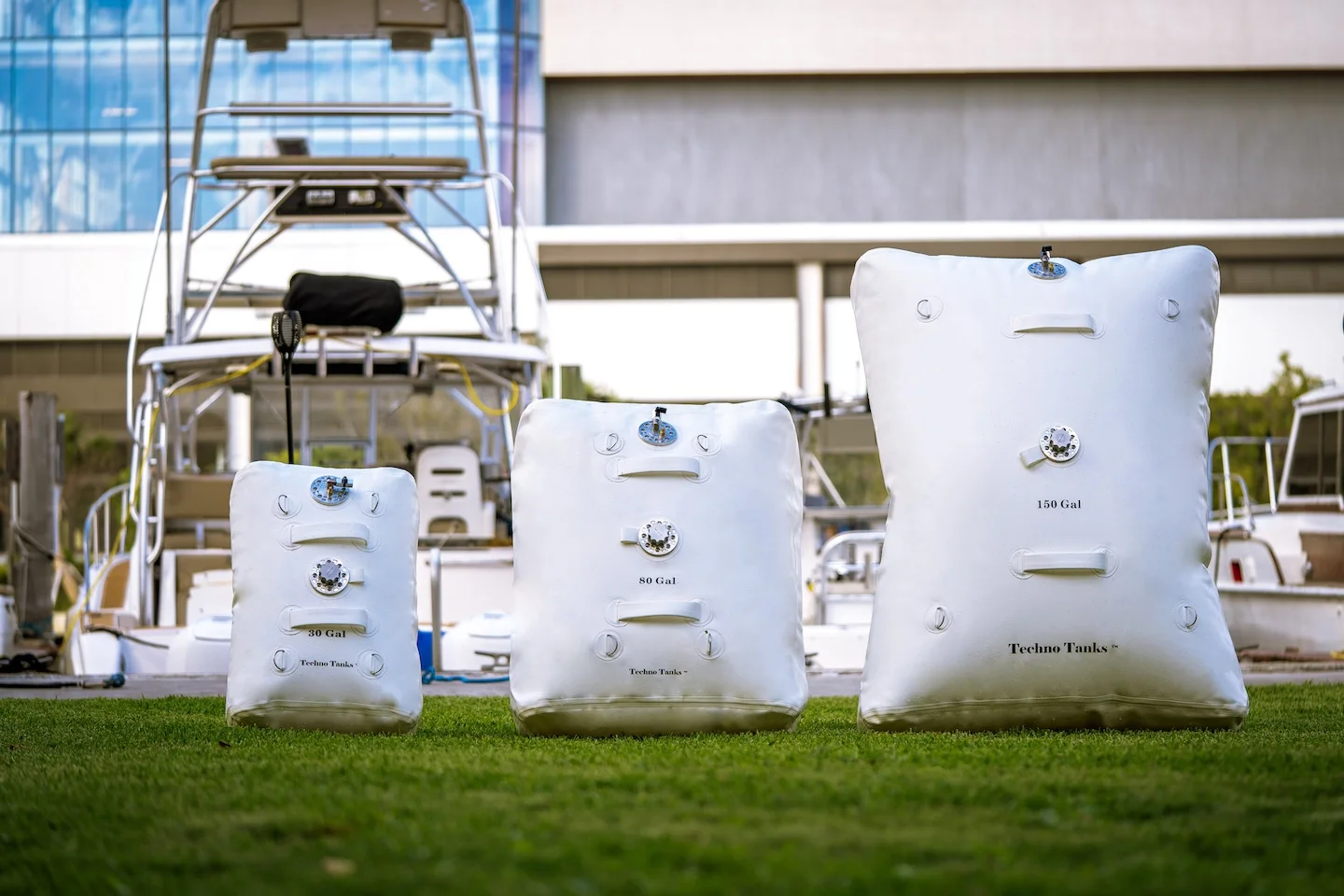
For serious operators who require tailored, high-performance fluid logistics, Techno Tanks designs and manufactures custom flexible fuel bladders ranging from 30 to 3,000 gallons. Built with premium TPU materials and engineered to withstand the harshest marine and terrestrial environments, these systems are built to perform when reliability matters most.
Ready to optimize your fuel storage and extend your operational range? Request a Custom Fuel Bladder Quote today to receive a tailored solution designed for your specific fuel type, capacity, and layout requirements.

