
Why Choosing the Right Offshore Commercial Fuel Tank Can Make or Break Your Operation
Offshore commercial fuel tanks come in several distinct types, each suited to different operational demands, vessel types, and logistical constraints. Here is a fast-reference breakdown for buyers comparing options:
| Tank Type | Best For | Key Trait |
|---|---|---|
| Rigid steel ISO tank | Heavy industrial transport, platform storage | High capacity, certified for crane lift |
| DNV 2.7-1 container tank | Offshore rig fuel supply | Offshore lift rated, double-walled |
| UN portable tank (T11, T14) | Chemical and fuel transport | Multi-modal certified, pressure rated |
| Flexible fuel bladder | Auxiliary range, deck storage, temporary supply | Collapsible, lightweight, space-saving |
| Helifuel (Jet A-1) tank | Aviation fuel on offshore platforms | Aviation-grade certified |
Offshore fuel logistics are demanding. Saltwater corrosion, limited deck space, strict lifting certifications, and the need for rapid deployment all shape which tank type actually works in practice.
Rigid steel tanks — including DNV 2.7-1-certified ISO containers and UN portable tanks like the T11 and T14 — are the standard for heavy industrial offshore operations. They handle large volumes and meet multi-modal transport regulations. But they are heavy, expensive to ship empty, and take up permanent deck footprint.
Flexible fuel bladders fill a different but equally important role. They offer collapsible, lightweight auxiliary fuel capacity that deploys fast, stores flat when empty, and fits into spaces where rigid tanks simply cannot go.
This guide compares both categories so operators, vessel managers, and commercial buyers can make a confident, informed decision.
Related content about offshore commercial fuel tanks:
Key Classifications of Offshore Commercial Fuel Tanks

Selecting the appropriate fuel containment system requires a complete understanding of how rigid steel structures compare to flexible, collapsible technology. Both play crucial roles in offshore logistics, yet they impose vastly different demands on deck space, payload capacity, and lifecycle costs.
Rigid Steel and ISO Offshore Commercial Fuel Tanks
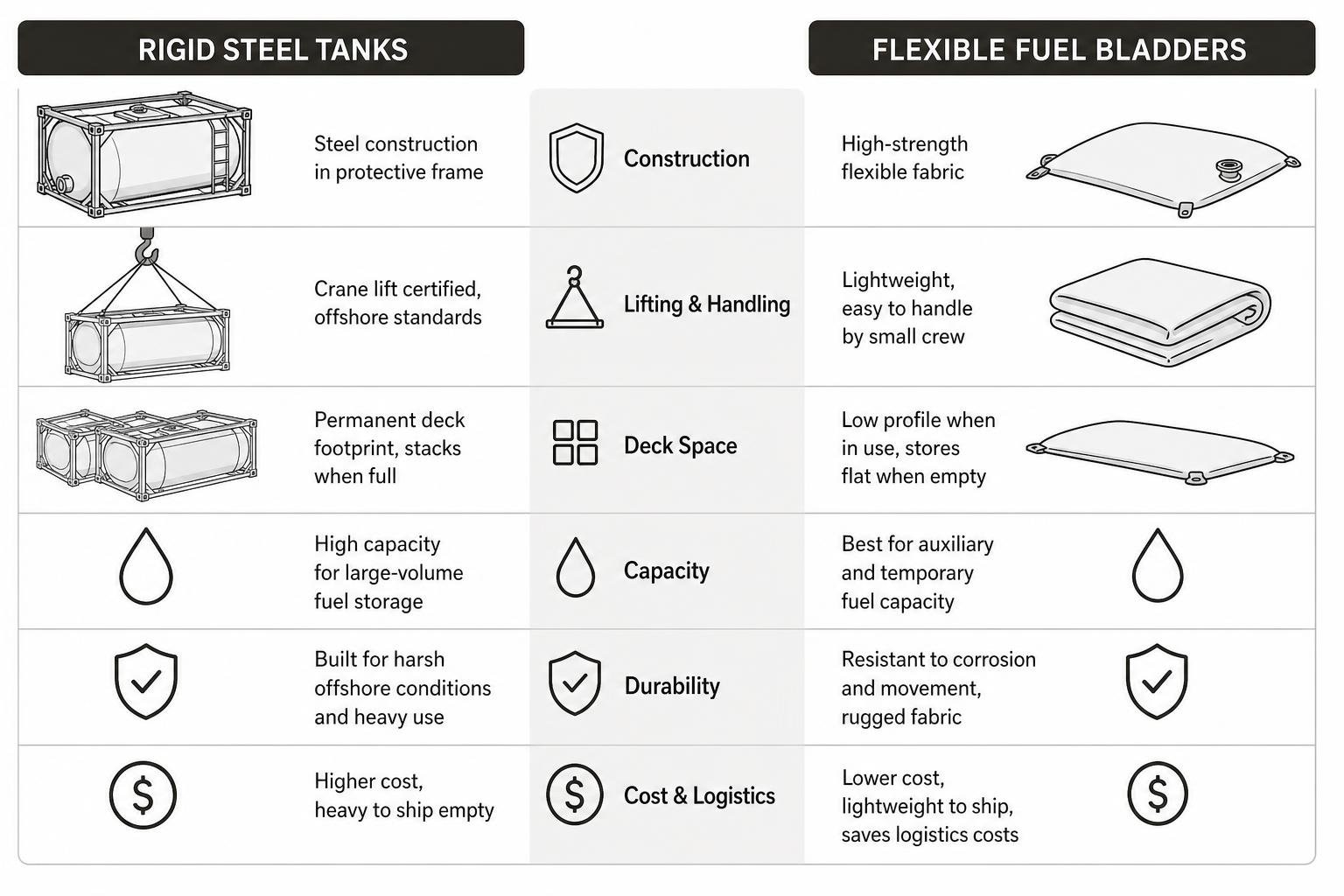
Rigid offshore tanks are engineered to withstand extreme physical abuse during transport and platform placement. These tanks are typically encased within heavy steel protective frames that double as structural ladders and multi-point lifting structures.
For large-volume transport, a standard 20FT Offshore Tank | Danteco ISO Tank Container provides a capacity of up to 20,000 liters (5,283 US gallons). These systems are built to rigid standards, including IMDG, DNV 2.7-1, and EN 12079, allowing a maximum gross weight of 36,000 kg for standard ISO shipping or a restricted 15,000 kg for dedicated offshore lifting operations.
Smaller, specialized rigid options, such as the Offshore Fueltank 2900 liters – Fuelbox , offer a nominal capacity of 2,900 liters with a tare weight of approximately 1,900 kg. While these tanks are highly durable, their structural weight presents a continuous logistical penalty.
The primary limitation of rigid steel tanks is their permanent footprint. Whether filled to capacity or completely empty, they occupy the exact same amount of deck space. When returning empty tanks to shore, operators must pay full freight rates for transporting heavy, hollow steel structures, which significantly drives up the total cost of ownership.
Flexible and Collapsible Offshore Commercial Fuel Tanks
For operations prioritizing payload efficiency and deck space optimization, flexible and collapsible fuel tanks offer an elegant alternative. These systems provide critical auxiliary fuel capacity and range extension without permanently altering the vessel’s deck layout.
Unlike rigid steel boxes, flexible marine systems collapse entirely flat as fuel is consumed. This allows operators to reclaim valuable deck space for other equipment, tools, or cargo during the return leg of a voyage.
These systems are highly valued by commercial operators and yacht captains who require temporary fuel storage but cannot justify the weight or permanent footprint of a metal tank. For a detailed guide on choosing these systems, operators can consult Don’t Get Stranded: Best Marine Fuel Bladder Tank Options for Offshore Trips.
Additionally, Collapsible Marine Fuel Tanks for Extended Offshore Trips details how these systems integrate into modern vessel layouts to maximize operational range safely. For high-end vessels, Yacht Fuel Bladder Systems: High Capacity Solutions for Long Distance Voyages provides specialized insights into preserving deck aesthetics and vessel balance.
Material Performance: Rigid Steel vs. Flexible TPU
The selection of tank materials directly impacts fuel purity, corrosion resistance, and long-term maintenance costs in harsh offshore environments.
In high-salinity marine environments, carbon steel tanks are highly susceptible to oxidation and rust. To prevent fuel contamination, operators often turn to stainless steel. As outlined in the guide on SS Diesel Tanks | Premium 304/316L SS Fuel Storage , marine-grade SS316L contains molybdenum, which provides superior resistance to chloride-induced pitting.
However, stainless steel tanks carry an initial cost that is 2.5 to 3 times higher than carbon steel. Even with high-grade stainless steel, welded joints can experience localized corrosion if the post-weld passivation treatment is not perfectly executed.
Flexible fuel bladders manufactured from high-grade Thermoplastic Polyurethane (TPU) bypass these metallic degradation issues entirely. TPU is completely impervious to saltwater corrosion, eliminating the risk of rust flakes contaminating the fuel supply.
Furthermore, rigid metal tanks suffer from “tank breathing.” As temperatures fluctuate, air is drawn into the headspace of a rigid tank, leading to condensation and water accumulation at the bottom of the tank. This water promotes microbial growth (commonly known as “fuel bugs”) that clogs filters and damages engines.
Because a flexible bladder collapses as fuel is drawn out, there is no empty headspace. This lack of air exposure prevents condensation, ensuring the highest level of fuel purity.
To learn more about the advanced polymers used in these systems, refer to The Ultimate Guide to Fuel Bladder Materials: Kevlar, Polymers and Beyond.
Safety Systems and Regulatory Compliance in Marine Environments
Operating in offshore environments requires strict adherence to international safety standards. Rigid tank containers must comply with a complex web of certifications, including:
- DNV 2.7-1 / EN 12079: Standards governing offshore containers and lifting sets to ensure they can withstand the dynamic forces of offshore supply vessel transfers.
- IMDG (International Maritime Dangerous Goods): Regulations detailing transport requirements for hazardous liquids by sea.
- ASME Section VIII: Codes regulating pressure vessel design and testing.
These systems are detailed in the Offshore tank container, helifuel tank, automatic fuel station – TLS OFFSHORE CONTAINERS & TLS ENERGY specifications, which emphasize the necessity of double-walled construction, integrated leak detection, and automatic overfill prevention.
For flexible fuel systems, safety is maintained through robust material engineering and secure anchoring systems. High-quality flexible bladders are designed with heavy-duty, multi-point tie-down straps that secure the bladder directly to the vessel’s deck. This prevents shifting or sliding in heavy seas.
Additionally, integrated anti-siphon valves, pressure relief vents, and reinforced fill ports ensure safe fuel transfer operations.
For a complete overview of transport safety protocols, see Navigating the Best Offshore Fuel Transport Solutions for Modern Fleets. To understand the operational handling and securement of these systems, refer to The Big Guide to Large Fuel Bladder Safety and Handling.
Logistics, Installation, and Lifecycle Management
The logistics of installing and maintaining offshore fuel storage systems depend heavily on the chosen technology. Rigid steel tanks require heavy infrastructure, including cranes, certified lifting slings, and dedicated deck space.
When planning a permanent or semi-permanent rigid installation, operators must follow strict guidelines, such as those found in Fuel Tank Installation . Additionally, regulatory frameworks like the EPA’s Underground Heating Oil and Motor Fuel Tanks Exempt … and commercial best practices in Guidelines for the Set-Up and Maintenance of Onsite Fuel … highlight the need for continuous inspection, containment bunding, and structural maintenance.
In contrast, flexible fuel bladders provide a highly modular and rapidly deployable solution. They require no heavy cranes for placement when empty; a small crew can easily carry, unroll, and secure an empty bladder.
This makes them ideal for emergency fuel reserves, remote operations, or temporary range extension. For emergency logistics, The Ultimate Guide to Marine Emergency Fuel Supply Systems and Don’t Run Dry: Emergency Marine Fuel Storage Tips for Boaters explain how to deploy auxiliary systems under tight timelines.
These flexible systems are also widely used to support offshore aviation. For example, Why Marine Helicopters Rely on Auxiliary Fuel Tanks to Extend Their Range demonstrates how flexible bladder technology provides reliable, clean fuel delivery in highly demanding offshore environments.
When evaluating the cost of offshore fuel storage, buyers should consider the full lifecycle, including maintenance, transport, and storage. Techno Tanks’ fuel bladder pricing depends on size, fuel type, configuration, application, custom requirements, and project scope.
Instead of dealing with fixed pricing that may not align with your specific vessel layout, buyers are encouraged to request a custom quote based on their exact operational requirements.
Frequently Asked Questions about Offshore Fuel Storage
What are the main operational differences between rigid steel tanks and flexible fuel bladders?
Rigid steel tanks provide high-volume, permanent storage and are certified for heavy crane lifts. However, they are heavy, susceptible to marine corrosion, and occupy a constant footprint on deck.
Flexible fuel bladders are lightweight, completely immune to corrosion, and collapse flat when empty. This allows operators to reclaim deck space and save on empty return shipping costs.
How do flexible fuel bladders handle harsh offshore marine environments?
High-quality flexible bladders are constructed from heavy-duty, UV-stabilized Thermoplastic Polyurethane (TPU). This material provides exceptional resistance to abrasion, puncture, saltwater, and fuel exposure.
To ensure safety in rough seas, they are secured to the deck using high-strength webbing straps and integrated tie-down points, preventing any shift in the vessel’s center of gravity.
Can flexible fuel bladders be used for commercial offshore operations?
Yes. Commercial operators use flexible bladders for temporary fuel storage, auxiliary range extension, and emergency fuel transfer. They are highly efficient for optimizing deck space on multi-mission supply vessels.
For selection criteria, see How to Choose the Safest Offshore Fuel Bladder Systems for Your Next Voyage.
Conclusion
Securing your offshore power supply requires a fuel storage solution that balances capacity, durability, and logistical efficiency. While rigid steel containers remain necessary for permanent platform installations, flexible fuel bladders offer unmatched versatility, space savings, and corrosion resistance for modern marine and commercial fleets.
Techno Tanks manufactures high-performance flexible fuel bladders and collapsible storage systems designed to perform in the harshest marine environments. Constructed from premium TPU and customizable from 30 to 3,000 gallons, these systems provide the ultimate solution for range extension and temporary fuel storage.
To find the ideal system for your vessel or platform, explore our Offshore Fuel Solutions, browse our range of Collapsible Fuel Tanks, or contact our engineering team directly to request a custom quote.

