
What Are the Best Offshore Fuel Transport Solutions for Modern Fleets?
Offshore fuel transport solutions range from large platform supply vessels and LNG bunkering ships to portable containerized systems and flexible deck-mounted fuel bladders. Here’s a quick comparison of the main options:
| Solution | Best For | Key Advantage |
|---|---|---|
| Platform Supply Vessels (PSVs) | Large offshore installations | High volume, multi-product delivery |
| ISO containerized fuel units | Remote and cross-border logistics | Intermodal, plug-and-play deployment |
| Ship-to-ship (STS) transfer | Vessels at sea or anchorage | No dock access required |
| Truck-to-ship (TTS) bunkering | Dockside or berthed vessels | Fast, flexible shore-based delivery |
| Flexible fuel bladders | Deck storage, range extension, auxiliary capacity | Lightweight, collapsible, custom-sized |
Keeping fuel flowing to offshore platforms, commercial vessels, and working fleets is not a simple logistics problem. Weather, access restrictions, environmental regulations, vessel size, and fuel type all shape the decision — and getting it wrong is expensive.
A single weekend fuel shortage at one marina cost its operator over $10,000 in lost revenue. For commercial offshore operations, the stakes are far higher.
The options available in May 2026 span everything from 8,200 m³ LNG bunkering ships to modular bladder systems that fit inside a standard 20-foot ISO container. No single solution fits every operation. The right choice depends on your vessel type, range requirements, available deck space, fuel compatibility needs, and how quickly you need to deploy.
This guide breaks down the primary methods, equipment types, safety requirements, and fuel options — with a focus on where flexible and collapsible fuel bladders offer a practical, space-efficient alternative to permanent rigid systems.
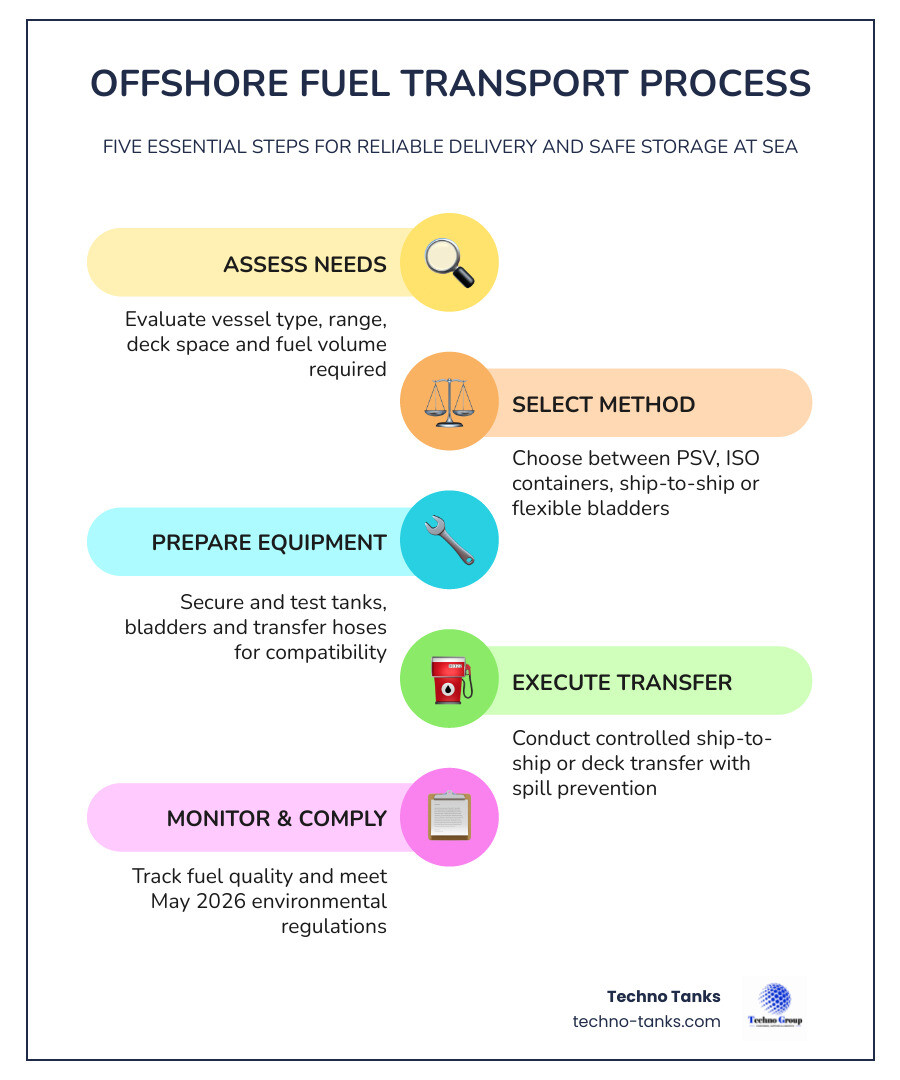
Primary Methods of Offshore Fuel Transport and Storage
The logistics of offshore fuel delivery require highly coordinated systems to ensure that marine vessels, drill rigs, and production platforms maintain continuous operations. Selecting the right method depends on the location of the receiving vessel, the volume of fuel required, and the infrastructure available at the supply point.
When operators evaluate their options, they typically choose between three primary delivery methods:
- Dockside / Truck-to-Ship (TTS) Bunkering: Best suited for vessels moored at a port, shipyard, or terminal. Fuel is transferred directly from onshore road tankers or hydrants to the vessel’s tanks.
- Ship-to-Ship (STS) Transfer: Performed in open water or at designated anchorage points. A dedicated bunkering tanker or supply vessel berths alongside the receiving vessel to transfer fuel.
- Offshore Supply and Auxiliary Storage: Used to support remote installations, such as offshore platforms or vessels executing long-range cruising. This relies on carrying additional fuel on deck using auxiliary systems.
For operators looking to secure a dependable supply chain, working with established logistics partners is essential. Navigating these options successfully requires understanding the strengths of each delivery method, as detailed in The Captain’s Guide to Reliable Marine Fuel Suppliers.
Comparing Permanent Rigid Tanks and Temporary Flexible Solutions
Traditionally, increasing a vessel’s fuel capacity meant installing permanent, rigid steel or aluminum tanks. While highly durable, rigid tanks present severe drawbacks for modern offshore fleets. They are heavy, expensive to install, and permanently occupy valuable internal or deck space.
In contrast, temporary fuel storage solutions—such as flexible fuel bladders—allow operators to scale their fuel capacity dynamically. When the additional range is required, the bladder is deployed and filled. Once the fuel is transferred or consumed, the bladder can be drained, collapsed, and compactly stored, freeing up deck space for other cargo. This level of deck space optimization is a primary reason fleet operators are shifting away from permanent retrofits. A deep dive into these operational trade-offs can be found in our comparison of Fuel Bladder vs Fuel Tank.
Vessel-to-Vessel Fuel Transfer and Auxiliary Storage
Vessel-to-vessel transfers in open water demand specialized equipment to mitigate the risks of fuel spills and vessel collisions. During these operations, having onboard auxiliary storage can streamline the process.
Using dedicated fuel transfer bladders allows vessels to receive larger batches of fuel during optimal weather windows, reducing the frequency of hazardous ship-to-ship transfers. This auxiliary capacity serves as a critical buffer, ensuring that vessels can complete extended missions without being forced to return to port or wait for a bunkering vessel in rough seas. To understand how these systems function during critical scenarios, refer to The Ultimate Guide to Marine Emergency Fuel Supply Systems.
Specialized Equipment for Offshore Fuel Logistics
Modern offshore fuel logistics relies on a diverse range of vessels and specialized storage equipment. From massive transport ships to modular, deck-mounted systems, the industry is increasingly focused on maximizing cargo efficiency and reducing operational footprint.
To help decision-makers compare the main structural options for offshore fuel transport, the table below highlights the key differences between traditional rigid tanks, containerized systems, and flexible TPU bladders:
| Feature | Rigid Steel Tanks | ISO Containerized Systems | Flexible TPU Fuel Bladders |
|---|---|---|---|
| Weight | Very Heavy | Heavy (due to steel frame/outer shell) | Extremely Lightweight |
| Footprint When Empty | Permanent (100% space occupied) | Permanent (100% space occupied) | Collapsible (takes up <5% of filled space) |
| Mobility | Fixed to vessel structure | Intermodal (requires cranes/flatbeds) | Hand-portable when empty |
| Installation Cost | High (requires dry-docking/welding) | Moderate (requires container locks) | Low (simple tie-down straps) |
| Custom Sizing | Difficult & expensive | Limited to standard ISO dimensions | Highly customizable to fit deck layouts |
Optimizing Platform Supply Vessels (PSVs) with Deck-Mounted Bladders
Platform Supply Vessels (PSVs) are the workhorses of the offshore energy sector. Companies like BOURBON manage substantial fleets—such as their 71 PSVs—to transport vital cargo, including diesel, base oil, fresh water, and methanol, to remote installations. Operators often utilize advanced logistics systems, such as those described by Transport and supply of offshore material | Bourbon , to coordinate these complex deliveries.
To maximize the utility of a PSV’s deck, operators can deploy flexible fuel bladders. Rather than dedicating permanent below-deck tanks to a single liquid product, a PSV can use its open deck space to carry temporary, flexible fuel storage. This allows the vessel to carry extra fuel on outbound journeys and collapse the tanks for the return trip, leaving the deck completely clear for heavy equipment, pipes, or dry cargo. This hybrid approach drastically improves vessel utilization rates. Learn more about configuring these systems on our Offshore Fuel Solutions page.
Replacing Heavy Rigid Containers with Portable and Flexible Marine Tanks
While containerized fuel systems—like the TCB-TEU system, which stores up to 15,000 gallons of fuel using four 3,750-gallon bladders inside a 20-foot ISO container—provide excellent modularity, they still require heavy cranes and dedicated container locks.
For vessels that do not have the crane capacity or deck space to handle a full ISO container, portable marine tanks made from high-strength Thermoplastic Polyurethane (TPU) offer an elegant alternative. These lightweight, flexible tanks can be positioned manually when empty, filled directly from standard shore-side bunkering vehicles, and secured using heavy-duty tie-down straps.
For shore-to-ship transfers, operators often rely on specialized vehicles equipped with positive displacement meters capable of handling up to 2000 LPM, as detailed by Bunkering Vehicles – Refuel International . Integrating these high-speed delivery systems with flexible deck bladders ensures rapid, safe, and highly efficient fueling cycles. For a comprehensive look at how portable bladders can optimize your deck layout, see Everything You Need to Know About Portable Marine Tanks.
Key Challenges and Safety Protocols in Offshore Fuel Logistics
Operating in open water introduces significant environmental and physical risks. To protect crews, assets, and marine ecosystems, offshore fuel logistics must adhere to strict international safety protocols and environmental regulations.
As of the latest May 2026 updates, regulatory bodies have tightened standards regarding emissions and spill prevention in offshore waters. Navigating these complex requirements demands a proactive approach to risk management and the use of certified storage systems, as outlined in The Ultimate List of Expert Fuel Storage Systems.
Environmental Compliance and Spill Prevention
Spill prevention is the highest priority during any offshore fuel transfer. Traditional rigid tanks are susceptible to structural cracking from stress, vibration, and corrosion. Flexible fuel bladders made from premium TPU offer a distinct advantage: their flexible nature allows them to absorb the constant movement, impacts, and vibrations of a vessel at sea without fatiguing.
To comply with strict environmental regulations, modern flexible tanks utilize double-walled constructions or are placed within temporary containment berms. This ensures that even in the highly unlikely event of an outer layer puncture, the fuel remains safely contained. Selecting the correct materials and configurations for these high-stakes environments is critical, and further details on spill-safe designs can be found under Fuel Transfer Bladders.
Managing Weather and Access Risks in Open Water
Weather is the most unpredictable variable in offshore logistics. High winds, heavy swells, and freezing temperatures can quickly turn a routine fuel transfer into a hazardous situation.
When utilizing flexible deck bladders in rough weather, proper securement is vital. Unlike rigid steel tanks, which have a high center of gravity and can cause a vessel to roll excessively in heavy seas, flexible bladders keep the fuel weight low on the deck. However, they must be secured using engineered harness systems and heavy-duty ratchet straps rated for marine dynamic loads.
[Vessel Deck] > [Protective Ground Mat] > [Flexible TPU Bladder] > [Engineered Webbing Harness] > [Deck D-Rings]
To prevent fuel sloshing—which can destabilize a vessel—operators must follow precise filling and discharge procedures. For step-by-step instructions on managing these transfers safely in open-water conditions, consult our guide on How to Transfer Fuel from a Fuel Bladder.
Specialized Marine Fuels, Compatibility, and Quality Control
The performance of an offshore vessel’s propulsion system is directly tied to fuel quality. Marine engines operate under high loads for extended periods, making them highly sensitive to fuel contamination, water intrusion, and microbial growth.
Maintaining strict quality control throughout the supply chain is essential. Operators often leverage specialized logistics networks, such as those provided by Fuel services – Peterson Logistics , to ensure fuel traceability from the refinery directly to the vessel’s storage system. For detailed strategies on maintaining fuel integrity during long voyages, see Fuel for Thought: The Essentials of Long Range Cruising.
Diesel and Gasoline Compatibility in Flexible TPU Bladders
Not all flexible materials are compatible with all fuel types. Standard rubbers and lower-grade plastics can degrade quickly when exposed to highly aromatic fuels, leading to fuel contamination and bladder failure.
Techno Tanks utilizes advanced, military-grade Thermoplastic Polyurethane (TPU) formulations that provide exceptional chemical resistance. This specialized material is engineered to handle:
- Ultra-Low Sulfur Diesel (ULSD)
- Premium Marine Diesel (including ValvTect formulations with BioGuard additives)
- High-Aromatic Marine Gasoline
Using a bladder specifically rated for your fuel type prevents material breakdown, ensuring that the fuel remains clean and free of particulate matter. For a deeper look at material compatibility and selecting the right bladder for diesel applications, visit Diesel Fuel Bladders.
Transitioning to Low-Emission and Sustainable Marine Fuels
As the maritime industry strives to meet global decarbonization goals, the adoption of low-emission and sustainable marine fuels is accelerating. This transition includes the use of Hydrotreated Vegetable Oil (HVO), liquefied natural gas (LNG), and dual-fuel propulsion systems.
Major milestones in green shipping infrastructure continue to emerge. For example, the launching of large-scale LNG bunkering vessels—such as CIMC SOE’s 8,200 m³ LNG bunkering ships measuring 113 meters in length—demonstrates the massive scale of this transition, as reported by CIMC SOE’s 8200 m³ LNG bunkering ship achieved two major nodes, launching and boarding, in one day .
For fleets transitioning to these newer fuels, fuel storage systems must remain adaptable. Flexible TPU bladders are highly compatible with HVO and other bio-based diesels, providing a future-proof solution for operators updating their environmental strategies. For information on temporary storage options for alternative fuels, refer to Temporary Fuel Storage.
Integrating Flexible and Collapsible Offshore Fuel Transport Solutions
Integrating flexible fuel storage into an existing offshore fleet does not require extensive vessel modifications or costly dry-dock periods. Because of their lightweight and adaptable design, collapsible tanks can be deployed on a wide variety of workboats, supply vessels, and utility crafts.

When evaluating these systems, operators can explore our full range of Collapsible Fuel Tanks to find the best fit for their specific deck layout and capacity requirements.
Flexible Fuel Bladders vs. Rigid Fuel Tanks
The choice between a flexible bladder and a rigid tank comes down to operational flexibility. A rigid tank represents a permanent commitment of weight and volume. A flexible bladder, however, is only there when you need it.
Techno Tanks’ premium TPU construction ensures that these bladders are incredibly puncture-resistant, UV-stable, and capable of withstanding extreme marine environments. When empty, they collapse to a fraction of their filled size, allowing crews to roll them up and store them in a small utility locker. This space-saving design is a game-changer for vessels that must balance fuel capacity with cargo-carrying capabilities. For a direct, head-to-head comparison of these two storage philosophies, read Fuel Bladder vs Fuel Tank.
Custom Sizing and Deployment of Collapsible Fuel Storage
Every vessel deck is configured differently, and off-the-shelf fuel tanks rarely maximize the available space. To solve this, custom-sized fuel bladders can be designed to fit the exact footprint of your vessel’s deck, well-deck, or hold.
Techno Tanks offers custom sizing for capacities ranging from 30 to 3,000 gallons, allowing operators to fine-tune their auxiliary fuel capacity to match their specific range-extension goals. Whether you are operating a commercial tug, a patrol vessel, or a long-range utility craft, custom-fit bladders ensure that you carry the maximum amount of fuel with the minimum impact on deck usability. To explore custom options tailored to your vessel, check out The Best Custom Marine Fuel Tanks to Keep You Cruising.
Frequently Asked Questions about Offshore Fuel Transport
What are the main differences between rigid deck tanks and flexible fuel bladders?
Rigid deck tanks are permanent, heavy, and occupy the same amount of deck space whether they are full or empty. Flexible fuel bladders are lightweight, highly portable, and completely collapsible. Once the fuel is discharged, a bladder can be rolled up and stored, freeing up 100% of the deck space for other cargo or operational needs.
How do operators prevent fuel contamination during offshore transfers?
Operators prevent contamination by utilizing closed-loop transfer systems, high-efficiency inline filtration, and water-separating fuel filters. Additionally, using high-quality TPU bladders prevents the fuel from coming into contact with air or condensation, drastically reducing the risk of water contamination and microbial growth compared to vented rigid tanks.
What are the benefits of using flexible fuel bladders for offshore operations?
The primary benefits include cost-effective range extension, temporary auxiliary capacity, and superior deck space optimization. They allow vessels to undertake long-range missions without the massive capital expense of installing permanent rigid tanks. For a detailed guide on solving range limitations, see Range Anxiety: Top Solutions for an Extended Cruising Range.
Conclusion
Successfully navigating offshore fuel transport solutions requires balancing reliability, safety, and space efficiency. While massive supply vessels and rigid containerized systems have their place in large-scale industrial logistics, flexible and collapsible fuel bladders provide an unmatched level of operational agility for modern working fleets.
By utilizing high-strength TPU construction, custom sizing, and space-saving designs, Techno Tanks helps marine operators safely carry the auxiliary fuel they need without sacrificing valuable deck space or committing to permanent, expensive retrofits.
Because every offshore application has unique demands regarding capacity, fuel type, deck space, and environmental conditions, Techno Tanks fuel bladder pricing depends on size, fuel type, configuration, application, custom requirements, and project scope. For accurate pricing and technical guidance tailored to your fleet’s specific requirements, we invite you to Request a Quote for Custom Offshore Fuel Solutions today.

