
What Are Auxiliary Fuel Systems — and Do You Need One?
Auxiliary fuel systems are secondary fuel storage and transfer solutions that work alongside a vessel’s or vehicle’s primary fuel supply to extend operational range, provide backup capacity, or support remote and extended deployments.
Quick answer for operators evaluating auxiliary fuel options:
| Question | Short Answer |
|---|---|
| What is an auxiliary fuel system? | A secondary fuel source that supplements your primary tank |
| Who needs one? | Marine operators, expedition crews, commercial vessels, remote-area operators |
| Main types | Rigid auxiliary tanks, flexible fuel bladders, collapsible tanks |
| Key benefit | Extended range and backup capacity without permanent infrastructure |
| Best flexible option | Custom-sized fuel bladders — space-efficient, deployable, removable |
| How to size and price? | Request a quote based on your vessel, fuel type, and capacity needs |
For serious marine operators, range is not just a convenience — it is a mission-critical variable. Whether you are running offshore, crossing open water, or operating in areas where refuelling infrastructure is unreliable or nonexistent, carrying additional fuel capacity is a practical necessity.
The challenge is how you carry it. Permanent rigid tanks require installation, add fixed weight, and consume space that cannot be recovered. Flexible fuel bladders and collapsible auxiliary tanks offer a different approach — custom-sized, deployable, and removable when not in use.
This guide covers the full picture: types of auxiliary fuel systems, how they integrate with primary fuel systems, what materials and safety standards matter, and how to choose the right solution for your vessel and operation.
Key auxiliary fuel systems vocabulary:
Understanding Auxiliary Fuel Systems and Primary Differences
To make informed decisions about range extension, operators must first understand how an auxiliary fuel system differs from the primary, built-in fuel infrastructure of a vessel, aircraft, or vehicle.
Defining Auxiliary Fuel Systems vs. Primary Systems
A primary or essential fuel system is designed as an integral part of the vehicle or vessel’s structure. It directly feeds the propulsion engines or generators under normal operating conditions. These systems are permanently plumbed, rigid, and built to meet the baseline operational specifications of the original equipment manufacturer (OEM).
In contrast, auxiliary fuel systems are designed to supplement this baseline capacity. They can be broadly categorized into two operational configurations:
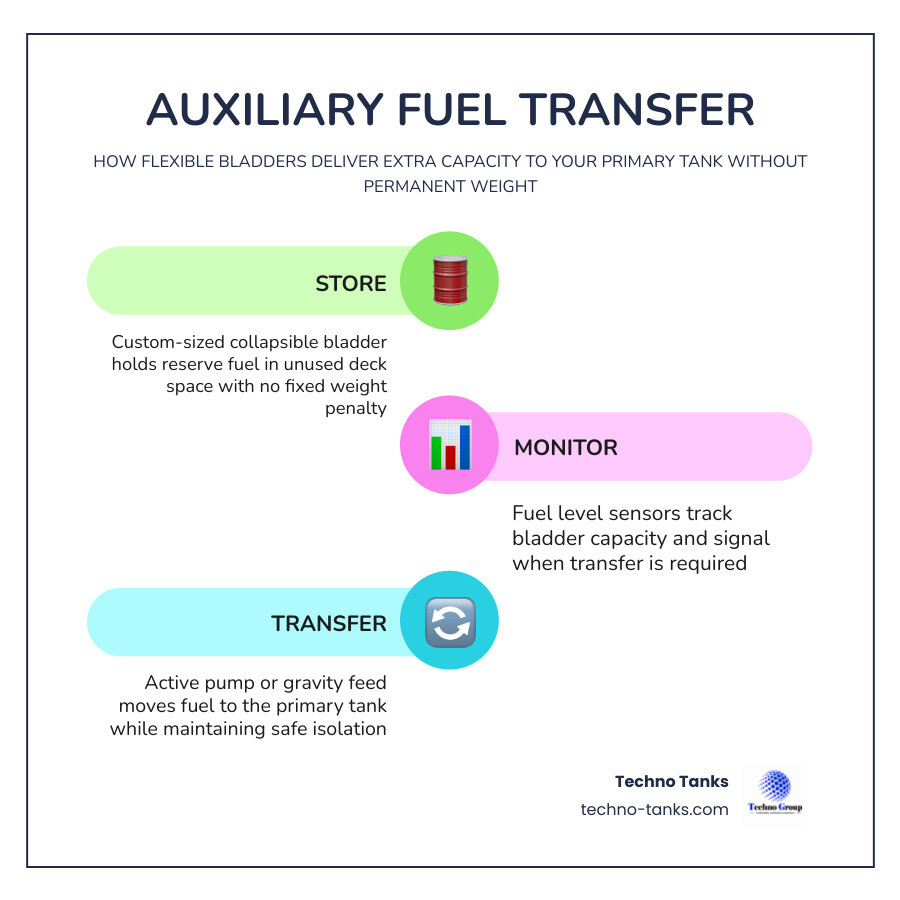
- Transfer Type Systems: These systems do not feed the engine directly. Instead, they store fuel and transfer it into the primary fuel tank as levels deplete. This is the most common configuration for marine fuel bladders and in-bed truck tanks, as it preserves the integrity of the OEM fuel delivery lines and filtration systems.
- Direct Feed Systems: These systems are plumbed to supply fuel directly to the engine or power plant in at least one operating mode. Because they bypass the primary tank, they require dedicated filtration, valving, and isolation mechanisms to prevent fuel starvation or pressure imbalances.
For transport aircraft, regulatory guidelines such as the FAA AC 25-8 – Auxiliary Fuel System Installations dictate strict isolation protocols to ensure that any failure in an auxiliary tank does not compromise the essential fuel supply required for safe flight. Whether on land, in the air, or at sea, the core engineering philosophy remains the same: auxiliary fuel must be isolated from primary fuel systems until the moment of transfer or controlled consumption.
Core Benefits of Auxiliary Fuel Capacity
Installing or deploying an auxiliary system provides several distinct operational advantages:
- Extended Range: For offshore vessels, an auxiliary system can double or even triple the distance between refuelling stops. This allows operators to undertake ambitious transoceanic crossings or reach remote fishing grounds that were previously inaccessible.
- Operational Flexibility: Commercial operators can bypass high-priced fuel docks in remote ports by purchasing fuel in bulk at their home ports. This provides significant cost savings over time.
- Peace of Mind: Having a secondary, isolated reserve mitigates the risks associated with fuel contamination in the primary tank. If a primary tank is compromised by water or microbial growth, an isolated auxiliary reserve can keep generators or secondary propulsion systems running.
Operators looking to optimize their vessels for transoceanic voyages or extended blue-water fishing trips often find that addressing range anxiety is the single most important step in preparation. By understanding the essentials of long range cruising, crews can plan routes based on optimal weather windows rather than fuel dock locations.
Types of Auxiliary Fuel Storage and Integration Technologies
The method of storing auxiliary fuel depends heavily on the platform (marine, aviation, or ground transport) and the frequency of use. While rigid tanks have historically been the default, modern flexible materials have changed how operators approach temporary storage.
| Feature | Flexible Fuel Bladders | Rigid Auxiliary Tanks (Steel/Aluminum) |
|---|---|---|
| Deck Space Utilization | Highly efficient; rolls up and packs away when empty | Permanent; occupies deck or bed space indefinitely |
| Weight Distribution | Conforms to deck space; adds zero “dead weight” when empty | Permanent weight penalty even when carrying no fuel |
| Storage Efficiency | Variable footprint; custom sizes fit irregular spaces | Fixed footprint; requires flat, unobstructed surfaces |
| Installation Complexity | Low; temporary tie-downs and portable transfer pumps | High; requires permanent mounting, drilling, and plumbing |
| Fuel Sloshing | Minimal; bladder collapses as fuel is drawn, eliminating air pockets | High; requires complex internal baffling to manage liquid shifting |
Why Flexible Bladders Outperform Rigid Auxiliary Tanks
While rigid aluminum or steel tanks are highly durable, they present significant drawbacks for temporary range extension. A rigid tank represents a permanent commitment. Once bolted to a cockpit sole, swim platform, or truck bed, it permanently consumes valuable space and adds dead weight that increases fuel consumption even when empty.
Furthermore, rigid tanks are prone to condensation. As fuel is consumed, air enters the tank. In marine environments, temperature fluctuations cause the moisture in this air to condense on the cold metal walls, leading to water contamination and microbial growth.
Flexible bladders solve this problem by collapsing as fuel is discharged. Because there is no air space inside a collapsing bladder, condensation is physically impossible, keeping the fuel pristine. Additionally, the lack of air space eliminates fuel sloshing, improving vessel stability in rough seas.
Flexible Fuel Bladders and Collapsible Tanks
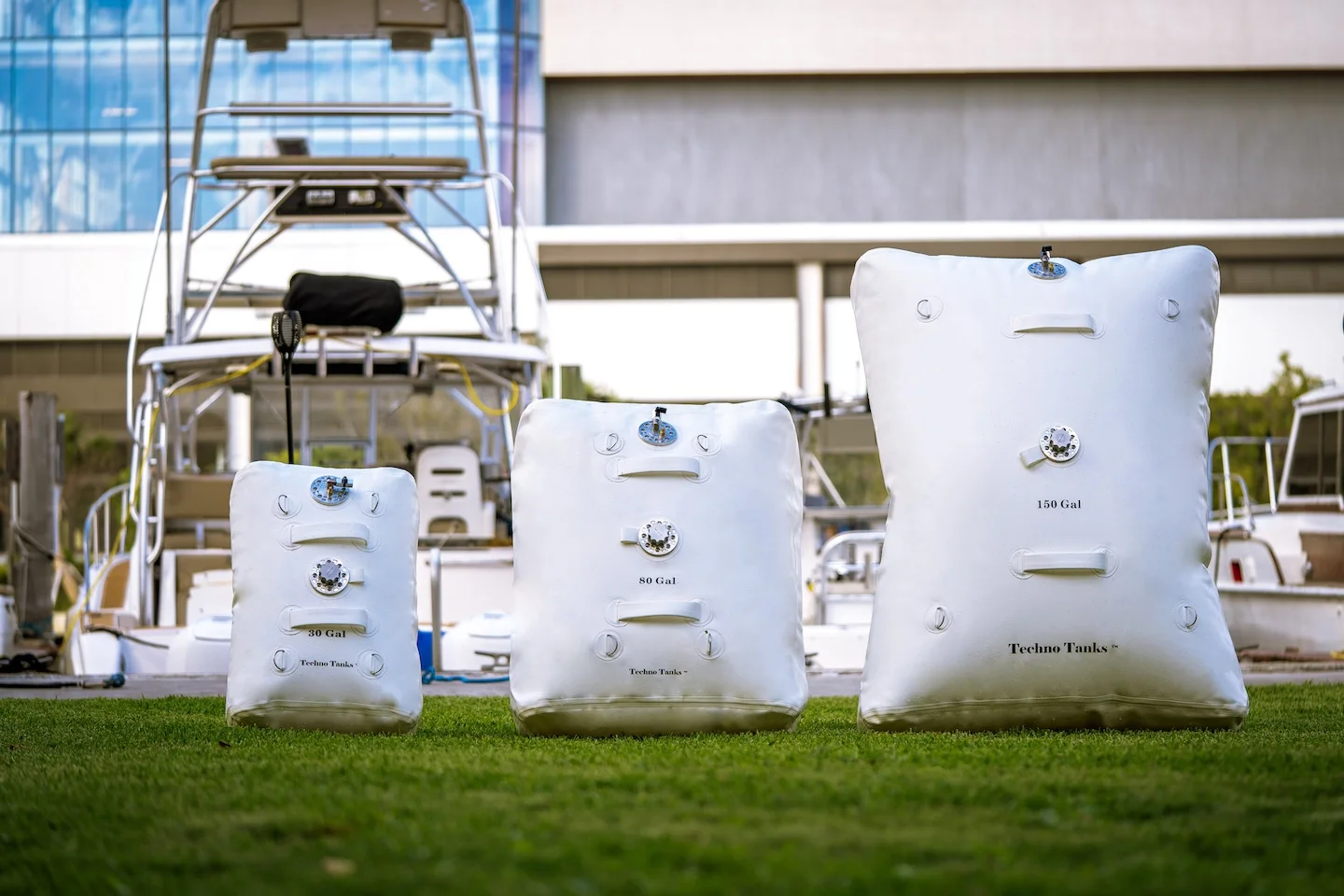
For offshore vessels, megayachts, and commercial workboats, flexible fuel bladders represent the gold standard for temporary range extension. Constructed from high-tensile thermoplastic polyurethane (TPU) or specialized rubber compounds, these bladders can hold anywhere from 30 to over 3,000 gallons of diesel or gasoline.
When preparing for a long voyage, the operator rolls out the bladder on the bow, cockpit deck, or in a dedicated utility space, secures it with heavy-duty tie-down straps, and fills it. Once the fuel is transferred to the primary tanks during the journey, the empty bladder is rolled up and stored in a locker, completely freeing up deck space.
For operators with unique deck layouts or tight spaces, choosing a custom boat fuel bladder ensures that every inch of available space is utilized safely. This custom approach is often far more practical than trying to modify a vessel to fit generic, off-the-shelf custom marine fuel tanks, which require extensive fabrication and structural modifications. If you are debating between these two approaches, reviewing the differences between a fuel bladder vs. fuel tank can help clarify which system fits your operational profile.
Integration and Active Transfer Mechanisms
Integrating an auxiliary tank into an existing fuel system requires careful engineering to ensure safe and reliable fuel transfer. The three primary transfer methods include:
- Active Transfer Pumps: The most reliable method for marine bladders. A dedicated, self-priming 12V or 24V DC pump transfers fuel from the auxiliary bladder through a filtration water-separator and directly into the primary tank’s fill deck pipe or a dedicated return port.
- Automatic Transfer Systems: Commonly used in modern diesel truck applications. These systems use a computerized electronic controller to monitor the level of the factory fuel tank. When the primary tank drops to a set threshold (e.g., half full), the controller automatically activates an inline transfer pump, refilling the primary tank to a set level (e.g., three-quarters full) before shutting off.
- Gravity Feed Systems: While simple, gravity-fed systems—where fuel flows from a higher auxiliary tank into a lower primary tank via a manual valve—are highly discouraged in many industries and are illegal for gasoline applications under DOT regulations. Gravity systems lack active shut-off mechanisms, creating a high risk of overfilling the primary tank and venting fuel onto the deck or ground. For a comparison of these methods, operators often look to the safety advantages of engineered automatic transfer systems over simple gravity setups, as detailed in discussions of why active transfer is better than gravity feed.
Materials, Construction Standards, and Safety Engineering
Because fuel is a hazardous material, the construction of any auxiliary storage device must prioritize structural integrity, chemical compatibility, and environmental resilience.
Durability Standards for Flexible Auxiliary Fuel Systems
To withstand the violent motion of a vessel in rough seas or the vibrations of a heavy-duty truck, flexible fuel bladders must be engineered to extreme standards.
High-quality bladders utilize advanced TPU (Thermoplastic Polyurethane) coatings over high-tensile woven ballistic nylon cores. This composite construction provides exceptional puncture resistance, high tensile strength, and the flexibility needed to withstand repeated folding and unfolding.
In industrial and military applications, these materials undergo rigorous testing, including hydrostatic pressure tests and drop tests—where fully loaded tanks are dropped from heights of up to 30 feet onto concrete or steel plates to ensure they will not rupture under extreme impact or crash loads.
Mitigating Environmental and Operational Risks
Auxiliary fuel systems must be engineered to handle several environmental threats:
- Fuel Contamination: Condensation and particulate entry are the enemies of modern high-pressure fuel injection systems. Auxiliary systems should always flow through a high-capacity water-separating fuel filter (such as a 10-micron filter) before reaching the primary tank or engine.
- Ignition Source Isolation: Static electricity is a major hazard during fuel transfer, especially with gasoline. Flexible bladders and rigid tanks alike must include grounding straps or static-dissipative materials to prevent spark generation.
- Temperature Extremes: Fuel expands and contracts with temperature changes. Auxiliary systems must feature pressure-relief valves or expansion chambers to prevent over-pressurization in hot climates, as well as robust UV inhibitors to prevent material degradation from sun exposure.
- Vapor Containment: High-barrier materials are required to prevent fuel vapors from permeating through the bladder walls, which is critical when storing fuel in semi-enclosed utility spaces or close to living quarters.
For emergency preparedness, integrating these durable materials with a dedicated marine emergency fuel supply system ensures that backup fuel remains clean, stable, and ready for deployment at a moment’s notice.
Regulatory Frameworks and Certification Requirements
Operating an auxiliary fuel system requires compliance with a complex web of marine, environmental, and transportation safety standards.
Marine and Offshore Standards
In the marine sector, auxiliary systems must align with safety guidelines set by organizations like the American Boat and Yacht Council (ABYC) and the United States Coast Guard (USCG).
For permanent installations, regulations dictate specific ventilation requirements, fire-resistant fuel lines, and secure mounting brackets capable of withstanding multi-directional G-forces.
For temporary flexible bladders, the focus shifts to secure tie-down protocols. Because a gallon of diesel weighs approximately 7.1 pounds (and gasoline weighs roughly 6.1 pounds), a 100-gallon deck bladder weighs over 700 pounds. Without heavy-duty, rated ratchet straps secured to structural deck eyes, a bladder can slide in rough weather, damaging the vessel’s superstructure or altering its center of gravity.
To ensure safe vessel handling and compliance, operators should consult a comprehensive guide on going the distance without running dry, which outlines the practicalities of managing large liquid loads on deck.
Ground and Marine Transport Regulations
For land-based transport, the Department of Transportation (DOT) and the Environmental Protection Agency (EPA) enforce strict rules regarding portable fuel transport.
Under regulations like 49 CFR 178, auxiliary tanks mounted in the beds of pickup trucks must meet specific crashworthiness and venting standards.
Crucially, gasoline auxiliary transfer tanks are heavily restricted or prohibited for public road transport in standard in-bed configurations due to gasoline’s low flashpoint and high volatility. Most commercial in-bed transfer systems are strictly rated for diesel fuel only. Furthermore, DOT-certified transfer tanks must undergo periodic pressure retesting every 2.5 years to maintain compliance.
Frequently Asked Questions about Auxiliary Fuel Systems
How do auxiliary fuel systems transfer fuel to the primary tank?
Most marine auxiliary systems use an active transfer mechanism. A self-priming electric fuel pump draws fuel from the auxiliary bladder or tank, passes it through a water-separating filter, and deposits it into the primary tank via the standard deck fill or a plumbed-in return line.
In automotive applications, electronic controllers automate this process by monitoring fuel levels and pumping fuel in controlled 10-minute cycles to prevent overfilling.
Can auxiliary fuel systems be used for both gasoline and diesel?
It depends on the system’s design, material compatibility, and local regulations. Diesel is a stable fuel with a high flashpoint, making it widely compatible with both rigid in-bed truck tanks and flexible deck bladders.
Gasoline has a much lower flashpoint, meaning it vaporizes easily and poses a high risk of spark ignition. While high-grade TPU flexible bladders can be chemically compatible with gasoline, strict regulatory standards (such as USCG and DOT rules) govern how and where gasoline can be transferred, often requiring specialized static-grounding kits and explosion-proof transfer pumps.
How do flexible fuel bladders compare to rigid auxiliary tanks?
Flexible fuel bladders offer unmatched space-saving advantages. When empty, they can be rolled up, packed into a compact storage bag, and stowed away, completely freeing up deck or utility space. They also eliminate the permanent weight penalty of rigid metal tanks.
Rigid tanks, while offering excellent physical protection against sharp objects, are permanent structures that add constant weight and are highly susceptible to internal condensation.
Conclusion
Expanding your operational range does not have to mean altering your vessel or vehicle with permanent, heavy, and expensive rigid tanks. Auxiliary fuel systems utilizing advanced flexible bladder technology provide a safe, reliable, and highly adaptable alternative.
Techno Tanks manufactures high-durability flexible fuel bladders and collapsible fuel storage systems designed for demanding marine, commercial, and offshore applications. Built from heavy-duty, fuel-compatible TPU and available in capacities ranging from 30 to 3,000 gallons, these systems allow you to carry the extra fuel you need for long-range deployments and roll them away when the job is done.
Because every vessel and deployment has unique requirements, Techno Tanks fuel bladder pricing depends on size, fuel type, configuration, application, and custom sizing needs.
Ready to plan your next long-range crossing with confidence? Contact Techno Tanks today to request a custom quote tailored to your specific fuel storage and transfer requirements, or explore our specialized marine fuel bladders to find the perfect fit for your deck layout.

