
Why Choosing the Right Portable Marine Fuel Pump Matters for Range and Safety
Portable marine fuel pumps are the critical link between your auxiliary fuel supply and your vessel’s main tank — and choosing the wrong one creates real risk: spills, static ignition, motor burnout, or simply running dry far from shore.
Here’s what you need to know quickly:
| Pump Type | Flow Rate | Best For |
|---|---|---|
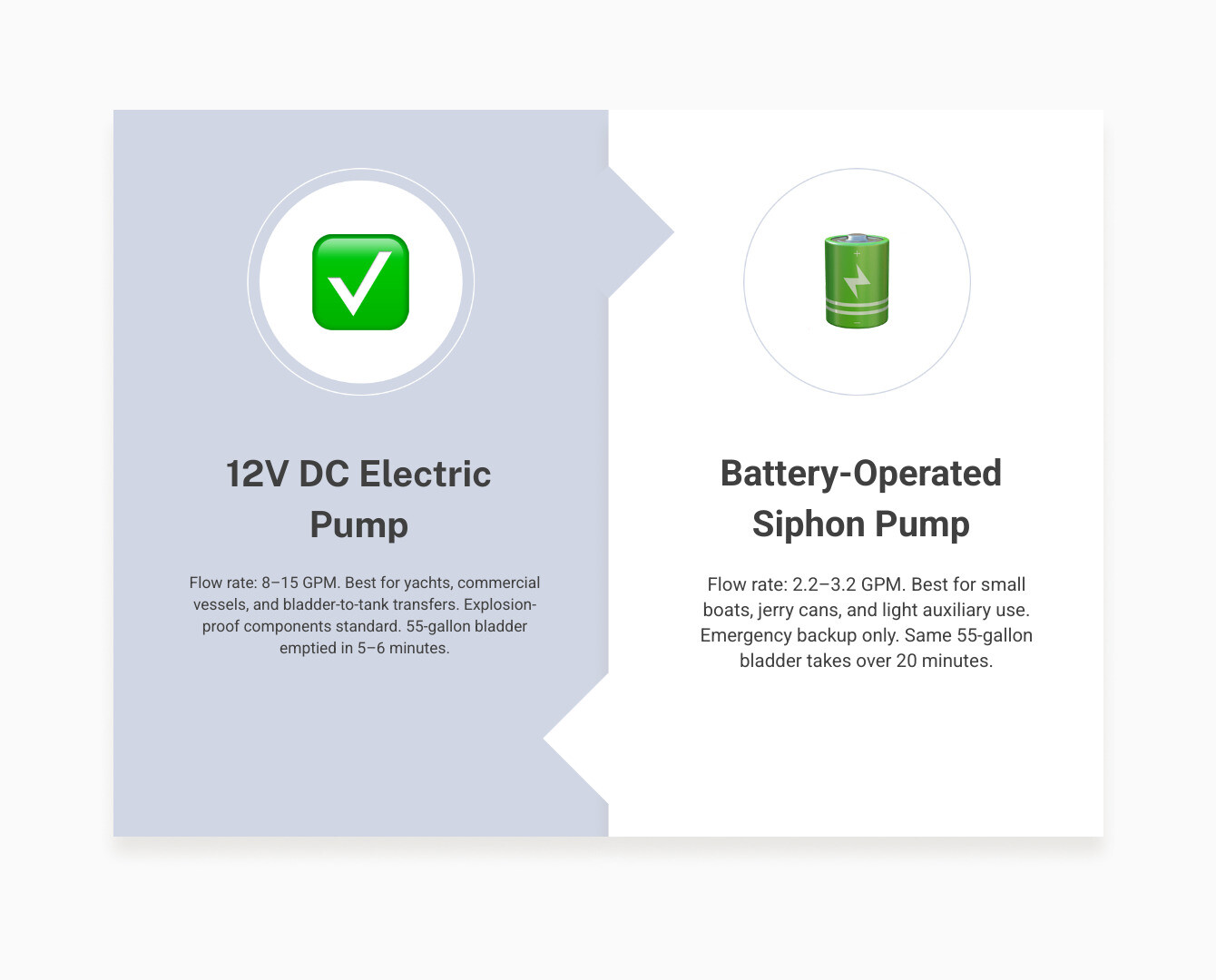
| 12V DC electric pump | 8–15 GPM | Yachts, commercial vessels, bladder-to-tank transfer |
| Battery-operated siphon pump | 2.2–3.2 GPM | Small boats, jerry cans, light auxiliary use |
| Manual siphon (shaker) | Slow | Emergency backup only |
For most serious marine operators — yacht crews, offshore fishing teams, commercial skippers, expedition vessels — a 12V DC pump with explosion-proof components is the standard choice. Battery-operated siphon pumps serve as backup or for smaller-volume transfers.
Flow rate is where most buyers underestimate their needs. A 10 GPM pump can empty a 55-gallon auxiliary bladder in roughly five to six minutes. A 2.4 GPM battery pump takes over twenty minutes for the same job. On a working vessel, that gap matters.
The pump is only half the equation, though. How you store that auxiliary fuel — whether in rigid jerry cans or a flexible marine fuel bladder that folds flat when empty — determines how practical your extended-range setup actually is.
This guide breaks down every key decision: pump type, flow rate, safety certifications, hose compatibility, and how to integrate a portable pump with an auxiliary fuel bladder system.
Portable marine fuel pumps vocab explained:
Selecting the Right Portable Marine Fuel Pumps for Your Vessel
Selecting the correct portable fuel transfer pump requires matching the pump’s power source, flow rate, and duty cycle to the vessel’s specific operational demands. In serious marine applications, operators must move large volumes of fuel safely under varying sea conditions.
When evaluating these systems, three primary categories of portable pumps emerge: heavy-duty 12V DC electric pumps, battery-operated siphon pumps, and manual hand pumps.
| Technical Parameter | Heavy-Duty 12V DC Pump | Battery-Operated Siphon Pump | Manual Hand / Shaker Siphon |
|---|---|---|---|
| Power Source | 12V DC (Vessel Battery) | AA / D-Cell Batteries | Manual Kinetic Energy |
| Typical Flow Rate | 8.0 to 15.0 GPM | 2.2 to 3.2 GPM | 1.0 to 2.5 GPM (gravity dependent) |
| Common Fuel Types | Diesel, Gasoline, Kerosene | Gasoline, Light Oils, Water | Diesel, Gasoline, Kerosene |
| Primary Marine Use | Bladder-to-tank transfer, offshore range extension | Small dayboats, tenders, auxiliary generators | Emergency backup, priming lines |
| Key Safety Advantage | Explosion-proof (ATEX/IECEx), integrated ground | Low-voltage, spark-free casing | Zero electrical components |
To understand how these pumps fit into a broader fuel management strategy, operators can consult detailed guides like How to Transfer Fuel from a Fuel Bladder to ensure safe, spill-free procedures.
Heavy-Duty 12V DC Portable Marine Fuel Pumps
For vessels carrying significant auxiliary fuel volumes—such as those utilizing collapsible deck bladders—heavy-duty 12V DC pumps are the industry standard. These systems connect directly to the vessel’s electrical system via battery clips or dedicated marine plugs, drawing power from 12-volt marine batteries.
Most high-performance 12V DC pumps utilize self-priming rotary vane configurations. The rotary vane design creates a strong vacuum, allowing the pump to draw fuel without manual priming, even when dry. This self-priming capability is critical when drawing fuel from collapsible bladders, where intake lines may contain pocketed air.
Additionally, premium DC pumps are engineered with a continuous or extended duty cycle, enabling them to run for 30 minutes or longer under load without overheating. For hazardous environments where gasoline or volatile fuel vapors may be present, specialized units like the Compact ATEX 12V DC Portable Fuel Pump 32 l/min | PIUSI EXGO! provide explosion-proof protection certified for naval and marine applications.
Battery-Powered and Manual Siphon Pumps
At the other end of the spectrum are light-duty, battery-operated siphon pumps and manual hand siphons. Battery-powered models typically run on standard AA or D-cell alkaline batteries. These pumps are highly portable and lightweight, making them popular for small-scale transfers, such as refueling a tender’s outboard or a small onboard generator from a 5-gallon jerry can.
Manual siphons, including “shaker” or “jiggle” siphons, rely on a simple check-valve brass head attached to a flexible hose. By shaking the hose vertically within the source container, kinetic energy forces fuel past the check valve until a gravity-fed siphon is established.
While manual and small battery-operated pumps are excellent, spark-free emergency backups, they lack the lift capacity and flow rates required for larger operations. Trying to transfer fuel from a 150-gallon deck bladder to a main tank using a 2.4 GPM battery siphon is highly impractical, particularly in rough seas where transfer times must be minimized to maintain safety and vessel stability.
Technical Specifications: Flow Rates, Duty Cycles, and Hose Compatibility
Understanding the mechanical limits of a fuel transfer system is essential to prevent equipment failure and environmental contamination. When selecting a pump, operators must evaluate flow rates, thermal duty cycles, and hose connection configurations.
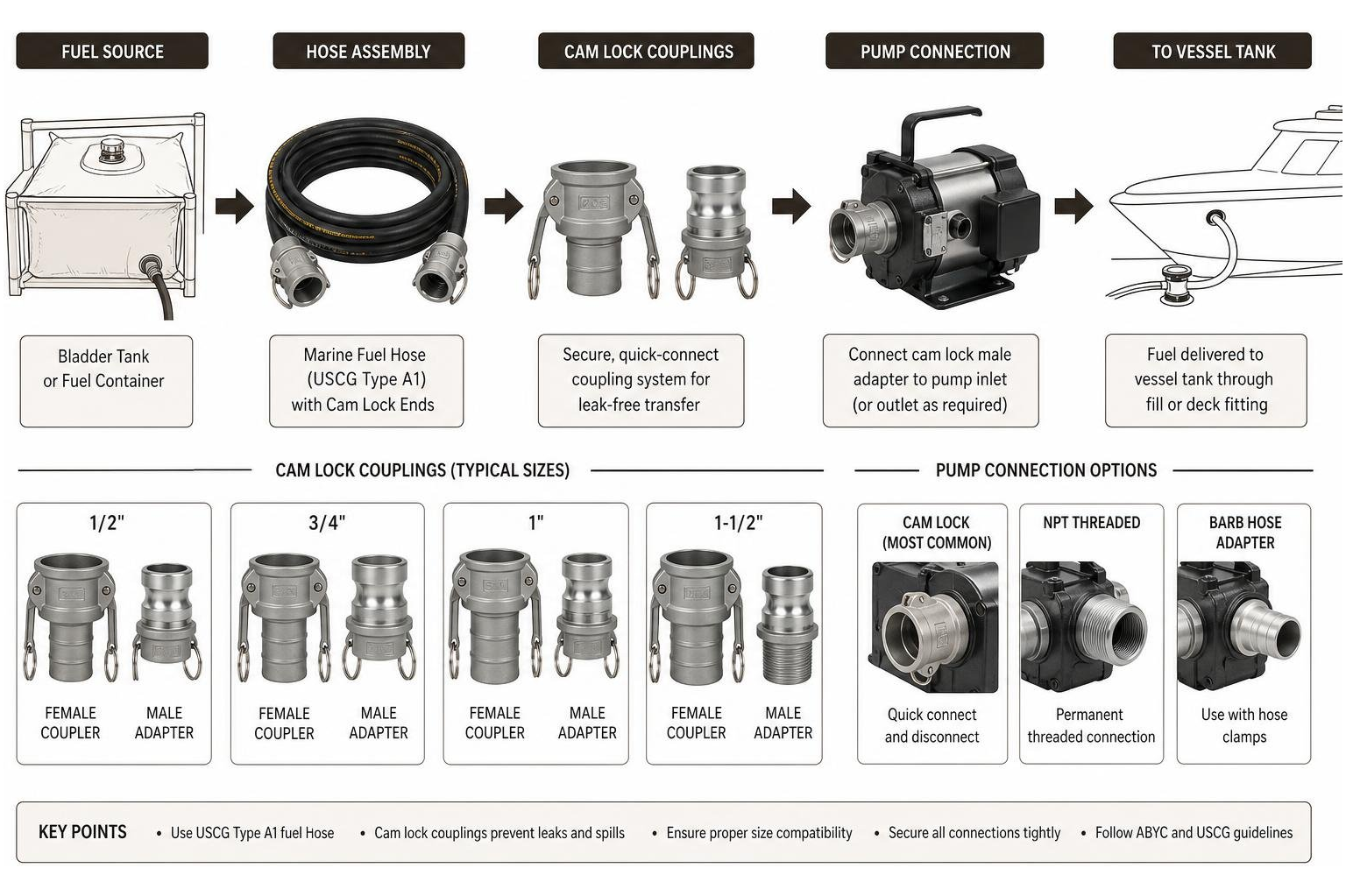
To ensure secure connections across the entire fuel line, operators should review The Essential Guide to Fuel Line Quick Connect Adapters to prevent air leaks and pressure drops.
Flow Rate (GPM) and Transfer Efficiency
The flow rate of a fuel pump, measured in Gallons Per Minute (GPM) or Liters Per Minute (LPM), directly dictates transfer efficiency and exposure time on deck. In offshore environments, reducing the time spent transferring fuel is a key safety priority.
- Low Flow (2.2 to 3.2 GPM): Standard for battery-operated consumer pumps. These are best suited for transfers under 15 gallons.
- Medium Flow (8 to 10 GPM): Ideal for mid-sized vessels. A 10 GPM system balances speed with manageable nozzle control, making it highly compatible with typical marine deck fills.
- High Flow (12 to 15+ GPM): Designed for rapid transfer of large fuel volumes. Systems like the 10 GPM 12V Portable Fuel Transfer Pump Kit with Auto Nozzle & Carry Ca allow operators to clear 50-gallon drums or auxiliary bladders in under five minutes, minimizing the physical effort and spill risks associated with extended transfer operations.
Hose Length and Tank Adapter Compatibility
The physical connections between the pump, the source tank, and the receiving deck plate must be completely airtight. Standard utility pumps often come with standard threaded NPT fittings, but marine environments demand more robust, leak-proof interfaces.
Heavy-duty transfer systems utilize Cam lock (cam-and-groove) quick disconnect fittings. These fittings provide a mechanical, gasket-sealed lock that prevents accidental disconnection under pressure. The intake hose must be constructed of wire-reinforced, fuel-resistant PVC or nitrile rubber to prevent collapse under suction.
For the discharge side, a high-quality rubber hose with an integrated static ground wire is necessary. These heavy-duty components are standard when pairing pumps with High-Capacity Marine Fuel Bladders for Range Extension, which require secure, high-flow connections to transfer fuel safely across a vessel’s deck.
Critical Safety Features for Marine Fuel Transfer
Transferring fuel on a vessel introduces unique hazards. Unlike land-based refueling, a boat is subject to constant motion, moisture, and potential static buildup on ungrounded surfaces. Incorporating specific safety features into your portable pumping system is non-negotiable.
For gasoline transfers, safety protocols are even more stringent. Operators must consult resources like Safe Gasoline Fuel Bladder Storage and Transfer to mitigate the risks associated with highly volatile fuel vapors.
Explosion-Proof Ratings and Fuel Compatibility
The most critical safety consideration is the distinction between gasoline-compatible and diesel-only pumps. Gasoline has a low flashpoint (-45°F) and easily vaporizes, creating an explosive fuel-air mixture in confined spaces. Diesel, with a higher flashpoint (above 126°F), is less volatile but still requires careful handling.
- Explosion-Proof Ratings: Any pump used to transfer gasoline must feature an explosion-proof, ignition-protected motor certified by ATEX, IECEx, or UL/cUL. These motors are completely sealed, preventing internal electrical sparks from contacting ambient fuel vapors.
- Diesel-Only Restrictions: Many high-flow 12V DC utility pumps are rated strictly for diesel, kerosene, or light oils. Running gasoline through a diesel-only pump can lead to motor ignition, seal degradation, and catastrophic fire.
- Multi-Fuel Certified Systems: High-end kits, such as the 8 GPM 12V Portable Fuel Transfer Pump Kit with Auto Nozzle, feature specialized internal seals and brushless, explosion-proof motors designed to safely handle gasoline, diesel, and ethanol blends.
Spill Prevention and Overfill Protection
In a marine environment, even a minor fuel spill can cause significant ecological damage and result in severe regulatory penalties. Portable marine pumps should incorporate mechanical and electronic safeguards to eliminate overflow risks:
- Automatic Shut-Off Nozzles: Similar to commercial gas station nozzles, these units utilize a venturi tube near the spout. When fuel reaches the tip of the nozzle, the pressure change trips a mechanical lever, instantly stopping the flow, even if the pump motor is still running.
- Integrated Bypass Valves: High-quality rotary vane pumps feature an internal bypass valve. When the nozzle is closed while the pump is active, the bypass valve recirculates fuel within the pump head, preventing pressure spikes that could burst hoses or damage seals.
- Purge Capabilities: Running a pump dry for a few seconds post-transfer purges remaining fuel from the lines, preventing lingering drips during storage. This practice is detailed in Extend Your Range with These Marine Fuel Pump Bladders, which covers complete system drainage.
Integrating Fuel Transfer Systems with Auxiliary Storage
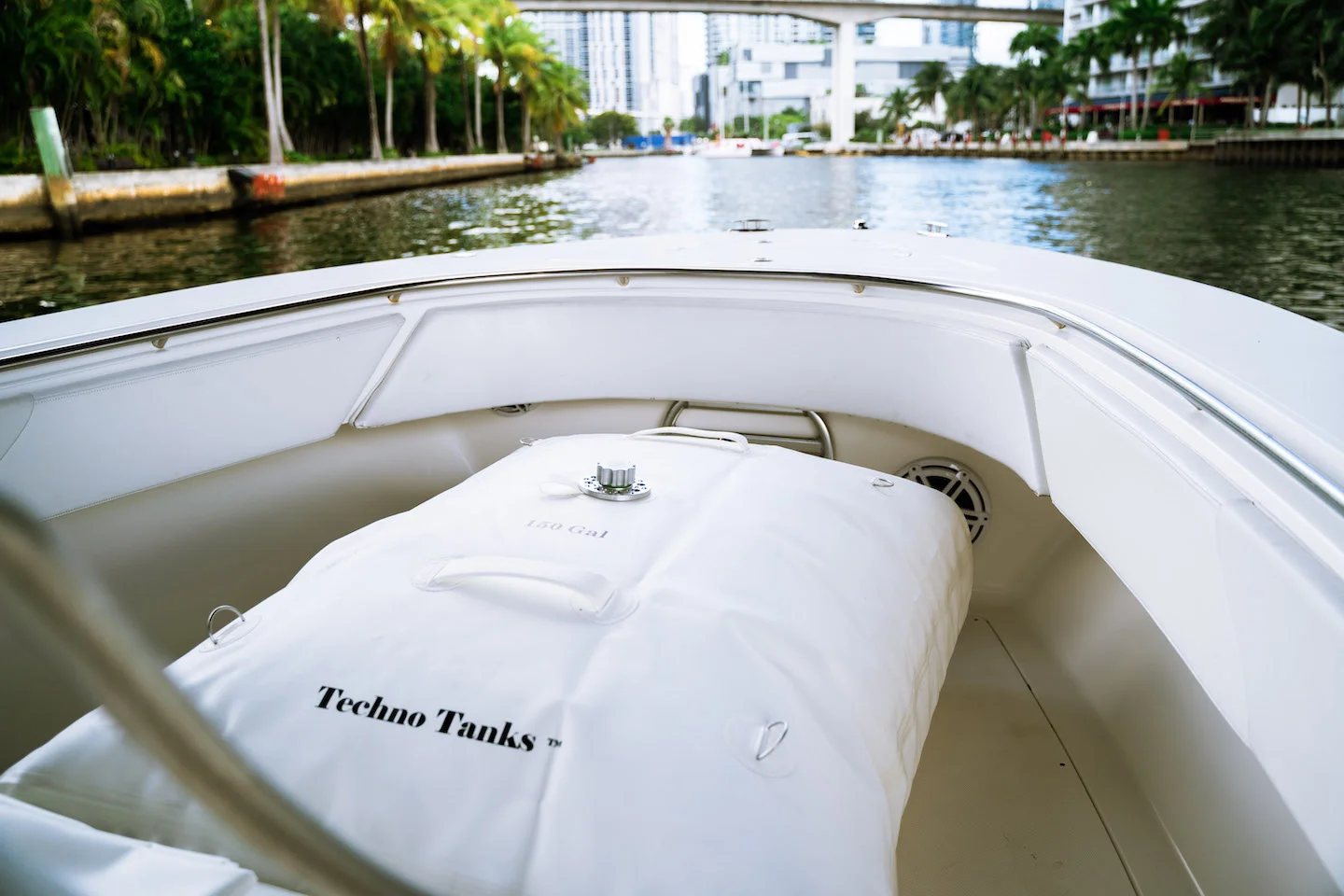
For long-range offshore transits, relying on rigid plastic jerry cans is highly inefficient. They are heavy, difficult to secure, and require manual pouring, which is a major source of spills. Modern offshore operators rely on flexible, collapsible fuel bladders paired with dedicated transfer pumps.
Integrating these components into a unified system ensures that extra fuel can be carried safely and transferred efficiently. For a comprehensive look at these systems, operators can explore Fuel Transfer Bladders to see how collapsible storage scales to meet offshore range demands.
Connecting Portable Marine Fuel Pumps to Flexible Bladders
Collapsible fuel bladders—available in pillow-style or space-saver rectangular configurations—require self-priming pumps because they lack rigid internal structures. As the pump draws fuel, the bladder collapses, preventing air from entering the system and maintaining fuel freshness.
To connect a portable pump to a flexible bladder:
- Cam Lock Connections: Utilize male and female Cam lock quick disconnects to secure the intake hose to the bladder’s discharge valve. This prevents air leaks that can cause the pump to lose its prime.
- Dual-Directional Pumping: Some advanced pumps, like the 15 GPM 5.3V Portable Fuel Transfer Pump Kit with Manual Nozzle, support dual-directional flow. This allows operators to easily reverse the pump to recover fuel remaining in the transfer lines or to evacuate a bladder completely before folding and storing it.
- Secure Deck Placement: The bladder should be secured to deck tie-down points using heavy-duty straps, with the pump positioned nearby on a stable, non-slip surface to prevent movement during operation.
Frequently Asked Questions About Portable Marine Fuel Pumps
Can I use the same portable pump for both gasoline and diesel?
In most cases, no, unless the pump is explicitly certified by the manufacturer for multi-fuel use. Gasoline and diesel have distinct chemical compositions. Gasoline acts as a solvent and can rapidly degrade the nitrile or rubber seals, O-rings, and impellers found in diesel-only pumps. This degradation leads to fuel leaks, pressure loss, and a high risk of electrical spark ignition. Always verify that the pump has an explosion-proof rating (such as ATEX or UL) before attempting to transfer gasoline.
How do I safely ground a 12V DC fuel pump on a boat?
Static electricity is a major hazard during fuel transfer, particularly when moving fuel from ungrounded plastic containers or flexible bladders. To ground a 12V DC pump:
- Use a Static Ground Wire: Ensure your pump’s discharge hose features an integrated static ground wire.
- Connect the Grounding Clamp: Before starting the pump, attach the pump’s grounding clamp to a bare metal part of the vessel’s common bonding system or a grounded metal component.
- Maintain Nozzle Contact: Keep the metal nozzle in direct, physical contact with the metal neck of the receiving fuel fill port throughout the entire transfer process to prevent static discharge.
What is the typical duty cycle for a portable marine fuel pump?
Most compact 12V DC fuel pumps have a 30-minute duty cycle (30 minutes on, followed by 30 minutes of rest). These high-output motors generate significant internal heat, and because they lack large, integrated cooling fans, they rely on passive heat dissipation. Running a pump beyond its rated duty cycle can lead to thermal overload, melting seals, and permanent motor damage. For larger transfers, plan your operations around these duty cycles or select a continuous-duty rated pump.
Conclusion
A high-quality portable marine fuel pump is an essential tool for any serious offshore operator. Whether you are running a commercial vessel, leading an offshore fishing expedition, or cruising remote islands, matching your pump’s flow rate, power source, and safety features to your vessel’s requirements is critical for a safe, efficient voyage.
When paired with a high-capacity, collapsible bladder system, a portable fuel transfer pump allows you to extend your vessel’s range without the weight, bulk, and permanent space commitment of rigid auxiliary tanks.
For customized range-extension setups, including specialized TPU fuel bladders and matched transfer systems, operators can Explore Offshore Fuel Solutions or contact Techno Tanks directly to request a custom quote tailored to their specific marine applications.

